Last Updated: June 25, 2026

PROLENSA Drug Patent Profile


✉ Email this page to a colleague

« Back to Dashboard


Which patents cover Prolensa, and when can generic versions of Prolensa launch?

Prolensa is a drug marketed by Bausch And Lomb and is included in one NDA. There are two patents protecting this drug and one Paragraph IV challenge.

This drug has fourteen patent family members in twelve countries.

The generic ingredient in PROLENSA is bromfenac sodium. Thirteen suppliers are listed for this compound. Additional details are available on the bromfenac sodium profile page.

DrugPatentWatch® Litigation and Generic Entry Outlook for Prolensa

A generic version of PROLENSA was approved as bromfenac sodium by SENTISS on January 22nd, 2014.

  Start Trial

AI Deep Research
Questions you can ask:
  • What is the 5 year forecast for PROLENSA?
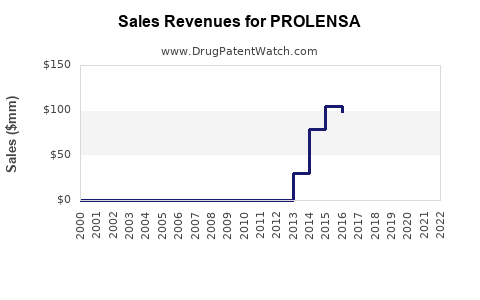
  • What are the global sales for PROLENSA?
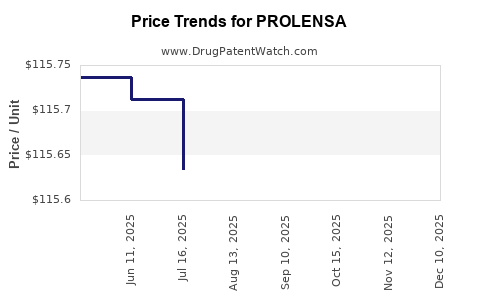
  • What is Average Wholesale Price for PROLENSA?
Recent Clinical Trials for PROLENSA

Identify potential brand extensions & 505(b)(2) entrants

SponsorPhase
Wyse EyecarePhase 4
Ocular Therapeutix, Inc.Phase 4
Sight Medical Doctors PLLCPhase 4

See all PROLENSA clinical trials

Pharmacology for PROLENSA
Paragraph IV (Patent) Challenges for PROLENSA
Tradename Dosage Ingredient Strength NDA ANDAs Submitted Submissiondate
PROLENSA Ophthalmic Solution bromfenac sodium 0.07% 203168 1 2013-07-26

US Patents and Regulatory Information for PROLENSA

PROLENSA is protected by two US patents.

Applicant Tradename Generic Name Dosage NDA Approval Date TE Type RLD RS Patent No. Patent Expiration Product Substance Delist Req. Exclusivity Expiration
Bausch And Lomb PROLENSA bromfenac sodium SOLUTION/DROPS;OPHTHALMIC 203168-001 Apr 5, 2013 AB RX Yes Yes 9,517,220 ⤷  Start Trial ⤷  Start Trial
Bausch And Lomb PROLENSA bromfenac sodium SOLUTION/DROPS;OPHTHALMIC 203168-001 Apr 5, 2013 AB RX Yes Yes 10,085,958 ⤷  Start Trial Y ⤷  Start Trial
>Applicant >Tradename >Generic Name >Dosage >NDA >Approval Date >TE >Type >RLD >RS >Patent No. >Patent Expiration >Product >Substance >Delist Req. >Exclusivity Expiration

Expired US Patents for PROLENSA

Applicant Tradename Generic Name Dosage NDA Approval Date Patent No. Patent Expiration
Bausch And Lomb PROLENSA bromfenac sodium SOLUTION/DROPS;OPHTHALMIC 203168-001 Apr 5, 2013 8,871,813 ⤷  Start Trial
Bausch And Lomb PROLENSA bromfenac sodium SOLUTION/DROPS;OPHTHALMIC 203168-001 Apr 5, 2013 9,144,609 ⤷  Start Trial
Bausch And Lomb PROLENSA bromfenac sodium SOLUTION/DROPS;OPHTHALMIC 203168-001 Apr 5, 2013 8,129,431 ⤷  Start Trial
Bausch And Lomb PROLENSA bromfenac sodium SOLUTION/DROPS;OPHTHALMIC 203168-001 Apr 5, 2013 8,754,131 ⤷  Start Trial
>Applicant >Tradename >Generic Name >Dosage >NDA >Approval Date >Patent No. >Patent Expiration

International Patents for PROLENSA

See the table below for patents covering PROLENSA around the world.

Country Patent Number Title Estimated Expiration
Canada 2852995 COMPOSITION OPHTALMIQUE QUI CONTIENT DU BROMFENAC PRESENTANT UNE BIODISPONIBILITE ACCRUE (OCULAR COMPOSITION CONTAINING BROMFENAC WITH INCREASED BIOAVAILABILITY) ⤷  Start Trial
European Patent Office 2765988 COMPOSITION CONTENANT BROMOFENAC À L'ADMINISTRATION À VOIE OCULAIRE AVEC UNE BIODISPONIBILITÉ AUGMENTÉ (OCULAR COMPOSITION CONTAINING BROMFENAC WITH INCREASED BIOAVAILABILITY) ⤷  Start Trial
European Patent Office 4491170 COMPOSITION CONTENANT BROMOFENAC À L'ADMINISTRATION PAR VOIE OCULAIRE AVEC UNE BIODISPONIBILITÉ AUGMENTÉ (OCULAR COMPOSITION CONTAINING BROMFENAC WITH INCREASED BIOAVAILABILITY) ⤷  Start Trial
Spain 2992712 ⤷  Start Trial
>Country >Patent Number >Title >Estimated Expiration

Supplementary Protection Certificates for PROLENSA

Patent Number Supplementary Protection Certificate SPC Country SPC Expiration SPC Description
1586316 C300494 Netherlands ⤷  Start Trial PRODUCT NAME: BROMFENAC, DESGEWENST IN DE VORM VAN EEN FARMACEUTISCH AANVAARDBAAR ZOUT OF HYDRAAT; REGISTRATION NO/DATE: EU/1/11/692/001 20110518
1586316 11C0031 France ⤷  Start Trial PRODUCT NAME: BROMFENAC, SES SELS OU HYDRATES PHARMACOLOGIQUEMENT ACCEPTABLES; REGISTRATION NO/DATE: EU/1/11/692/001 20110518
1586316 1190018-0 Sweden ⤷  Start Trial RAETTELSE AV SKYDDSTID: 2024-01-17 TILL OCH MED DEN 2026-05-22
1586316 SPC/GB11/054 United Kingdom ⤷  Start Trial PRODUCT NAME: BROMFENAC 2-AMINO-3-(4-BROMOBENZOYL)PHENYLACETIC ACID OR A PHARMACOLOGICALLY ACCEPTABLE SALT THEREOF OR A HYDRATE THEREOF; REGISTERED: UK EU/1/11/692/001 20110523
>Patent Number >Supplementary Protection Certificate >SPC Country >SPC Expiration >SPC Description

PROLENSA (bromfenac ophthalmic solution) market dynamics and financial trajectory: pricing, volume drivers, exclusivity, and generic/biosimilar threat

Last updated: May 29, 2026

Executive summary: PROLENSA (bromfenac ophthalmic solution) is a niche ophthalmology product whose financial trajectory is defined by (1) a limited patient pool tied to cataract surgery and (2) diminishing patent and regulatory exclusivity pressure that enables generic substitution. Market performance is typically measured by prescription and bottle demand rather than broad primary-care penetration, so category share, payer controls, and brand-to-generic switching timing drive revenue more than incremental clinical differentiation.


How does PROLENSA (bromfenac) perform financially and what revenue drivers matter?

PROLENSA is an ophthalmic NSAID used for pain and inflammation following cataract surgery. The economic model is dominated by: (a) cataract procedure volumes, (b) prescriber habits at post-op follow-up, (c) payer formularies and copay pressure, and (d) inventory cycles tied to generic entry.

What are the core demand drivers for bromfenac ophthalmic post-cataract use

  • Procedure volume linkage: The addressable market tracks cataract surgeries. Prescription volume rises with cataract volume and post-op regimen compliance.
  • Surgical seasonality and clinic workflow: Billing and dispensing follow the cadence of outpatient surgery centers and ophthalmology practices, creating short-cycle demand swings.
  • Switching friction: Bromfenac ophthalmic products compete with other NSAID drops (and sometimes steroid-based regimens), but switching tends to be fast once payer coverage narrows the branded option.

What determines PROLENSA net sales in practice

  • WAC-to-net compression: Branded ophthalmics face net-price erosion from rebates and contracting.
  • Channel mix: Higher share in certain retail chains or specialty channels can alter gross-to-net.
  • Managed care behavior: Formularies often drive “preferred generic” substitution once a bioequivalent option is available.

How PROLENSA’s niche status changes financial trajectory

  • Revenue is concentrated in a smaller therapeutic footprint than systemic blockbuster drugs.
  • Substitution risk is concentrated at specific “decision points” such as formulary updates rather than gradual diffusion.

When does PROLENSA face loss of exclusivity and what is the generic entry timeline?

Featured query answer: PROLENSA’s exclusivity and patent posture has been eroding over time, enabling generic ophthalmic bromfenac competition once relevant listed protections expired or were overcome.

Patent and exclusivity questions that govern timing

  • Orange Book listing protections: Drug product patents and exclusivity listed in FDA Orange Book determine when Abbreviated New Drug Applications (ANDAs) can be approved and marketed.
  • Paragraph IV pathway: If an ANDA filer challenges a listed patent, generic entry timing can depend on litigation outcomes and any 30-month stay.

What to monitor for PROLENSA’s entry risk

  • Orange Book “drug product” vs “method of use” vs “process” patents: These categories can delay approval differently even when active ingredient coverage ends.
  • Litigation and settlement: Brand-generic settlements can set launch dates that do not necessarily align with hard patent expirations.
  • Supply readiness: Even after legal readiness, manufacturing and distribution contracts can shift launch impact.

What patents protect PROLENSA bromfenac ophthalmic solution and how strong is the estate?

Featured query answer: PROLENSA’s patent protection is typically centered on formulation, composition, and/or use-related claims listed in FDA’s Orange Book; estate strength is evaluated by remaining expiry dates and the likelihood of non-infringement or invalidity defenses succeeding.

How patent estates are mapped for ophthalmic drops

  • Active ingredient (bromfenac) patents: Usually older and not the main blocker for generic entry after long periods.
  • Drug product/formulation patents: Often the most relevant for switching risk because generic substitutes must meet bioequivalence and formulation constraints.
  • Method-of-use patents: Can be relevant if they claim specific dosing schedules or post-op treatment regimens that generics must avoid or carve out.

What makes ophthalmic patent estates vulnerable

  • Claim scope: Many ophthalmic formulations have overlapping excipient and concentration ranges, which can narrow the effective exclusion.
  • Generic design-around: Generic sponsors can modify excipients or process parameters while maintaining quality and equivalence.

What is the Orange Book status of PROLENSA and what listings matter most?

Featured query answer: Orange Book listings for PROLENSA are the gating factor for ANDA approvals and define the exact patents and exclusivity blocks associated with the approved drug product.

Key Orange Book listing categories to extract for PROLENSA

  • Active ingredient and strength: Confirms which version (e.g., concentration, dosage form) the listings attach to.
  • Dosage form: Ensures the listed patents correspond to the marketed solution type.
  • Patent type: Drug substance, drug product, and method-of-use designations change legal leverage.
  • Exclusivity type: 5-year New Chemical Entity (NCE) or 3-year/other exclusivity, when applicable, governs a separate approval gate from patents.

Which companies sell competing bromfenac ophthalmic drops and how does PROLENSA compare?

Featured query answer: PROLENSA competes in a crowded ophthalmic NSAID category where generics and branded comparators drive pricing pressure and switching.

Competitive axes that decide share

  • Formulary preference: Lower net price generic versions usually dominate once coverage allows.
  • Dosing simplicity: Patient adherence and clinic standardization affect outcomes and substitution.
  • Tolerability and post-op workflow: Clinicians choose based on comfort, inflammation control, and perceived efficacy among available NSAIDs and steroids.

How to benchmark PROLENSA against class alternatives

  • Compare by therapeutic category (ophthalmic NSAID) and by availability of generic equivalents.
  • Compare by net pricing and contract status (preferred vs non-preferred tier).

What Paragraph IV challenges affect PROLENSA and how do they change launch dates?

Featured query answer: Paragraph IV ANDAs for listed PROLENSA patents can trigger a 30-month stay or lead to an immediate carve-out launch if the court or settlement permits.

Common litigation pathways in ophthalmic ANDAs

  • No-stay approvals: If the challenged patent is held not infringed or invalid, generics can launch sooner.
  • Stays and launch schedules: If the stay is triggered and remains in force, revenue loss can be delayed until the stay expires.

What outcomes typically do to net sales

  • Delayed generic entry: Preserves branded share and net pricing.
  • Early launch or settlement entry: Causes rapid volume loss and net-price compression.

How do settlements and licensing deals shape PROLENSA’s financial trajectory?

Featured query answer: Settlements often set delayed launch or design-around terms that determine when generic market share shifts away from PROLENSA.

Settlement mechanisms that matter commercially

  • Launch date commitments: A settlement can create an agreed entry date even if patents might have expired earlier.
  • Carve-outs: Generic entry can be limited to specific strengths, dosing regimens, or labeling sections.
  • Payment terms: Transfers from brand to generic are common; operational effect is the launch timetable.

What FDA regulatory status applies to PROLENSA and its generics?

Featured query answer: PROLENSA is an FDA-approved ophthalmic drug; generic versions are governed by ANDA pathways, demonstrating bioequivalence and meeting labeling requirements that avoid protected use claims where relevant.

How FDA status translates into market outcomes

  • ANDA approval = legal readiness: Once approved and any litigation stays are resolved, generic supply can move quickly.
  • Labeling carve-outs = faster switches: If generics can market with a labeling position close to the brand, pharmacies and prescribers switch faster.

Key regulatory checkpoints that shift revenue

  • ANDA “tentative approval” timing: Usually precedes launch, but does not necessarily shift sales until distribution begins.
  • Final approval and product availability: Revenue risk accelerates when bottles hit wholesalers and pharmacy shelves.

What formulation and manufacturing/IP barriers could delay PROLENSA generic substitution?

Featured query answer: For ophthalmic products, manufacturing controls and formulation/presentation claims can be the main non-patent barriers after legal approval is granted.

Typical barriers

  • Sterility assurance and fill-finish: Ophthalmic drops require stringent sterility and particulate control.
  • Stability and viscosity: Bromfenac formulations must maintain stability in solution over shelf life.
  • Bioequivalence constraints: ANDA applicants must meet pharmacokinetic and labeling standards.

Why these barriers rarely prevent eventual entry

  • Generic sponsors usually have established ophthalmic fill-finish capability.
  • Stability and equivalence testing is routine once a formulation pathway is selected.

When will PROLENSA face the biggest revenue decline and what is the switching curve?

Featured query answer: The biggest decline usually aligns with the first sustained period when multiple generic equivalents are actively stocked under payer-preferred coverage.

Switching curve dynamics

  • Early period (0 to 3 months post-launch): Share shifts quickly where prescriptions are rewritable and payers push tiering.
  • Mid period (3 to 12 months): Contracting consolidates preferred status; branded share stabilizes at a smaller niche.
  • Long period (12+ months): Brand pricing falls to defend remaining share or exits distribution tiers depending on profitability.

What accelerates the curve

  • Multiple ANDA entrants
  • Strong payer incentives for generic
  • Clinic protocols standardizing to least-cost NSAID drops

How does PROLENSA compare with other ophthalmic NSAIDs in patent life and market risk?

Featured query answer: Relative risk is lower for brands with later-expiring listed patents and higher for those already exposed to generic conversion and payer-driven substitutability.

Competitive comparison framework

  • Patent expiry schedule: Later drug product or method-of-use listings reduce generic pressure.
  • Number of generic entrants: More entrants reduces pricing floor and increases volume share loss.
  • Strength and dosing formats: If comparators have more formulations covered, they can command better payer coverage.

Key takeaways for PROLENSA market strategy

  • PROLENSA’s financial trajectory is controlled by cataract procedure volume and by payer-driven brand-to-generic switching once Orange Book listed protections lapse or are cleared through litigation/settlement.
  • The largest revenue impacts generally occur after ANDA approvals translate into broad pharmacy stocking under preferred-tier coverage.
  • Patent estate strength in ophthalmics usually hinges on drug product/formulation and method-of-use claims listed in the Orange Book, not on the underlying active ingredient alone.
  • Pricing compression is expected as generic alternatives accumulate and contracts tighten.

FAQs

1) What drives PROLENSA prescribing versus other ophthalmic NSAIDs?
Formulary status, net cost, dosing convenience, and post-op protocol alignment.

2) Does PROLENSA’s market depend more on payer decisions or clinical differentiation?
Payer tiering and contracting typically dominate once generics enter; differentiation matters most pre-generic or where coverage remains permissive.

3) What is the typical impact of generic bromfenac ophthalmic launches on brand revenue?
A rapid share shift and net-price compression after initial distribution, then stabilization at a reduced branded tier.

4) How do Orange Book method-of-use patents affect ANDA labeling for bromfenac drops?
They can force labeling carve-outs that restrict how generics describe the protected regimen, which can slow substitution if prescribers follow the brand-specific language.

5) What litigation outcome most improves branded protection for PROLENSA?
An outcome that preserves enforceable listings through the full term or yields a settlement that delays generic launch beyond immediate approval.


References (APA)

  1. U.S. Food and Drug Administration. Orange Book: Approved Drug Products with Therapeutic Equivalence Evaluations. FDA. https://www.accessdata.fda.gov/scripts/cder/daf/
  2. U.S. FDA. ANDA (Abbreviated New Drug Application) approval pathway information. FDA. https://www.fda.gov/drugs/abbreviated-new-drug-application-anda
  3. U.S. FDA. 505(b)(2) and 505(j) application overview (relevant for exclusivity and approval gates). FDA. https://www.fda.gov/drugs/
  4. U.S. Food and Drug Administration. Drug Approval Process. FDA. https://www.fda.gov/drugs/development-approval-process-drugs

More… ↓

⤷  Start Trial

Make Better Decisions: Try a trial or see plans & pricing

Drugs may be covered by multiple patents or regulatory protections. All trademarks and applicant names are the property of their respective owners or licensors. Although great care is taken in the proper and correct provision of this service, thinkBiotech LLC does not accept any responsibility for possible consequences of errors or omissions in the provided data. The data presented herein is for information purposes only. There is no warranty that the data contained herein is error free. We do not provide individual investment advice. This service is not registered with any financial regulatory agency. The information we publish is educational only and based on our opinions plus our models. By using DrugPatentWatch you acknowledge that we do not provide personalized recommendations or advice. thinkBiotech performs no independent verification of facts as provided by public sources nor are attempts made to provide legal or investing advice. Any reliance on data provided herein is done solely at the discretion of the user. Users of this service are advised to seek professional advice and independent confirmation before considering acting on any of the provided information. thinkBiotech LLC reserves the right to amend, extend or withdraw any part or all of the offered service without notice.