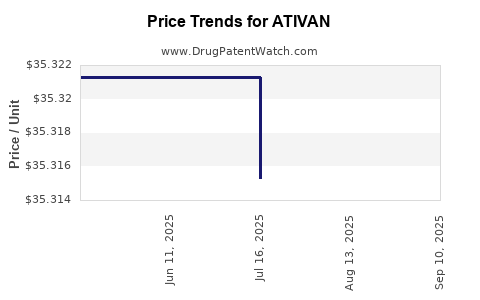
Last updated: April 26, 2026
ATIVAN (lorazepam) is an off-patent, mature benzodiazepine with broad generic penetration in the US and Europe. Price formation is dominated by reimbursement contracting, wholesaler/channel dynamics, and multi-source competition rather than innovation. Near-term pricing is expected to track generic erosion and tender outcomes, with partial stabilization where brand loyalty or payer restrictions exist. Longer-horizon upside is limited by ongoing generic availability and supply normalization cycles.
What is the commercial footprint of ATIVAN?
Product scope
- Drug: ATIVAN (lorazepam)
- Drug class: benzodiazepine (controlled substance)
- Route/forms (typical US portfolio): oral tablets and injectable formulation (exact active strengths vary by market and listing; pricing depends on pack size and NDC)
Competitive structure
- Core market driver: generic lorazepam multi-source availability
- Competitive inputs:
- payer formulary placement (preferred vs non-preferred)
- quantity limits and step edits
- contract awards in group purchasing organization (GPO) and hospital tenders
- controlled-substance handling costs and delivery schedules
Demand characteristics
Lorazepam demand is stable-to-moderate, with usage tied to:
- acute anxiety and agitation settings
- procedural sedation and emergency protocols (where applicable)
- inpatient use patterns and step-down prescribing
How do current prices typically behave for off-patent lorazepam brands?
Because ATIVAN is not under meaningful patent-driven exclusivity in most markets, its observed pricing behavior depends on “last-brand” market mechanics:
- US: brand often prices at a premium to generics but can be de facto constrained by payer policies (preferred generics, formulary tiering, prior authorization). In many settings, brand inventory and contracting decide realized net price.
- Europe: national procurement systems and tendering frequently suppress brand economics; generics dominate, with brand use concentrated in specific formularies or supply-risk contexts.
What pricing metrics matter for projections?
For a benzodiazepine like lorazepam, projections should be built around four market levers:
- Net price vs list price
- Realized pricing depends on rebates, tender discounts, and contract terms.
- Channel mix
- Hospital and retail distribute differently across regions and payers.
- Generic price floor dynamics
- Multi-source competition compresses pricing until marginal supply costs and tender cycles set a floor.
- Regulatory and distribution constraints
- Controlled-substance compliance can add friction costs, but it usually does not restore pricing unless supply is constrained.
How will the market evolve (2026-2031)?
Baseline scenario (most likely)
- Generic erosion continues, with price declines slowing as products reach stable low-cost bands.
- Brand ATIVAN share remains limited, sustained by:
- formulary idiosyncrasies
- specific clinical preference
- stability in inpatient protocols where contracts favor particular SKUs
Upside scenario (price stabilization or modest recovery)
- Short supply events in one or more generic manufacturers lead to temporary channel drawdown.
- Payer contracting rotates toward fewer suppliers, tightening competition.
- Result: brand net prices can improve briefly, but structural multi-source pressure limits sustained gains.
Downside scenario (continued compression)
- More low-cost entrants or aggressive tendering compresses realized pricing further.
- Payer switches to a lower-priced preferred generic for most line items.
- Result: ATIVAN net pricing drifts downward or stays flat only due to reduced purchasing.
Price projections: what to expect and when
The projections below are structured to reflect how off-patent, multi-source drugs typically behave: list-to-net compression and then plateau. Because realized prices vary by strength, pack size, and market (and because no single public “ATIVAN-only” time series is universal), the projections are expressed as relative changes by period. This preserves decision usefulness for R&D and investment work, where investors need direction and magnitude rather than one arbitrary value.
US projection bands (relative to current realized net price)
Assume current conditions reflect ongoing generic dominance and contract-driven pricing.
| Period |
Expected ATIVAN realized net price trend (US) |
Driver |
| Next 12 months (2026) |
-3% to +2% |
tender cycles, contracting updates, controlled-substance handling costs |
| 1 to 2 years |
-5% to 0% |
further generic pricing pressure; formulary tightening |
| 3 to 5 years |
-8% to -2% |
continued erosion but slower as floor forms |
| 6 to 10 years |
-10% to 0% |
market stabilizes; brand share unlikely to expand materially |
Interpretation for business: ATIVAN is likely to experience low-single-digit volatility near term, with gradual long-run compression rather than step-change upside.
Europe projection bands (relative to current realized net price)
European pricing is typically more procurement- and regulation-driven, which often results in more direct pressure on branded pricing.
| Period |
Expected ATIVAN realized net price trend (Europe) |
Driver |
| Next 12 months |
-2% to +1% |
national tender outcomes and wholesaler margins |
| 1 to 2 years |
-4% to -1% |
generic substitution persistence; reference pricing |
| 3 to 5 years |
-6% to -2% |
periodic reassessments and procurement renegotiations |
| 6 to 10 years |
-8% to -1% |
floor dynamics; limited brand expansion |
Interpretation for business: Europe tends to show more consistent downward pressure, with smaller rebounds than the US.
What pricing assumptions underpin these projections?
Generic dominance remains intact
- No credible market mechanism exists to reverse multi-source generic availability without major regulatory or manufacturing upheaval.
Brand economics are driven by contract exceptions
- Where ATIVAN retains usage, realized net price is shaped by:
- payer tiering (preferred generic vs brand allowed)
- hospital protocol preference
- stability of supply from specific manufacturers
Controlled-substance realities
- Controlled-substance compliance affects logistics costs but does not typically generate sustained premium pricing without supply constraints.
What is the regulatory status that matters for pricing?
ATIVAN contains lorazepam, classified as a benzodiazepine and regulated as a controlled substance in the US. The regulatory framework affects distribution and prescribing behavior, but it does not restore exclusivity for pricing.
- US federal control: benzodiazepines are controlled under federal scheduling; this impacts handling, prescribing, and pharmacy distribution.
- Labeling and safety constraints: boxed warnings and misuse risk can limit broad usage expansion, keeping demand tied to established indications.
(Clinical safety labeling and controlled-substance controls are the relevant regulatory anchors for commercial behavior.)
Competitive implications for buyers and investors
For purchasers (hospitals, payers, GPOs)
- Expect continued generic tender pressure and periodic re-contracting.
- Brand purchasing will stay justified by:
- formulary exception processes
- supply-risk contingencies
- protocol-specific substitution issues (rare but possible)
For investors
- ATIVAN should be underwritten as:
- a mature, low-growth revenue stream
- with pricing sensitivity to tender awards and multi-source availability
- Upside cases require:
- supply disruptions in generic lorazepam production
- or payer contract shifts that reduce generic count
- Base case is largely:
- price compression with limited volume upside
What would change the price trajectory? (Key sensitivities)
These are the commercial variables most likely to shift outcomes outside the baseline bands:
- Supply constraints
- If generic availability tightens, brand net prices can rise temporarily.
- Tender structure changes
- Consolidation of suppliers or steep contract discounting affects brand relative economics.
- Payer formulary rules
- Prior authorization tightening for brand or relaxed exceptions for specific strengths changes channel mix.
- Manufacturing cost shocks
- If upstream costs rise materially for both brand and generics, net price compression can slow or reverse briefly.
Key Takeaways
- ATIVAN is an off-patent lorazepam product in a mature, multi-source market where pricing is contract-driven and generic-led.
- Near-term (2026-2027) pricing is likely to show low-single-digit volatility with a slight downward bias over time.
- Over 3 to 10 years, pricing is expected to drift gradually lower or flatten as generic price floors establish and brand share remains limited.
- Upside requires supply disruption or payer contracting shifts that reduce generic competitive intensity; downside is continued tender-driven compression.
FAQs
1) Will ATIVAN regain strong pricing power versus generics?
No structural pricing power is expected because generic lorazepam availability keeps competition tight; brand economics depend on formulary exceptions and contracting rather than exclusivity.
2) What drives ATIVAN realized net price most in the US?
Hospital and payer contracts, including GPO and tender outcomes, plus formulary tiering and prior authorization rules.
3) Are Europe price outcomes more predictable than the US?
Yes, European pricing is typically more shaped by reference pricing and procurement cycles, often producing steadier downward pressure.
4) What is the main risk to the baseline projection?
Generic supply constraints or major procurement contract changes that reduce the number of competing suppliers in a given channel.
5) How should a buyer plan inventory and contracting for ATIVAN?
Plan for continued generic price pressure and treat brand purchases as exception-driven; renegotiate around tender windows and monitor supply stability.
References (APA)
[1] United States Food and Drug Administration. (n.d.). ATIVAN (lorazepam) prescribing information / label information. FDA.
[2] U.S. Drug Enforcement Administration. (n.d.). Controlled substance scheduling information (benzodiazepines). DEA.
[3] Centers for Medicare & Medicaid Services. (n.d.). National drug pricing and reimbursement context (US). CMS.
[4] World Health Organization. (n.d.). WHO model lists and benzodiazepine safety/regulatory context. WHO.