Share This Page
Drug Sales Trends for ATIVAN
✉ Email this page to a colleague
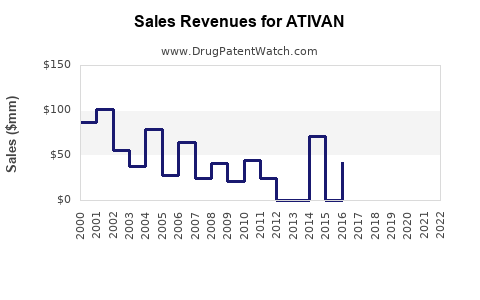
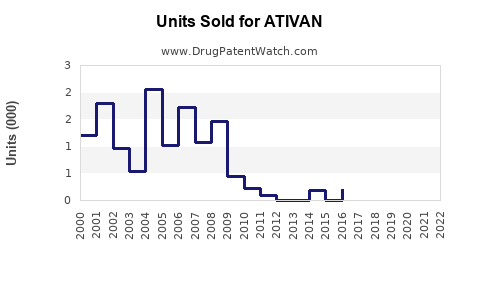
Annual Sales Revenues and Units Sold for ATIVAN
| Drug Name | Revenues (USD) | Units | Year |
|---|---|---|---|
| ATIVAN | ⤷ Start Trial | ⤷ Start Trial | 2022 |
| ATIVAN | ⤷ Start Trial | ⤷ Start Trial | 2021 |
| ATIVAN | ⤷ Start Trial | ⤷ Start Trial | 2020 |
| >Drug Name | >Revenues (USD) | >Units | >Year |
Ativan (Lorazepam) Market Analysis and Sales Projections
Ativan, the brand name for lorazepam, is a mature benzodiazepine with limited branded commercial value and sustained generic demand. U.S. sales are driven primarily by generic lorazepam tablets, oral concentrate, and injection products rather than by the Ativan brand. The market is characterized by low patent risk, generic price erosion, controlled-substance regulation, and stable use in anxiety, insomnia associated with anxiety, status epilepticus, and preoperative sedation.
The commercial outlook is flat to moderately declining in volume. A reasonable base-case projection is a 2% to 4% annual decline in U.S. prescription volume through 2029, with generic revenue declining faster because of price competition. Acute-care injection demand should remain more resilient than outpatient tablet demand.
What is Ativan and how is lorazepam used?
Ativan contains lorazepam, a gamma-aminobutyric acid type A receptor modulator in the benzodiazepine class. The FDA-approved uses include anxiety disorders, short-term relief of anxiety symptoms, anxiety-associated insomnia, status epilepticus, and preanesthetic medication, depending on dosage form and labeling.[1]
| Attribute | Ativan and lorazepam |
|---|---|
| Active ingredient | Lorazepam |
| Drug class | Benzodiazepine |
| Main dosage forms | Tablets, oral concentrate, injection |
| U.S. controlled-substance schedule | Schedule IV |
| Primary prescribers | Primary care, psychiatry, emergency medicine, neurology, anesthesiology |
| Main competitors | Alprazolam, clonazepam, diazepam, midazolam, hydroxyzine, buspirone |
| Commercial status | Mature brand with extensive generic competition |
| Main demand channels | Retail pharmacy, hospital, emergency department, procedural care |
Lorazepam has a relatively short to intermediate duration of action compared with diazepam. Its clinical familiarity and availability in injectable form support continued institutional use. Outpatient use faces pressure from prescribing restrictions, dependence concerns, tapering initiatives, and increased use of non-benzodiazepine treatments.
What is the current Ativan market structure?
The U.S. market is effectively a generic lorazepam market. Ativan does not have the commercial profile of a protected branded medicine because the core composition and primary clinical uses have been generic for decades.
The market has three segments:
- Oral tablets, which represent the largest outpatient segment.
- Oral concentrate, which serves patients who have difficulty swallowing tablets and selected institutional uses.
- Injection, which is used in hospitals and emergency settings for status epilepticus, acute agitation, procedural sedation, and preanesthetic treatment.
Retail tablet demand is exposed to generic substitution and low reimbursement. Hospital injection demand has stronger clinical persistence but remains subject to group purchasing organization negotiations, supply disruptions, and formulary substitution with diazepam or midazolam.
How does Ativan compare with competing benzodiazepines?
| Drug | Principal commercial advantage | Principal risk to lorazepam |
|---|---|---|
| Alprazolam | High recognition in outpatient anxiety and panic disorder | Competes directly for anxiety prescriptions |
| Clonazepam | Longer duration and broad psychiatric use | Substitution in chronic anxiety and seizure-related use |
| Diazepam | Low cost, broad indications, injectable and rectal products | Competes in seizure, muscle spasm, and acute-care settings |
| Midazolam | Strong procedural and hospital use | Competes with injectable lorazepam in sedation |
| Hydroxyzine | Non-controlled alternative for anxiety | Captures patients where dependence risk limits benzodiazepines |
| Buspirone | Non-benzodiazepine chronic anxiety option | Reduces long-term lorazepam use |
Lorazepam retains an advantage in status epilepticus and hospital protocols, but outpatient anxiety is more vulnerable to substitution. Prescribers also increasingly use benzodiazepines for shorter durations because of dependence, withdrawal, falls, cognitive impairment, and overdose concerns.
What are the sales projections for Ativan and generic lorazepam?
Public companies do not generally report Ativan revenue separately from broader generic or hospital portfolios. The most defensible projection is therefore an indexed market forecast rather than a branded sales estimate.
The following base case uses 2024 U.S. lorazepam market activity as an index of 100. It assumes declining outpatient prescriptions, stable hospital demand, continued generic price erosion, and no major change in benzodiazepine regulation.
| Year | Prescription-volume index | Net-sales index | Base-case market view |
|---|---|---|---|
| 2024 | 100 | 100 | Mature generic market |
| 2025 | 98 | 95 | Outpatient decline and price pressure |
| 2026 | 96 | 90 | Continued substitution and reimbursement compression |
| 2027 | 94 | 86 | Stable institutional demand offsets some erosion |
| 2028 | 92 | 82 | Lower retail utilization and generic competition |
| 2029 | 90 | 78 | Mature, low-growth market |
The implied base case is a 10% decline in prescription volume and a 22% decline in net sales from 2024 to 2029. The sales decline is greater than the volume decline because generic manufacturers compete primarily through price.
What are the bull, base, and bear scenarios?
| Scenario | 2024-2029 volume change | 2024-2029 sales change | Key assumptions |
|---|---|---|---|
| Bull | +2% | -8% | Hospital demand growth, supply constraints, slower tapering |
| Base | -10% | -22% | Gradual outpatient decline and ordinary generic price erosion |
| Bear | -25% | -40% | Strong prescribing restrictions, rapid substitution, excess generic supply |
A branded Ativan recovery is unlikely without a new delivery system, a reformulated product, or a differentiated indication. The existing tablet market does not provide a conventional premium-price opportunity.
When does Ativan lose exclusivity?
Ativan’s core composition and original product exclusivity expired decades ago. Lorazepam is now available from multiple generic manufacturers. The original benzodiazepine patent estate is historical rather than commercially blocking.
The relevant commercial conclusion is:
- No meaningful composition-of-matter exclusivity remains.
- Generic lorazepam tablets have long been approved.
- Brand-level price protection is absent.
- Any new protection would need to arise from a distinct formulation, delivery system, manufacturing process, or newly approved use.
The FDA Orange Book should be reviewed for current product-specific listings because patent listings and regulatory status can change by dosage form and sponsor. The core Ativan tablet market, however, is not dependent on an active foundational patent.[2]
What patents protect Ativan and lorazepam?
The original lorazepam patent family dates to the 1960s and is expired. Historical patents covering benzodiazepine compounds and related pharmaceutical compositions no longer prevent generic manufacture in the United States.
| Patent category | Commercial status |
|---|---|
| Original lorazepam compound patents | Expired |
| Original Ativan tablet protection | Expired |
| Generic tablet approvals | Established |
| New formulation patents | Potentially relevant only if a new product is developed |
| Method-of-use patents | Limited value for established labeled uses |
| Manufacturing-process patents | May affect individual suppliers but do not block the market broadly |
What formulations are protected by Ativan patents?
The conventional tablet, oral concentrate, and injectable products are mature dosage forms. A commercially meaningful patent position would require a differentiated formulation such as extended release, abuse-deterrent delivery, transmucosal administration, depot delivery, or a combination product.
A formulation patent would face several commercial constraints. Benzodiazepine products must satisfy FDA safety requirements, demonstrate bioequivalence or clinical benefit where applicable, and overcome payer resistance to premium pricing. A formulation that does not materially improve adherence, safety, abuse liability, or acute treatment outcomes would have limited market value.
What is the FDA regulatory status of Ativan?
Lorazepam is FDA-approved and marketed in multiple dosage forms. The main regulatory issue is not approval risk but controlled-substance compliance and post-market safety management.
The FDA labeling identifies risks including sedation, respiratory depression, abuse, misuse, addiction, physical dependence, and withdrawal. Concomitant use with opioids can produce profound sedation, respiratory depression, coma, and death.[1]
The FDA-approved commercial pathway for generic lorazepam is abbreviated new drug application approval. Generic applicants must generally demonstrate pharmaceutical equivalence and bioequivalence to the reference product. Hospital injectable products also face manufacturing, sterility, supply-chain, and quality-system requirements.
What is the Orange Book status of Ativan?
Ativan and generic lorazepam are subject to product-specific FDA Orange Book records. The relevant commercial point is that generic applicants have been able to enter the market, demonstrating that no active foundational patent blocks standard lorazepam tablets.
Orange Book analysis should distinguish:
- The reference listed drug.
- Active generic approvals.
- Dosage-form differences.
- Any listed patents or exclusivity entries.
- Discontinued or withdrawn products.
- Reference products for oral and injectable formulations.
For investors and acquirers, the Orange Book is more useful for confirming the absence of a current blocking patent than for identifying a durable Ativan franchise.
Which companies are challenging Ativan exclusivity?
Generic competition is already established rather than emerging through a new wave of Paragraph IV litigation. U.S. generic manufacturers of lorazepam have included large and mid-sized suppliers such as Mylan, Teva, Sandoz, Zydus, and other FDA-approved manufacturers, depending on dosage form and market period.
Are there current Paragraph IV risks?
Paragraph IV litigation is not the central commercial risk for standard lorazepam. The basic product is already genericized, and market participants compete on price, supply reliability, manufacturing quality, and hospital contracting.
A new formulation or delivery technology could generate Paragraph IV activity if it received separate patent protection. That situation would concern the new product, not the established generic lorazepam market.
What patent litigation and settlement agreements affect Ativan?
No major current patent litigation is central to the mature Ativan tablet market. Historic patent disputes may appear in litigation databases, but they do not create a practical barrier to current generic supply.
Settlement agreements would be commercially important only if they restricted launch timing for a new patented lorazepam formulation. Existing generic lorazepam manufacturers are generally exposed to ordinary product-liability, manufacturing, shortage, and controlled-substance compliance risks rather than branded patent settlements.
What generic launch risks exist for lorazepam?
Generic entry is legally straightforward but operationally exposed to several risks.
Manufacturing and supply risks
Lorazepam is subject to controlled-substance handling requirements. Manufacturers must manage quotas, security, diversion controls, validated production, and regulatory reporting. Injectable lorazepam adds sterile manufacturing requirements and greater exposure to plant shutdowns or quality failures.
Market and pricing risks
The principal commercial risks are:
- Excess supplier capacity.
- Reimbursement reductions.
- Pharmacy benefit manager price competition.
- Hospital group purchasing pressure.
- Product discontinuations after margin compression.
- Shortages affecting specific strengths or dosage forms.
These risks can create temporary price increases without improving long-term market value. A shortage can lift sales for suppliers with available inventory, but it does not establish durable pricing power.
What geographic markets offer the strongest opportunity?
The United States remains commercially important because of its large prescription base and extensive hospital use. It is also the most restrictive market from a controlled-substance, opioid-combination, and prescribing-policy perspective.
Europe and other developed markets have established lorazepam use but face national reimbursement controls and tighter benzodiazepine prescribing policies. Emerging markets may offer volume growth, but pricing is lower and regulatory, distribution, and diversion risks are higher.
| Region | Market opportunity | Primary constraint |
|---|---|---|
| United States | High-value hospital and retail market | Generic pricing and controlled-substance regulation |
| Western Europe | Stable clinical demand | Reimbursement controls and prescribing limits |
| Japan | Established benzodiazepine use | Local regulatory and pricing requirements |
| Latin America | Potential volume growth | Lower prices and distribution complexity |
| Asia-Pacific emerging markets | Broad demand potential | Regulatory variation and diversion controls |
How strong is the Ativan patent estate?
The patent estate is weak for the existing product and strong only in the sense that the drug has a long-established regulatory and clinical position. Patent strength and commercial durability are separate issues.
| Asset dimension | Assessment |
|---|---|
| Composition patent | Weak or expired |
| Core tablet protection | Expired |
| Regulatory approval | Established |
| Physician familiarity | Strong |
| Hospital utility | Moderate to strong |
| Pricing power | Weak |
| Generic barriers | Low for tablets; higher for sterile injection |
| Reformulation opportunity | Possible but unproven |
| Litigation exposure | Low for the legacy product |
The principal defensible assets are manufacturing capability, hospital contracts, supply reliability, regulatory compliance, and distribution scale.
What is the revenue exposure for manufacturers?
For a diversified generic manufacturer, lorazepam is usually a small product rather than a primary revenue driver. The product can contribute strategically when a supplier has:
- Reliable access to active pharmaceutical ingredient.
- Multiple approved strengths.
- Injectable manufacturing capacity.
- Hospital contracts.
- Strong controlled-substance compliance systems.
- The ability to maintain supply during competitor shortages.
The brand Ativan itself has limited standalone growth potential. An acquisition thesis based solely on brand revival would be weak. A broader generic portfolio strategy could justify the product as a stable, low-growth cash-flow asset.
Key Takeaways
- Ativan is a mature lorazepam product with no meaningful remaining composition or core tablet patent protection.
- The U.S. market is dominated by generic lorazepam rather than the branded product.
- Base-case prescription volume is projected to decline about 10% from 2024 to 2029.
- Base-case net sales are projected to decline about 22% over the same period because generic pricing erodes faster than volume.
- Hospital injectable demand is more defensible than outpatient anxiety prescriptions.
- Paragraph IV litigation and patent settlements are not central risks for the established product.
- The strongest commercial barriers are sterile manufacturing, controlled-substance compliance, supply reliability, and hospital contracting.
- A meaningful growth strategy would require a differentiated formulation, delivery system, or new clinical use.
FAQs About Ativan Market Sales and Exclusivity
Is Ativan still sold as a branded drug?
Ativan remains a recognized brand name, but the commercial market is primarily supplied by generic lorazepam. Brand sales are limited relative to aggregate generic sales.
Is lorazepam a profitable generic drug?
Lorazepam can be profitable for manufacturers with efficient production, hospital contracts, or supply advantages. Standard tablets generally have limited pricing power because multiple generic suppliers compete.
Does Ativan have remaining patent protection?
The original lorazepam and core Ativan product protection expired long ago. New patents would need to cover a distinct formulation, delivery system, manufacturing process, or use.
Will lorazepam sales grow through 2029?
The base case is a gradual decline in both volume and revenue. Hospital injection demand may remain stable, but outpatient use is likely to face continued pressure from prescribing controls and non-benzodiazepine alternatives.
Could a new Ativan formulation support premium pricing?
A new formulation could support premium pricing only if it provides measurable clinical or safety advantages, such as reduced abuse liability, improved administration, longer duration, or better seizure-control performance. Conventional reformulation alone would likely face strong payer and generic competition.
References
- U.S. Food and Drug Administration. (2023). Ativan (lorazepam) prescribing information. FDA.
- U.S. Food and Drug Administration. (2024). Approved drug products with therapeutic equivalence evaluations: The Orange Book. FDA.
- U.S. Drug Enforcement Administration. (2024). Drug scheduling. U.S. Department of Justice.
- U.S. Food and Drug Administration. (2024). Drugs@FDA: FDA-approved drugs database. FDA.
- U.S. Food and Drug Administration. (2024). Approved drug products and abbreviated new drug applications. FDA.
More… ↓
