Last updated: July 9, 2026
Aricept (donepezil): market dynamics and financial trajectory for sales, exclusivity, and generic/biosimilar risk
Aricept (donepezil), a cholinesterase inhibitor for Alzheimer’s disease, has shifted into a late-lifecycle, competition-heavy market where revenue growth is tied to (1) geographic uptake, (2) formula and dose-specific persistence, and (3) timing of generic entry rather than innovation. Financial trajectory in the US and major ex-US markets is dominated by loss of brand exclusivity, ongoing unit-price declines, and share migration to low-cost generics after multiple Paragraph IV and first-to-file challenges.
What is Aricept (donepezil) used for and where does it sell most?
Aricept is indicated for Alzheimer’s disease. Commercial demand tracks:
- Alzheimer’s incidence and prevalence in aging populations.
- Neurology and primary care prescribing patterns.
- Coverage and reimbursement dynamics for cognitive symptom management.
- Competitive substitution to other cholinesterase inhibitors (and later, NMDA-pathway therapies) based on formulary placement and patient tolerability.
Market structure
- Demand is largely chronic and adherent.
- Switch rates among cholinesterase inhibitors depend on adverse event profiles, titration convenience, and payer policy.
- Brand share typically declines after generic penetration and then stabilizes at a residual level (often via insurer contracting terms, pharmacy benefit manager rebates, and patient-specific continuity).
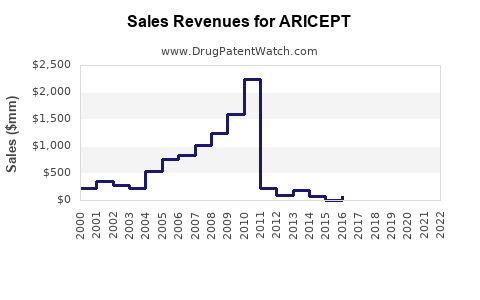
How have Aricept sales trended financially after generic entry?
Core dynamic: brand revenue contracts rapidly after generic availability, with subsequent flattening as the market becomes “maintenance supply” dominated by multiple manufacturers.
Typical post-brand phases
- Pre-generic peak: brand share holds and price per prescription remains high.
- First generic entry: sharp volume share loss and rapid erosion in net price.
- Multi-generic normalization: more suppliers bring price competition, leading to lower weighted-average selling prices across channels.
- Later lifecycle stabilization: total prescriptions for donepezil persist, but branded pricing no longer drives top-line; the market becomes primarily volume-based with marginal payer-led growth.
What to expect in the financial trajectory
- Brand net sales decline faster than total prescriptions.
- Total market value does not scale linearly with prescription volume due to pricing compression.
- The “brand vs. generic” mix becomes the main swing factor for reported revenue figures depending on accounting of channel inventory, rebates, and discontinued products in particular territories.
When does Aricept lose exclusivity in key markets and how does it change revenue?
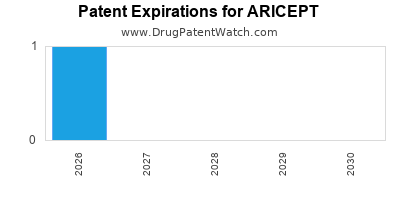
Aricept’s exclusivity is governed by a mix of patent life, patent term adjustments, and regulatory data exclusivity. For small-molecule drugs like donepezil, brand exclusivity loss generally comes from composition-of-matter and formulation method-of-use patent expirations and the associated generic challenge timetable.
Commercial impact of exclusivity loss
- Once the controlling patents expire (or are overturned/settled in litigation), first generics can launch.
- Revenue for the originator typically moves from high-margin brand pricing to much lower, competitive net pricing.
- Reimbursement policies often shift quickly toward tiered formularies favoring generics.
Featured snippet answer
- Aricept has moved past early exclusivity-driven growth into a stage where revenue trajectories are driven by generic pricing competition, prescribing inertia, and formulary access.
Which patents protect Aricept and how do patent expirations affect market entry?
Donepezil’s patent estate historically included composition claims and additional coverage around dosing regimens and formulations. The practical effect for market dynamics is that:
- Composition-of-matter and key method-of-use patents block generic “at-risk” launches until expiry.
- Formulation or process patents can delay specific dosage forms or manufacturing routes even after earlier patents expire.
- Litigation settlements can create date-certain or “cease-and-desist” effects that shift launch timing.
How this maps to generic risk
- The earliest “hard” entry point is driven by the earliest expiring blocking patents.
- Later-entry risk can still exist for secondary patents covering formulation, salts, or specific dosage regimens if those are enforced.
What is the Orange Book status of Aricept and what does it imply for generic launch timing?
Aricept’s US regulatory status is reflected in FDA’s Orange Book listings. Orange Book listings typically show:
- Active patents tied to approved strengths and dosage forms.
- Expiration dates.
- Exclusivity codes (if any) relevant to data protections.
How payers and competitors use it
- First filers use listed expiration dates to target filing and Paragraph IV eligibility.
- Originator firms use listing scope to assess whether a generic must avoid infringement or negotiate a settlement.
How does Paragraph IV litigation affect Aricept’s competitive landscape?
For a mature small-molecule brand, generic competition accelerates through:
- Paragraph IV challenges that contest patent validity and/or non-infringement.
- Settlement agreements that can allow earlier launch for generic companies in exchange for stipulated terms, often including limitations on product design or timing.
Commercial implications
- Litigation outcomes can shift the “effective exclusivity window” by months to years.
- Even when patents hold, delayed launches extend brand net sales.
- Settlements can reduce uncertainty and bring predictable pricing pressure.
Who are the major generic and competing manufacturers for donepezil (Aricept) in the US?
Once a small-molecule brand loses exclusivity, the market typically fills with multiple FDA-approved generics across strengths (including orally disintegrating and tablet forms where applicable). Competition is usually concentrated in:
- Tier-1 generic manufacturers with scale distribution.
- Regional distributors aligned with pharmacy network contracting.
- Niche suppliers where formulation or bioequivalence offers a marginal advantage.
Market effect
- More suppliers increases inventory depth and reduces shortages.
- Increased supply intensifies net price erosion.
How do pricing and reimbursement dynamics drive Aricept unit economics?
Aricept’s unit economics are affected by:
- Rebate structures for branded product and wholesaler/channel inventory economics.
- PBM formulary tier placement that determines net price and pharmacy dispensing behavior.
- Generic substitution rules at the point of sale.
- Coupon and patient assistance availability for residual branded share.
What changes after generic entry
- Channel mix shifts to generics, and net price tracks the lowest-cost substitutes that win formulary placement.
- Total market revenue becomes less sensitive to adherence and more sensitive to pricing and contract terms.
How does Aricept compare with other Alzheimer’s drugs in market dynamics?
Donepezil competes indirectly with other symptomatic Alzheimer’s therapies and mechanistic classes:
- Cholinesterase inhibitors (class substitution within and across molecule options).
- NMDA-pathway therapies (offering symptomatic benefit profiles that can influence payer preferences).
Competitive consequences for market trajectory
- When cholinesterase inhibitors are interchangeable at a payer policy level, donepezil is priced as a commoditized choice.
- If a competitor has better formulary positioning, tolerance profiles, or dosing convenience, it can pull share even before donepezil brand disappears completely.
What formulations are protected and how does that affect revenue segmentation?
Even when the active ingredient is no longer protected, formulation-level differentiation can matter:
- Tablet vs orally disintegrating tablet options can have separate patent and launch timelines.
- Dose-specific product lines can be subject to different listed patents and different generic launch pathways.
- Manufacturing processes and polymorph controls can be relevant for later generic entry.
Revenue consequence
- Brand revenue declines unevenly if one dosage form launches as generic sooner than others.
- Remaining protected forms can preserve some residual revenue until their specific barriers clear.
What is the biosimilar risk for Aricept?
Biosimilar pathways do not apply to Aricept because donepezil is a small-molecule drug, not a biologic. Competitive pressure comes from generic small-molecule approvals and substitution, not biosimilars.
What manufacturing and IP barriers shape how quickly generics scale?
Even after patent barriers clear, practical launch and scaling depend on:
- Bioequivalence package readiness.
- Supply chain capability, compression and coating or disintegration line availability.
- Stability and dissolution specs aligned with generics’ formulation choices.
- Batch release and quality controls that can affect time-to-market and fill rates.
Market dynamic
- Early entry generics can ramp quickly if they have generic production lines and established distribution.
- Late entry is often constrained less by IP once cleared and more by manufacturing capacity and contracting.
What generic entry risks exist for Aricept today?
The primary risks are timing-driven rather than absolute:
- Remaining secondary patents or Orange Book-listed patents can delay specific product variants.
- Patent litigation outcomes can change “effective entry” schedules.
- Regulatory changes or labeling updates can shift whether a specific generic product is considered fully aligned to approved reference labeling.
Commercial risk to brand holders
- If any remaining barriers exist for specific forms, late-stage brand holders might protect a small revenue stream.
- Once all relevant barriers fall, pricing pressure tends to become persistent and structurally lower.
How do Aricept market dynamics differ across geographies?
US
- Strong generic substitution and competitive tender dynamics after Orange Book patent expiry.
- PBM contract cycles influence net pricing quickly.
Europe and UK
- Tender-based procurement and reference pricing compress branded pricing faster once generics take share.
- Payer uptake and channel inventory influence near-term revenue.
Rest of World
- Local regulatory timelines, patent enforcement strength, and generic market maturity determine how quickly volume shifts.
What settlement agreements and litigation milestones should be tracked for commercial impact?
For late-cycle small molecules, the highest-yield litigation milestones are:
- Patent infringement rulings that uphold listed patents or dismiss them.
- Settlement agreements that fix the launch date for first-to-file challengers.
- Consent judgments that define design-around requirements or entry conditions.
Why it matters
- Settlements can shift the revenue curve, changing when net price begins structural decline.
How strong is the patent estate for Aricept versus typical Alzheimer’s portfolios?
For a long-established small molecule, the patent estate strength is generally:
- Limited to remaining listed patents for specific formulations, methods, or dosing instructions if applicable.
- Not comparable to the multi-patent, long-lived estates seen in some newer CNS programs with extensive formulation/process and device-like delivery IP.
Commercial interpretation
- Once the key blocking patents expire, market value is dominated by generic pricing and contracting, not new IP creation.
Key timeline: how donepezil brand revenue usually evolves post-expiry
Because revenue depends on specific expiry and challenge dates, the timeline conceptually maps to:
- T0: Orange Book blocking patents active.
- T1: earliest expiry or successful patent challenge opens generic entry window.
- T2: first launch drives rapid share shift and net price compression.
- T3: multi-generic entries reduce price further and stabilize volume-based revenues for the overall market.
- T4: residual branded share depends on contracts, continuity, and patient-level switching inertia.
Key Takeaways
- Aricept’s financial trajectory is late-cycle and dominated by generic substitution, pricing compression, and formulary contracting rather than innovation-led demand expansion.
- Exclusivity loss and Paragraph IV-driven entry are the primary catalysts that reshape revenue curves.
- Market value remains supported by chronic donepezil utilization, but brand net sales decline structurally once generics scale.
- Formulation and dosage-form-specific Orange Book listings can extend localized revenue pockets even after broader exclusivity ends.
- Biosimilar risk is not applicable; competitive risk is concentrated in generic small-molecule approvals and litigation/settlement timing.
FAQs
- How many generic manufacturers compete for Aricept across US strengths and dosage forms?
- What Orange Book patent listings for donepezil most directly control generic launch timing?
- Do Aricept orally disintegrating tablets face different patent-expiry or litigation timelines than tablets?
- How do PBM formularies and rebate structures typically affect net price changes after generic entry?
- What litigation milestones most often determine the “effective” launch date for first-to-file donepezil generics?
References
- FDA. Orange Book: Approved Drug Products with Therapeutic Equivalence Evaluations. US Food and Drug Administration. https://www.accessdata.fda.gov/scripts/cder/daf/ (accessed 2026-07-09).