AMONDYS 45 Drug Patent Profile
✉ Email this page to a colleague
When do Amondys 45 patents expire, and what generic alternatives are available?
Amondys 45 is a drug marketed by Sarepta Theraps Inc and is included in one NDA. There are six patents protecting this drug.
This drug has ninety patent family members in twenty-five countries.
The generic ingredient in AMONDYS 45 is casimersen. One supplier is listed for this compound. Additional details are available on the casimersen profile page.
DrugPatentWatch® Generic Entry Outlook for Amondys 45
Amondys 45 was eligible for patent challenges on February 25, 2025.
By analyzing the patents and regulatory protections it appears that the earliest date
for generic entry will be November 12, 2030. This may change due to patent challenges or generic licensing.
There has been one patent litigation case involving the patents protecting this drug, indicating strong interest in generic launch. Recent data indicate that 63% of patent challenges are decided in favor of the generic patent challenger and that 54% of successful patent challengers promptly launch generic drugs.
Indicators of Generic Entry
AI Deep Research
Questions you can ask:
- What is the 5 year forecast for AMONDYS 45?
- What are the global sales for AMONDYS 45?
- What is Average Wholesale Price for AMONDYS 45?
Summary for AMONDYS 45
| International Patents: | 90 |
| US Patents: | 6 |
| Applicants: | 1 |
| NDAs: | 1 |
| Finished Product Suppliers / Packagers: | 1 |
| Patent Litigation and PTAB cases: | See patent lawsuits and PTAB cases for AMONDYS 45 |
| What excipients (inactive ingredients) are in AMONDYS 45? | AMONDYS 45 excipients list |
| DailyMed Link: | AMONDYS 45 at DailyMed |
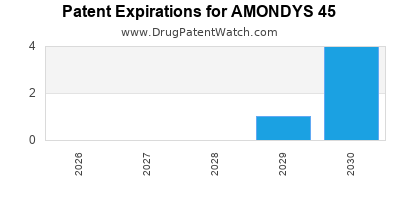
DrugPatentWatch® Estimated Loss of Exclusivity (LOE) Date for AMONDYS 45
Generic Entry Date for AMONDYS 45*:
Constraining patent/regulatory exclusivity:
NDA:
Dosage:
SOLUTION;INTRAVENOUS |
*The generic entry opportunity date is the latter of the last compound-claiming patent and the last regulatory exclusivity protection. Many factors can influence early or later generic entry. This date is provided as a rough estimate of generic entry potential and should not be used as an independent source.
Pharmacology for AMONDYS 45
| Drug Class | Antisense Oligonucleotide |
| Physiological Effect | Increased Protein Synthesis |
US Patents and Regulatory Information for AMONDYS 45
AMONDYS 45 is protected by eight US patents and two FDA Regulatory Exclusivities.
Based on analysis by DrugPatentWatch, the earliest date for a generic version of AMONDYS 45 is ⤷ Get Started Free.
This potential generic entry date is based on patent 9,228,187.
Generics may enter earlier, or later, based on new patent filings, patent extensions, patent invalidation, early generic licensing, generic entry preferences, and other factors.
| Applicant | Tradename | Generic Name | Dosage | NDA | Approval Date | TE | Type | RLD | RS | Patent No. | Patent Expiration | Product | Substance | Delist Req. | Exclusivity Expiration |
|---|---|---|---|---|---|---|---|---|---|---|---|---|---|---|---|
| Sarepta Theraps Inc | AMONDYS 45 | casimersen | SOLUTION;INTRAVENOUS | 213026-001 | Feb 25, 2021 | RX | Yes | Yes | 9,758,783 | ⤷ Get Started Free | ⤷ Get Started Free | ||||
| Sarepta Theraps Inc | AMONDYS 45 | casimersen | SOLUTION;INTRAVENOUS | 213026-001 | Feb 25, 2021 | RX | Yes | Yes | 9,447,415 | ⤷ Get Started Free | Y | Y | ⤷ Get Started Free | ||
| Sarepta Theraps Inc | AMONDYS 45 | casimersen | SOLUTION;INTRAVENOUS | 213026-001 | Feb 25, 2021 | RX | Yes | Yes | RE48960 | ⤷ Get Started Free | Y | Y | ⤷ Get Started Free | ||
| Sarepta Theraps Inc | AMONDYS 45 | casimersen | SOLUTION;INTRAVENOUS | 213026-001 | Feb 25, 2021 | RX | Yes | Yes | 9,228,187 | ⤷ Get Started Free | Y | Y | ⤷ Get Started Free | ||
| Sarepta Theraps Inc | AMONDYS 45 | casimersen | SOLUTION;INTRAVENOUS | 213026-001 | Feb 25, 2021 | RX | Yes | Yes | 10,781,450 | ⤷ Get Started Free | ⤷ Get Started Free | ||||
| Sarepta Theraps Inc | AMONDYS 45 | casimersen | SOLUTION;INTRAVENOUS | 213026-001 | Feb 25, 2021 | RX | Yes | Yes | 10,287,586 | ⤷ Get Started Free | Y | Y | ⤷ Get Started Free | ||
| >Applicant | >Tradename | >Generic Name | >Dosage | >NDA | >Approval Date | >TE | >Type | >RLD | >RS | >Patent No. | >Patent Expiration | >Product | >Substance | >Delist Req. | >Exclusivity Expiration |
Expired US Patents for AMONDYS 45
| Applicant | Tradename | Generic Name | Dosage | NDA | Approval Date | Patent No. | Patent Expiration |
|---|---|---|---|---|---|---|---|
| Sarepta Theraps Inc | AMONDYS 45 | casimersen | SOLUTION;INTRAVENOUS | 213026-001 | Feb 25, 2021 | 10,533,174 | ⤷ Get Started Free |
| Sarepta Theraps Inc | AMONDYS 45 | casimersen | SOLUTION;INTRAVENOUS | 213026-001 | Feb 25, 2021 | 9,447,415 | ⤷ Get Started Free |
| Sarepta Theraps Inc | AMONDYS 45 | casimersen | SOLUTION;INTRAVENOUS | 213026-001 | Feb 25, 2021 | 9,416,361 | ⤷ Get Started Free |
| >Applicant | >Tradename | >Generic Name | >Dosage | >NDA | >Approval Date | >Patent No. | >Patent Expiration |
International Patents for AMONDYS 45
When does loss-of-exclusivity occur for AMONDYS 45?
Based on analysis by DrugPatentWatch, the following patents block generic entry in the countries listed below:
Australia
Patent: 10317599
Patent: Antisense molecules and methods for treating pathologies
Estimated Expiration: ⤷ Get Started Free
Patent: 16202924
Patent: Antisense molecules and methods for treating pathologies
Estimated Expiration: ⤷ Get Started Free
Patent: 18202105
Patent: Antisense Molecules and Methods for Treating Pathologies
Estimated Expiration: ⤷ Get Started Free
Patent: 20260498
Patent: Antisense Molecules and Methods for Treating Pathologies
Estimated Expiration: ⤷ Get Started Free
Patent: 23203103
Patent: Antisense Molecules and Methods for Treating Pathologies
Estimated Expiration: ⤷ Get Started Free
Brazil
Patent: 2012011195
Patent: OLIGONUCLEOTÍDEO ANTISSENTIDO, COMPOSIÇÃO E RESPECTIVO USO.
Estimated Expiration: ⤷ Get Started Free
Patent: 2023023194
Estimated Expiration: ⤷ Get Started Free
Canada
Patent: 80563
Patent: MOLECULES ANTISENS ET PROCEDES DE TRAITEMENT DE PATHOLOGIES (ANTISENSE MOLECULES AND METHODS FOR TREATING PATHOLOGIES)
Estimated Expiration: ⤷ Get Started Free
China
Patent: 3003430
Patent: Antisense molecules and methods for treating pathologies
Estimated Expiration: ⤷ Get Started Free
Patent: 5838714
Patent: 反义分子和治疗疾病的方法 (Antisense molecules and methods for treating pathologies)
Estimated Expiration: ⤷ Get Started Free
Croatia
Patent: 0181824
Estimated Expiration: ⤷ Get Started Free
Cyprus
Patent: 21198
Estimated Expiration: ⤷ Get Started Free
Denmark
Patent: 99249
Estimated Expiration: ⤷ Get Started Free
European Patent Office
Patent: 99249
Patent: MOLÉCULES ANTISENS ET PROCÉDÉS DE TRAITEMENT DE PATHOLOGIES (ANTISENSE MOLECULES AND METHODS FOR TREATING PATHOLOGIES)
Estimated Expiration: ⤷ Get Started Free
Patent: 31603
Patent: MOLÉCULES ANTISENS ET PROCÉDÉS DE TRAITEMENT DE PATHOLOGIES (ANTISENSE MOLECULES AND METHODS FOR TREATING PATHOLOGIES)
Estimated Expiration: ⤷ Get Started Free
Hungary
Patent: 40445
Estimated Expiration: ⤷ Get Started Free
Israel
Patent: 9753
Patent: אוליגונוקלאוטידי אנטיסנס לגרימת דילוג אקסון בגן דיסטרופין (Antisense oligonucleotides for inducing exon skipping in the dystrophin gene)
Estimated Expiration: ⤷ Get Started Free
Patent: 5707
Patent: אוליגונוקלאוטידי אנטיסנס לגרימת דילוג אקסון בגן דיסטרופין (Antisense oligonucleotides for inducing exon skipping in the dystrophin gene)
Estimated Expiration: ⤷ Get Started Free
Patent: 4525
Patent: אוליגונוקלאוטידי אנטיסנס לגרימת דילוג אקסון בגן דיסטרופין (Antisense oligonucleotides for inducing exon skipping in the dystrophin gene)
Estimated Expiration: ⤷ Get Started Free
Patent: 6947
Patent: אוליגונוקלאוטידי אנטיסנס לגרימת דילוג אקסון בגן דיסטרופין (Antisense oligonucleotides for inducing exon skipping in the dystrophin gene)
Estimated Expiration: ⤷ Get Started Free
Patent: 7299
Patent: אוליגונוקלאוטידי אנטיסנס לגרימת דילוג אקסון בגן דיסטרופין (Antisense oligonucleotides for inducing exon skipping in the dystrophin gene)
Estimated Expiration: ⤷ Get Started Free
Patent: 4343
Estimated Expiration: ⤷ Get Started Free
Japan
Patent: 63678
Estimated Expiration: ⤷ Get Started Free
Patent: 94393
Estimated Expiration: ⤷ Get Started Free
Patent: 25449
Estimated Expiration: ⤷ Get Started Free
Patent: 36830
Estimated Expiration: ⤷ Get Started Free
Patent: 13510561
Estimated Expiration: ⤷ Get Started Free
Patent: 16198105
Patent: 病状を治療するためのアンチセンス分子及び方法 (ANTISENSE MOLECULES AND METHODS FOR TREATING PATHOLOGIES)
Estimated Expiration: ⤷ Get Started Free
Patent: 18082714
Patent: 病状を治療するためのアンチセンス分子及び方法 (ANTISENSE MOLECULES AND METHODS FOR TREATING PATHOLOGIES)
Estimated Expiration: ⤷ Get Started Free
Patent: 19141073
Patent: 病状を治療するためのアンチセンス分子及び方法 (ANTISENSE MOLECULES AND METHODS FOR TREATING PATHOLOGIES)
Estimated Expiration: ⤷ Get Started Free
Patent: 22001053
Patent: 病状を治療するためのアンチセンス分子及び方法 (ANTISENSE MOLECULES AND METHODS FOR TREATING PATHOLOGIES)
Estimated Expiration: ⤷ Get Started Free
Patent: 24029262
Estimated Expiration: ⤷ Get Started Free
Lithuania
Patent: 99249
Estimated Expiration: ⤷ Get Started Free
New Zealand
Patent: 6359
Patent: Antisense molecules and methods for treating pathologies
Estimated Expiration: ⤷ Get Started Free
Patent: 6534
Estimated Expiration: ⤷ Get Started Free
Poland
Patent: 99249
Estimated Expiration: ⤷ Get Started Free
Portugal
Patent: 99249
Estimated Expiration: ⤷ Get Started Free
San Marino
Patent: 01800579
Estimated Expiration: ⤷ Get Started Free
Serbia
Patent: 079
Estimated Expiration: ⤷ Get Started Free
Slovenia
Patent: 99249
Estimated Expiration: ⤷ Get Started Free
South Korea
Patent: 1958491
Estimated Expiration: ⤷ Get Started Free
Patent: 2000762
Estimated Expiration: ⤷ Get Started Free
Patent: 2113306
Estimated Expiration: ⤷ Get Started Free
Patent: 2239374
Estimated Expiration: ⤷ Get Started Free
Patent: 2366851
Estimated Expiration: ⤷ Get Started Free
Patent: 2487132
Estimated Expiration: ⤷ Get Started Free
Patent: 2581868
Estimated Expiration: ⤷ Get Started Free
Patent: 130084595
Patent: ANTISENSE MOLECULES AND METHODS FOR TREATING PATHOLOGIES
Estimated Expiration: ⤷ Get Started Free
Patent: 180004745
Patent: 안티센스 분자 및 이를 이용한 질환 치료방법 (Antisense Molecules and Methods for Treating Pathologies)
Estimated Expiration: ⤷ Get Started Free
Patent: 190084360
Patent: 안티센스 분자 및 이를 이용한 질환 치료방법 (Antisense Molecules and Methods for Treating Pathologies)
Estimated Expiration: ⤷ Get Started Free
Patent: 200055161
Patent: 안티센스 분자 및 이를 이용한 질환 치료방법 (Antisense Molecules and Methods for Treating Pathologies)
Estimated Expiration: ⤷ Get Started Free
Patent: 210041130
Patent: 안티센스 분자 및 이를 이용한 질환 치료방법 (Antisense Molecules and Methods for Treating Pathologies)
Estimated Expiration: ⤷ Get Started Free
Patent: 220031125
Patent: 안티센스 분자 및 이를 이용한 질환 치료방법 (Antisense Molecules and Methods for Treating Pathologies)
Estimated Expiration: ⤷ Get Started Free
Patent: 230010814
Patent: 안티센스 분자 및 이를 이용한 질환 치료방법 (Antisense Molecules and Methods for Treating Pathologies)
Estimated Expiration: ⤷ Get Started Free
Patent: 230137491
Patent: 안티센스 분자 및 이를 이용한 질환 치료방법 (Antisense Molecules and Methods for Treating Pathologies)
Estimated Expiration: ⤷ Get Started Free
Patent: 250005448
Patent: 안티센스 분자 및 이를 이용한 질환 치료방법 (Antisense Molecules and Methods for Treating Pathologies)
Estimated Expiration: ⤷ Get Started Free
Spain
Patent: 93459
Estimated Expiration: ⤷ Get Started Free
Turkey
Patent: 1816523
Estimated Expiration: ⤷ Get Started Free
Generics may enter earlier, or later, based on new patent filings, patent extensions, patent invalidation, early generic licensing, generic entry preferences, and other factors.
See the table below for additional patents covering AMONDYS 45 around the world.
| Country | Patent Number | Title | Estimated Expiration |
|---|---|---|---|
| Israel | 276947 | אוליגונוקלאוטידי אנטיסנס לגרימת דילוג אקסון בגן דיסטרופין (Antisense oligonucleotides for inducing exon skipping in the dystrophin gene) | ⤷ Get Started Free |
| European Patent Office | 1814596 | COMPOSES ANTIVIRAUX ANTISENS ET METHODES DE TRAITEMENT D'INFECTION PAR UN FILOVIRUS (ANTISENSE ANTIVIRAL COMPOUNDS AND METHODS FOR TREATING FILOVIRUS INFECTION) | ⤷ Get Started Free |
| Australia | 2006287530 | ⤷ Get Started Free | |
| Canada | 2651881 | ⤷ Get Started Free | |
| Japan | 2024029262 | ⤷ Get Started Free | |
| Spain | 2367289 | ⤷ Get Started Free | |
| >Country | >Patent Number | >Title | >Estimated Expiration |
Market Dynamics and Financial Trajectory for Amondys 45
More… ↓
Make Better Decisions: Try a trial or see plans & pricing
Drugs may be covered by multiple patents or regulatory protections. All trademarks and applicant names are the property of their respective owners or licensors. Although great care is taken in the proper and correct provision of this service, thinkBiotech LLC does not accept any responsibility for possible consequences of errors or omissions in the provided data. The data presented herein is for information purposes only. There is no warranty that the data contained herein is error free. We do not provide individual investment advice. This service is not registered with any financial regulatory agency. The information we publish is educational only and based on our opinions plus our models. By using DrugPatentWatch you acknowledge that we do not provide personalized recommendations or advice. thinkBiotech performs no independent verification of facts as provided by public sources nor are attempts made to provide legal or investing advice. Any reliance on data provided herein is done solely at the discretion of the user. Users of this service are advised to seek professional advice and independent confirmation before considering acting on any of the provided information. thinkBiotech LLC reserves the right to amend, extend or withdraw any part or all of the offered service without notice.
ISSN: 2162-2639

Privacy and Cookies
Terms & Conditions
Site Map
DrugPatentWatch Alternatives
LOE / Major Patent Expirations 2025 - 2026
NCE-1 Patent Challenge Dates 2025 - 2026
Friedman, Yali. "DrugPatentWatch" DrugPatentWatch, thinkBiotech, 2025, www.DrugPatentWatch.com.
See Primary Research Papers Citing DrugPatentWatch