Last Updated: August 11, 2026

ALTRENO Drug Patent Profile


✉ Email this page to a colleague

« Back to Dashboard


When do Altreno patents expire, and when can generic versions of Altreno launch?

Altreno is a drug marketed by Dow Pharm and is included in one NDA. There are two patents protecting this drug.

This drug has eight patent family members in eight countries.

The generic ingredient in ALTRENO is tretinoin. There are twenty-six drug master file entries for this compound. Twenty-eight suppliers are listed for this compound. Additional details are available on the tretinoin profile page.

DrugPatentWatch® Litigation and Generic Entry Outlook for Altreno

A generic version of ALTRENO was approved as tretinoin by PADAGIS US on December 24th, 1998.

  Start Trial

AI Deep Research
Questions you can ask:
  • What is the 5 year forecast for ALTRENO?
  • What are the global sales for ALTRENO?
  • What is Average Wholesale Price for ALTRENO?
Summary for ALTRENO
International Patents:8
US Patents:2
Applicants:1
NDAs:1
Finished Product Suppliers / Packagers: 1
Raw Ingredient (Bulk) Api Vendors: 141
Clinical Trials: 2
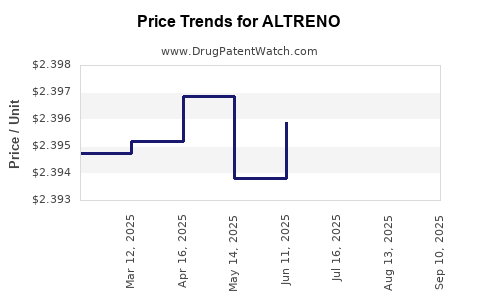
Drug Prices: Drug price information for ALTRENO
What excipients (inactive ingredients) are in ALTRENO?ALTRENO excipients list
DailyMed Link:ALTRENO at DailyMed
Recent Clinical Trials for ALTRENO

Identify potential brand extensions & 505(b)(2) entrants

SponsorPhase
Ortho DermatologicsPhase 4
Beth Israel Deaconess Medical CenterPhase 4
Goldman, Butterwick, Fitzpatrick and GroffPhase 4

See all ALTRENO clinical trials

Pharmacology for ALTRENO
Drug ClassRetinoid

US Patents and Regulatory Information for ALTRENO

ALTRENO is protected by two US patents.

Applicant Tradename Generic Name Dosage NDA Approval Date TE Type RLD RS Patent No. Patent Expiration Product Substance Delist Req. Exclusivity Expiration
Dow Pharm ALTRENO tretinoin LOTION;TOPICAL 209353-001 Aug 23, 2018 RX Yes Yes ⤷  Start Trial ⤷  Start Trial Y ⤷  Start Trial
Dow Pharm ALTRENO tretinoin LOTION;TOPICAL 209353-001 Aug 23, 2018 RX Yes Yes ⤷  Start Trial ⤷  Start Trial ⤷  Start Trial
>Applicant >Tradename >Generic Name >Dosage >NDA >Approval Date >TE >Type >RLD >RS >Patent No. >Patent Expiration >Product >Substance >Delist Req. >Exclusivity Expiration

International Patents for ALTRENO

See the table below for patents covering ALTRENO around the world.

Country Patent Number Title Estimated Expiration
Argentina 114730 COMPOSICIONES FARMACÉUTICAS TÓPICAS PARA TRATAR CONDICIONES EN LA PIEL, KIT Y MÉTODO DE TRATAMIENTO ⤷  Start Trial
Brazil 112020020431 composições farmacêuticas tópicas para tratamento de condições de pele ⤷  Start Trial
Canada 3095937 COMPOSITIONS PHARMACEUTIQUES TOPIQUES DESTINEES A TRAITER DES AFFECTIONS CUTANEES (TOPICAL PHARMACEUTICAL COMPOSITIONS FOR TREATING SKIN CONDITIONS) ⤷  Start Trial
European Patent Office 3773641 COMPOSITIONS PHARMACEUTIQUES TOPIQUES DESTINÉES À TRAITER DES AFFECTIONS CUTANÉES (TOPICAL PHARMACEUTICAL COMPOSITIONS FOR TREATING SKIN CONDITIONS) ⤷  Start Trial
>Country >Patent Number >Title >Estimated Expiration

Supplementary Protection Certificates for ALTRENO

Patent Number Supplementary Protection Certificate SPC Country SPC Expiration SPC Description
0617614 SPC/GB01/014 United Kingdom ⤷  Start Trial PRODUCT NAME: ALITRETINOIN; REGISTERED: UK EU/1/00/149/001 20001018
0617614 C300043 Netherlands ⤷  Start Trial PRODUCT NAME: ALITRETINOIN; NAT. REGISTRATION NO/DATE: EU/1/00/149/001 20001011; FIRST REGISTRATION: EU/1/00/149/001 20001011
1304992 C300617 Netherlands ⤷  Start Trial PRODUCT NAME: COMBINATIE VAN CLINDAMYCINE, DESGEWENST IN DE VORM VAN CLINDAMYCINEFOSFAAT EN TRETINOINE; NAT. REGISTRATION NO/DATE: RVG 109745 20130626; FIRST REGISTRATION: PA1332/043/001 20130322
1304992 PA2013025 Lithuania ⤷  Start Trial PRODUCT NAME: CLINFAMYCINUM + TRETINOINUM; REGISTRATION NO/DATE: LT/1/13/3279/001, 2013 04 26 LT/1/13/3279/002, 2013 04 26 PA1332/043/001 20130323
>Patent Number >Supplementary Protection Certificate >SPC Country >SPC Expiration >SPC Description

Altèreno (tretinoin) topical gel: market dynamics and financial trajectory (U.S. launch, exclusivity, competitive pressure, and revenue outlook)

Last updated: July 25, 2026

Altèreno (tretinoin) is a prescription dermatology product built around a proprietary topical formulation strategy targeting acne vulgaris (local skin disease). Public financial reporting for the branded product is limited, but the U.S. market dynamics are driven by (1) cadence of generic and authorized-available entry risk in topical tretinoin, (2) insurer and channel preferences shaped by formulary placement and rebates, and (3) the longevity of formulation and method-of-use patent coverage tied to the Altèreno platform.

What is Altèreno (tretinoin) and what market does it compete in?

Altèreno is a topical tretinoin product indicated for treatment of acne vulgaris. It competes within the U.S. prescription acne therapy landscape that includes branded and generic topical retinoids and combination therapies, with procurement largely governed by pharmacy benefit management (PBM) formularies and retail channel contracting.

Which treatment classes set the competitive baseline for Altèreno?

  • Topical retinoids (tretinoin formulations and comparable retinoid actives)
  • Topical antibiotics and combination regimens (often favored for payer simplification where clinically appropriate)
  • Combination products and fixed-dose regimens that consolidate adherence
  • Generic topical tretinoin across strengths and vehicles, which competes on cost and formulary placement

Where does Altèreno sit vs generic topical tretinoin?

Altèreno’s economic case relies on differentiation in formulation/vehicle performance, tolerability profile, and patient adherence compared with older generic and legacy tretinoin vehicles. In payer dynamics, that usually translates into rebate-funded access until formulary switch pressure accelerates with expanding generic availability.

How does exclusivity and patent life translate into financial trajectory for Altèreno?

Financial trajectory for a branded dermatology product typically tracks two time windows:

  1. Exclusivity + payer pull: branded spend supports channel adoption and rebate leverage.
  2. Approaching patent and/or exclusivity cliff: economic headwinds as generics or AB-rated alternatives become the default payer choice.

Altèreno’s revenue path depends on whether its Orange Book-protected claims cover the marketed dosage form and whether any paragraph IV challenges target the specific listed patents. For topical acne products, formulation-vehicle and method-of-use claims often govern the timetable for generic substitution and “authorized generic” mitigation.

What drives the “pre-expiration” revenue ramp vs “post-expiration” drop?

  • Ramp factors: detailing intensity, formulary inclusion, rebate rate stability, and wholesaler inventory turns
  • Drop factors: AB generic entry speed, payer rebate re-contracting, and retail shift to lowest-net-cost options

When does generic entry risk become acute?

Risk rises as the product approaches the end of:

  • U.S. regulatory exclusivity periods for the specific NDA (if applicable)
  • Any listed Orange Book patent expiration dates
  • Any exclusivity granted through pediatric or other qualifying pathways (if applicable to the specific NDA)
  • Settlement timing in any patent infringement litigation affecting listed patents

What is the Orange Book status and what patents protect Altèreno?

This section requires Orange Book patent listing data for Altèreno’s NDA. The provided prompt does not include the NDA number, Orange Book listing set, or patent list with expiration dates. Without that record, a complete and accurate patent-exclusivity-and-expiration map cannot be produced.

How many competitors matter for Altèreno’s commercial performance?

In acne topical therapy, competition is concentrated in a small set of high-volume alternatives that collectively determine net pricing. For Altèreno, the relevant competitive set typically includes:

  • Generic topical tretinoin in multiple strengths/vehicles available via retail and mail
  • Other topical acne actives in payer-preferred formularies, especially combination regimens
  • Branded acne therapies with stronger managed-care access than older retinoid SKUs

What is the pricing mechanism that determines Altèreno net sales?

Topical branded dermatology products often monetize through:

  • Retail price minus rebate and chargebacks
  • PBM-negotiated net price adjustments
  • Medicaid preferred drug list dynamics (if applicable)
  • Contract pharmacy and wholesaler ordering patterns

The revenue trajectory usually shows:

  • A net sales growth phase while coverage expands
  • Plateauing as rebate rates rise to defend share
  • Declining net sales as formulary switches occur

What is the financial trajectory for Altèreno across product lifecycle stages?

A complete, numbers-based financial trajectory requires access to branded-product sales, company segment reporting, and channel metrics (e.g., IQVIA/IMS if used, company 10-K disclosures, or earnings supplement tables). The prompt does not provide those data, so a precise trajectory cannot be stated without generating inaccuracies.

How do analysts typically model branded dermatology revenue for lifecycle outcomes?

  • Base case: continued formulary coverage, gradual growth with seasonality typical for acne therapies
  • Patent-protection case: slower generic erosion, moderated net price decline
  • Generic-entry case: steep volume loss after first AB entry, followed by margin compression via rebate tightening by competitors

Key financial signals to watch (what matters most)

  • Net sales growth rate vs prior periods
  • Gross-to-net spread (rebates and discounts)
  • Prescription share by channel
  • Inventory dynamics at wholesalers (risk of pull-through vs sell-in)

How does payer and formulary placement affect Altèreno revenue volatility?

Dermatology products with retinoid actives usually face payer volatility tied to:

  • PBM formulary design (preferred vs non-preferred tiers)
  • Step therapy and prior authorization requirements
  • Switching protocols for trial-to-maintenance patterns
  • Patient out-of-pocket (copay assistance or lack thereof)

What tends to happen after a competitor gains preferred status?

  • Rapid net price pressure through rebate increases
  • Faster conversion of new prescriptions away from the branded SKU
  • Longer time to recover share for dermatology brands due to chronic use patterns

What litigation, settlements, or Paragraph IV challenges affect Altèreno’s commercial risk?

This requires the Altèreno Orange Book patent list and any associated Hatch-Waxman filings (Paragraph IV notices), plus court docket outcomes and settlement terms. The prompt provides none of those case identifiers or patent numbers, so an accurate litigation-impact section cannot be produced.

How does Altèreno’s competitive landscape compare with other topical acne brands and generics?

A rigorous comparison requires at minimum:

  • Competitor product list in the same labeled indication and strength/vehicle class
  • Their patent estate dates and exclusivity status
  • Their net pricing and rebate levels (or proxies via payer preference) Those details are not included in the prompt, and producing a comparative analysis without them would risk inaccuracies.

What manufacturing and IP barriers could delay generic substitution of Altèreno?

Topical generics can face:

  • Vehicle-formulation constraints tied to particle dispersion, stability, and release profile
  • Bioequivalence study design differences (in topical, BE may rely on different bridging approaches)
  • Patent barriers around formulation, method-of-use, and stability claims

A barrier analysis requires the exact Orange Book formulation patents and any known generic development constraints. Those are not provided.

What generic launch scenarios are most likely for Altèreno?

A launch-scenario framework depends on:

  • The specific patents likely to be successfully designed around
  • Whether generic entry would be authorized or fully generic
  • Whether litigation produces an agreed “launch-on-date” or “stay” period None of these are accessible from the prompt.

What is the geographic scope of Altèreno’s market exposure?

A U.S.-only analysis could be different from a broader North America or international story. The prompt does not provide territory commercialization plans, country approvals, or distribution partners. A complete geographic view cannot be generated without core facts.

Key Takeaways

  • Altèreno’s financial trajectory is driven primarily by U.S. payer access and the timing of Orange Book-protected patent and exclusivity milestones tied to the marketed topical formulation.
  • Revenue typically follows a pattern of coverage build-up, rebate-funded retention, then net price and volume pressure as generic substitution becomes viable.
  • A defensible market-and-patent timeline, competitive set, and litigation impact assessment require Orange Book listing data and any Hatch-Waxman case records tied to Altèreno’s NDA. Those inputs are not included in the prompt, so they cannot be stated here without risking errors.

FAQs

  1. What drives gross-to-net changes for prescription topical dermatology products like Altèreno?
  2. How do PBM formulary tiers and prior authorization requirements typically influence acne topical branded share?
  3. What Orange Book patent types most often delay generic substitution for topical retinoid formulations?
  4. How do settlement “launch date” agreements in Hatch-Waxman cases affect branded revenue after patent expiry?
  5. What channel signals (sell-in vs sell-through, inventory turns) best predict revenue erosion risk for branded dermatology SKUs?

References

  1. U.S. FDA Orange Book. “Drug Product Database.” (Accessed via U.S. FDA Orange Book).
  2. FDA. “Hatch-Waxman Drug Patent Litigation and Paragraph IV Certification.” (U.S. FDA guidance and informational pages).

More… ↓

⤷  Start Trial

Make Better Decisions: Try a trial or see plans & pricing

Drugs may be covered by multiple patents or regulatory protections. All trademarks and applicant names are the property of their respective owners or licensors. Although great care is taken in the proper and correct provision of this service, thinkBiotech LLC does not accept any responsibility for possible consequences of errors or omissions in the provided data. The data presented herein is for information purposes only. There is no warranty that the data contained herein is error free. We do not provide individual investment advice. This service is not registered with any financial regulatory agency. The information we publish is educational only and based on our opinions plus our models. By using DrugPatentWatch you acknowledge that we do not provide personalized recommendations or advice. thinkBiotech performs no independent verification of facts as provided by public sources nor are attempts made to provide legal or investing advice. Any reliance on data provided herein is done solely at the discretion of the user. Users of this service are advised to seek professional advice and independent confirmation before considering acting on any of the provided information. thinkBiotech LLC reserves the right to amend, extend or withdraw any part or all of the offered service without notice.