Last updated: September 23, 2026
Albuterol is a mature, low-cost short-acting beta2-agonist used for rapid relief of bronchospasm in asthma and chronic obstructive pulmonary disease. The active ingredient has no meaningful remaining molecule-level exclusivity in the United States. Commercial value is concentrated in inhaler devices, manufacturing capacity, distribution, brand recognition, and payer access rather than in the chemical entity.
The U.S. market is dominated by generic albuterol sulfate inhalation products, with branded or authorized-generic products from companies including GSK, Teva, Viatris, and Perrigo. Revenue growth for the category is limited. Financial performance depends on volume, price erosion, product mix, contract wins, supply reliability, and the success of newer digital or device-enabled inhalers.
What is albuterol and how is the market segmented?
Albuterol, known as salbutamol outside the United States, is a short-acting beta2-adrenergic agonist. It relaxes airway smooth muscle and is sold in several dosage forms:
| Product category |
Typical use |
Main commercial characteristics |
| Metered-dose inhaler, or MDI |
Rescue treatment for asthma and COPD |
Largest branded and generic segment in the U.S. |
| Nebulizer solution |
Acute and maintenance bronchodilation |
Highly genericized; used in hospitals, clinics, and home nebulizers |
| Dry-powder inhaler |
Rescue treatment in selected markets |
Smaller segment; device and formulation patents matter |
| Oral tablets and syrup |
Less common systemic therapy |
Mature products with limited growth |
| Digital inhaler |
Dose tracking and adherence support |
Technology-driven niche with higher pricing potential |
The principal U.S. products include albuterol sulfate inhalation aerosol, albuterol sulfate inhalation solution, ProAir HFA, ProAir Digihaler, Ventolin HFA, and generic equivalents. FDA product labeling identifies albuterol sulfate inhalation aerosol as a rescue bronchodilator indicated for treatment or prevention of bronchospasm in patients aged four years and older in products such as Ventolin HFA and ProAir HFA. [1][2]
How large is the albuterol market?
There is no single audited global revenue pool for albuterol because sales are divided among branded products, authorized generics, unbranded generics, hospital contracts, retail prescriptions, and products sold under the international name salbutamol.
The U.S. market is best characterized as a high-volume, low-margin category:
- Retail and mail-order prescriptions generate most commercial volume.
- Nebulizer solutions add institutional and home-health demand.
- Branded inhalers retain some share through formulary placement, patient familiarity, and device preference.
- Generic inhalers face higher manufacturing complexity than oral solid drugs because the product includes a metered-dose valve, actuator, canister, propellant, and aerosol formulation.
- The transition from chlorofluorocarbon propellants to hydrofluoroalkane propellants reshaped the product market and created formulation and device development costs.
IQVIA and other commercial data providers track U.S. prescription volume and net sales, but public-company filings generally do not report albuterol revenue as a separate line item. GSK reports respiratory sales at a broader portfolio level, while Teva and Viatris disclose larger therapeutic or geographic categories rather than a standalone albuterol figure. [3][4][5]
What is the financial trajectory for albuterol products?
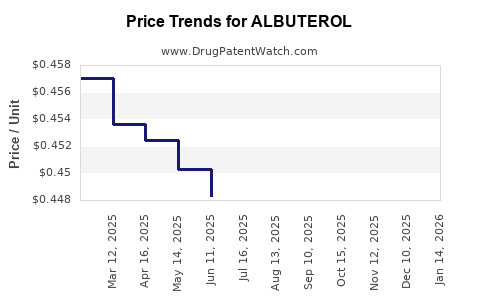
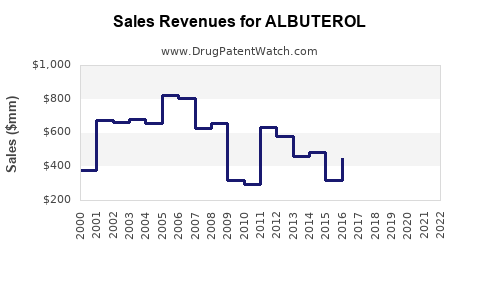
Albuterol has a mature, declining-to-stable financial profile rather than a conventional growth-drug trajectory.
Revenue drivers
The principal revenue drivers are:
- Prescription volume linked to asthma and COPD prevalence.
- Seasonal respiratory disease activity.
- Generic substitution rates.
- Inhaler reimbursement and formulary positioning.
- Institutional contracts and government purchasing.
- Product availability during shortages.
- Premium pricing for integrated digital inhalers or differentiated devices.
Demand is relatively resilient because albuterol is a standard rescue medicine. Volume can rise during severe allergy seasons, wildfire smoke events, respiratory-virus surges, and periods of poor air quality. Revenue does not necessarily rise in parallel because generic price competition can offset volume growth.
Margin pressure
Generic albuterol has experienced the same structural pressures affecting other mature respiratory medicines:
- Multiple abbreviated new drug applications compete for formulary access.
- Retailers and pharmacy benefit managers use preferred-product contracts.
- Manufacturers face pressure to lower list and net prices.
- Device components increase production costs.
- Regulatory controls and quality requirements make inhalers more expensive to manufacture than many oral generics.
- Contract manufacturing and component shortages can compress margins.
The highest-margin opportunities are generally differentiated products, authorized generics with controlled distribution, and device-enabled products. Standard albuterol sulfate inhalation solution is more exposed to commoditization.
Public-company exposure
| Company |
Relevant albuterol exposure |
Financial interpretation |
| GSK |
Ventolin HFA and other respiratory products |
Strategic brand and respiratory-channel exposure; standalone albuterol revenue is generally not disclosed |
| Teva |
ProAir franchise and generic albuterol products |
Exposure includes branded, authorized-generic, and generic respiratory products |
| Viatris |
Generic respiratory portfolio, including albuterol-related products |
Mature generic exposure with limited product-level public disclosure |
| Perrigo |
Consumer and generic respiratory products in selected markets |
Exposure varies by market and product rights |
| Catalent and other suppliers |
Inhalation manufacturing and device supply |
Indirect exposure through contract manufacturing and component demand |
Teva’s acquisition of Allergan’s generics business in 2016 added ProAir and other respiratory assets to Teva’s portfolio. [6] GSK continues to market Ventolin HFA in the United States. [1] Product-level profitability remains difficult to isolate because companies report broader portfolio results.
When did albuterol lose exclusivity?
The albuterol molecule lost exclusivity decades ago. The commercial history of the category is controlled by successive product and device approvals, not by a single surviving compound patent.
Important milestones include:
| Event |
Date |
Commercial effect |
| Early albuterol approvals |
1980s |
Established the active ingredient in asthma treatment |
| U.S. HFA inhaler transition |
1990s and early 2000s |
Created new formulation and device markets |
| ProAir HFA approval |
1996 |
Established a major U.S. rescue inhaler brand |
| Ventolin HFA U.S. approval |
1990s |
Established GSK’s HFA rescue-inhaler franchise |
| ProAir Digihaler approval |
2018 |
Added an electronic dose-counting and data-enabled device |
| Broad generic entry |
2010s onward |
Accelerated price and market-share pressure |
ProAir HFA was approved by the FDA in 1996. ProAir Digihaler was approved in 2018 as a digitally enabled albuterol inhaler. [2][7] The presence of later patents covering inhaler construction, dose counters, electronics, packaging, or manufacturing does not restore exclusivity to albuterol as an active ingredient.
What patents protect albuterol products?
Current patent value is concentrated in product-specific and device-specific claims.
Formulation patents
Formulation claims may cover:
- Propellant composition.
- Particle-size distribution.
- Suspension stability.
- Excipient selection.
- Canister coating.
- Valve performance.
- Dose uniformity.
- Low-emission or low-global-warming-propellant configurations.
Older HFA albuterol products were protected by patents and regulatory exclusivity associated with the specific inhaler product. Many of those protections have expired or are no longer commercially decisive. The remaining barrier is often manufacturing know-how and FDA approval of a reliable device-formulation combination.
Device patents
Device protection may cover:
- Actuator geometry.
- Metering valves.
- Dose counters.
- Electronic sensors.
- Bluetooth or wireless connectivity.
- Inhalation-triggered recording.
- User interfaces and software.
Device patents can delay direct substitution when a generic must reproduce the same functional product. They do not necessarily prevent a competitor from launching a different inhaler design under an ANDA or another FDA pathway if the regulatory requirements are satisfied.
Method-of-use patents
Method-of-use patents for albuterol have limited strategic value because the core indications are long established. Potential claims can address age groups, dosing schedules, administration techniques, or combination use, but broad rescue-treatment claims face substantial validity and obviousness pressure.
What is the Orange Book status of albuterol?
The FDA Orange Book identifies approved prescription products and associated patent or exclusivity information. For mature albuterol products, the practical status is generally:
- No remaining new-molecular-entity exclusivity.
- No meaningful active ingredient exclusivity.
- Product-specific patents may have expired or may have limited commercial effect.
- Generic inhaler approvals remain subject to FDA requirements for pharmaceutical equivalence, device performance, dose delivery, and labeling.
- Some product listings can remain commercially relevant even when patent barriers are weak because of manufacturing complexity and limited approved suppliers.
FDA’s Orange Book and Drugs@FDA databases should be used at the product level because “albuterol” is not a single listed product. Ventolin HFA, ProAir HFA, ProAir Digihaler, nebulizer solutions, and other products have separate regulatory records. [8][9]
Which companies are challenging albuterol brands with generics?
Competition comes from both traditional generic manufacturers and branded companies that launch authorized generics.
Key competitive groups include:
- Teva, through ProAir and generic respiratory products.
- Viatris and its legacy Mylan generic portfolio.
- Cipla and other international inhalation manufacturers.
- Perrigo and regional suppliers.
- Specialty respiratory manufacturers with metered-dose inhaler capabilities.
- Hospital and institutional suppliers of nebulizer solution.
The competitive landscape is less open than the molecule’s age might suggest. Generic inhalers require specialized development, device testing, extractables and leachables assessment, dose uniformity data, container-closure controls, and reliable high-volume manufacturing. These requirements limit the number of credible suppliers relative to oral tablets.
How many patents cover albuterol?
There is no commercially useful single count of “albuterol patents.” The number depends on the scope:
- Active ingredient patents: effectively zero meaningful U.S. exclusivity.
- Product patents: vary by brand, dosage form, and jurisdiction.
- Device patents: vary by actuator, valve, dose counter, and electronic functions.
- Manufacturing patents: may cover suspension processing, filling, propellant handling, or component assembly.
- International patent families: differ materially across the United States, Europe, Japan, China, and emerging markets.
A patent search must distinguish expired patents from live claims, continuation applications, terminal disclaimers, reissued claims, and patents that are not listed for FDA regulatory purposes. Patent family count alone is not a proxy for blocking strength.
What patent litigation affects albuterol?
Albuterol has not developed the sustained, high-value patent litigation profile associated with medicines such as insulin analogs, GLP-1 agonists, oncology biologics, or leading inhaled combination products.
Potential disputes focus on:
- Infringement of inhaler-device patents.
- Substitution between a branded inhaler and an ANDA product.
- Patent-listing disputes.
- Design-around strategies involving the actuator or dose counter.
- Manufacturing and supply agreements.
- Trade-secret claims involving device assembly or formulation processes.
Litigation risk is typically product-specific and lower in value than litigation involving a protected new chemical entity. Public litigation databases and FDA patent listings should be reviewed for each named brand and generic applicant because disputes can change with product withdrawals, settlements, or patent expiration.
Are there Paragraph IV challenges for albuterol?
Paragraph IV challenges remain possible for branded albuterol inhalers when a generic applicant certifies that listed patents are invalid, unenforceable, or not infringed. The commercial importance of a Paragraph IV filing depends on whether the brand has enforceable listed patents and whether the applicant qualifies for 180-day generic exclusivity.
For long-established albuterol products, the main issue is often not the active ingredient but the device and formulation. A Paragraph IV filing can create litigation even when the expected market value is modest. Generic applicants evaluate:
- Remaining patent term.
- Number of approved competitors.
- Expected price erosion.
- Complexity of the inhaler.
- Cost of clinical and device-equivalence development.
- Probability of a 30-month stay.
- Availability of alternative non-infringing designs.
What generic entry risks exist for albuterol brands?
Generic entry risk is high for conventional albuterol products.
| Risk factor |
Effect on branded product |
| Expired active-ingredient protection |
Removes the strongest exclusivity barrier |
| Multiple approved generics |
Increases price erosion |
| Pharmacy substitution |
Reduces brand retention |
| Formulary exclusion |
Limits branded prescriptions |
| Device complexity |
Slows entry but does not eliminate it |
| Supply disruption |
Can temporarily support brand or supplier pricing |
| Digital features |
May create differentiation but also add regulatory and cost burdens |
The most exposed products are conventional rescue inhalers with interchangeable generic alternatives. Products with digital monitoring, differentiated user interfaces, or specialized delivery systems may retain more pricing power, but clinical adoption and payer coverage determine whether those features generate durable revenue.
How does albuterol compare with competing rescue medicines?
| Medicine |
Class |
Market position |
Patent and financial profile |
| Albuterol |
Short-acting beta2 agonist |
Dominant standard rescue medicine |
Highly genericized and price-sensitive |
| Levalbuterol |
R-enantiomer of albuterol |
Smaller niche market |
Limited differentiation; generic competition |
| Terbutaline |
Beta2 agonist |
Limited use in some markets |
Mature and less commercially significant |
| Ipratropium |
Anticholinergic bronchodilator |
Often used in COPD or combination therapy |
Genericized, with different clinical positioning |
| Albuterol/ipratropium |
Combination bronchodilator |
Important in COPD |
More complex formulation and device competition |
| Inhaled corticosteroids |
Controller therapy |
Not a direct rescue substitute |
Larger value in chronic disease management |
Levalbuterol can command a premium in selected settings, but its clinical and commercial differentiation from racemic albuterol is limited. Combination products may have stronger commercial value because they address broader COPD treatment needs, but they face their own patent and generic-entry cycles.
What licensing deals affect albuterol?
Albuterol licensing is generally less visible than licensing for novel medicines. Commercial arrangements commonly involve:
- Brand rights by geographic territory.
- Authorized-generic supply agreements.
- Contract manufacturing.
- Inhaler-device technology licenses.
- Electronic dose-counter or connectivity partnerships.
- Government and institutional procurement contracts.
The most important economic rights often sit in supply and distribution agreements rather than in headline discovery licenses. Royalty and milestone disclosures are limited because albuterol products are mature and transactions may be embedded in broader respiratory portfolios.
What is the FDA regulatory status of albuterol?
Albuterol is FDA approved in multiple prescription dosage forms. FDA-approved products include metered-dose inhalers and nebulizer solutions. The regulatory burden differs by dosage form:
- An MDI requires demonstration of dose delivery, aerodynamic performance, device function, and pharmaceutical equivalence.
- A nebulizer solution requires control of concentration, sterility or microbiological quality, container closure, and delivered dose.
- A digital inhaler adds electronic hardware, software, cybersecurity, data integrity, and human-factors considerations.
- A generic product must meet FDA requirements under the ANDA pathway and demonstrate equivalence to the reference product.
The FDA has also treated albuterol inhalers as part of the broader transition toward lower-impact propellants. Propellant changes can create both regulatory costs and future product-development opportunities. [10]
What manufacturing and intellectual-property barriers remain?
The principal barriers are operational rather than molecule-based.
Manufacturing barriers
Manufacturers need:
- Specialized filling lines.
- Metering-valve and actuator supply.
- Controlled propellant handling.
- High-speed assembly and leak testing.
- Device-performance laboratories.
- Validated dose-uniformity testing.
- Regulatory experience with inhalation products.
Shortages can arise when one component supplier, filling facility, or contract manufacturer experiences a quality or capacity problem. Inhaler supply is therefore more vulnerable to manufacturing concentration than many oral generic categories.
Intellectual-property barriers
Remaining IP may cover the complete product combination rather than albuterol itself. A competitor can avoid a blocking patent by modifying the actuator, valve, formulation, electronic system, or manufacturing process, but each design-around can require new development and regulatory work.
What generic launch scenarios are most likely?
Base case
The base case is continued generic dominance, gradual price erosion, stable demand, and limited revenue growth. Brand products retain share in selected formularies and patient populations but do not control the category.
Upside case for manufacturers
Manufacturers can improve results through:
- Capturing supply during shortages.
- Winning large payer or government contracts.
- Launching an authorized generic.
- Improving production yields.
- Offering lower-cost or lower-emission inhalers.
- Expanding in emerging markets where branded substitution is less complete.
Downside case
Downside risks include:
- Aggressive additional generic entry.
- Price compression from pharmacy benefit managers.
- Loss of preferred formulary status.
- Device-component shortages.
- FDA manufacturing observations or recalls.
- Reduced use of rescue medication through improved controller therapy and disease management.
What is the geographic coverage of albuterol markets?
Albuterol is sold globally, usually as salbutamol. Regulatory and commercial conditions differ by region:
- The United States has high generic penetration but strict inhaler-equivalence requirements.
- Europe has fragmented national reimbursement and tender systems.
- Emerging markets often have greater branded-generic competition and wider price dispersion.
- China and India have substantial local manufacturing capacity and export activity.
- Public procurement can dominate hospital and institutional sales in many countries.
Global revenue potential is therefore tied to distribution rights, local registration, manufacturing economics, and reimbursement rather than to U.S. patent exclusivity.
Key Takeaways
- Albuterol is a mature, highly genericized respiratory medicine.
- The active ingredient has no meaningful remaining U.S. exclusivity.
- Commercial protection centers on inhaler devices, formulations, dose counters, manufacturing processes, and supply agreements.
- Conventional albuterol products face high generic-entry and price-erosion risk.
- Public companies generally do not disclose standalone albuterol revenue.
- Revenue is stable to declining in mature markets, with temporary volume gains during respiratory-disease surges and supply disruptions.
- Manufacturing capability is a more important barrier than compound patent protection.
- Digital inhalers and lower-impact propellants offer differentiation, but their financial value depends on payer coverage and patient adoption.
- Generic launch risk is highest for standard MDIs and nebulizer solutions with multiple approved competitors.
- The strongest commercial opportunities are in reliable supply, specialized device platforms, institutional contracts, and differentiated respiratory delivery systems.
FAQs
Is albuterol still patent protected?
The albuterol molecule is not meaningfully patent protected in the United States. Certain branded inhalers, devices, formulations, and manufacturing processes may have had or may still have product-specific patent rights.
Is Ventolin HFA exclusive?
Ventolin HFA is not protected by new-molecular-entity exclusivity. Its commercial position depends on brand recognition, formulary access, manufacturing reliability, and the availability and substitutability of competing inhalers.
Does albuterol have biosimilar competition?
No. Albuterol is a chemically synthesized small molecule, not a biologic. Competition proceeds through generic-drug pathways rather than the biosimilar pathway.
Why are albuterol inhalers harder to genericize than tablets?
An inhaler combines the active ingredient with a metering valve, actuator, canister, propellant, and aerosol-performance requirements. A generic must demonstrate consistent delivered dose and device performance, not only chemical sameness.
Can albuterol revenue grow despite generic competition?
Yes, but growth is more likely to come from volume, supply shortages, international expansion, institutional contracts, differentiated devices, or product mix than from price increases.
References
- GSK. (n.d.). Ventolin HFA prescribing information. U.S. Food and Drug Administration. https://www.accessdata.fda.gov
- U.S. Food and Drug Administration. (1996). ProAir HFA albuterol sulfate inhalation aerosol approval information. Drugs@FDA. https://www.accessdata.fda.gov/scripts/cder/daf/
- GSK plc. (2024). Annual report 2023. https://www.gsk.com/en-gb/investors/annual-report/
- Teva Pharmaceutical Industries Ltd. (2024). Annual report 2023. https://ir.tevapharm.com/financial-information/annual-reports
- Viatris Inc. (2024). Annual report 2023. https://investor.viatris.com/financial-information/annual-reports
- Teva Pharmaceutical Industries Ltd. (2016). Teva completes acquisition of Allergan generics business. https://www.teva.com/news-and-media/press-releases/
- U.S. Food and Drug Administration. (2018). ProAir Digihaler approval information. Drugs@FDA. https://www.accessdata.fda.gov/scripts/cder/daf/
- U.S. Food and Drug Administration. (2024). Approved drug products with therapeutic equivalence evaluations, Orange Book. https://www.fda.gov/drugs/drug-approvals-and-databases/approved-drug-products-therapeutic-equivalence-evaluations-orange-book
- U.S. Food and Drug Administration. (2024). Drugs@FDA database. https://www.accessdata.fda.gov/scripts/cder/daf/
- U.S. Food and Drug Administration. (2023). Guidance and regulatory information for metered-dose inhalers and propellant transition. https://www.fda.gov/drugs/industrial-guidance-compliance-and-regulatory-information