Last updated: August 9, 2026
Adrenalin is a branded epinephrine injection product used primarily in hospitals and emergency settings. Its commercial outlook is determined by supply reliability, hospital contracting, generic injectable competition, and procurement pricing rather than by patent exclusivity. Product-level revenue is not publicly disclosed, so the financial trajectory must be assessed through market structure, parent-company disclosures, FDA supply data, and the economics of injectable epinephrine.
What is Adrenalin and who markets it?
Adrenalin is epinephrine injection, USP, a sterile injectable formulation used to treat anaphylaxis and other acute cardiovascular and respiratory emergencies. The product is associated with Par Pharmaceutical, a business historically owned by Endo International. Par’s U.S. portfolio includes hospital products and specialty pharmaceuticals.
| Attribute |
Adrenalin |
| Active ingredient |
Epinephrine |
| Dosage form |
Injectable solution |
| Common concentration |
1 mg/mL, equivalent to 1:1,000 |
| Primary customers |
Hospitals, emergency departments, ambulances, clinics and institutional pharmacies |
| Product category |
Branded hospital injectable |
| FDA pathway |
New drug application product |
| Principal commercial issue |
Supply continuity and contract access |
| Major substitute products |
Generic epinephrine injection, prefilled syringes, autoinjectors and alternative suppliers |
| Biosimilar exposure |
None |
| Standalone revenue disclosure |
Not publicly reported |
Adrenalin should not be confused with EpiPen, Auvi-Q or other epinephrine autoinjectors. Those products address community and outpatient emergency use, while Adrenalin competes mainly in institutional injectable procurement.
How large is the epinephrine injection market?
The U.S. epinephrine market is fragmented across several delivery systems. Hospital epinephrine injection is a mature, low-cost segment, while autoinjectors generate greater revenue per treatment unit because of device complexity, branding and recurring prescriptions.
U.S. epinephrine market segments
| Segment |
Typical users |
Competitive structure |
Relative pricing |
| Epinephrine injection vials |
Hospitals and clinics |
Generic-heavy |
Low |
| Prefilled epinephrine syringes |
Hospitals, emergency services |
Limited supplier base |
Moderate to high |
| Epinephrine autoinjectors |
Patients, schools, emergency responders |
Branded and authorized-generic competition |
High |
| Epinephrine ampules |
Hospitals and pharmacies |
Generic |
Low |
| Specialty delivery systems |
Selected emergency and procedural uses |
Product-specific |
Variable |
Adrenalin’s addressable market is narrower than the total epinephrine market. Demand is relatively stable because epinephrine is an essential emergency medicine, but volume growth is limited. Revenue depends more on price, supply allocation and contract wins than on underlying disease expansion.
What drives Adrenalin market dynamics?
Hospital purchasing and group purchasing organizations
Hospitals typically buy injectable epinephrine through group purchasing organizations, regional systems and distributor contracts. Buyers emphasize:
- Product availability
- FDA compliance
- Shortage resilience
- Shelf life
- Unit-dose convenience
- Recall history
- Contract pricing
- Supplier diversification
A branded product can retain institutional business when it offers dependable supply or a differentiated package configuration. That advantage is difficult to sustain when hospitals can substitute an FDA-approved generic vial with the same active ingredient and concentration.
Drug shortages and supply reliability
Epinephrine injections have experienced periodic supply disruptions involving manufacturing constraints, demand changes, packaging limitations and competing supplier outages. The FDA’s drug-shortage database identifies supply conditions by product and manufacturer rather than by commercial brand alone.[1]
Shortages can temporarily improve pricing and order volumes for an available supplier. The effect is usually temporary because hospitals and distributors seek alternative approved products, and additional manufacturers may enter or restore supply.
Formulation and presentation
Adrenalin’s value is tied to its presentation as an injectable product. The formulation itself is mature and difficult to differentiate clinically. Commercial differentiation can arise from:
- Single-dose vial configuration
- Concentration labeling
- Carton and syringe compatibility
- Storage requirements
- Packaging that reduces medication errors
- Institutional distribution
- Availability during shortage periods
These attributes may support procurement preference but generally do not create durable pricing power comparable to a patented formulation or delivery device.
What is Adrenalin’s financial trajectory?
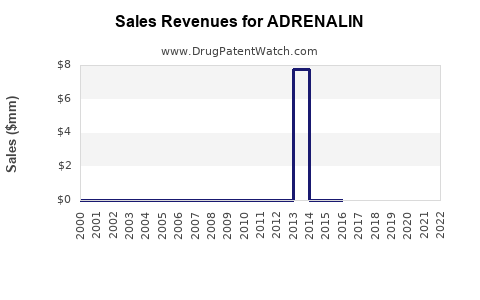
Adrenalin’s standalone sales and profit are not publicly reported. Endo’s public filings report broader business segments and product categories, not a separate Adrenalin income statement. The product’s financial trajectory is therefore best characterized as mature, volume-stable and price-sensitive.
Financial outlook by driver
| Financial driver |
Likely impact on Adrenalin |
| Unit demand |
Stable, with modest institutional growth |
| Average selling price |
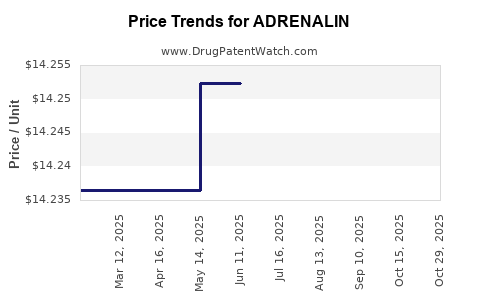
Downward pressure from generic substitution |
| Gross margin |
Vulnerable to hospital-contract pricing and manufacturing costs |
| Revenue during shortages |
Potential short-term increase |
| Long-term revenue |
Likely flat to declining without supply or presentation differentiation |
| Commercial investment |
Limited relative to high-growth specialty products |
| Patent-driven revenue protection |
Minimal |
| Cash-flow profile |
Potentially steady but low-growth if manufacturing remains reliable |
The product can generate recurring revenue because epinephrine is medically essential and hospitals maintain baseline inventory. That does not translate into high growth. Mature injectable products often have low unit prices, limited marketing requirements and thin margins after distributor discounts, manufacturing expenses and contract rebates.
Parent-company context
Endo International’s financial distress materially affected the strategic context for Par products. Endo filed for Chapter 11 protection in 2022 and completed its restructuring in 2024, emerging as a private company under new ownership.[2] Public restructuring materials do not provide a separate Adrenalin valuation or product-level revenue forecast.
The restructuring increases the importance of portfolio-level cash generation. A mature hospital injectable can be valuable as a recurring revenue asset even without strong growth, particularly if it has established regulatory approvals, distribution access and manufacturing infrastructure. Its strategic value is more likely to come from dependable cash contribution than from a premium acquisition multiple based on intellectual property.
When does Adrenalin lose exclusivity?
Adrenalin has little practical exclusivity protection because epinephrine is an old small-molecule active ingredient with longstanding generic availability. The principal competitive threat is therefore generic substitution, not a future patent cliff.
Patent and exclusivity profile
| Protection category |
Adrenalin position |
| Active-ingredient patent |
Expired or unavailable for practical commercial protection |
| Core formulation patent |
No significant publicly established blocking estate |
| Method-of-use patent |
Unlikely to provide meaningful market protection |
| Pediatric exclusivity |
Not a material commercial factor |
| New chemical entity exclusivity |
Not applicable to epinephrine |
| Biologic exclusivity |
Not applicable |
| Generic entry risk |
Persistent and established |
| Patent-cliff event |
No identifiable high-value future cliff |
FDA product labeling identifies the approved use and formulation, but labeling does not establish durable market exclusivity.[3] Any packaging, manufacturing or formulation patents would need to be evaluated individually for enforceability and claim scope. They would not normally prevent substitution with a standard epinephrine injection product.
What is the Orange Book status of Adrenalin?
Adrenalin is regulated as a small-molecule prescription drug. The relevant regulatory question is whether an approved generic can rely on the reference product through an abbreviated new drug application and whether the reference product has listed patents or exclusivity that delay approval.
For a mature epinephrine injection product, the Orange Book is more relevant to regulatory reference-product status than to commercial protection. Generic manufacturers can generally compete through abbreviated approval pathways when they satisfy requirements for active ingredient, strength, dosage form, route of administration, labeling and quality.
No meaningful Orange Book patent barrier is publicly associated with epinephrine’s active ingredient. Any product-specific listing would require review of the current FDA Orange Book entry and applicable supplement history.[4]
Which companies compete with Adrenalin?
Adrenalin competes against generic epinephrine injection suppliers rather than against one dominant branded rival. The competitive field has included large generic manufacturers, hospital-supply companies and specialty injectable producers.
Potential competitors include products supplied by:
- Pfizer or Hospira
- Hikma Pharmaceuticals
- Fresenius Kabi
- Teva Pharmaceuticals
- Sandoz
- Amphastar
- Other FDA-approved injectable manufacturers
The precise supplier set varies by concentration, vial size, presentation, shortage status and hospital contract. Institutional buyers can qualify several suppliers, which limits the ability of any single brand to raise price sustainably.
Adrenalin versus EpiPen and Auvi-Q
| Metric |
Adrenalin |
EpiPen/Auvi-Q |
| Delivery system |
Vial or institutional injectable format |
Autoinjector |
| Main market |
Hospitals and emergency services |
Retail, outpatient and community use |
| Prescription pattern |
Institutional purchasing |
Patient-specific prescriptions |
| Price sensitivity |
High at contract level |
Historically lower at list-price level |
| Patent relevance |
Limited |
Device and formulation claims may matter more |
| Brand differentiation |
Supply and packaging |
Device design, usability and patient access |
| Growth profile |
Mature |
Dependent on diagnosis, access and device adoption |
The products treat the same emergency condition but do not compete on identical purchasing criteria.
What generic launch risks exist for Adrenalin?
Generic launch risk is already embedded in Adrenalin’s market. The relevant risk is continued erosion of branded share and price, not a discrete future launch date.
Main generic risks
- Therapeutic substitution: Hospitals can use an approved generic with the same active ingredient and concentration.
- Contract displacement: A distributor or group purchasing organization can move volume to a lower-priced supplier.
- Shortage normalization: A temporary supply advantage disappears once competing suppliers restore inventory.
- Private-label competition: Distributors may market equivalent products under institutional or private-label arrangements.
- Margin compression: Even stable unit volume can produce lower revenue if contract prices decline.
The principal defense is operational. Reliable production, validated suppliers, sufficient inventory and strong distribution can preserve share even when patent protection is absent.
What formulation patents protect Adrenalin?
No major publicly established patent estate is known to protect the core epinephrine injection formulation in a manner comparable to a modern specialty drug. Epinephrine injection is a conventional sterile solution with a long regulatory history.
Possible intellectual-property areas include:
- Container-closure systems
- Syringe or vial packaging
- Stability improvements
- Manufacturing processes
- Labeling and medication-error reduction
- Combination emergency kits
These rights would generally have narrower commercial effect than an active-ingredient patent. A packaging or manufacturing patent may affect a specific product configuration while leaving generic vial products free to compete.
What method-of-use patents apply to Adrenalin?
Epinephrine has broad, long-established emergency uses, including treatment of anaphylaxis and selected cardiovascular conditions. Those uses are well known and are unlikely to provide meaningful exclusivity for a conventional injection product.
A method-of-use patent could theoretically cover a narrow dosing protocol, patient population or administration setting. Such a patent would have limited value if hospitals can lawfully purchase and administer generic epinephrine under established clinical practice and approved labeling.
What patent litigation and Paragraph IV challenges affect Adrenalin?
No major, publicly prominent patent litigation involving Adrenalin is identified as a central market event through the publicly available record. Paragraph IV challenges are also unlikely to be the primary commercial issue because the product competes in a mature generic market with little apparent patent protection.
The principal legal risks are more likely to involve:
- FDA manufacturing compliance
- Product quality
- Recalls
- Contract disputes
- Distribution arrangements
- Pricing and procurement terms
- Patent disputes involving a specific delivery device or packaging format
A Paragraph IV filing would matter only if a listed patent created a meaningful approval delay. For conventional epinephrine injection, that scenario appears less commercially important than supplier economics and shortage conditions.
What FDA regulatory issues affect Adrenalin?
FDA regulation is central to Adrenalin’s performance because injectable products face strict quality and manufacturing requirements. Key regulatory issues include:
- Sterility assurance
- Particulate control
- Potency and concentration accuracy
- Container-closure integrity
- Labeling clarity
- Manufacturing-site compliance
- Stability and expiration dating
- Recall risk
- Supply reporting during shortages
An FDA warning letter, import alert, manufacturing interruption or recall could quickly shift institutional demand to competitors. Conversely, a clean compliance record and reliable availability can support retention even without patent protection.
The FDA’s Drug Shortages database and product-specific safety communications are the most relevant public sources for monitoring supply risk.[1]
How strong is the Adrenalin patent estate?
Adrenalin’s patent estate is weak as a source of commercial exclusivity. Its defensibility rests on operating assets rather than intellectual property.
| Defense category |
Assessment |
| Active-ingredient protection |
Weak or absent |
| Formulation protection |
Limited |
| Delivery-device protection |
Limited for conventional vial products |
| Regulatory exclusivity |
Not a major factor |
| Manufacturing know-how |
Potentially meaningful |
| Supply reliability |
Commercially important |
| Hospital contracts |
Important but reversible |
| Brand recognition |
Moderate in institutional settings |
| Overall patent strength |
Low |
| Overall operating defensibility |
Moderate if supply is reliable |
The product can remain commercially viable without strong patents because hospitals need epinephrine continuously. Its economic durability depends on cost control, quality performance and access to procurement channels.
What licensing deals affect Adrenalin?
No major publicly disclosed Adrenalin-specific licensing transaction is a recognized driver of the product’s economics. The product’s commercial history is more closely linked to Par Pharmaceutical and Endo’s broader portfolio transactions than to a standalone license involving epinephrine injection.
Any future licensing or divestiture would likely be evaluated on:
- FDA approval status
- Manufacturing ownership
- Supply obligations
- Hospital contracts
- Shortage history
- Gross-to-net pricing
- Product liability exposure
- Remaining regulatory commitments
Because standalone revenue is not disclosed, a transaction valuation would likely rely on diligence-level sales data rather than public financial statements.
What generic launch scenarios exist for Adrenalin?
Base case
Adrenalin maintains a stable institutional presence but experiences gradual price erosion. Generic suppliers retain most volume, and the product remains a cash-generating mature asset.
Upside case
A competitor experiences a prolonged shortage, recall or manufacturing interruption. Adrenalin captures temporary volume and may improve utilization among hospital customers. The effect fades when supply normalizes.
Downside case
A lower-cost supplier secures a national group purchasing contract, or Adrenalin faces manufacturing disruption. Volume and price decline at the same time, reducing product contribution.
Strategic case
The owner retains the product as part of a hospital portfolio, using shared distribution and manufacturing infrastructure to preserve margins. Adrenalin is managed for cash flow rather than growth.
How does Adrenalin compare with other epinephrine products?
Adrenalin is less exposed to patient-level brand loyalty than autoinjectors. Hospital pharmacists can substitute products more readily, subject to purchasing protocols and clinical equivalence. Its commercial advantages are operational rather than consumer-facing.
Compared with autoinjectors, Adrenalin has:
- Lower revenue per unit
- Higher procurement sensitivity
- Lower marketing requirements
- Greater exposure to hospital contracts
- Less meaningful patent protection
- More direct substitution by generic vials
- Greater dependence on sterile manufacturing performance
Key Takeaways
- Adrenalin is a mature branded epinephrine injection product focused on institutional healthcare.
- Standalone sales and profitability are not publicly disclosed.
- The product has limited patent-based exclusivity and faces ongoing generic competition.
- Its financial trajectory is likely stable to declining under normal supply conditions, with temporary upside during competitor shortages.
- Hospital contracts, distributor access, manufacturing reliability and FDA compliance are more important than patent rights.
- Adrenalin is not exposed to biosimilar competition because epinephrine is a small molecule.
- Endo’s 2022 bankruptcy and 2024 restructuring changed the portfolio context but did not create a publicly reported Adrenalin-specific valuation.
- The principal commercial risk is generic price erosion or supply disruption, not a future patent expiration event.
FAQs About Adrenalin Market and Financial Outlook
Is Adrenalin the same product as EpiPen?
No. Adrenalin is an institutional epinephrine injection product, generally supplied in vial or comparable medical-use formats. EpiPen is an epinephrine autoinjector designed for patient and community use.
Does Adrenalin have biosimilar competition?
No. Biosimilars apply to biologic products. Epinephrine is a small-molecule drug and competes with generic injectable products.
Can hospitals substitute generic epinephrine for Adrenalin?
Generally, hospitals can use FDA-approved generic epinephrine products that match the required active ingredient, concentration, dosage form and route of administration, subject to institutional policies and procurement rules.
Is Adrenalin a high-growth pharmaceutical product?
No. It is a mature emergency injectable. Revenue growth is more likely to come from temporary shortage-related volume or price changes than from expanding clinical demand.
What would increase Adrenalin’s commercial value?
Higher value would likely require dependable supply, a differentiated presentation, favorable hospital contracts, manufacturing cost advantages or a broader portfolio transaction. A new patent alone would have limited value unless it covered a commercially important delivery or formulation improvement.
References
- U.S. Food and Drug Administration. (n.d.). Drug shortages. https://www.fda.gov/drugs/drug-safety-and-availability/drug-shortages
- Endo International plc. (2024). Annual report and restructuring disclosures. https://www.endo.com
- U.S. Food and Drug Administration. (n.d.). Adrenalin: Epinephrine injection, USP prescribing information. https://www.accessdata.fda.gov
- U.S. Food and Drug Administration. (n.d.). Approved drug products with therapeutic equivalence evaluations. https://www.fda.gov/drugs/drug-approvals-and-databases/orange-book-data-files