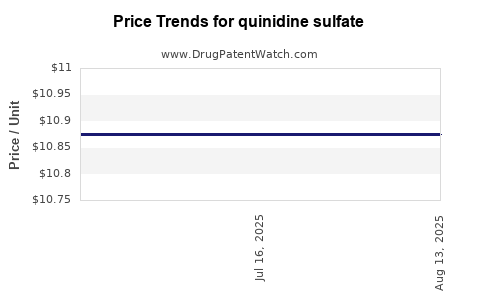
Last updated: July 29, 2026
Quinidine sulfate is a legacy antiarrhythmic with limited brand-style monopoly economics. The market is dominated by generics and procurement-driven contracting, with recurring substitution and price pressure risk typical of off-patent small-molecule cardiovascular products. Financial trajectory is shaped less by patent-protected innovation and more by (1) FDA availability and supply continuity, (2) wholesale acquisition cost compression, (3) payer and hospital formularies, and (4) competitive dynamics among generic manufacturers. This profile also implies that upside is constrained unless there is a reformulation, supply stabilization deal, or a credible strategy that shifts utilization (new indications, guideline repositioning, or differentiated bioavailability and compliance tooling).
What is the current market size and demand drivers for quinidine sulfate?
Quinidine sulfate demand is tethered to arrhythmia epidemiology and guideline-driven use, with prescribing heavily influenced by safety monitoring and comparative effectiveness versus alternatives (other antiarrhythmics and rate/rhythm-control strategies). The product’s commercial base typically behaves like a mature, low-growth cardiovascular generic:
- Hospital and specialty cardiology procurement: Use concentrates where formularies include multiple generic equivalents.
- Switching velocity: Low differentiation supports rapid substitution, especially after any supply disruptions resolve.
- Channel dynamics: Procurement tends to favor lowest-cost sources meeting quality and supply requirements.
- Clinical friction: Therapeutic drug monitoring, QT-risk management, and practical dosing constraints can limit uptake even when price is low.
Which patient populations drive use of quinidine sulfate?
Demand is primarily tied to:
- Rhythm disorders where quinidine has a role (historically including atrial arrhythmias and certain supraventricular/ventricular rhythm contexts, depending on evolving clinical guidance).
- Lines of therapy influenced by comorbidity and toxicity risk.
How does utilization differ across settings?
- Inpatient cardiology: More sensitive to formulary availability and supply stability.
- Outpatient long-term: More price-sensitive with tighter switching constraints only around tolerability and continuity.
How do pricing and reimbursement dynamics move for generic quinidine sulfate?
For off-patent generics, the dominant financial variable is price erosion and volume elasticity. Quinidine sulfate pricing trajectories typically follow a pattern: sharp early erosion after generic entry, then a slower decline tied to competitive sourcing, raw-material and manufacturing cost changes, and sporadic supply constraints.
What drives wholesale acquisition cost compression?
- Multiple ANDA suppliers: Intensifies downward pressure as contracted pricing competes.
- State and federal purchasing programs: Encourage competitive bidding.
- Payer policies: Prefer lowest-cost therapeutically equivalent options.
What happens to margins when supply tightens?
When manufacturing constraints reduce availability:
- Short-term price spikes can occur through limited supply.
- Contracts and rebates may dampen realized margin increases, depending on payer contracting.
- Once additional supply returns, prices usually revert quickly.
Which companies manufacture and compete in quinidine sulfate generics?
Competitive dynamics for quinidine sulfate depend on which ANDA holders are actively marketing, their lot-release reliability, and whether they maintain inventory through cyclical capacity disruptions.
How to evaluate competitive intensity
A practical lens for commercial planning:
- Number of marketed ANDAs
- Manufacturing site continuity
- FDA quality indicators and supply stability
- Contracting penetration by wholesalers and group purchasing organizations
What is the patent and exclusivity landscape for quinidine sulfate?
Quinidine sulfate is a long-established small molecule. From a market-entry and financial trajectory standpoint, the product’s economics are largely determined by whether any still-active exclusivities exist for a specific dosage form, strength, or listed product in FDA systems. For legacy molecules, patent-driven commercial protection is often minimal compared with generic competition.
How do patents usually show up for older drugs like quinidine sulfate?
Even when the base compound is old, patents may still exist for:
- Specific formulations (e.g., immediate-release versus extended-release or different salt forms, though quinidine sulfate is itself a salt)
- Manufacturing processes
- Method-of-use (which can exist long after the compound’s core chemistry patents lapse, though success depends on enforceability and FDA listing)
What is the Orange Book status of quinidine sulfate?
Orange Book status must be checked per specific label (manufacturer, dosage form, strength). Market decisions for generic entry hinge on which patents and exclusivities are actually listed for the exact marketed product.
When does quinidine sulfate lose exclusivity and enable generic entry risks?
For a legacy drug, the risk for new entrants is not “patent life” so much as:
- Whether any still-active Orange Book-listed patents cover the specific dosage form/strength
- Whether any exclusivity periods still apply to a later-filed application (rare for a fully legacy product, but possible for specific line extensions)
Paragraph IV challenges: what to expect
For drugs already widely generic, Paragraph IV activity can remain sporadic:
- New ANDA applicants may target unprotected bottlenecks (a missing marketed strength, a formulation with narrower competition, or an alternative labeled indication that has exclusivity/patents).
- Hatch-Waxman settlement dynamics can impact short-term supply and price.
What formulations are protected for quinidine sulfate?
Commercial differentiation is limited when multiple generic equivalents are available. If any proprietary product exists, it typically comes from:
- Different release characteristics (if applicable for quinidine products)
- Specific excipient systems that claim bioavailability or stability advantages
- Packaging and manufacturing controls that affect shelf life and reliability of supply
How formulation patents affect pricing
When a branded or quasi-unique formulation exists behind listed patents:
- Generic entry timing can be delayed for that specific product
- Competition remains thinner, supporting higher pricing until expiry
When no formulation moat exists:
- Pricing rapidly converges to low-cost generic benchmarks.
What patent litigation affects quinidine sulfate commercialization?
Legacy small molecules can still see litigation, but the financial relevance depends on:
- Whether litigation blocks a major supplier
- Whether settlement terms carve out market timing or launch design
- Whether injunctions or design-around strategies are implemented successfully
How litigation translates into market outcomes
Key outcomes that show up in financials:
- Delayed generic availability can stabilize pricing temporarily.
- Post-settlement entry timing can trigger stepwise reductions in contract pricing.
- Supply constraints can create temporary gross margin lift for available suppliers.
What is the FDA regulatory status and market authorization footing for quinidine sulfate?
Quinidine sulfate is typically regulated under ANDA/OTC? and prescription labeling frameworks. The market’s operational trajectory hinges on whether:
- Multiple ANDAs remain “active” with consistent distribution
- Recalls or stability issues disrupt supply
- Product availability affects hospital stocking behavior
What FDA milestones matter most commercially
For procurement-driven drugs, the highest-impact regulatory events are:
- Approval of additional ANDAs for competing strengths
- Withdrawal or discontinuation events for specific NDCs
- Quality issues tied to manufacturing sites affecting release schedules
How does quinidine sulfate compare with other antiarrhythmics in market economics?
Quinidine competes indirectly with:
- Other rhythm-control agents
- Alternative management pathways (rate control, ablation strategies)
Even if quinidine is still used, its financial trajectory depends on whether the therapeutic community reduces use in favor of drugs and procedures with better tolerability profiles or easier monitoring.
What economic effect does guideline positioning have?
When a drug’s role shrinks:
- Utilization declines first
- Then procurement volume becomes less stable
- Contract pricing becomes more competitive as buyers reduce inventory risk
What generic entry risks exist for quinidine sulfate?
Given the typical structure of legacy generics, entry risk is usually “supply and compliance risk” rather than “legal risk.” For a new applicant, the critical risks are:
- Regulatory approval timing (pre- and post-approval controls)
- Facility readiness and lot release consistency
- Market access via wholesaler stocking and hospital contracting
- Potential niche protection if any Orange Book-listed patents or exclusivities cover a specific NDC
What scenario triggers meaningful financial upside?
Upside usually comes from one of the following:
- Securing a contract as a preferred supplier due to consistent supply
- Replacing a withdrawn competitor product at scale
- Capturing an opportunity where a small number of suppliers dominate a strength or NDC
Absent these, financial trajectories tend to be linear with market erosion.
Revenue and profit trajectory: how to model quinidine sulfate financially
Because quinidine sulfate behaves like an established generic, a workable model uses:
- Net sales = contracted volume × realized price
- Realized price = WAC minus rebates/discounts + contract mix
- COGS = API and excipient input costs + manufacturing yield + freight
- Gross margin = realized price minus COGS
- Operating leverage = limited, since demand is relatively stable and competitive
Key financial indicators to track
- Number of active NDCs and manufacturers
- Market share shifts by supplier
- Wholesale and hospital contract pricing trends
- Inventory days and allocation events during supply tightness
- Recall and complaint rates impacting release and distribution
Key takeaways
- Quinidine sulfate’s financial trajectory is primarily driven by generic market forces: contracting, price compression, and supply continuity.
- Patent and exclusivity impact is usually secondary for legacy products, but it can still matter for specific NDCs or dosage forms if Orange Book listings remain active.
- Litigation and Paragraph IV events can temporarily change supply and pricing but typically do not sustain long-term premium economics for off-patent cardiovascular generics.
- The highest-leverage commercial risks and opportunities are supply reliability and contracting penetration among the limited set of reliably marketed suppliers.
FAQs
1) What NDC-level factors most affect quinidine sulfate revenue stability?
Active marketing status, strength-specific availability, and lot release consistency that supports hospital formulary stocking.
2) How do supply disruptions change quinidine sulfate pricing and margins?
Reduced available inventory can cause short-term price increases, but realized margins depend on contract terms and buyer purchasing behavior.
3) What does Paragraph IV timing mean for quinidine sulfate market entry?
Where still-listed patents exist for a specific NDC, Paragraph IV can drive entry timing, settlement-related delays, and stepwise pricing changes.
4) Do formulation changes create lasting differentiation for quinidine sulfate?
Usually only if tied to Orange Book-listed formulation patents or exclusivities at the NDC level; otherwise therapeutic equivalence drives rapid substitution.
5) What competitive strategy works best for quinidine sulfate distributors or manufacturers?
Consistency of supply and contracting as a preferred source to prevent stock-outs and capture share when competitors withdraw or under-fulfill.
References
- FDA. Orange Book: Approved Drug Products with Therapeutic Equivalence Evaluations. United States Food and Drug Administration.
- FDA. Drug Approvals and Databases: Drugs@FDA. United States Food and Drug Administration.