Last updated: August 16, 2026
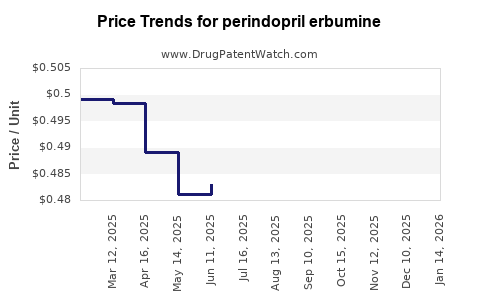
Perindopril erbumine is a mature, off-patent ACE inhibitor with broad generic availability and limited standalone financial disclosure. The commercial market is driven by hypertension and cardiovascular risk management, but pricing is constrained by long-established generic competition. Originator economics declined materially after loss of exclusivity, while demand remains relatively stable because treatment is chronic, inexpensive, and embedded in clinical practice.
What is the current market position of perindopril erbumine?
Perindopril erbumine is the erbumine salt of perindopril, an angiotensin-converting enzyme inhibitor. It is administered as a prodrug and converted to the active metabolite perindoprilat. Its main use is blood-pressure reduction; some markets also use perindopril products in cardiovascular risk reduction and coronary artery disease management.
The market has four defining characteristics:
| Factor |
Market effect |
| Chronic cardiovascular use |
Supports recurring prescription volume |
| Generic status |
Keeps prices low and limits brand margins |
| Multiple salt and formulation variants |
Creates regional product differences |
| Established therapeutic alternatives |
Limits pricing power and market expansion |
Perindopril is commonly marketed as perindopril erbumine in some countries and as perindopril arginine in others. The two products deliver the same active moiety but are not interchangeable solely on the basis of salt form, strength labeling, or tablet composition.
The original branded product was Aceon in the United States and Coversyl in several international markets. Servier developed and commercialized Coversyl outside the United States. The United States market has had generic perindopril erbumine products, while the commercial importance of the original brand has diminished substantially.
How large is the perindopril erbumine market?
No major manufacturer publicly reports global revenue for perindopril erbumine as a standalone product. Public company filings generally include the product within broader cardiovascular or mature-brand categories. Precise market-size estimates therefore depend on commercial databases such as IQVIA, which are not generally disclosed in public filings.
The defensible market assessment is qualitative:
- Volume is supported by long-term treatment of hypertension.
- Revenue per prescription is low in markets with several generic suppliers.
- Growth is likely to track diagnosed hypertension, population aging, and cardiovascular treatment rates rather than product innovation.
- Value migration has moved from the original brand to generic manufacturers, wholesalers, pharmacies, and public payers.
- Fixed-dose combinations capture a portion of the value previously attributed to the standalone molecule.
Perindopril remains commercially relevant in Europe, Canada, Australia, parts of Asia, and other markets where it has established prescribing history. Its position is weaker in the United States, where ACE inhibitors such as lisinopril and enalapril have greater generic penetration and broader prescribing familiarity.
Which therapeutic categories compete with perindopril?
Perindopril competes within the renin-angiotensin system market against:
- Lisinopril
- Enalapril
- Ramipril
- Captopril
- Losartan
- Valsartan
- Irbesartan
- Telmisartan
- Candesartan
ACE inhibitors have generally lost share in uncomplicated hypertension to angiotensin receptor blockers, especially where cough or tolerability concerns affect treatment selection. Perindopril retains demand where prescribers value its established cardiovascular evidence, combination products, or regional brand familiarity.
The broader market is also affected by calcium-channel blockers, thiazide-type diuretics, beta blockers, and single-pill combinations.
What is the financial trajectory of perindopril erbumine?
The financial trajectory follows the standard pattern for a mature small-molecule cardiovascular product:
- Originator expansion: Servier built Coversyl into a significant international cardiovascular brand.
- Patent expiry: Generic entry reduced price and originator share.
- Mature generic phase: Volume remained durable, but revenue became fragmented.
- Combination-product phase: Commercial value shifted toward fixed-dose combinations and differentiated strengths.
- Long-term stabilization: Revenue now depends mainly on prescription volume, supply reliability, reimbursement, and manufacturing cost.
The originator's peak revenue cannot be isolated reliably from publicly available Servier disclosures. Servier is privately held and has not consistently published product-level revenue for Coversyl or perindopril erbumine. Public financial analysis should therefore avoid treating broader Servier cardiovascular sales as perindopril revenue.
What financial metrics matter for manufacturers?
For generic manufacturers, the relevant metrics are:
| Metric |
Commercial relevance |
| Tablet volume |
Determines manufacturing utilization |
| Average selling price |
Indicates generic price erosion |
| Number of approved suppliers |
Measures competitive intensity |
| Reimbursement status |
Determines prescription access |
| API cost and supply |
Affects gross margin |
| Combination-product share |
Indicates product differentiation |
| Recall and shortage history |
Affects substitution and contracting |
The product is unlikely to support high gross margins as a standalone immediate-release tablet unless a supplier benefits from temporary shortages, limited competition, a strong regional tender position, or a differentiated combination product.
When did perindopril erbumine lose exclusivity?
Perindopril erbumine is no longer protected by commercially meaningful composition-of-matter exclusivity in the major regulated markets. The original patents covering perindopril and its pharmaceutical use expired many years ago, subject to country-specific patent-term adjustments, supplementary protection certificates, and local filing histories.
The United States had an originator product, Aceon, approved under NDA 20-596. The FDA Orange Book has historically identified Aceon as discontinued, while generic perindopril erbumine products have entered through abbreviated new drug applications. The original product-level patent estate does not create a current barrier to routine generic entry in the United States.[1]
What patents protect perindopril erbumine today?
The core active ingredient is not protected by a live global patent monopoly. Potentially relevant rights may still arise from:
- Specific fixed-dose combinations
- Modified-release formulations
- Manufacturing processes
- Particle-size or solid-state claims
- Particular packaging or stability systems
- Country-specific formulations
- New therapeutic uses, where patentable
These secondary rights generally do not recreate originator exclusivity for ordinary perindopril erbumine tablets. Their commercial value depends on claim scope, enforceability, regulatory relevance, and whether prescribers can substitute a non-infringing product.
Patent databases may contain expired perindopril compound, process, and formulation records. Expired records should not be treated as current market barriers.
What is the Orange Book status of perindopril erbumine?
The relevant United States reference product is Aceon, perindopril erbumine tablets. FDA records distinguish the discontinued reference product from approved generic products. Orange Book status should be assessed at the product and strength level because an inactive reference listing does not necessarily eliminate generic approvals.
The practical regulatory implications are:
- An ANDA applicant can rely on the reference product's safety and efficacy findings.
- A generic applicant must demonstrate pharmaceutical equivalence and bioequivalence.
- A Paragraph IV certification is relevant only if an unexpired listed patent remains applicable.
- For an off-patent, immediate-release product, the principal barriers are formulation development, bioequivalence, manufacturing validation, and commercial scale.
The FDA label for Aceon identifies perindopril erbumine tablets in 2 mg, 4 mg, and 8 mg strengths for hypertension. Labeling and availability should be checked by strength because commercial listings can change over time.[2]
Are there Paragraph IV challenges to perindopril erbumine?
Paragraph IV litigation is not a meaningful current market driver for the basic perindopril erbumine tablet. The relevant core patents expired long ago, and the product has already experienced generic entry.
A new Paragraph IV dispute could arise only around a later patent covering a specific formulation, combination, manufacturing process, or method of use. Such a dispute would not necessarily block generic entry for the ordinary tablet.
The likely generic launch profile is therefore:
| Scenario |
Probability assessment |
Commercial effect |
| New generic entry for standard tablet |
Routine where demand supports filing |
Further price pressure |
| Litigation over core molecule |
Low |
No practical current basis |
| Litigation over combination product |
Possible |
May affect one product configuration |
| Supply-driven temporary price increase |
Possible |
Short-term margin expansion |
| Broad market exclusivity restoration |
Unlikely |
Requires a new, enforceable product claim |
What formulations are protected by perindopril patents?
The most commercially relevant formulation opportunities involve:
- Perindopril plus indapamide
- Perindopril plus amlodipine
- Perindopril plus another antihypertensive
- Alternate salt forms
- Modified-release tablets
- Stability-enhanced formulations
- Pediatric or special-population presentations
Fixed-dose combinations have greater strategic value than the standalone tablet because they can improve adherence, support substitution control, and obtain separate regulatory or reimbursement positioning. The underlying perindopril molecule remains generic, but a combination may have separate patents, regulatory exclusivity, or market access advantages.
Combination-product protection is usually narrower than a composition-of-matter patent. Generic companies can sometimes avoid infringement by using a different ratio, salt, excipient system, or manufacturing process, subject to the applicable claims.
Does perindopril erbumine have biosimilar risk?
No. Perindopril erbumine is a chemically synthesized small molecule, not a biologic. Biosimilar regulation does not apply.
Competitive risk comes from:
- Generic ACE inhibitors
- Generic ARBs
- Fixed-dose combinations
- Therapeutic substitution
- Hospital and national procurement tenders
- Pharmacy-level substitution
This distinction matters financially. There is no biologic-style reference-product moat, interchangeability debate, or biosimilar development cost structure. Generic entry is comparatively straightforward, although each market applies its own bioequivalence and quality requirements.
Which companies compete in the perindopril erbumine market?
Competition varies by country. Originator and generic participants have included Servier, Teva, Mylan or Viatris, Sandoz, Lupin, Glenmark, Torrent, Apotex, and regional pharmaceutical companies. Product availability changes as companies discontinue low-margin products, transfer approvals, or exit specific markets.
The competitive structure is fragmented rather than concentrated. Servier retains brand recognition for Coversyl in markets where the product remains actively promoted, but generic suppliers generally control the low-price segment.
How strong is the manufacturing and intellectual-property position?
Manufacturing barriers are moderate to low for a standard tablet. The active pharmaceutical ingredient is established, tablet technology is conventional, and multiple contract manufacturing and API sources exist.
The principal operational barriers are:
- API qualification
- Impurity control
- Salt-form consistency
- Stability under regional climatic conditions
- Bioequivalence across strengths
- Reliable supply for government tenders
- Regulatory maintenance in multiple countries
The strongest defensible positions are more likely to arise from quality systems, dependable supply, regulatory breadth, and combination-product portfolios than from core patent rights.
What litigation and settlement issues affect perindopril erbumine?
Perindopril erbumine does not have a major current patent-litigation profile comparable with high-value oncology, immunology, or specialty drugs. Historical disputes may exist around generic entry, process patents, or combination products, but those matters do not generally alter the present competitive status of the standalone molecule.
No broad current settlement framework appears to control global generic entry for standard perindopril erbumine tablets. Settlement terms, where they existed historically, would be jurisdiction-specific and should not be extrapolated across Europe, the United States, Canada, or emerging markets.
What is the FDA regulatory status of perindopril erbumine?
Perindopril erbumine has an established FDA regulatory pathway through the Aceon reference product and generic ANDA approvals. The product is a conventional prescription tablet rather than a new molecular entity.
The regulatory profile includes:
- Established active ingredient
- Conventional oral dosage form
- Generic approval through ANDA procedures
- Bioequivalence-based entry
- No biosimilar pathway
- No current pediatric exclusivity or new-chemical-entity exclusivity attached to the mature product
The FDA prescribing information identifies hypertension as the principal labeled indication for Aceon. Other clinical uses may be recognized in international labeling or supported by clinical evidence but should not be assumed to be FDA-approved without product-specific verification.[2]
How does perindopril compare with ramipril and lisinopril?
| Attribute |
Perindopril erbumine |
Ramipril |
Lisinopril |
| Drug class |
ACE inhibitor |
ACE inhibitor |
ACE inhibitor |
| Market status |
Mature generic |
Mature generic |
Mature generic |
| Main use |
Hypertension and cardiovascular risk management |
Hypertension, heart failure, cardiovascular risk |
Hypertension, heart failure |
| Commercial differentiation |
Brand history and combinations |
Broad evidence and combinations |
High generic familiarity |
| Pricing power |
Low |
Low |
Very low in many markets |
| Patent moat |
Expired core rights |
Expired core rights |
Expired core rights |
| Main risk |
Therapeutic substitution and price erosion |
Same |
Strong generic competition |
Lisinopril generally has the broadest low-cost generic presence in the United States. Ramipril has a strong cardiovascular evidence base and established use in several regions. Perindopril's relative strength lies in regional prescribing habits, Coversyl brand recognition, and combination products rather than a superior patent position.
What generic entry risks exist for perindopril erbumine?
For an originator or branded supplier, the principal risks are already realized:
- Loss of core patent exclusivity
- Permanent price erosion
- Substitution by lisinopril, ramipril, or ARBs
- Tender-driven purchasing
- Generic supply consolidation
- Declining promotional return
- Reduced physician sensitivity to brand differences
For a generic manufacturer, the risk profile is different:
- Low unit pricing
- Limited differentiation
- API and finished-dose competition
- Regulatory maintenance costs
- Stock-outs or quality recalls
- Weak profitability at low-volume strengths
A new entrant may obtain volume without obtaining attractive margins. The best commercial opportunities are usually in markets with fewer registered suppliers, combination products, reliable tender access, or supply disruption among incumbents.
What is the geographic coverage of perindopril erbumine?
Perindopril products have broad international coverage, but the salt form, brand name, indication, and strength vary by jurisdiction.
| Region |
Commercial position |
| United States |
Generic perindopril erbumine market; weaker brand economics |
| European Union |
Established perindopril and combination-product use; strong generic pressure |
| United Kingdom |
Mature generic prescribing with NHS reimbursement controls |
| Canada |
Generic and branded availability varies by province |
| Australia |
Established cardiovascular product with generic substitution |
| Asia and emerging markets |
Regional demand, tender sensitivity, and variable regulatory coverage |
| Middle East and Africa |
Brand and distributor coverage varies widely |
Geographic revenue is likely concentrated in markets with established perindopril prescribing and national reimbursement, rather than in the United States alone.
Key Takeaways
- Perindopril erbumine is a mature, off-patent ACE inhibitor.
- The original core patent estate no longer provides meaningful market exclusivity.
- Aceon is the historical United States reference product; generic products have entered through ANDA pathways.
- Servier's historical Coversyl franchise created the principal originator value, but public filings do not provide reliable current standalone revenue.
- Current revenue is driven by chronic prescription volume, reimbursement, tenders, and generic supply rather than innovation.
- Fixed-dose combinations have more strategic value than standard perindopril tablets.
- Biosimilar risk does not apply because perindopril erbumine is a small molecule.
- The main competitive threats are generic ACE inhibitors, ARBs, and low-cost combination products.
- Manufacturing and regulatory execution are more important than core patent rights.
- Generic entry is technically feasible, but margins are constrained by established competition.
FAQs
Is perindopril erbumine still commercially viable?
Yes, but mainly as a high-volume, low-margin generic or as part of a fixed-dose combination. Standalone originator economics are limited.
Is Coversyl the same as perindopril erbumine?
Coversyl is a brand associated with perindopril products. The exact salt form and labeling depend on the country. Some markets use perindopril erbumine, while others use perindopril arginine.
Can a company obtain a new patent on perindopril erbumine?
A new patent may be possible for a novel formulation, combination, manufacturing process, or use. A patent on the old active ingredient itself is no longer commercially available in the major markets.
Is perindopril erbumine available as a generic in the United States?
Generic availability has existed through FDA ANDA approvals, although individual manufacturers, strengths, and current supply status can change.
What is the best commercial strategy for a perindopril manufacturer?
The strongest strategy is usually a low-cost, reliable generic supply position, regional tender participation, or a differentiated fixed-dose combination. A standalone tablet generally offers limited pricing power.
References
- U.S. Food and Drug Administration. (2024). Approved drug products with therapeutic equivalence evaluations: The Orange Book. https://www.fda.gov
- U.S. Food and Drug Administration. (n.d.). Aceon (perindopril erbumine) prescribing information. https://www.accessdata.fda.gov
- U.S. Food and Drug Administration. (n.d.). Abbreviated new drug application approvals and generic drug information. https://www.fda.gov
- World Health Organization Collaborating Centre for Drug Statistics Methodology. (2024). ATC/DDD index: C09AA04 perindopril. https://www.whocc.no/atc_ddd_index/
- Servier. (n.d.). Annual reports and corporate publications. https://www.servier.com
- National Institute for Health and Care Excellence. (2019). Hypertension in adults: Diagnosis and management, NG136. https://www.nice.org.uk/guidance/ng136