Last updated: September 8, 2026
Pentoxifylline is a mature, low-cost generic drug with limited commercial momentum. Its original branded market has largely disappeared, patent protection is no longer a meaningful barrier in the United States, and clinical demand is constrained by competition from cilostazol, supervised exercise, revascularization, and newer peripheral artery disease management practices. Financial value now resides primarily in low-margin generic supply, contract manufacturing, and selected international markets.
What is the current market position of pentoxifylline?
Pentoxifylline is a methylxanthine derivative marketed primarily as an extended-release 400 mg tablet for the treatment of intermittent claudication associated with chronic occlusive arterial disease. The drug improves red blood cell deformability and reduces blood viscosity, but its clinical effect is modest.
The product was historically sold under the Trental brand by Hoechst and later Sanofi-related entities. In the United States, the market has shifted to generic pentoxifylline extended-release tablets. Brand-level commercial investment is minimal, and the drug does not have the growth profile associated with protected specialty pharmaceuticals.
| Market characteristic |
Pentoxifylline position |
| Primary active ingredient |
Pentoxifylline |
| Main dosage form |
Extended-release oral tablet |
| Common strength |
400 mg |
| Original branded product |
Trental |
| Primary approved use |
Intermittent claudication |
| U.S. market structure |
Generic-dominated |
| Patent barrier |
No material current barrier |
| Biosimilar exposure |
None |
| Commercial maturity |
Mature or declining |
| Main competitive alternatives |
Cilostazol, exercise therapy, revascularization |
| Typical economic profile |
Low price, low gross margin, volume-dependent |
The FDA-approved label states that pentoxifylline is intended to improve functional symptoms in patients with intermittent claudication. The label does not establish the drug as a disease-modifying treatment or a replacement for vascular intervention where intervention is clinically indicated (U.S. Food and Drug Administration, 2023).
How large is the pentoxifylline market?
The global pentoxifylline market is difficult to quantify because manufacturers generally do not report the product as a separate revenue line. Public pharmaceutical company filings usually aggregate pentoxifylline within broader generic portfolios, and retail claims databases are not equivalent to audited market revenue.
The commercial market is fragmented across low-cost generic suppliers. Revenue is generated through prescriptions for extended-release tablets, hospital and clinic procurement, and international branded or multisource products. No major pharmaceutical company appears to have material consolidated revenue exposure to pentoxifylline as a standalone asset.
Market size is affected by four factors:
- The prevalence of peripheral artery disease and intermittent claudication.
- The extent to which clinicians prescribe pentoxifylline rather than cilostazol or nonpharmacological treatment.
- Generic pricing and pharmacy reimbursement.
- Continued availability of manufacturers willing to supply a low-margin product.
Peripheral artery disease creates a large theoretical patient pool, but the addressable pentoxifylline market is much smaller because many patients receive exercise therapy, antiplatelet therapy, statins, smoking-cessation support, or revascularization rather than hemorheologic treatment.
When did pentoxifylline lose exclusivity?
Pentoxifylline lost meaningful market exclusivity decades ago. The drug was approved in the United States in the 1980s, and generic products have long been available. Any original compound patent, regulatory exclusivity, or brand-based protection has expired.
| Exclusivity category |
Current status |
| Original compound protection |
Expired |
| Original branded exclusivity |
Expired |
| U.S. new chemical entity exclusivity |
Expired |
| Generic approval pathway |
Available |
| Active Orange Book patent barrier |
No material barrier identified |
| Formulation protection |
Historical protection has expired or is commercially ineffective |
| Regulatory orphan exclusivity |
Not applicable |
The absence of meaningful exclusivity means that manufacturers compete primarily on price, supply reliability, product quality, and distribution access. A company cannot generally preserve premium pricing through the original active ingredient.
What is the FDA and Orange Book status of pentoxifylline?
Pentoxifylline is an FDA-approved prescription drug available through abbreviated new drug applications. The commercial product is generally an extended-release tablet rather than a new branded innovation.
The Orange Book remains relevant for checking current reference-listed products, therapeutic equivalence ratings, and any listed patents or exclusivity. For pentoxifylline, the relevant commercial conclusion is straightforward: generic substitution and multisource competition define the U.S. market. The product is not a current patent-driven launch opportunity.
Pentoxifylline products must satisfy ordinary generic requirements, including pharmaceutical equivalence, bioequivalence, manufacturing controls, labeling, and stability requirements. Extended-release performance creates more technical requirements than an immediate-release tablet, but it does not create a durable market moat.
Are there Paragraph IV challenges involving pentoxifylline?
Paragraph IV litigation is not a central feature of the current pentoxifylline market. The principal patent disputes associated with the drug occurred during the transition from the original branded product to generic supply. The present market does not depend on a pending high-value Paragraph IV challenge.
For generic manufacturers, the strategic issue is not whether a competitor can enter through Paragraph IV certification. The issue is whether the expected sales volume justifies filing, manufacturing validation, regulatory maintenance, and commercial distribution costs.
A generic applicant can face ordinary risks involving:
- Bioequivalence of the extended-release formulation.
- Inactive-ingredient differences.
- Manufacturing-site qualification.
- Drug shortage or supply-chain exposure.
- Low expected selling prices after multiple approvals.
Those risks are operational rather than patent-driven.
What formulations are protected by pentoxifylline patents?
Pentoxifylline has historically been commercialized mainly through extended-release oral tablets. Formulation know-how can involve polymer matrices, dissolution control, tablet compression, coating, and release kinetics.
Historical formulation patents may have provided temporary protection for extended-release products, but current commercial value is limited because:
- The formulation technology is mature.
- Multiple suppliers have developed equivalent products.
- Generic approval does not require use of the original brand formulation if the product meets applicable equivalence standards.
- Price competition reduces the return from incremental formulation changes.
Potentially differentiating products could include modified-release tablets, alternative oral delivery systems, or combination products. None has established a large, clearly protected commercial segment in the mainstream pentoxifylline market.
How does pentoxifylline compare with cilostazol?
Cilostazol is the principal pharmacological comparator in intermittent claudication. It is a phosphodiesterase 3 inhibitor that has generally stronger guideline support for improving walking distance, although it is contraindicated in patients with heart failure.
| Factor |
Pentoxifylline |
Cilostazol |
| Drug class |
Methylxanthine derivative |
PDE3 inhibitor |
| Main indication |
Intermittent claudication |
Intermittent claudication |
| U.S. dosage form |
Extended-release tablet |
Tablet |
| Clinical positioning |
Limited or secondary |
More established for walking improvement |
| Major limitation |
Modest efficacy |
Contraindicated in heart failure |
| Patent status |
Mature generic |
Mature generic |
| Pricing power |
Low |
Low |
| Commercial outlook |
Stable to declining |
Larger but also genericized |
The 2016 American Heart Association/American College of Cardiology guideline stated that cilostazol improves symptoms and walking distance in claudication, while pentoxifylline was not effective for treatment of claudication symptoms and walking distance in the assessed evidence base (Gerhard-Herman et al., 2017).
That distinction weakens pentoxifylline’s ability to retain prescriptions in evidence-driven markets. Where a drug has weaker guideline support and no meaningful price premium, volume tends to migrate toward better-supported alternatives or nonpharmacological management.
What clinical and regulatory factors are driving market decline?
Pentoxifylline faces structural demand pressure rather than a single regulatory event.
Guideline positioning
Contemporary peripheral artery disease guidelines emphasize supervised exercise, risk-factor reduction, antiplatelet therapy, lipid lowering, blood-pressure control, smoking cessation, and revascularization when appropriate. Pentoxifylline has a limited role within this treatment framework.
Modest efficacy
The clinical benefit is generally incremental. Patients and prescribers may prefer treatments with clearer evidence or more visible functional benefit.
Generic substitution
Multiple-source generic competition compresses reimbursement and wholesale pricing. Pharmacies can substitute among manufacturers, limiting brand retention and reducing manufacturer control over demand.
Limited innovation
Pentoxifylline has not generated a strong pipeline of differentiated combinations, delivery systems, or biomarker-defined uses. The lack of a current development program limits opportunities to reset pricing.
Narrow commercial channel
The drug is primarily a prescription product. It has little consumer-brand awareness and limited ability to generate direct-to-consumer demand.
What is the financial trajectory for pentoxifylline?
Pentoxifylline’s financial trajectory is best described as mature, low-growth, and margin-sensitive.
Revenue trajectory
Standalone global revenue is not generally disclosed by manufacturers. The commercial pattern is consistent with a long-established generic:
- Historical revenue was concentrated in the branded Trental franchise.
- Brand erosion followed generic entry.
- Revenue shifted from premium pricing to volume-based generic sales.
- Per-unit prices declined as suppliers entered.
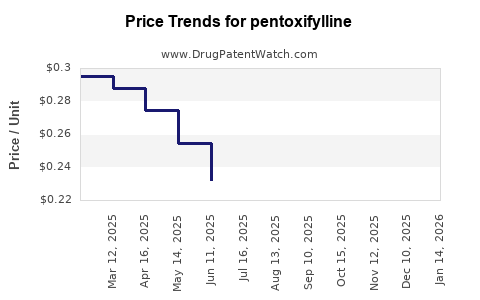
- Total market value likely contracted faster than prescription demand because price erosion exceeded any volume growth.
- Future revenue is likely to remain stable only where local competition is limited or the product retains established prescribing habits.
Margin trajectory
Generic margins vary significantly by country and supply structure. Profitability can remain acceptable for a low-cost tablet if manufacturing is efficient and the supplier has a reliable distribution contract. Margins deteriorate when several approved manufacturers compete for the same pharmacy or wholesaler demand.
| Financial driver |
Effect on pentoxifylline |
| Expired exclusivity |
Reduces pricing power |
| High number of generic suppliers |
Compresses selling price |
| Established manufacturing process |
Lowers production cost |
| Low clinical differentiation |
Limits premium pricing |
| Extended-release technology |
Adds quality-control cost |
| Small prescription opportunity |
Limits scale |
| International demand |
Can support residual volume |
| Shortages or supplier exits |
Can temporarily improve pricing |
There is no clear basis for valuing pentoxifylline as a standalone growth asset. Its economic value is more likely to appear in portfolio-level generic manufacturing, especially when the product uses existing tablet capacity and shares distribution infrastructure with other mature products.
Which companies are positioned in the pentoxifylline market?
The market includes generic manufacturers and regional pharmaceutical companies rather than a dominant innovator. U.S. and international suppliers may include companies with broad generic portfolios, contract manufacturers, and local licensees. Supplier participation can change as companies discontinue low-volume products or consolidate manufacturing sites.
The relevant competitive dimensions are:
- FDA approval and therapeutic equivalence.
- Consistent supply of 400 mg extended-release tablets.
- Wholesale acquisition price and reimbursement.
- Manufacturing cost.
- Distributor and pharmacy contracts.
- Ability to maintain the product during periods of low demand.
No company appears to have a durable strategic advantage based on proprietary pentoxifylline intellectual property.
What patent litigation affects pentoxifylline?
Current high-value patent litigation is not a major market variable. The product’s patent estate is old, and the commercial market has already transitioned to generic supply.
Litigation risk may still arise from ordinary issues such as:
- ANDA patent certifications.
- Product liability claims.
- Manufacturing or quality disputes.
- Labeling and regulatory compliance.
- Contractual disputes between suppliers and distributors.
These risks are unlikely to produce the type of market-wide entry delay associated with a protected oncology drug, biologic, or specialty formulation.
What generic launch scenarios exist for pentoxifylline?
The most likely commercial scenarios are:
Base case
Pentoxifylline remains available from several generic suppliers. Pricing stays low, prescription demand gradually declines, and revenue remains immaterial to diversified manufacturers.
Consolidation case
Some suppliers exit because of low margins or manufacturing rationalization. Remaining suppliers gain volume, but total market value remains constrained by generic substitution.
Shortage-driven case
A temporary manufacturing or distribution disruption causes a short-term price increase or allocation problem. This would improve supplier economics temporarily but would not create durable exclusivity.
Repositioning case
A company develops a differentiated formulation or obtains evidence for a new use. This scenario has low commercial probability because new clinical development would face limited reimbursement and uncertain guideline adoption.
What geographic markets remain commercially relevant?
Pentoxifylline is more likely to retain commercial relevance in markets where:
- Generic medicines dominate prescribing.
- Brand loyalty to Trental or local brands persists.
- Reimbursement favors inexpensive oral therapy.
- Access to vascular specialists and supervised exercise programs is limited.
- Clinicians continue to use the drug for peripheral vascular or off-label indications.
The United States is a mature, low-value generic market. International sales may be more resilient in selected countries, but country-level revenue depends on local registration, reimbursement, prescription practices, and competition.
How strong is the pentoxifylline patent estate?
The patent estate is commercially weak. Original composition and product protection have expired, and the drug lacks a current exclusivity mechanism capable of supporting premium pricing.
| Patent-estate factor |
Assessment |
| Core molecule |
Unprotected |
| Original brand |
No meaningful exclusivity |
| Extended-release formulation |
Mature and broadly reproducible |
| Method-of-use patents |
Limited commercial relevance |
| Manufacturing patents |
No broad market barrier |
| Patent litigation leverage |
Low |
| Licensing value |
Low unless bundled with a broader portfolio |
Licensing opportunities would generally concern geographic rights, supply agreements, or portfolio transactions rather than a proprietary pentoxifylline asset.
Key Takeaways
- Pentoxifylline is a mature generic drug with no meaningful current patent barrier.
- The original Trental commercial model has been replaced by low-price multisource supply.
- U.S. demand is constrained by modest efficacy and weaker guideline positioning than cilostazol.
- No major pharmaceutical company appears to have material standalone revenue exposure.
- Financial value depends on manufacturing efficiency, supply reliability, and regional distribution.
- Formulation and manufacturing know-how can support regulatory compliance but do not create a durable competitive moat.
- Current commercial risk is operational and pricing-related, not primarily patent-related.
- The most likely trajectory is stable-to-declining volume, continued price pressure, and limited strategic upside.
Frequently Asked Questions
Is pentoxifylline still prescribed in the United States?
Yes. FDA-approved generic extended-release tablets remain available, although clinical use is limited by modest efficacy and competition from other treatments for intermittent claudication.
Is pentoxifylline a profitable generic drug?
It can generate incremental portfolio revenue when produced efficiently, but its low price, generic competition, and limited demand make it unlikely to be a high-margin standalone product.
Does pentoxifylline have an active U.S. patent?
Pentoxifylline’s original compound and branded-product protections have expired. The current market does not depend on an active core patent.
Can a company obtain orphan-drug exclusivity for pentoxifylline?
Pentoxifylline is not positioned as an orphan drug for its established intermittent claudication use. Orphan designation would require a qualifying rare disease and a separate development and regulatory strategy.
Is pentoxifylline exposed to biosimilar competition?
No. Pentoxifylline is a small-molecule oral drug, so it competes with generic drugs rather than biosimilars.
References
-
Gerhard-Herman, M. D., Gornik, H. L., Barrett, C., Barshes, N. R., Corriere, M. A., Drachman, D. E., Fleisher, L. A., Fowkes, F. G. R., Hamburg, N. M., Kinlay, S., Lookstein, R., Misra, S., Mureebe, L., Olin, J. W., Patel, R. A. G., Regensteiner, J. G., Schanzer, A., Shishehbor, M. H., Stewart, K. J., Treat-Jacobson, D., & Walsh, M. E. (2017). 2016 AHA/ACC guideline on the management of patients with lower extremity peripheral artery disease. Circulation, 135(12), e726-e779. https://doi.org/10.1161/CIR.0000000000000471
-
U.S. Food and Drug Administration. (2023). Pentoxifylline extended-release tablets prescribing information. DailyMed. https://dailymed.nlm.nih.gov/
-
U.S. Food and Drug Administration. (2024). Approved drug products with therapeutic equivalence evaluations: Orange Book. https://www.fda.gov/drugs/drug-approvals-and-databases/approved-drug-products-therapeutic-equivalence-evaluations-orange-book
-
U.S. Food and Drug Administration. (2024). Drugs@FDA: FDA-approved drugs database. https://www.accessdata.fda.gov/scripts/cder/daf/