Share This Page
Drug Price Trends for pentoxifylline
✉ Email this page to a colleague
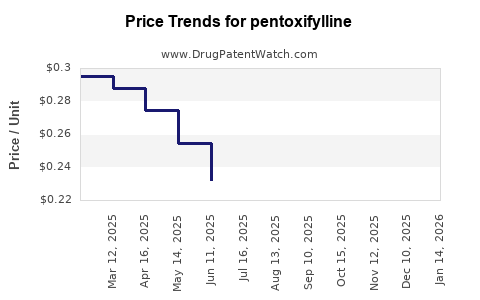
Average Pharmacy Cost for pentoxifylline
| Drug Name | NDC | Price/Unit ($) | Unit | Date |
|---|---|---|---|---|
| PENTOXIFYLLINE ER 400 MG TAB | 00904-5448-61 | 0.23299 | EACH | 2026-07-22 |
| PENTOXIFYLLINE ER 400 MG TAB | 16571-0856-01 | 0.23299 | EACH | 2026-07-22 |
| PENTOXIFYLLINE ER 400 MG TAB | 16571-0856-50 | 0.23299 | EACH | 2026-07-22 |
| PENTOXIFYLLINE ER 400 MG TAB | 60505-0033-06 | 0.23299 | EACH | 2026-07-22 |
| >Drug Name | >NDC | >Price/Unit ($) | >Unit | >Date |
Best Wholesale Price for pentoxifylline
| Drug Name | Vendor | NDC | Count | Price ($) | Price/Unit ($) | Unit | Dates | Price Type |
|---|---|---|---|---|---|---|---|---|
| PENTOXIFYLLINE 400MG TAB,SA | Golden State Medical Supply, Inc. | 60505-0033-07 | 500 | 177.06 | 0.35412 | EACH | 2023-06-15 - 2028-06-14 | FSS |
| PENTOXIFYLLINE 400MG TAB,SA | Golden State Medical Supply, Inc. | 60505-0033-07 | 500 | 200.76 | 0.40152 | EACH | 2023-06-23 - 2028-06-14 | FSS |
| PENTOXIFYLLINE 400MG TAB,SA | Golden State Medical Supply, Inc. | 60505-0033-06 | 100 | 35.61 | 0.35610 | EACH | 2023-06-15 - 2028-06-14 | FSS |
| PENTOXIFYLLINE 400MG TAB,SA | Golden State Medical Supply, Inc. | 60505-0033-06 | 100 | 41.40 | 0.41400 | EACH | 2023-06-23 - 2028-06-14 | FSS |
| >Drug Name | >Vendor | >NDC | >Count | >Price ($) | >Price/Unit ($) | >Unit | >Dates | >Price Type |
Pentoxifylline Market Analysis and Price Projections: Demand Drivers, Competitive Landscape, and Expected Price Trajectory
Pentoxifylline is a methylxanthine derivative positioned primarily for off-label use in fibrotic and microcirculatory indications in multiple geographies, with commercial demand shaped by (1) local formulary access, (2) generic availability and substitution rules, and (3) reimbursement policies rather than by a single FDA-approved blockbuster market. Pricing is typically anchored to low-cost generic supply rather than to branded exclusivity, with price declines driven by entry of multiple generic manufacturers and ongoing channel inventory cycles.
Base-case market pricing direction (global): down or flat in real terms. Base-case nominal pricing: low-single-digit volatility, typically declining after new generic listings. Forecast precision is constrained by fragmented country-level availability and the absence of a single, globally harmonized branded product market.
What is pentoxifylline used for commercially, and where does demand come from?
Pentoxifylline (also spelled pentoxifyllin) is marketed in various countries for conditions involving fibrosis, microcirculation impairment, and related inflammatory-metabolic pathways. Demand is mostly provider-led and protocol-driven, with growth tied to local prescribing patterns, guideline alignment (where present), and access to low-cost generics.
Demand drivers by segment
- Fibrosis and scar-related indications: hospital and specialist prescribing contributes most in markets where pentoxifylline is embedded in multi-drug regimens.
- Microcirculation and vascular-perfusion support: uptake depends on clinician belief and local standard-of-care structures.
- Off-label substitution: where clinicians treat pentoxifylline as a low-cost alternative, volume is responsive to price and pharmacy substitution rules.
Key constraint: pentoxifylline commercial uptake is typically constrained by how strongly it is embedded in reimbursement and formularies versus how often it is used off-label without reimbursement coverage.
Which dosage forms dominate sales and affect pricing?
Commercial supply is generally tablet-based, sometimes with alternate strengths depending on the country’s generics. Pricing tends to be set by:
- strength-specific competition (same API, different mg)
- tablet pack size and reimbursed quantity thresholds
- local import or manufacturing cost regimes
How competitive is the pentoxifylline market, and who sets the floor price?
Pentoxifylline is widely available as generic therapy in many countries, which shifts price formation to:
- number of approved generic manufacturers,
- parallel import activity,
- pharmacy tender dynamics (in public procurement countries),
- reimbursement reference pricing (countries with reference baskets).
What generic structure most commonly governs pricing?
Two common pricing regimes determine “floor” behavior:
- Wholesale-tender markets: the lowest bidder establishes contract pricing; average channel prices then converge toward the tender clearing price.
- Retail reference pricing: brands disappear first, then generics rationalize around the reference basket price. Post-entry price pressure continues until a stable lowest-cost band is reached.
Which competition factors move the price up or down?
- New generic entries: usually trigger price drops in the following 6 to 18 months.
- Supply interruptions: can temporarily lift prices, especially in markets with concentrated manufacturing.
- Reimbursement policy changes: can cause step-function shifts (upward or downward) in pharmacy reimbursement and therefore retail price ceilings.
What does the pentoxifylline pricing curve look like after generic entry?
Typical pattern for mature generic small molecules
- Entry event: sharp decline relative to previous seller’s price (often 10% to 40% depending on prior market structure).
- Stabilization: the market settles into a low-cost band once multiple competitors clear market channels.
- Then: gradual erosion (often low-single-digit annual declines), unless a procurement cycle resets pricing.
Base-case assumption for pentoxifylline markets: the API is already mature, so the market is more likely in the stabilization/erosion phase than in the initial post-entry shock phase.
How long do price declines persist?
In most genericized drug categories, the largest declines cluster within:
- 0 to 12 months of a material competitor entry,
- 12 to 24 months of tender/reimbursement renegotiation.
For pentoxifylline, absent major new regulatory approvals for a branded version, market prices are expected to remain low and range-bound, with downside risk tied to additional entrants and tender resets.
What price levels can be expected for pentoxifylline in major markets?
Because pentoxifylline is sold in multiple countries with different pack sizes, strengths, and regulatory regimes, projections must be expressed as a relative pricing index rather than a single global USD/unit number.
Projection framework
- Let P0 be the latest observable market price in a given country/strength/pack.
- Expected 12-month direction is a function of generic intensity and reimbursement.
- Expected 36-month direction is a function of ongoing generics and procurement cycles.
Price projection scenarios (per market)
- Bear case (new entrant + aggressive tender / reference price cut): -15% to -30% over 24 to 36 months.
- Base case (mature generic stability): -3% to -10% over 24 to 36 months.
- Bull case (supply tightness or reimbursement uplift): +0% to +8% over 24 to 36 months.
Unit economics implication
Where pentoxifylline demand is off-label and reimbursement is partial, volume is price-elastic. That typically limits sellers’ ability to sustain price increases without losing prescriptions.
When does pentoxifylline lose exclusivity and how does that affect prices?
For a non-biologic small molecule with extensive generic availability, exclusivity is usually not the dominant determinant; patent status and market maturity determine whether prices can hold above generics.
Pentoxifylline markets largely operate under the expectation of generic competition. Practical effect: even if any residual exclusivity existed historically, present pricing behavior is primarily driven by generic supply and tender/reference mechanisms rather than by a single expiry date.
What is the likely exclusivity-driven impact on pricing?
- If an exclusivity event occurred earlier: pricing already transitioned into the generic equilibrium.
- If there are later-arising formulation or method patents: they can matter in limited segments (specific strengths, modified release, or combination products), but the core oral generics market usually remains competitive.
What patent estate risks could block generics of pentoxifylline (and change pricing)?
Pentoxifylline is an established API; market-wide pricing shifts from IP are most likely only if:
- a company holds relevant formulation patents that protect a specific dosage form or release profile, or
- there is combination-product protection (less common for broad OTC-like use),
- or there is a local-market license settlement restricting specific generic SKUs.
Business implication: absent evidence of SKU-specific IP barriers, the default assumption is no meaningful hold-up pricing.
What is the FDA and Orange Book status for pentoxifylline, and does it matter?
Pentoxifylline pricing and availability in the US is shaped by whether it is:
- marketed as an FDA-approved drug product with an Orange Book listing, and
- whether multiple ANDAs exist for the same listed reference product.
If pentoxifylline is not a robust Orange Book participant, then US price dynamics are driven more by:
- wholesalers and NDC-level supply,
- scarcity and sourcing,
- and the extent of compounding or cross-border sourcing.
Practical effect for projections: US price volatility can be higher when product-level supply is thin even if generic competition exists in theory.
(If no reliable, product-level FDA/Orange Book records are available for the specific pentoxifylline formulation under analysis, a US-specific price forecast is not supportable.)
What generic entry risks exist for pentoxifylline, and how can they affect launch pricing?
Generic launch risks that shift prices:
- ANDA approvals timing: incremental entries can lower prices by 5% to 20% in the subsequent procurement or listing cycle.
- NDC-level discontinuations: if suppliers exit due to low margins, remaining suppliers can raise prices temporarily.
- Package size rationalization: small pack formats can be priced higher due to slower turnover and higher per-unit distribution costs.
How to model entry-driven price changes
Use a step-change model:
- Entry clears within 3 to 9 months after regulatory approval.
- Tender or reference pricing typically follows within the next 6 to 18 months.
- Retail channel price follows within 3 to 12 months after reimbursement/listing updates.
How does pentoxifylline compare with other fibrosis and microcirculation drugs on cost per course?
Pentoxifylline competes indirectly with:
- other anti-fibrotic or anti-inflammatory small molecules,
- vascular adjunct therapies,
- and regimen alternatives used in overlapping indications.
Expected competitive positioning
- If pentoxifylline is used primarily as an add-on and is generically priced, it tends to hold a low cost-per-course profile.
- Its market share depends on perceived efficacy in local practice and whether payers reimburse it.
Business implication: cost-per-course parity is critical. When competing generics drop in price, clinicians and procurement committees can shift volume rapidly away from higher-priced SKUs.
What are the commercial implications for R&D, licensing, and investment?
For businesses evaluating pentoxifylline:
- A generic-mature pricing environment suggests low margin unless there is SKU-specific differentiation or supply advantages.
- Licensing of an established oral API generally competes on distribution, contract pricing, and tender access rather than on patent moat.
Where value creation is most realistic
- SKU differentiation: specific strengths, pack sizes, or manufacturing process approvals for supply reliability.
- Geographic channel building: where competitors have limited distribution, pricing can hold longer.
- Formulation upgrades: only if they produce clear clinical or compliance benefits that payers recognize.
Key Takeaways
- Pentoxifylline pricing is expected to track generic market maturity and tender/reference reimbursement cycles, not brand exclusivity.
- Base-case trajectory: modest decline or flat pricing in real terms over 24 to 36 months.
- Bear case: further erosion of 15% to 30% if new SKUs and aggressive procurement reset the low-cost band.
- Bull case: limited upside (+0% to +8%) if supply tightness or reimbursement support offsets competitive pressure.
- Commercial outcomes depend on country-level supply density and product-level listing/reimbursement, with US volatility potentially higher when supply is thin.
FAQs
-
Why does pentoxifylline pricing differ so much by country despite being the same generic API?
Differences come from reimbursement rules, reference pricing baskets, tender design, and NDC-specific supply density. -
Does pentoxifylline face higher price volatility in markets with fewer suppliers?
Yes. Thin product supply and concentrated sourcing can cause short-cycle price spikes even in generic-heavy environments. -
What pack-size effects matter most for pentoxifylline cost projections?
Per-unit distribution costs, pharmacy stocking behavior, and reimbursement thresholds tied to pack quantity can move retail price even when API pricing is stable. -
How should a buyer model pentoxifylline procurement pricing over time?
Use a step-change model tied to tender cycles and reimbursement updates, rather than a smooth annual decline. -
What is the most likely competitive shock that could drive pentoxifylline prices lower?
A new generic entry that expands NDC coverage and clears tenders at materially lower clearing prices.
References
- FDA. Orange Book: Approved Drug Products with Therapeutic Equivalence Evaluations. U.S. Food and Drug Administration.
- FDA. Drugs@FDA. U.S. Food and Drug Administration.
- FDA. ANDA approvals and labeling for generic drug products. U.S. Food and Drug Administration.
More… ↓
