Last updated: September 1, 2026
Nadolol is a mature, low-cost beta blocker with no material remaining U.S. patent barrier, no biologic or biosimilar exposure, and limited branded revenue. Its commercial value is concentrated in chronic prescriptions for hypertension, angina, arrhythmia management, and selected off-label uses such as long-QT syndrome and portal hypertension. Financial performance is driven by generic volume, contract pricing, supply continuity, and institutional purchasing rather than innovation-based pricing.
What is nadolol, and which products contain it?
Nadolol is a nonselective beta-adrenergic blocker marketed originally as Corgard. The FDA approved nadolol for hypertension and angina pectoris. The drug is administered orally, generally once daily, and is available in tablet strengths including 20 mg, 40 mg, 80 mg, and 160 mg, depending on product and market availability [1].
| Attribute |
Nadolol |
| Active ingredient |
Nadolol |
| Original brand |
Corgard |
| Drug class |
Nonselective beta blocker |
| Initial U.S. approval |
1980s |
| Primary labeled uses |
Hypertension; angina pectoris |
| Dosage form |
Immediate-release oral tablet |
| FDA pathway |
Small-molecule NDA and ANDA products |
| Biologic status |
Not applicable |
| Current market structure |
Generic-dominated |
| Major commercial risks |
Price erosion, supply disruption, substitution by competing beta blockers |
Nadolol has pharmacokinetic characteristics that distinguish it from more commonly prescribed beta blockers. It is substantially renally eliminated and has a relatively long half-life, supporting once-daily dosing. Those characteristics can preserve demand in patients who require stable beta blockade, but they do not create significant pricing power in a generic market.
What is the FDA regulatory status of nadolol?
Nadolol remains an FDA-approved prescription drug. Corgard was the reference branded product, while multiple manufacturers have marketed generic nadolol tablets through abbreviated new drug applications.
The FDA label identifies nadolol for the treatment of hypertension and angina pectoris. As with other beta blockers, the label includes warnings and contraindications involving bradycardia, heart block, cardiogenic shock, overt cardiac failure, and bronchospastic disease [1].
Is nadolol a generic drug or a branded drug?
Both branded and generic products exist, but the U.S. market is economically generic. Corgard has little practical influence on net pricing compared with lower-cost nadolol tablets. Prescribing decisions are usually based on clinical familiarity, pharmacy availability, formulary status, and price.
FDA-approved generic products may differ in inactive ingredients, tablet appearance, packaging, and manufacturer. They must demonstrate bioequivalence to the reference product under the ANDA framework, but they do not need to repeat the full clinical efficacy program conducted for the original NDA [2].
Does nadolol have FDA exclusivity?
Nadolol has no meaningful current U.S. new-drug exclusivity period. Any approval-related exclusivity associated with the original product expired decades ago. Generic manufacturers therefore compete primarily through ANDA approvals, manufacturing reliability, distribution, and price.
What patents protect nadolol and Corgard?
Nadolol is a legacy small molecule whose core composition-of-matter protection expired long ago. The current commercial market is not protected by an active U.S. composition-of-matter patent or a meaningful formulation patent barrier.
The FDA Orange Book is the primary source for patents and regulatory exclusivity associated with approved reference products. Current nadolol competition is consistent with a product that has passed its patent-protected period and is open to generic substitution [3].
| IP category |
Current commercial relevance |
| Composition-of-matter patent |
Expired |
| Original Corgard patent estate |
Expired |
| Pediatric exclusivity |
No current material block |
| New chemical entity exclusivity |
Expired |
| Formulation patents |
No widely recognized active barrier controlling U.S. entry |
| Method-of-use patents |
No material barrier for labeled indications |
| Manufacturing patents |
May exist at supplier level but do not block ordinary generic entry |
What formulation patents protect nadolol?
No formulation patent appears to control the mainstream U.S. nadolol tablet market. The commercial product is an immediate-release oral tablet rather than a complex delivery system such as an extended-release implant, inhaled product, depot injection, or transdermal system.
A manufacturer could seek protection for a specific dosage form, excipient combination, process, or alternative delivery system. Such rights would apply only to the protected product and would not restore exclusivity to conventional nadolol tablets.
What manufacturing and intellectual-property barriers exist?
Manufacturing barriers are operational rather than patent-based. Nadolol production requires controlled synthesis, validated analytical methods, pharmaceutical-grade active ingredient, and compliance with current good manufacturing practices. The active ingredient is not generally considered among the most technically difficult small molecules to manufacture.
Commercial barriers include:
- Reliable access to active pharmaceutical ingredient
- FDA-compliant finished-dose manufacturing
- Stability and dissolution performance
- Scale sufficient to support low-margin contracts
- Ability to maintain supply during plant inspections or shortages
- Pharmacy and wholesaler distribution
These barriers can reduce the number of active suppliers even when legal entry is open. They do not normally support premium pricing.
When does nadolol lose exclusivity?
Nadolol lost meaningful U.S. exclusivity many years ago. The drug is now in the post-exclusivity phase, with generic manufacturers able to enter under the ANDA pathway after satisfying FDA requirements.
| Milestone |
Commercial effect |
| Original NDA approval in the 1980s |
Established Corgard market |
| Expiration of original patent protection |
Opened market to generic nadolol |
| Generic ANDA approvals |
Shifted volume away from the brand |
| Current period |
Mature generic competition and low pricing |
The principal commercial question is no longer when exclusivity ends. It is whether enough manufacturers remain active to preserve supply and competitive pricing.
How many patents cover nadolol?
No active U.S. patent appears to provide broad market protection for conventional nadolol tablets. Historical patents may remain visible in patent databases or regulatory records, but expired patents do not prevent generic competition.
Patent counts can be misleading for mature drugs. A large historical patent family does not equal current exclusivity. For nadolol, the relevant conclusion is that the core molecule and original product protection are expired, while no active patent estate is widely recognized as controlling standard generic entry.
Are there Paragraph IV challenges to nadolol?
Paragraph IV litigation risk is low because nadolol is a mature product with established generic competition. Paragraph IV certifications apply when an ANDA applicant challenges listed patents for a reference product. If no unexpired, relevant Orange Book patent remains listed, there is little basis for a conventional Paragraph IV dispute.
No active, commercially material Paragraph IV campaign is broadly associated with standard nadolol tablets. Historical ANDA litigation, if any, would have limited current impact unless it produced a settlement, launch restriction, or enforceable patent term that remains in effect. The current market structure indicates that generic entry has already occurred without a continuing patent blockade.
What patent litigation affects nadolol?
Nadolol does not have a significant current patent-litigation profile comparable with protected cardiovascular products or high-revenue specialty drugs. Litigation exposure is more likely to arise from:
- Manufacturing-related patent disputes
- Formulation-specific products
- Trade secrets involving active ingredient production
- Regulatory or product-liability matters
- Supply and contract disputes
Those issues would affect individual manufacturers rather than the entire nadolol market.
What is the Orange Book status of nadolol?
The Orange Book identifies approved reference products and relevant patents and exclusivity information. Nadolol’s Orange Book position is consistent with a legacy reference drug whose original exclusivity has expired and whose standard tablet market is served by approved generics [3].
The practical implications are:
- No current Orange Book patent is widely viewed as blocking generic nadolol tablets.
- Generic substitution is legally and commercially established.
- Corgard does not possess the exclusivity profile of a protected branded cardiovascular product.
- Market share depends more on formulary and supply execution than on patent control.
Which companies compete in the nadolol market?
Competition varies by country and over time because manufacturers may discontinue low-volume products or change distribution arrangements. In the United States, generic nadolol has been associated with large and mid-sized generic manufacturers, including companies such as Teva, Zydus, Upsher-Smith, and other ANDA holders or distributors, subject to product availability and current FDA listing status.
The competitive field is fragmented. A manufacturer may hold an approved ANDA but sell little product, while another may supply wholesalers under a private-label or contract arrangement. Approved status therefore does not equal meaningful market share.
How does nadolol compare with competing beta blockers?
Nadolol competes with metoprolol, atenolol, propranolol, carvedilol, bisoprolol, and labetalol. Metoprolol and carvedilol are particularly important in cardiovascular prescribing because of their broader use across hypertension, ischemic disease, arrhythmia, and heart failure.
| Drug |
Beta selectivity |
Common commercial strengths |
Competitive position |
| Nadolol |
Nonselective |
Once-daily dosing; long half-life |
Niche, mature generic |
| Propranolol |
Nonselective |
Broad indications; immediate and extended release |
Larger, more diversified market |
| Metoprolol |
Beta-1 selective |
Immediate and extended release |
Major cardiovascular competitor |
| Atenolol |
Beta-1 selective |
Low-cost generic |
Direct hypertension substitute |
| Carvedilol |
Nonselective with alpha blockade |
Heart failure and hypertension |
Strong heart-failure position |
| Bisoprolol |
Beta-1 selective |
Hypertension and heart failure |
Regional and specialty competition |
Nadolol retains demand where clinicians value once-daily nonselective beta blockade, including certain arrhythmia and congenital long-QT treatment protocols. It lacks the heart-failure evidence and broad commercial positioning of carvedilol or metoprolol succinate.
What is the financial trajectory for nadolol?
Nadolol’s financial trajectory follows the standard lifecycle of an older small-molecule medicine:
- Branded growth under Corgard.
- Patent expiry and generic entry.
- Rapid branded-price and market-share erosion.
- Stable but low-margin generic demand.
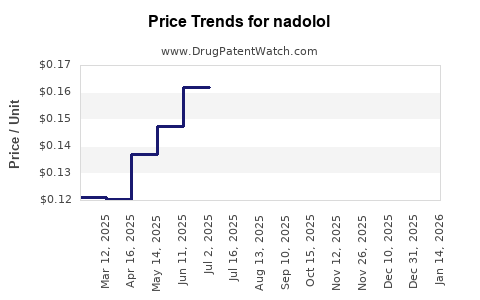
- Periodic price increases or supply constraints when supplier concentration rises.
- Long-term volume persistence without major revenue expansion.
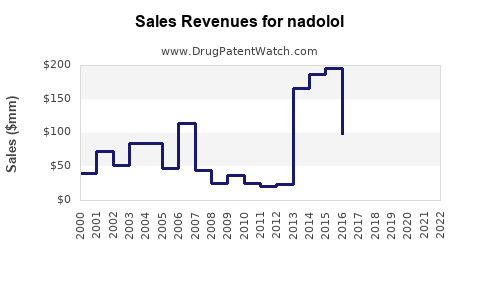
Public company filings generally do not report nadolol revenue as a standalone product. Manufacturers usually aggregate it within generic cardiovascular revenue, making precise global sales estimates unavailable from audited public disclosures. The commercial opportunity is therefore better measured through prescription volume, active suppliers, reimbursement rates, and shortage status than through branded revenue forecasts.
Is nadolol a high-revenue pharmaceutical product?
No. Nadolol is a low-revenue product relative to patented cardiovascular drugs, specialty medicines, and combination therapies. Its value is distributed across generic manufacturers and pharmacy channels rather than captured by a single patent holder.
The product can still generate attractive cash flow for a supplier with:
- Low manufacturing cost
- Reliable API access
- Limited active competitors
- Stable institutional contracts
- Favorable reimbursement spreads
- Low regulatory remediation risk
The market does not support substantial research-and-development pricing because the molecule is old, clinically familiar, and therapeutically substitutable.
What generic entry risks exist for nadolol?
Generic entry risk to the former brand is effectively realized rather than prospective. For current manufacturers, the relevant risks are margin compression and supplier withdrawal.
| Risk |
Likely effect |
| New ANDA approvals |
Lower prices and reduced share |
| Manufacturer exit |
Temporary supply tightness and higher prices |
| FDA warning letter or recall |
Market-share loss and shortage risk |
| API disruption |
Production delays |
| Formulary substitution |
Rapid switching among generic suppliers |
| Therapeutic substitution |
Volume migration to metoprolol, atenolol, or propranolol |
| Low demand |
Reduced incentive to maintain multiple suppliers |
Because nadolol demand is relatively small compared with major beta blockers, a manufacturer may exit if margins do not cover compliance, inventory, and distribution costs.
Does nadolol face biosimilar risk?
No. Nadolol is a synthetic small molecule, not a biologic. Biosimilar regulation does not apply. The relevant competitive pathways are ANDA generic entry, therapeutic substitution, formulation differentiation, and supplier competition [2].
Are there licensing deals for nadolol?
No major current licensing transaction is broadly associated with nadolol. The original Corgard commercialization involved the branded innovator structure of the period, but present-day commercial activity is more likely to involve:
- ANDA ownership transfers
- Contract manufacturing
- Private-label distribution
- API supply agreements
- Product portfolio acquisitions
These arrangements may change the commercial supplier without changing the legal patent position or the clinical market.
What is the geographic coverage of the nadolol market?
Nadolol is marketed in multiple countries, but availability and brand names differ. The United States has an established generic tablet market. Canada, Europe, and other jurisdictions may have different reference products, national reimbursement rules, approved strengths, and supplier sets.
Geographic revenue is shaped by national tender systems and reimbursement controls. In Europe and other price-regulated markets, nadolol may remain available as a low-cost generic or through hospital and specialty channels. In markets with fewer suppliers, discontinuation can create localized shortages without creating durable patent-based pricing power.
What is the outlook for nadolol through 2030?
The base-case outlook is stable, low-growth demand with continued generic price pressure. Volume should remain supported by chronic cardiovascular use and selected specialty prescribing, but no major revenue catalyst is evident.
Potential upside would come from supply consolidation, product shortages among competitors, or expanded use in specialty arrhythmia protocols. Downside would come from therapeutic substitution, manufacturer exits, reimbursement reductions, and declining use of nonselective beta blockers in favor of newer treatment approaches.
What could change nadolol’s commercial trajectory?
The most important variables are:
- Number of active U.S. suppliers
- FDA shortage or enforcement activity
- Changes in clinical guidelines
- Relative pricing versus metoprolol and atenolol
- Continued use in long-QT syndrome
- Availability of competing nonselective beta blockers
- Reimbursement policy and pharmacy substitution
Key Takeaways
- Nadolol is a mature generic beta blocker marketed originally as Corgard.
- Its composition-of-matter and original product protection have expired.
- No active patent estate is broadly viewed as blocking conventional nadolol tablets.
- Paragraph IV and patent-litigation risk are currently limited.
- Nadolol has no biosimilar exposure because it is a synthetic small molecule.
- Financial value is concentrated in low-margin generic supply, not branded exclusivity.
- Public filings generally do not disclose standalone nadolol revenue.
- The principal business risks are price erosion, supplier withdrawal, API disruption, and substitution by metoprolol, atenolol, propranolol, or carvedilol.
- Stable demand is likely through 2030, but significant market expansion is unlikely without a new formulation or clinical positioning.
FAQs
Is nadolol still commercially available in the United States?
Yes. FDA-approved nadolol products remain available through generic manufacturers, although individual strengths and suppliers can change because of manufacturing and distribution decisions.
Is Corgard still a profitable brand?
Corgard has limited commercial significance compared with its pre-generic period. Generic substitution and low-cost alternatives have removed most of the original branded pricing power.
Can a company obtain new patents on nadolol?
A company could pursue patents on a novel formulation, dosage regimen, manufacturing process, or delivery system if the statutory requirements are met. Such patents would not automatically protect conventional nadolol tablets.
Is nadolol used for long-QT syndrome?
Yes. Nadolol is used in clinical practice for some patients with congenital long-QT syndrome, although this use is generally distinct from the original FDA-labeled hypertension and angina indications and may be guided by specialist protocols [4].
Could nadolol become a shortage-risk drug?
Yes. Its relatively modest demand and generic economics can reduce supplier participation. A manufacturing interruption or API disruption could create localized or national availability problems even without patent restrictions.
References
-
U.S. Food and Drug Administration. (2011). Corgard (nadolol) prescribing information. FDA.
-
U.S. Food and Drug Administration. (2024). Generic drug facts. FDA.
-
U.S. Food and Drug Administration. (2024). Approved drug products with therapeutic equivalence evaluations: Orange Book. FDA.
-
Priori, S. G., Wilde, A. A. M., Horie, M., Cho, Y., Behr, E. R., Berul, C., ... & Zareba, W. (2013). HRS/EHRA/APHRS expert consensus statement on the diagnosis and management of patients with inherited primary arrhythmia syndromes. Heart Rhythm, 10(12), 1932-1963.