Last updated: September 7, 2026
Lovastatin is a mature, off-patent statin with low current commercial value compared with atorvastatin, rosuvastatin, and simvastatin. Merck’s Mevacor generated approximately billion-dollar annual sales before generic entry, but patent expiry and therapeutic substitution shifted lovastatin into a low-price, multi-supplier market. No biosimilar risk applies because lovastatin is a chemically synthesized small-molecule drug, not a biologic.
What is the current market position of lovastatin?
Lovastatin remains an FDA-approved antihyperlipidemic drug, but its commercial role is limited. It is available primarily as generic immediate-release tablets in 10 mg, 20 mg, and 40 mg strengths. The branded products Mevacor and Altoprev no longer drive the market in the way they did before generic competition.
Lovastatin inhibits HMG-CoA reductase and lowers low-density lipoprotein cholesterol. It is less potent than newer statins and has a less favorable interaction profile because it is substantially metabolized by CYP3A4. The FDA label warns against use with strong CYP3A4 inhibitors and sets dose limitations with several interacting medicines.[1]
| Market factor |
Lovastatin position |
| Drug class |
HMG-CoA reductase inhibitor |
| Original brand |
Mevacor |
| Original sponsor |
Merck |
| FDA approval |
1987 |
| Main dosage forms |
Immediate-release tablets; historical extended-release tablets |
| Current status |
Generic, mature, low-price market |
| Biosimilar exposure |
None |
| Main substitutes |
Atorvastatin, rosuvastatin, simvastatin, pravastatin |
| Commercial differentiation |
Limited |
| Primary demand base |
Generic prescriptions and formulary use |
When did lovastatin lose exclusivity?
Lovastatin lost meaningful U.S. market exclusivity in the early 2000s. Merck’s original patent estate covered the active compound and manufacturing-related technology, but those rights no longer block generic competition.
The key historical patent was U.S. Patent No. 4,231,938, covering mevinolin, the compound later commercialized as lovastatin. Related Merck patents covered processes, intermediates, and cholesterol-lowering compounds. The principal commercial consequence was the opening of the U.S. market to ANDA-approved generic lovastatin products around 2001.[2]
| Exclusivity event |
Approximate timing |
Commercial effect |
| Mevacor FDA approval |
1987 |
Merck obtained first-mover market position |
| Core composition and process protection |
Late 1980s to early 2000s |
Restricted direct generic competition |
| Generic lovastatin approvals |
2001 onward |
Rapid price erosion |
| Altoprev extended-release approval |
2001 |
Attempted lifecycle management |
| Broad generic availability |
2000s |
Brand erosion and supplier competition |
| Current U.S. position |
Off patent |
No meaningful blocking exclusivity |
Exact historical expiration dates can differ by patent, patent-term adjustments, and regulatory extensions. The commercial entry date is more important than any single legacy patent because the lovastatin market became broadly generic in the early 2000s.
What patents protect lovastatin today?
No commercially significant U.S. patent is known to block generic immediate-release lovastatin. The original composition, process, and formulation patents have expired or ceased to function as effective market barriers.
Historical patent categories
The lovastatin estate historically included:
- Compound patents covering lovastatin and related statin molecules.
- Fermentation and production patents covering microbial production.
- Chemical conversion and purification patents.
- Pharmaceutical composition patents.
- Extended-release formulation patents associated with Altoprev.
- Method-of-use claims covering cholesterol reduction and cardiovascular risk management.
The most important expired rights were the foundational compound and production patents. Later formulation claims had narrower scope and did not preserve a durable branded market.
Patent strength assessment
| Patent layer |
Historical strength |
Current commercial strength |
| Core compound |
High before expiry |
None |
| Fermentation process |
Moderate to high |
Low because alternative processes and expired rights exist |
| Immediate-release tablet |
Low to moderate |
None |
| Extended-release formulation |
Moderate |
Low; product has limited commercial relevance |
| Method of use |
Limited by broad clinical practice and prior art |
None as a generic-market barrier |
| Manufacturing know-how |
Potentially useful |
Not sufficient to prevent competition |
Lovastatin therefore has a weak current patent estate. Its remaining competitive advantages are manufacturing scale, regulatory history, supply reliability, and low cost rather than patent exclusivity.
What is the FDA regulatory status and Orange Book position of lovastatin?
FDA-approved lovastatin products include generic immediate-release tablets. Mevacor was the original reference product. Altoprev was an extended-release lovastatin product approved for patients requiring a modified-release formulation.
The FDA Orange Book historically listed patents associated with the reference products. Those listings supported the ANDA certification framework, including Paragraph IV challenges during the period when relevant patents remained in force.[3]
Today, the practical Orange Book position is straightforward:
- Generic immediate-release lovastatin products are approved through ANDAs.
- The active ingredient is not protected by current primary-patent exclusivity.
- Orange Book-listed legacy patents do not create a meaningful barrier to ordinary generic entry.
- Extended-release products have limited commercial importance compared with immediate-release tablets.
- No biologic license application or biosimilar pathway is involved.
Were there Paragraph IV challenges to lovastatin?
Lovastatin generic entry occurred after the core patent barriers had substantially weakened or expired. Historical ANDA certifications and related patent disputes formed part of the broader generic launch process, but lovastatin did not retain a durable litigation-based delay comparable to some newer small-molecule blockbusters.
Paragraph IV risk was principally relevant to:
- Core compound patents.
- Manufacturing patents.
- Extended-release formulation patents.
- Product-specific patents listed for Mevacor or Altoprev.
The commercial outcome was generic market entry rather than a prolonged patent settlement structure. Lovastatin is therefore a poor analogue for current high-value Paragraph IV litigation involving oncology, immunology, or specialty medicines.
What formulations are protected by lovastatin patents?
The primary commercial formulation is an immediate-release tablet. Historical formulation innovation focused on extended-release lovastatin, including Altoprev.
Immediate-release tablets
Immediate-release lovastatin tablets are technically simple relative to modified-release products. Generic manufacturers can source the active pharmaceutical ingredient and reproduce the tablet dosage form using conventional pharmaceutical manufacturing methods.
The product has limited formulation differentiation because:
- The active ingredient is well characterized.
- The dosage form is a standard tablet.
- Bioequivalence pathways are established.
- Multiple manufacturers have long regulatory experience.
- No current formulation patent appears to create a broad market barrier.
Extended-release formulations
Altoprev used a modified-release approach intended to deliver lovastatin over an extended period. Such formulations can create patentable claims around release profiles, coatings, matrix systems, and pharmacokinetic performance. Those claims were narrower than the foundational compound patents and did not preserve a large long-term market.
Extended-release lovastatin also faced a commercial problem: physicians and payers could substitute other statins with stronger efficacy, broader guideline use, and generic availability.
How did lovastatin revenue change after generic entry?
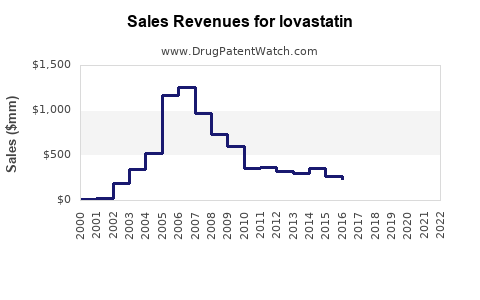
Merck’s Mevacor was a major cardiovascular product before generic competition. Public company reporting placed Mevacor sales at approximately $1 billion annually around the peak period, although reported figures varied by year and reporting treatment.[4]
The financial trajectory followed the standard small-molecule loss-of-exclusivity pattern:
| Period |
Financial profile |
Market driver |
| 1987-1990s |
Rapid growth and high branded margins |
First-in-class positioning and limited competition |
| Late 1990s |
Approximately billion-dollar annual sales |
Large treated population and cardiovascular use |
| 2001-2003 |
Sharp revenue decline |
Generic entry and price compression |
| Mid-2000s |
Residual brand and generic revenue |
Formulary substitution |
| 2010s onward |
Low-margin commodity market |
Mature generic supply |
| Current period |
Limited molecule-level revenue visibility |
Multiple suppliers and therapeutic substitution |
The largest financial loss was not caused solely by lower unit prices. Mevacor also lost prescription volume to newer statins, especially simvastatin, atorvastatin, and later rosuvastatin. Lovastatin’s lower potency and drug-interaction limitations reduced its ability to defend share after exclusivity ended.
How does lovastatin compare with competing statins?
Lovastatin competes primarily on low acquisition cost, not clinical or patent differentiation.
| Drug |
Generic status |
Relative potency |
Commercial position |
| Lovastatin |
Generic |
Lower |
Mature, low-cost option |
| Simvastatin |
Generic |
Moderate |
Broad historical use and low cost |
| Atorvastatin |
Generic |
High |
Strong primary-care and guideline position |
| Rosuvastatin |
Generic |
High |
Strong LDL reduction and continued demand |
| Pravastatin |
Generic |
Lower to moderate |
Used where interaction considerations matter |
Atorvastatin and rosuvastatin generally provide greater LDL reduction at standard doses. Simvastatin has historically been a closer commercial substitute because it is inexpensive and widely used. Pravastatin competes in patients requiring a different interaction profile.
Lovastatin’s limitations include:
- CYP3A4-mediated interaction risk.
- Lower potency than high-intensity statins.
- Fewer current clinical reasons to prefer it.
- Reduced use in patients requiring aggressive LDL reduction.
- Limited branded support and marketing.
What generic entry risks exist for lovastatin?
Generic entry risk is no longer a forward-looking patent threat. It is an established market condition.
Generic launch scenario
A new manufacturer would face low patent risk but meaningful commercial execution risk. A successful launch would require:
- FDA ANDA approval.
- A reliable lovastatin API source.
- Competitive tablet manufacturing costs.
- Pharmacy and wholesaler distribution.
- Adequate supply continuity.
- Compliance with current good manufacturing practices.
The main risks are price competition, low market size, manufacturing-site compliance, and limited formulary leverage. A new entrant could obtain approval without achieving significant market share.
Pricing dynamics
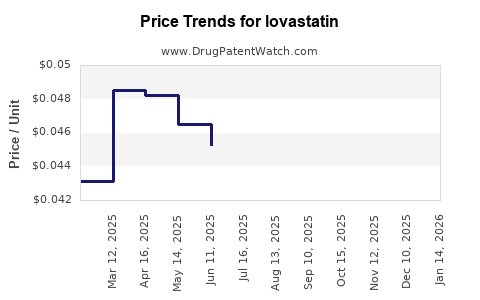
Lovastatin pricing is shaped by the number of active suppliers. In a multi-source generic market, additional entrants generally reduce prices unless shortages or supplier exits tighten supply. The market has limited tolerance for premium pricing because therapeutic substitutes are abundant.
The financial profile favors efficient manufacturers with existing cardiovascular portfolios. Lovastatin alone is unlikely to justify substantial new manufacturing investment.
Is there biosimilar risk for lovastatin?
No. Biosimilar risk does not apply to lovastatin.
Lovastatin is a small-molecule drug regulated through the generic ANDA pathway. The relevant competitive threats are:
- Additional ANDA entrants.
- Existing generic price reductions.
- Therapeutic substitution.
- Supply-chain disruption.
- Use of alternative statins.
The proper regulatory comparison is generic competition versus biosimilar competition. Lovastatin faces the former, not the latter.
Which companies manufacture or market lovastatin?
Lovastatin has historically been supplied by multiple generic manufacturers, including major U.S. and international generic companies. Supplier participation has varied by strength, dosage form, product discontinuation, and FDA listing status.
The commercially relevant distinction is between:
- API manufacturers.
- Finished-dose tablet manufacturers.
- ANDA holders.
- Contract manufacturers.
- Wholesalers and pharmacy suppliers.
Because the market is mature, ownership of an ANDA does not necessarily translate into significant sales. Market share depends on active manufacturing, wholesaler contracts, pharmacy purchasing, and consistent supply.
What licensing deals affect lovastatin?
No current licensing arrangement appears to provide a material commercial barrier for generic lovastatin. Historical development involved Merck’s discovery and commercialization of lovastatin, while generic manufacturers later operated through independent ANDA approvals and supply arrangements.
The most relevant current contractual issues are ordinary generic-sector arrangements:
- API supply agreements.
- Contract manufacturing.
- Authorized distribution.
- Product-transfer arrangements.
- Quality and regulatory services.
A licensing strategy based on lovastatin’s expired compound technology would have limited value unless tied to a differentiated delivery system, combination product, or specialized manufacturing process.
What patent litigation affects lovastatin?
Lovastatin’s commercially important patent disputes are historical. The market no longer depends on an active patent litigation campaign to control entry.
Current litigation risk is more likely to involve:
- Manufacturing quality.
- Product liability.
- Supply contracts.
- Antitrust or distribution conduct.
- FDA compliance.
- Counterfeit or diverted products.
A new lovastatin formulation could generate patent disputes if it claimed a distinct release profile or combination, but ordinary immediate-release tablets would have limited patent exposure.
How strong is the lovastatin commercial opportunity?
The opportunity is weak for an originator and modest for an efficient generic manufacturer.
| Investment criterion |
Assessment |
| Patent protection |
Very weak |
| Regulatory complexity |
Low to moderate |
| Manufacturing complexity |
Low for tablets; higher for API fermentation |
| Demand stability |
Moderate |
| Pricing power |
Very low |
| Competitive intensity |
High |
| Clinical differentiation |
Low |
| Litigation exposure |
Low for standard tablets |
| Revenue growth potential |
Limited |
| Supply opportunity |
Possible where competitors exit or shortages occur |
The API may require fermentation or specialized synthesis capabilities, but those technical requirements are not equivalent to an enforceable IP barrier. Manufacturing know-how can support cost advantages, yet it does not prevent competitors from entering through alternative suppliers.
What is the geographic coverage of lovastatin exclusivity?
Patent exclusivity was jurisdiction-specific and largely expired in major regulated markets. Generic lovastatin is available across multiple regions, subject to local marketing authorizations and national reimbursement systems.
The commercial situation differs by geography:
- United States: mature generic market with ANDA-based competition.
- European Union: national and decentralized generic approvals under the EU regulatory framework.
- India: multiple generic suppliers and price-sensitive demand.
- China: domestic generic competition and evolving centralized procurement pressure.
- Emerging markets: availability depends on local registration, API sourcing, and public procurement.
No global patent portfolio creates a unified barrier. Current competitive advantage comes from regulatory approvals, local distribution, and manufacturing economics.
Key Takeaways
- Lovastatin is a mature generic statin with no meaningful current compound-patent protection.
- Merck’s Mevacor reached approximately billion-dollar annual sales before generic entry.
- Generic competition began broadly around 2001 and caused major price and volume erosion.
- Altoprev extended-release technology did not preserve a durable commercial franchise.
- Lovastatin has no biosimilar risk because it is a small-molecule drug.
- The current market is driven by low cost, supply reliability, and formulary access.
- Atorvastatin and rosuvastatin are stronger clinical and commercial competitors.
- New investment is more defensible in supply, API manufacturing, or portfolio scale than in lovastatin-specific IP.
- The principal risks are price compression, supplier concentration, quality compliance, and therapeutic substitution.
FAQs
Does lovastatin still have patent protection?
No meaningful patent protection remains for ordinary immediate-release lovastatin tablets in the United States. Foundational compound and process patents expired years ago.
Is Mevacor still sold?
Mevacor has largely been displaced by generic lovastatin. Current availability depends on market, product listing, and distributor status.
Can a company launch generic lovastatin without Paragraph IV litigation?
Yes. Because the principal blocking patents have expired, a new ANDA applicant would generally face a much lower patent risk than applicants challenging a currently protected branded drug.
Is lovastatin a high-intensity statin?
No. Lovastatin is generally considered a low- to moderate-intensity statin, depending on dose. It is less potent than high-intensity atorvastatin and rosuvastatin.
Could a new extended-release lovastatin product obtain patent protection?
Potentially, if it contains a genuinely novel and non-obvious release system or clinical-use limitation. Any protection would likely be narrower than the original compound patents and would still face competition from established generic statins.
References
-
U.S. Food and Drug Administration. (2024). Lovastatin tablets: Prescribing information. FDA.
-
U.S. Patent and Trademark Office. (1980). U.S. Patent No. 4,231,938: Mevinolin and a process for preparing same. USPTO.
-
U.S. Food and Drug Administration. (2024). Approved drug products with therapeutic equivalence evaluations. FDA.
-
Merck & Co., Inc. (2001). Annual report. Merck & Co.