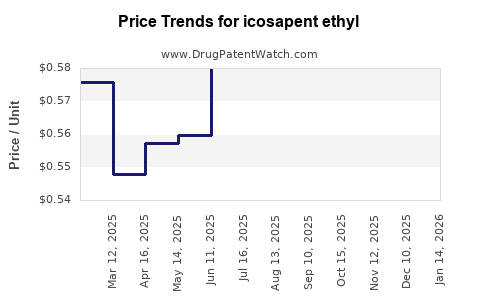
Last updated: September 22, 2026
Icosapent ethyl, marketed primarily as Vascepa by Amarin, moved from a niche triglyceride-lowering product to a cardiovascular-risk reduction therapy after the 2019 REDUCE-IT label expansion. Its commercial trajectory then reversed when generic competition entered the U.S. market in late 2020. U.S. revenue declined from approximately $614 million in 2020 to about $311 million in 2023, reflecting rapid price erosion, payer pressure, patent litigation losses and limited differentiation among generic products.
The product retains clinical value in selected statin-treated patients with elevated triglycerides, but its commercial position is substantially weaker than before generic entry. Growth opportunities are concentrated in branded international markets, adherence to the FDA-approved cardiovascular indication and potential expansion of generic utilization.
What is icosapent ethyl and how does it work?
Icosapent ethyl is a highly purified ethyl ester of eicosapentaenoic acid, or EPA. It is an omega-3 fatty acid product administered orally in capsule form.
The FDA-approved uses are:
| Indication |
FDA status |
| Severe hypertriglyceridemia, triglycerides at least 500 mg/dL |
Approved in 2012 |
| Reduction of cardiovascular risk in adults with elevated triglycerides, established cardiovascular disease or diabetes plus additional risk factors, and statin therapy |
Approved in 2019 |
The cardiovascular indication is based on the REDUCE-IT trial, which enrolled statin-treated patients with controlled LDL cholesterol and triglycerides generally between 135 and 499 mg/dL. The trial reported a 25% relative reduction in the primary composite cardiovascular endpoint compared with placebo, although the placebo contained mineral oil and the trial’s design has been debated in the medical literature (Bhatt et al., 2019).
Icosapent ethyl is different from mixed EPA/DHA products such as prescription omega-3-acid ethyl esters. DHA-containing products can increase LDL cholesterol in some patients, while icosapent ethyl contains purified EPA.
How large is the icosapent ethyl market?
The addressable market is larger than the branded Vascepa market because icosapent ethyl is now available through generic manufacturers. Market demand is shaped by four segments:
- Patients with established atherosclerotic cardiovascular disease and persistent triglyceride elevation.
- High-risk diabetic patients receiving statins.
- Patients with severe hypertriglyceridemia.
- Patients receiving nonprescription fish-oil products without equivalent clinical evidence or regulatory standards.
The commercial market expanded sharply after the 2019 cardiovascular label. Amarin positioned Vascepa as a cardiovascular-risk reduction product rather than a conventional triglyceride medication. The strategy increased physician awareness and supported broader reimbursement, but it also created dependence on a single clinical-outcome indication.
What drives demand for icosapent ethyl?
The main demand drivers are:
- Persistent residual cardiovascular risk despite statin treatment.
- Increasing diagnosis and treatment of hypertriglyceridemia.
- Guideline recognition of purified EPA in selected high-risk patients.
- Generic availability and lower out-of-pocket cost.
- Physician familiarity with REDUCE-IT.
The main constraints are:
- Generic substitution.
- Uneven payer coverage.
- Patient adherence to a four-capsule daily regimen in the cardiovascular indication.
- Confusion between prescription icosapent ethyl and over-the-counter fish oil.
- Negative or mixed evidence from other omega-3 cardiovascular-outcome trials.
The STRENGTH trial of an EPA/DHA carboxylic acid formulation did not reduce major cardiovascular events and was stopped for futility. Its result did not directly test icosapent ethyl, but it increased skepticism about the omega-3 category and made product-specific clinical evidence more important (Nicholls et al., 2020).
What has been the financial trajectory of Vascepa?
Vascepa revenue peaked before generic competition and then declined materially.
| Fiscal year |
Approximate Amarin total revenue |
Principal commercial condition |
| 2019 |
$429 million |
Cardiovascular label expansion |
| 2020 |
$614 million |
Peak commercial period; generic entry late in year |
| 2021 |
$582 million |
Early generic erosion and litigation pressure |
| 2022 |
$372 million |
Accelerating U.S. price and volume decline |
| 2023 |
$311 million |
Mature generic competition and restructuring |
Sources include Amarin annual reports and SEC filings for the respective periods.
The 2020 revenue peak reflected the first full commercial year after the REDUCE-IT label expansion. Amarin increased sales and marketing investment, expanded its commercial organization and pursued broad physician adoption. The company’s forecast assumed that the cardiovascular indication would support long-duration branded exclusivity.
That assumption failed after a federal court found key Vascepa patents invalid in 2020. Hikma Pharmaceuticals launched a generic version, followed by additional generic manufacturers. Amarin’s U.S. revenue then declined as pharmacies and payers substituted lower-priced products.
Why did Vascepa revenue fall after 2020?
The decline had four main causes:
- Loss of enforceable patent protection for key U.S. patents.
- Launches by Hikma and other generic manufacturers.
- Rapid net-price erosion through formulary substitution and rebates.
- Reduced return on Amarin’s sales and marketing infrastructure.
The revenue decline was not driven solely by lower prescription volume. Unit demand continued in the cardiovascular-risk population, but a larger share shifted to generic icosapent ethyl at lower prices.
Amarin responded with workforce reductions, lower operating expenses and greater focus on commercial execution in Europe and other international markets. The company also reduced its reliance on a large U.S. specialty-sales infrastructure.
When did generic icosapent ethyl enter the U.S. market?
Generic icosapent ethyl entered the U.S. market in December 2020 after Hikma launched following adverse patent rulings for Amarin. The launch occurred before the expiration of all listed Vascepa patents because the relevant patents were challenged and found invalid.
Known generic suppliers have included Hikma and other manufacturers that obtained FDA approval for abbreviated new drug applications. Generic products are available in the same principal capsule strengths used for Vascepa, including 0.5-gram and 1-gram capsules, depending on the approved product.
The commercial consequence was significant because icosapent ethyl is a small-molecule oral product with no complex delivery technology. Once key composition and method-of-use patents were defeated, manufacturing barriers were limited.
What patents protected Vascepa?
Vascepa protection relied on composition, formulation and method-of-use patents. The most commercially important disputes involved patents covering the use of icosapent ethyl in patients with elevated triglycerides and cardiovascular risk.
| Patent or patent family |
General subject matter |
Commercial outcome |
| U.S. Patent No. 8,110,578 |
Icosapent ethyl composition and related product claims |
Challenged in generic litigation |
| U.S. Patent No. 8,445,524 |
Purified EPA composition and related formulations |
Challenged in generic litigation |
| U.S. Patent No. 9,700,467 |
Cardiovascular and triglyceride-related methods |
Challenged by generic applicants |
| U.S. Patent No. 10,568,861 |
Method-of-use claims associated with cardiovascular risk reduction |
Invalidated in litigation |
| Later Orange Book-listed patents |
Additional method, formulation or treatment claims |
Limited ability to prevent generic entry after core rulings |
The U.S. District Court for the District of Nevada held key Amarin patents invalid in the Hikma litigation, finding the asserted claims obvious. The Federal Circuit affirmed the invalidity ruling in 2020. That decision removed the principal legal barrier to generic launch (Amarin Pharma, Inc. v. Hikma Pharmaceuticals USA Inc., 2020).
Patent protection was therefore weakened by litigation rather than by a single predictable expiration date. The practical exclusivity date for the U.S. cardiovascular market was December 2020, when generic entry began.
What is the FDA and Orange Book status of icosapent ethyl?
Vascepa remains FDA-approved for both severe hypertriglyceridemia and cardiovascular-risk reduction. Generic icosapent ethyl products are approved through the abbreviated new drug application pathway and are therapeutically equivalent to the referenced listed drug when assigned an AB rating.
The Orange Book has historically listed Vascepa patents covering product and method-of-use claims. Orange Book listing does not guarantee enforceability. Generic applicants can file Paragraph IV certifications alleging that listed patents are invalid, unenforceable or not infringed.
In the Vascepa disputes, generic applicants used Paragraph IV certifications to challenge Amarin’s patents. The resulting litigation produced invalidity findings that permitted generic launch before the nominal expiration dates of certain patents.
Which companies have challenged Vascepa patents?
Hikma was the most commercially important challenger because it launched generic icosapent ethyl after prevailing in patent litigation. Other generic manufacturers, including Dr. Reddy’s Laboratories, Teva and Apotex, have participated in the generic supply landscape or pursued U.S. approvals.
The relevant competitive set includes:
| Company |
Role |
| Amarin |
Originator of Vascepa and holder of the primary commercial franchise |
| Hikma |
Early and significant U.S. generic entrant |
| Dr. Reddy’s Laboratories |
Generic supplier and patent challenger in the U.S. market |
| Teva |
Generic supplier with U.S. commercial infrastructure |
| Apotex |
Generic supplier and abbreviated-application participant |
| Various authorized distributors |
Pharmacy and payer supply channels |
The generic market is more fragmented than the branded market, which increases purchasing leverage for wholesalers, pharmacy benefit managers and health systems.
How strong is the icosapent ethyl patent estate?
The patent estate is commercially weak in the United States but remains more valuable in selected foreign jurisdictions and for certain product claims.
U.S. patent strength
U.S. patent strength is limited because:
- Core asserted patents were invalidated.
- Generic entry has already occurred.
- Icosapent ethyl is a conventional oral small molecule.
- Manufacturing processes do not present a major barrier.
- The REDUCE-IT clinical outcome is difficult to protect once method-of-use claims fail.
Later patents may have narrower scope, but they have limited value if they cannot block generic sale of the approved product.
International patent strength
International protection varies by country. Amarin has pursued regulatory and commercial rights through licensing and distribution arrangements, including partnerships in Europe and other markets. Foreign markets may retain branded pricing where local patents, regulatory exclusivity or reimbursement rules delay substitution.
The commercial value of these rights depends on country-specific reimbursement, generic approval timing and the ability of a local partner to promote the cardiovascular indication.
What licensing deals affect icosapent ethyl?
Amarin has used regional licensing and commercialization arrangements to expand Vascepa outside the United States. European commercialization has involved partners rather than a wholly owned infrastructure in every market.
The key commercial issue is that licensing can reduce operating expense but also transfers part of the product’s economics to regional partners. Royalty and milestone structures can preserve cash flow while limiting Amarin’s direct exposure to sales-force costs.
International arrangements have not offset the U.S. revenue decline because the U.S. was the largest and most profitable Vascepa market before generic entry.
What generic launch scenarios exist for icosapent ethyl?
Three scenarios define the current market.
Scenario 1: Continued generic price erosion
This is the base-case market structure. Multiple approved suppliers compete for pharmacy and payer volume, pushing net prices lower. Prescription volume can remain stable or grow while branded revenue contracts.
Scenario 2: Branded retention in specialist care
Vascepa can retain a portion of patients through physician preference, adherence programs, payer coverage and brand familiarity. This is most likely in cardiovascular practices that specifically follow the REDUCE-IT evidence base.
Scenario 3: International branded growth
Amarin and its partners can increase sales in countries where generic competition is delayed or where the cardiovascular indication has stronger reimbursement. The opportunity is meaningful but unlikely to reproduce the pre-2020 U.S. revenue profile.
How does icosapent ethyl compare with other omega-3 products?
| Product category |
Main component |
Cardiovascular-outcome evidence |
Generic pressure |
| Icosapent ethyl |
Purified EPA |
Positive REDUCE-IT result |
High |
| Omega-3 acid ethyl esters |
EPA plus DHA |
No equivalent outcome result for the approved class |
Very high |
| EPA/DHA carboxylic acids |
EPA plus DHA |
STRENGTH was negative |
Limited commercial success |
| OTC fish oil |
Variable EPA/DHA content |
Not equivalent to REDUCE-IT evidence |
Very high |
| Fibrates and other triglyceride drugs |
Non-omega-3 mechanisms |
Different evidence base |
Product-specific |
Icosapent ethyl’s strongest differentiation is clinical-outcome evidence in a defined statin-treated population. Its weakest commercial feature is the absence of a durable U.S. patent barrier.
What is the outlook for revenue and profitability?
The U.S. branded revenue trajectory is structurally lower than the 2020 peak. Future performance depends on prescription growth, brand retention and international contribution rather than restoration of pre-generic pricing.
Profitability should be assessed through operating expense discipline and contribution margin, not revenue alone. Amarin’s cost reductions can preserve cash flow even as Vascepa sales decline. International partnerships can reduce fixed costs, but partner royalties and country-level reimbursement limits constrain upside.
The principal financial risks are:
- Further U.S. net-price erosion.
- Increased substitution by generic icosapent ethyl.
- Weak brand reimbursement.
- Failure to expand international cardiovascular use.
- New clinical evidence that reduces physician confidence in omega-3 therapy.
- Limited ability to enforce later patents against approved generics.
The principal upside factors are:
- Broader guideline adoption of purified EPA.
- Increased generic volume at lower patient cost.
- Improved reimbursement for residual cardiovascular-risk treatment.
- International market expansion.
- Lower operating expenses at Amarin.
What patent litigation affects icosapent ethyl?
The central litigation was Amarin’s action against Hikma and related generic defendants. The court held important Vascepa patents invalid, and the Federal Circuit affirmed the result. The decision enabled generic entry and changed the economic profile of the product.
There is no comparable current litigation barrier that restores U.S. branded exclusivity for the cardiovascular indication. Any later dispute would need to involve narrower patents, different claims or specific manufacturing processes rather than the broad commercial blocking position Amarin previously sought.
Key Takeaways
- Icosapent ethyl has strong product-specific cardiovascular evidence from REDUCE-IT.
- Vascepa revenue peaked at approximately $614 million in 2020.
- U.S. generic entry began in December 2020 after key patent invalidity rulings.
- Amarin revenue fell to approximately $311 million in 2023.
- Generic competition is the dominant force in the U.S. market.
- The U.S. patent estate no longer provides reliable commercial exclusivity.
- International licensing and branded markets remain the principal growth avenues.
- The product’s clinical differentiation is stronger than its current commercial and patent protection.
- Long-term value depends on lower operating costs, generic market growth and international reimbursement.
FAQs About Icosapent Ethyl Market and Financial Outlook
Is icosapent ethyl the same as Vascepa?
Yes. Vascepa is the original branded product, while generic icosapent ethyl contains the same active ingredient and is approved through the FDA abbreviated new drug application pathway.
Can generic icosapent ethyl be used for cardiovascular-risk reduction?
Yes. Approved generic products may be substituted for Vascepa where the product labeling and state substitution rules permit. The relevant population is statin-treated patients with qualifying cardiovascular risk and elevated triglycerides.
Why did Amarin lose Vascepa exclusivity before patent expiration?
Generic applicants challenged the patents under Paragraph IV certifications. Courts found key asserted patents invalid, allowing generic launch before the nominal expiration dates of all listed patents.
Does fish oil provide the same benefit as icosapent ethyl?
No. Over-the-counter fish oil products are not equivalent in purity, dose, composition or clinical evidence. The REDUCE-IT result applies to prescription icosapent ethyl, not to generic fish-oil supplements.
What is the main investment risk for icosapent ethyl?
The main risk is continued U.S. price erosion from generic competition. International sales and operating-cost reductions can support the business, but they do not recreate the economics of a U.S. branded cardiovascular franchise with market exclusivity.
References
-
Amarin Corporation plc. (2021). Annual report pursuant to Section 13 or 15(d) of the Securities Exchange Act of 1934 for the fiscal year ended December 31, 2020. U.S. Securities and Exchange Commission.
-
Amarin Corporation plc. (2022). Annual report pursuant to Section 13 or 15(d) of the Securities Exchange Act of 1934 for the fiscal year ended December 31, 2021. U.S. Securities and Exchange Commission.
-
Amarin Corporation plc. (2023). Annual report pursuant to Section 13 or 15(d) of the Securities Exchange Act of 1934 for the fiscal year ended December 31, 2022. U.S. Securities and Exchange Commission.
-
Amarin Corporation plc. (2024). Annual report pursuant to Section 13 or 15(d) of the Securities Exchange Act of 1934 for the fiscal year ended December 31, 2023. U.S. Securities and Exchange Commission.
-
Bhatt, D. L., Steg, P. G., Miller, M., Brinton, E. A., Jacobson, T. A., Ketchum, S. B., Doyle, R. T., Juliano, R. A., Jiao, L., Granowitz, C., Tardif, J.-C., & Ballantyne, C. M. (2019). Cardiovascular risk reduction with icosapent ethyl for hypertriglyceridemia. New England Journal of Medicine, 380(1), 11-22.
-
Food and Drug Administration. (2024). Vascepa (icosapent ethyl) prescribing information. U.S. Department of Health and Human Services.
-
Nicholls, S. J., Lincoff, A. M., Garcia, M., Bash, D., Ballantyne, C. M., Barter, P. J., Davidson, M. H., Kastelein, J. J. P., Koenig, W., McGuire, D. K., Mozaffarian, D., Ridker, P. M., Ray, K. K., & Wolski, K. (2020). Effect of high-dose omega-3 fatty acids vs corn oil on major cardiovascular events in patients at high cardiovascular risk: The STRENGTH randomized clinical trial. JAMA, 324(22), 2268-2280.
-
Amarin Pharma, Inc. v. Hikma Pharmaceuticals USA Inc., 70 F.4th 145 (Fed. Cir. 2023).