Last updated: August 11, 2026
VASCEPA, Amarin’s prescription icosapent ethyl product, moved from rapid commercial expansion after its 2019 cardiovascular-risk approval to severe revenue erosion after generic entry. U.S. sales peaked above $600 million in 2020, then declined to approximately $228 million in 2023. The principal drivers were generic competition, loss of practical exclusivity after adverse patent litigation, reduced sales-force investment, and limited international scale.
How did VASCEPA revenue change over time?
VASCEPA revenue peaked in 2020 and has declined each year since.
| Fiscal year |
Approximate Amarin revenue |
Primary market condition |
| 2019 |
$430 million |
Cardiovascular indication approved late in the year |
| 2020 |
$614 million |
Early expansion after FDA approval for cardiovascular-risk reduction |
| 2021 |
$580 million |
Continued growth, followed by patent litigation setbacks |
| 2022 |
$369 million |
Generic launch and accelerated price pressure |
| 2023 |
$228 million |
Mature generic erosion and reduced commercial spending |
Sources: Amarin annual reports and Form 10-K filings [1-5].
The 2020 revenue peak reflected the December 2019 FDA approval of VASCEPA to reduce cardiovascular risk in adults with elevated triglycerides and established cardiovascular disease or diabetes plus additional risk factors. The expanded indication substantially enlarged the addressable market beyond patients treated only for severe hypertriglyceridemia.
The subsequent decline was structural rather than cyclical. Generic icosapent ethyl products entered the U.S. market, lowering average selling prices and reducing branded prescription volume. Amarin also reduced its U.S. commercial infrastructure and shifted its operating model toward a smaller, more focused business.
What is VASCEPA and which market does it target?
VASCEPA is a purified prescription formulation of icosapent ethyl, an ethyl ester of eicosapentaenoic acid. It is marketed in 0.5-gram and 1-gram capsules. The product has two principal FDA-approved uses:
- As an adjunct to diet for adults with severe hypertriglyceridemia.
- In combination with a statin to reduce the risk of myocardial infarction, stroke, coronary revascularization, and unstable angina in specified high-risk adults.
The cardiovascular indication was based principally on the REDUCE-IT outcomes trial, which enrolled statin-treated patients with elevated triglycerides and controlled low-density lipoprotein cholesterol. The trial reported a statistically significant reduction in major cardiovascular events for icosapent ethyl compared with placebo [6].
The commercial opportunity was large because the product addressed residual cardiovascular risk in statin-treated patients rather than replacing statins. Its limitations were cost, prescription status, adherence requirements, and the need to distinguish prescription icosapent ethyl from over-the-counter fish-oil supplements.
How did the REDUCE-IT approval change VASCEPA’s market position?
The December 2019 label expansion transformed VASCEPA from a triglyceride-lowering product into a cardiovascular-risk-reduction therapy.
Before the expansion, the market was concentrated in patients with very high triglycerides. After the expansion, Amarin targeted cardiologists, primary-care physicians, endocrinologists, and patients with atherosclerotic cardiovascular disease or diabetes. The relevant commercial market became the broader residual-risk segment of statin-treated patients.
The expansion also increased payer scrutiny. Insurers had to evaluate whether patients met the indication criteria, whether triglyceride thresholds were satisfied, and whether the cardiovascular benefit justified the branded price relative to generic lipid therapies.
When did VASCEPA lose exclusivity?
VASCEPA’s practical market exclusivity began to weaken in 2020 and ended materially with generic launches in 2021-2022.
FDA regulatory exclusivity and patent exclusivity were separate issues:
| Exclusivity element |
Timing and effect |
| Original approval |
2012 approval for severe hypertriglyceridemia |
| Expanded cardiovascular indication |
Approved December 2019 |
| Regulatory exclusivity |
Covered the relevant approval and clinical-data period but did not prevent all generic entry indefinitely |
| Patent protection |
Multiple formulation, composition, and method-of-use patents were listed or asserted |
| Practical exclusivity |
Undermined by federal court findings that key asserted patents were invalid and by generic launches |
The key commercial event was the federal litigation involving Hikma Pharmaceuticals and other generic manufacturers. In 2020, the U.S. District Court for the District of Delaware held asserted VASCEPA patents invalid for obviousness in litigation involving generic defendants. The Federal Circuit later affirmed the core invalidity ruling, removing a significant barrier to generic competition [7-9].
What patents protect VASCEPA?
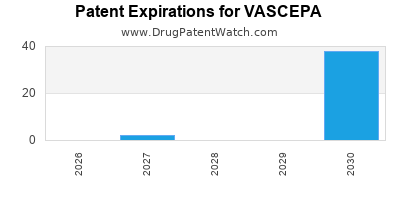
VASCEPA’s patent estate included patents directed to icosapent ethyl compositions, purity characteristics, dosing, and cardiovascular-risk-reduction methods. Patents frequently associated with Amarin’s VASCEPA litigation included U.S. Patent Nos. 9,700,158 and 10,568,861, along with related patents asserted against generic manufacturers [7-9].
The estate’s commercial strength was reduced by three factors:
- Key patents were challenged through Paragraph IV certifications.
- The asserted claims were held invalid for obviousness.
- The FDA-approved cardiovascular label created a difficult but litigable boundary between authorized generic uses and induced infringement.
Amarin’s patent strategy depended heavily on method-of-use claims covering cardiovascular-risk reduction. Those claims could have delayed generic competition if upheld. The court rulings instead enabled abbreviated new drug application, or ANDA, applicants to proceed.
What formulations are protected by VASCEPA patents?
The relevant intellectual-property portfolio covered prescription icosapent ethyl formulations and related pharmaceutical compositions. The product’s differentiation did not depend on a complex delivery device or biologic manufacturing process. That reduced manufacturing barriers once the principal patents were weakened.
Generic manufacturers could produce capsules using the same active pharmaceutical ingredient, subject to FDA bioequivalence and quality requirements. This made VASCEPA more exposed to price competition than products protected by injectable devices, complex biologics, or specialized manufacturing platforms.
Which companies challenged VASCEPA patents?
The principal U.S. generic challengers included Hikma Pharmaceuticals and Dr. Reddy’s Laboratories. Other generic companies pursued icosapent ethyl approvals or entered the market after patent disputes and related settlement arrangements.
The litigation centered on Paragraph IV certifications, which assert that listed patents are invalid, unenforceable, or not infringed. Amarin sued generic applicants to trigger the statutory 30-month stay applicable to relevant ANDAs. The resulting court decisions determined that the litigation did not provide durable protection for the branded product.
The case had an important commercial consequence: once the asserted patents were found invalid, multiple generic manufacturers had an incentive to launch rather than wait for later patent expiration dates.
What is the FDA and Orange Book status of VASCEPA?
VASCEPA remains an FDA-approved prescription product. Generic icosapent ethyl products have also received FDA approval through the ANDA pathway.
The FDA Orange Book has been central to the dispute because listed patents define the patent certifications required from generic applicants. The presence of a listed patent does not guarantee effective market protection. A generic applicant can file a Paragraph IV certification, and a court can later determine that the patent is invalid or not infringed.
The regulatory distinction between VASCEPA and generic icosapent ethyl is limited. Generic products compete primarily on price and payer formulary access, while Amarin’s branded product retains advantages in brand recognition, prescriber familiarity, and commercial contracting.
How strong is the VASCEPA patent estate?
The VASCEPA patent estate is commercially weak after the principal federal court decisions.
| Strength factor |
Assessment |
| Active ingredient complexity |
Low to moderate; icosapent ethyl is a defined small molecule |
| Manufacturing barrier |
Low relative to biologics and complex injectables |
| Formulation differentiation |
Moderate, but vulnerable to generic replication |
| Method-of-use protection |
Historically important, but weakened by invalidity findings |
| Litigation record |
Unfavorable for key asserted patents |
| Remaining commercial protection |
Limited and insufficient to block broad generic competition |
The product’s clinical evidence remains a commercial asset, but clinical differentiation does not substitute for enforceable exclusivity. Generic manufacturers can rely on the same active ingredient and demonstrate bioequivalence without reproducing Amarin’s full commercial investment in REDUCE-IT.
What generic entry risks exist for VASCEPA?
Generic entry creates four principal risks.
First, price compression reduces net revenue even when prescription volume remains substantial. Second, payer substitution moves prescriptions from the branded product to lower-cost generic products. Third, pharmacy-level substitution can occur without a prescriber actively selecting the generic. Fourth, reduced sales supports can weaken physician awareness and refill persistence.
The impact is greater because VASCEPA is an oral capsule with no major administration barrier. Generic manufacturers do not need to build infusion centers, specialty pharmacies, or complex distribution networks.
Generic products also create a labeling dynamic. Amarin has argued that the cardiovascular-risk-reduction indication is clinically important and that generic labeling and promotional conduct must be evaluated under patent and regulatory rules. Generic applicants, however, can use carve-out labeling strategies where legally permissible.
How does VASCEPA compare with competing omega-3 products?
| Product or class |
Active ingredient |
Main positioning |
Competitive effect |
| VASCEPA |
Icosapent ethyl |
Cardiovascular-risk reduction and triglyceride lowering |
Original branded product; now exposed to generic substitution |
| Generic icosapent ethyl |
Icosapent ethyl |
Equivalent prescription therapy |
Main source of price and share pressure |
| Lovaza and generic omega-3 acid ethyl esters |
EPA plus DHA |
Severe hypertriglyceridemia |
Lower-cost alternative, but not clinically identical |
| Epanova |
Omega-3 carboxylic acids |
Hypertriglyceridemia |
Failed to establish a durable commercial position |
| Over-the-counter fish oil |
Variable EPA/DHA content |
Consumer supplementation |
Competes for awareness but is not a direct regulatory substitute |
VASCEPA’s strongest historical differentiator was the REDUCE-IT cardiovascular-outcomes evidence. Other omega-3 products cannot automatically be treated as clinically interchangeable because their active ingredients, formulations, trial data, and approved indications differ.
The presence of generic icosapent ethyl removes much of the economic value of that differentiation for payers. It does not eliminate the clinical distinction between icosapent ethyl and mixed EPA/DHA products, but it sharply reduces the premium available to Amarin.
What licensing deals and geographic markets matter?
Amarin pursued regional commercialization and licensing arrangements outside the United States, including partnerships associated with Canada, Europe, the Middle East, and China. These arrangements were intended to reduce the cost of building independent commercial organizations and to expand VASCEPA beyond the U.S. market.
International performance did not replace the U.S. opportunity. The United States generated the majority of VASCEPA’s commercial value, while regulatory approvals, reimbursement policies, local partners, and differing cardiovascular-treatment guidelines limited global scale.
Amarin later narrowed its international operating footprint and concentrated resources on the U.S. business. The company’s international strategy therefore shifted from broad commercial expansion toward selective licensing and partner-led activity [1-5].
What patent litigation affects VASCEPA?
The most important litigation was Amarin’s infringement action against generic applicants, including Hikma and Dr. Reddy’s. The Delaware court’s obviousness rulings against key patents materially changed the competitive timeline. The Federal Circuit’s later decision reinforced the loss of patent leverage [7-9].
The litigation outcome affected:
- The timing of generic launches.
- The value of Amarin’s Orange Book listings.
- The bargaining position in generic settlements.
- The expected duration of branded pricing.
- Investor projections for VASCEPA revenue.
A settlement can delay generic entry when it preserves enforceable patent rights or provides a negotiated launch date. In VASCEPA’s case, the adverse validity findings reduced the ability to rely on settlement economics as a long-term protection strategy.
Is there biosimilar risk for VASCEPA?
There is no biosimilar risk because VASCEPA is a chemically synthesized small-molecule drug, not a biologic. The relevant competitive pathway is the FDA ANDA process for generic drugs.
This distinction matters financially. Generic manufacturers can generally rely on abbreviated approval requirements and do not need to conduct a full comparative clinical-development program equivalent to a biosimilar development package.
What are the likely VASCEPA launch scenarios?
Continued branded erosion
This is the base-case scenario. Generic icosapent ethyl maintains formulary and pharmacy advantages, while Amarin retains a smaller branded segment supported by physician familiarity and patients who remain on the branded product.
Stable niche brand
Amarin may preserve a limited premium segment through contracting, prescriber loyalty, and confidence in the VASCEPA brand. This scenario supports ongoing revenue but not a return to peak sales.
Generic price compression
If several manufacturers compete aggressively, generic prices fall and the branded product loses further share. Amarin’s revenue could decline faster than prescription volume because average net price would fall.
Partner-led international recovery
International licensing could produce incremental revenue, but the commercial upside is unlikely to offset U.S. generic erosion unless a partner achieves materially stronger reimbursement and physician adoption than prior efforts.
What is the financial outlook for Amarin and VASCEPA?
VASCEPA remains commercially relevant but no longer has the financial profile of a protected growth product. The product’s revenue trajectory is now driven by generic penetration, net pricing, payer coverage, and operating-cost discipline.
The central investment question is no longer whether REDUCE-IT supports clinical value. It is whether Amarin can convert residual brand demand, licensing revenue, and cost reductions into sustainable cash generation after generic entry.
Revenue fell by approximately 63% from the 2020 peak to 2023. That decline indicates that the U.S. commercial franchise has moved from expansion to defense. Future value depends on the durability of the remaining branded share and the company’s ability to operate profitably at a lower revenue base.
Key Takeaways
- VASCEPA revenue peaked at approximately $614 million in 2020.
- Revenue declined to approximately $228 million in 2023 after generic entry and patent setbacks.
- The December 2019 cardiovascular-risk-reduction approval created the product’s largest market opportunity.
- Hikma, Dr. Reddy’s, and other generic manufacturers challenged Amarin’s patent estate through Paragraph IV filings.
- Key asserted patents were held invalid for obviousness, weakening the Orange Book protection strategy.
- Generic icosapent ethyl is the main competitive threat; biosimilars are irrelevant.
- VASCEPA’s clinical evidence remains differentiated from mixed EPA/DHA products, but that differentiation does not preserve branded pricing after generic entry.
- The product’s future financial value is based on residual brand demand, payer contracting, partner revenue, and cost control rather than renewed exclusivity.
FAQs
Is VASCEPA still protected by patents?
Some patent rights may remain listed or enforceable, but key patents asserted against major generic challengers were found invalid for obviousness. Those rulings materially reduced effective exclusivity.
Are generic icosapent ethyl products clinically the same as VASCEPA?
They contain the same active ingredient and are approved through the ANDA pathway. Clinical substitution decisions remain subject to product labeling, payer rules, and prescriber judgment.
Why did VASCEPA sales fall after the REDUCE-IT approval?
The product initially grew after the cardiovascular indication, but later lost commercial protection when generic manufacturers entered following unfavorable patent litigation outcomes.
Does fish oil provide the same benefit as VASCEPA?
No direct equivalence can be assumed. Over-the-counter fish oil products vary in composition and dose, while VASCEPA contains purified icosapent ethyl and has cardiovascular-outcomes evidence from REDUCE-IT.
Can Amarin recover VASCEPA revenue through international licensing?
Licensing can provide incremental revenue and reduce commercial costs, but international partnerships are unlikely to fully offset U.S. generic erosion without substantial reimbursement and market-access gains.
References
- Amarin Corporation plc. (2021). Annual report pursuant to Section 13 or 15(d) of the Securities Exchange Act of 1934 for the fiscal year ended December 31, 2020.
- Amarin Corporation plc. (2022). Annual report pursuant to Section 13 or 15(d) of the Securities Exchange Act of 1934 for the fiscal year ended December 31, 2021.
- Amarin Corporation plc. (2023). Annual report pursuant to Section 13 or 15(d) of the Securities Exchange Act of 1934 for the fiscal year ended December 31, 2022.
- Amarin Corporation plc. (2024). Annual report pursuant to Section 13 or 15(d) of the Securities Exchange Act of 1934 for the fiscal year ended December 31, 2023.
- U.S. Food and Drug Administration. (2019). FDA approves use of Vascepa to reduce risk of cardiovascular events in certain patient groups.
- Bhatt, D. L., Steg, P. G., Miller, M., Brinton, E. A., Jacobson, T. A., Ketchum, S. B., Doyle, R. T., Juliano, R. A., Jiao, L., Granowitz, C., Tardif, J.-C., & Ballantyne, C. M. (2019). Cardiovascular risk reduction with icosapent ethyl for hypertriglyceridemia. New England Journal of Medicine, 380(1), 11-22.
- Amarin Pharma, Inc. v. Hikma Pharmaceuticals International Ltd., 24 F.4th 1367 (Fed. Cir. 2022).
- Amarin Pharma, Inc. v. Hikma Pharmaceuticals USA Inc., No. 19-883, U.S. District Court for the District of Delaware.
- U.S. Patent and Trademark Office. (2024). Patent Center and Patent Examination Data System records for VASCEPA-related patents.