Last updated: September 9, 2026
Guaifenesin is a mature, low-cost over-the-counter expectorant with limited standalone patent protection. Its commercial value comes from brand equity, retail distribution, combination products, seasonal demand, and formulation execution rather than from exclusivity. The principal branded products are Mucinex, owned by Reckitt, and Robitussin products sold by Haleon. Generic and private-label guaifenesin products create substantial price competition.
What is the current market position of guaifenesin?
Guaifenesin is an FDA-recognized OTC expectorant used to loosen phlegm and thin bronchial secretions. It is sold in immediate-release tablets, extended-release tablets, liquid syrups, capsules, dissolvable products, and combination cough, cold, and congestion products.
The market has four main segments:
| Segment |
Primary products |
Competitive basis |
| Branded expectorants |
Mucinex, select Robitussin products |
Brand recognition, advertising, retail placement |
| Generic products |
Store brands and pharmacy generics |
Price and availability |
| Combination products |
Guaifenesin with dextromethorphan, pseudoephedrine, acetaminophen or antihistamines |
Convenience and symptom coverage |
| Pediatric and liquid products |
Syrups, oral solutions and age-specific products |
Dosing, flavor and packaging |
Mucinex is the strongest dedicated guaifenesin brand in the U.S. Reckitt markets Mucinex in immediate-release and extended-release formats, including products containing guaifenesin alone and products combined with dextromethorphan or other active ingredients. Haleon’s Robitussin portfolio has broader cough and cold positioning and includes guaifenesin-containing formulations.
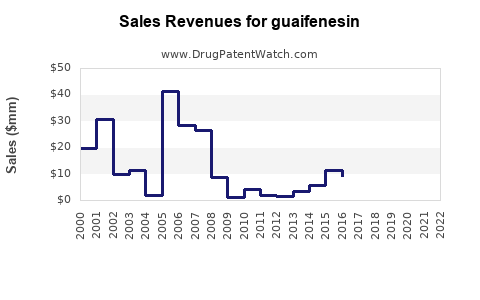
Global market reports generally place the guaifenesin market in the high hundreds of millions to low single-digit billions of U.S. dollars, depending on whether the estimate includes combination products, regional retail sales, contract-manufactured products and adjacent expectorant categories. These estimates are not directly comparable because companies do not report guaifenesin revenue as a distinct audited line item.
How large is the guaifenesin market and how is it growing?
Public company filings do not disclose global guaifenesin revenue separately. Reckitt reports guaifenesin exposure within its broader U.S. and international over-the-counter portfolio, while Haleon reports products within broader respiratory-health categories. This limits the precision of product-level revenue analysis.
The market’s financial trajectory is shaped by five factors:
- Seasonal respiratory illness cycles.
- Pricing and promotional activity in mass retail and pharmacy channels.
- Brand-to-private-label substitution.
- Growth in combination products.
- Expansion of organized retail and self-medication in emerging markets.
Growth is generally low to mid-single digit in established markets. Unit growth is constrained by the maturity of the category, while dollar growth can be higher during periods of inflation, supply disruption or premiumization.
The category experienced unusual demand volatility during the COVID-19 period. Early pandemic stocking increased demand for some OTC respiratory products, followed by normalization. Later changes in respiratory-virus circulation and consumer purchasing patterns created uneven sales across cough and cold products. These effects make short-term revenue comparisons less useful than multiyear trends.
Financial exposure of major manufacturers
| Company |
Relevant guaifenesin exposure |
Public revenue disclosure |
| Reckitt |
Mucinex and related respiratory products |
Reported within consumer-health categories, not as standalone guaifenesin revenue |
| Haleon |
Robitussin and combination cough products |
Reported within respiratory or broader consumer-health portfolios |
| Perrigo |
Store-brand and private-label OTC products; manufacturing exposure |
Reported by segment, not active ingredient |
| Kenvue and retailers |
Potential private-label and retail-channel exposure |
Product-level guaifenesin revenue generally not disclosed |
| Regional generic manufacturers |
Tablets, liquids and contract-manufactured products |
Mostly private or aggregated reporting |
Reckitt’s Mucinex franchise has greater direct exposure to guaifenesin than most competitors because of the brand’s dedicated expectorant positioning. Haleon has a broader respiratory portfolio, which reduces dependence on guaifenesin alone but increases exposure to competitive substitution across cough and cold products.
What FDA regulatory status applies to guaifenesin?
Guaifenesin is regulated in the United States as an OTC drug under the FDA’s OTC cough-cold framework. The relevant regulatory provisions appear in 21 C.F.R. Part 341, including the expectorant monograph provisions for guaifenesin.
Common adult dosing includes:
- Immediate-release products: 200 to 400 mg every four hours.
- Extended-release products: 600 to 1,200 mg every 12 hours.
- Maximum daily amounts depend on the specific product labeling and formulation.
FDA OTC monograph compliance can allow marketing without an approved new drug application when the product satisfies the applicable monograph conditions, labeling rules, dosage requirements and manufacturing obligations. Products outside the monograph may require an FDA application or another lawful regulatory pathway.
The FDA has also moved OTC monograph regulation toward the administrative-order system created by the CARES Act. This transition changes the procedural framework for monograph amendments but does not create new exclusivity for an old active ingredient such as guaifenesin.
What is the Orange Book status of guaifenesin?
Guaifenesin itself does not have meaningful Orange Book protection comparable to a recently approved prescription drug. The active ingredient has been marketed for decades, and ordinary OTC guaifenesin products are generally governed by the OTC monograph system rather than by product-specific new-drug exclusivity.
Orange Book analysis may still be relevant to a particular prescription or NDA product containing guaifenesin, but it is not the central market-access mechanism for ordinary Mucinex, Robitussin or private-label OTC products.
There is no conventional Orange Book patent cliff for guaifenesin. Competitive entry is driven by formulation development, monograph compliance, manufacturing capacity and retailer access.
What patents protect guaifenesin products?
The base molecule has no commercially meaningful remaining composition-of-matter patent protection. Guaifenesin was discovered and commercialized many decades ago, making a new-molecule patent barrier unavailable.
Potential patent categories include:
| Patent category |
Current commercial relevance |
| Guaifenesin composition patents |
Expired or commercially irrelevant |
| Extended-release matrices |
Historically important but generally vulnerable to expiration and design-around |
| Bilayer or multilayer tablets |
May protect a specific manufacturing or release configuration |
| Combination formulations |
May cover particular active-ingredient ratios or release profiles |
| Liquid and pediatric formulations |
Possible claims to flavoring, dosing or stability systems |
| Packaging and delivery systems |
Narrow, product-specific protection |
| Manufacturing processes |
Potentially confidential or narrow; rarely a broad market barrier |
Patents on extended-release guaifenesin products can be more relevant than patents on the active ingredient. However, a formulation patent protects only the claimed composition or process. It does not prevent competitors from selling immediate-release guaifenesin, a different extended-release matrix, a liquid formulation or a combination product that falls outside the claims.
Patent strength is therefore moderate to low at the market level and potentially stronger for an individual product if the formulation has difficult-to-design-around release characteristics.
When does guaifenesin lose exclusivity?
Guaifenesin has already lost practical molecular exclusivity. No meaningful future loss-of-exclusivity event is expected for the active ingredient.
| Exclusivity element |
Status |
| Composition-of-matter patent |
Expired |
| Regulatory exclusivity for the active ingredient |
Not commercially relevant |
| OTC monograph access |
Available subject to compliance |
| Brand protection |
Maintained through trademarks, advertising and distribution |
| Formulation protection |
Product-specific and dependent on patent scope |
| Biosimilar exclusivity |
Not applicable |
Mucinex and Robitussin retain commercial differentiation through trademarks, packaging, consumer recognition and retail execution. Those protections do not prevent generic guaifenesin competition.
What generic entry risks exist for guaifenesin?
Generic entry risk is structurally high. Store brands can sell guaifenesin in comparable strengths and dosage forms, often at substantial discounts to branded products.
The main entry scenarios are:
Immediate-release generic entry
This is the lowest-barrier scenario. Manufacturers can produce standard tablets, capsules and oral liquids if they meet the OTC monograph, current good manufacturing practice and labeling requirements.
Extended-release competition
Extended-release products require greater formulation and process control. Competitors must demonstrate appropriate release characteristics and maintain product consistency. This raises technical execution risk but does not create a durable barrier if the formulation can be designed around existing claims.
Combination-product entry
Combination products can compete against Mucinex DM and similar products. The commercial barrier is often regulatory and operational rather than patent-based because manufacturers must manage multiple active ingredients, dosing limits, warnings and stability requirements.
Private-label substitution
Retailers can replace branded guaifenesin products with store-brand equivalents. This places pressure on price, shelf space and promotional spending. Private-label competition is especially strong for single-ingredient products.
Are there Paragraph IV challenges for guaifenesin?
Paragraph IV litigation is not a central risk for ordinary OTC guaifenesin products. Paragraph IV certifications apply to abbreviated new drug applications challenging listed patents for approved products. Most monograph-compliant guaifenesin products do not depend on the type of NDA-based Orange Book patent structure that generates repeated Paragraph IV litigation.
A formulation-specific NDA could create a Paragraph IV pathway, but that would concern the particular listed formulation and not guaifenesin as a molecule. Publicly visible patent disputes around mainstream guaifenesin products have not created a market-wide exclusivity barrier.
What patent litigation affects guaifenesin?
Guaifenesin is not associated with a current, molecule-level patent litigation campaign comparable to major branded prescription medicines. Litigation risk is more likely to arise from:
- A specific extended-release formulation.
- A combination product.
- Trade dress or trademark rights.
- Manufacturing-process disputes.
- Contract manufacturing or supply agreements.
- Product liability and labeling claims.
The absence of major molecule-level litigation lowers legal barriers for entrants. It does not eliminate commercial disputes involving branded packaging, advertising claims, product quality or supply arrangements.
Are there biosimilar risks for guaifenesin?
No. Guaifenesin is a small-molecule chemical drug, not a biologic. Biosimilar regulation under the Public Health Service Act does not apply.
The relevant competitive threats are generic, private-label and authorized-equivalent products. This distinction matters because biosimilar interchangeability, biologic reference-product exclusivity and biologic patent settlements are not part of the guaifenesin market.
What formulations are protected by guaifenesin patents?
The formulations with the greatest potential for differentiated protection are:
- Twelve-hour extended-release tablets.
- Bilayer tablets combining immediate and extended release.
- Guaifenesin-dextromethorphan products.
- Pediatric liquids with improved taste and stability.
- Multi-symptom products using controlled release.
- Products using specialized excipients or manufacturing processes.
Protection is usually narrower than the product label suggests. A patent covering a particular release profile, excipient combination or tablet architecture may not cover every product delivering guaifenesin over an equivalent period.
Formulation economics also matter. A technically defensible formulation has limited value if competitors can sell a lower-priced product with comparable consumer performance.
How does guaifenesin compare with competing expectorants?
Guaifenesin is the dominant conventional oral expectorant in the U.S. OTC market. Its main competition is indirect rather than molecule-for-molecule.
| Product or category |
Primary role |
Competitive relationship |
| Guaifenesin |
Expectorant |
Core category |
| Dextromethorphan |
Cough suppressant |
Often combined with guaifenesin |
| Bromhexine or ambroxol |
Mucolytic/expectorant |
More relevant in international markets |
| Acetylcysteine |
Mucolytic |
Stronger clinical and hospital relevance in some markets |
| Pseudoephedrine and phenylephrine |
Decongestants |
Combination-product competitors |
| Honey and non-drug remedies |
Symptom relief |
Consumer substitution, especially in pediatric use |
Guaifenesin benefits from a simple regulatory position, broad consumer familiarity and extensive retail availability. Its weaknesses are low switching costs, limited scientific differentiation and heavy price competition.
What licensing deals affect guaifenesin?
Guaifenesin has limited licensing value at the active-ingredient level. The molecule is widely available and no longer supports a conventional exclusivity-based licensing model.
Commercial agreements are more likely to involve:
- Brand licensing in specific territories.
- Contract manufacturing.
- Private-label supply.
- Distribution rights.
- Combination-product commercialization.
- Retailer-exclusive packaging.
The Reckitt ownership of Mucinex followed its acquisition of Adams Respiratory Therapeutics in 2008. That transaction transferred a branded respiratory portfolio, including Mucinex, rather than licensing exclusivity in guaifenesin itself. Mucinex remains a strategic brand asset within Reckitt’s consumer-health business.
What is the geographic coverage of guaifenesin products?
The United States is the most commercially important market for Mucinex and guaifenesin-based extended-release products. Canada, Latin America, Europe and Asia-Pacific have broader variation in expectorant preferences, permitted ingredients, dosing conventions and OTC classifications.
Geographic barriers include:
- Different monograph or registration requirements.
- Local rules for combination products.
- Country-specific labeling and pediatric restrictions.
- Regional preferences for syrups, sachets or tablets.
- Local manufacturing and import requirements.
- Trademark availability and brand recognition.
A manufacturer with U.S. OTC expertise may still need separate regulatory and commercial strategies for Europe and emerging markets.
What manufacturing and intellectual-property barriers exist?
Manufacturing barriers are higher than molecule-level patent barriers but lower than barriers for complex drug delivery systems. Standard immediate-release guaifenesin is relatively accessible to qualified manufacturers. Extended-release products require tighter controls over:
- Particle size and active-ingredient distribution.
- Excipient selection.
- Compression and coating parameters.
- Dissolution profiles.
- Batch-to-batch uniformity.
- Stability under temperature and humidity stress.
Supply-chain risk can affect margins because guaifenesin products are low-cost and often manufactured at high volume. A recall, raw-material shortage or contract-manufacturer disruption can shift retail share quickly.
What is the likely financial trajectory for guaifenesin?
The base case is stable, low-growth revenue with periodic seasonal volatility. Branded manufacturers can sustain dollar sales through price increases, premium packaging, combination products and advertising, but unit share remains exposed to generic substitution.
Base-case outlook
- Mature U.S. single-ingredient products: flat to modest unit growth.
- Extended-release branded products: better margin retention than basic tablets.
- Combination products: moderate growth where consumers prefer multi-symptom treatment.
- Private label: continued share pressure.
- Emerging markets: higher volume growth but lower average selling prices.
- Patent-derived margin expansion: unlikely.
The most valuable commercial assets are brand recognition, retailer relationships, formulation know-how and reliable supply. Patent ownership alone is unlikely to support a premium valuation for guaifenesin products.
Key Takeaways
- Guaifenesin is a mature OTC expectorant with no meaningful molecular exclusivity.
- Mucinex, owned by Reckitt, is the leading dedicated branded franchise in the U.S.
- Robitussin, owned by Haleon, provides broader respiratory competition.
- Generic and private-label entry risk is high, especially for immediate-release products.
- Extended-release and combination formulations can have narrower formulation patents, but those rights are product-specific.
- Paragraph IV litigation and biosimilar competition are not central market risks.
- FDA access is primarily governed by the OTC monograph framework and applicable manufacturing and labeling requirements.
- Public companies do not report guaifenesin revenue as a standalone audited metric.
- Long-term financial performance depends on brand equity, seasonal demand, combination products, pricing and distribution.
- The category has stable commercial value but limited patent-based upside.
FAQs About Guaifenesin Market and Patent Risk
Is Mucinex protected by a guaifenesin patent?
Mucinex’s commercial position is based mainly on brand rights, formulation differentiation, distribution and marketing. Any formulation patents apply to specific product designs and do not provide broad exclusivity over guaifenesin.
Can a generic manufacturer sell guaifenesin without a Paragraph IV filing?
A manufacturer marketing a compliant OTC monograph product generally does not follow the same Paragraph IV process used to challenge patents listed for many prescription NDAs. Product-specific NDA patents may create a different pathway.
Does guaifenesin have FDA-approved prescription exclusivity?
Guaifenesin’s mainstream commercial market is OTC. It does not have a current prescription-style exclusivity position that controls ordinary guaifenesin retail products.
Which guaifenesin products have the highest commercial margins?
Branded extended-release and combination products generally have greater pricing power than basic immediate-release tablets. Margin depends on advertising, retailer fees, manufacturing costs and private-label competition.
Is guaifenesin a defensible pharmaceutical investment?
It is more defensible as a consumer-health brand or supply-chain asset than as a patent asset. The active ingredient has low legal barriers, while brand strength, formulation execution and distribution determine commercial durability.
References
-
Code of Federal Regulations. (2024). 21 C.F.R. Part 341: Cold, cough, allergy, bronchodilator, and antiasthmatic drug products for over-the-counter human use. U.S. Government Publishing Office.
-
Food and Drug Administration. (2020). Coronavirus Aid, Relief, and Economic Security Act: Over-the-counter monograph drug products. U.S. Department of Health and Human Services.
-
Haleon plc. (2024). Annual report and financial statements 2023. Haleon.
-
Reckitt Benckiser Group plc. (2024). Annual report and financial statements 2023. Reckitt.
-
U.S. Food and Drug Administration. (2024). Drug products marketed in the United States under the OTC monograph system. U.S. Department of Health and Human Services.
-
U.S. Food and Drug Administration. (2024). Orange Book: Approved drug products with therapeutic equivalence evaluations. U.S. Department of Health and Human Services.