Last updated: May 29, 2026
Mucinex D (Guaifenesin + Dextromethorphan HBr + Phenylephrine) Market Dynamics and Financial Trajectory: Sales Trends, Pricing, Channel Mix, and Exclusivity Drivers
Mucinex D is an over-the-counter (OTC) cold-and-flu combination brand sold in the US. Because it is not subject to FDA prescription exclusivity and does not rely on branded patent-driven monopoly pricing in the same way as Rx products, its financial trajectory is dominated by (1) OTC seasonal volume swings, (2) competitive substitution across comparable cough/cold products, (3) retailer and wholesale contracting, (4) ingredient and labeling changes driven by US decongestant policy, and (5) promotional intensity and assortment breadth at major chains.
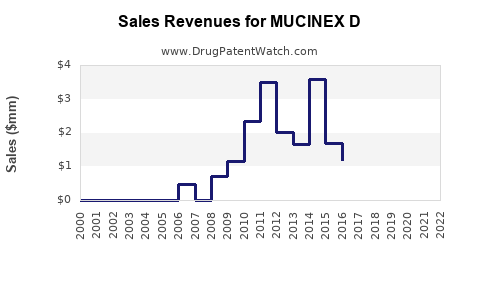
How has Mucinex D sales trended over time and what drives seasonality?
Featured snippet answer: Mucinex D’s financial trajectory tracks US respiratory seasonality (winter peak, shoulder seasons in fall/spring), with quarterly sales driven by promotional cadence, retailer inventory cycles, and mix shifts between day/night and “DM + decongestant” combinations.
What drives OTC cold/cough category unit demand?
OTC cold/cough demand is primarily seasonal and weather-linked, with category-wide spikes tied to school return and respiratory illness waves. For a multi-ingredient product like Mucinex D, unit demand also depends on consumer “symptom fit” and bundle logic, since shoppers often select by a perceived complete cold regimen rather than single-ingredient cues.
What shifts can change Mucinex D mix without changing category size?
- Dayparting: “DM” cough suppression plus nasal decongestion tends to win shoppers seeking a single “all-in-one” option.
- Form factor: tablets vs. liquid, multipacks, and value pack pricing influence conversion at checkout.
- Retail shelf strategy: planogram placement and endcap rotation are high-impact levers for OTC brands.
- Consumer sentiment: preference cycles for faster symptom relief and fewer perceived side effects can move mix between competing OTC SKUs.
Why does “OTC promotional intensity” matter for financial trajectory?
OTC brands frequently trade margin for velocity during peak season. That shows up as:
- higher retailer funded promotions,
- increased couponing (digital and circular),
- temporary price cuts or “buy more, save more” programs.
These levers can lift units while compressing net sales per unit. Over multiple years, the net effect on topline depends on whether promotions are “necessary” to defend share or “incremental” for growth.
What is the US competitive landscape for Mucinex D and how does it affect pricing and margins?
Featured snippet answer: Mucinex D competes in the “cough + decongestant” OTC segment against major pharmacy and mass private label plus large branded peers, pushing pricing down and increasing retailer-driven promotional share.
Key competitor groups by shopper decision
- Other “DM + decongestant” combinations
Shoppers comparing “all-in-one” cold products anchor on decongestant strength and cough suppression.
- Single-ingredient substitutes (retailer shelves)
Some consumers separate decongestant from cough treatment.
- Private label and store brand equivalents
Private label often expands during periods of retailer margin pressure, increasing price discipline.
Pricing architecture typical for this category
- MSRP vs net price: OTC brands usually operate with a discounted net realized price due to trade spend.
- Trade spend as a margin lever: growth can come with higher retailer deductions, shifting profitability even if revenue rises.
- Cost of goods vs promotional mix: ingredient costs and packaging drives COGS; competitive promos drive net price.
How have regulatory and formulation policies around decongestants influenced Mucinex D?
Featured snippet answer: US decongestant policy and ingredient-level constraints influence product availability, formulation eligibility, and labeling, which can alter long-run assortment and consumer switching.
Decongestant ingredient constraints: what changes in-market?
Over recent years, US policy and enforcement patterns have created pressure around OTC decongestant ingredient controls, including where and how products can be sold and what formats are permitted under specific interpretations. When restrictions tighten, manufacturers adjust:
- retail availability and channel access,
- product form factors,
- labeling content and consumer-facing claims.
For a combination decongestant product, these changes can translate into:
- assortment rationalization,
- temporary inventory disruptions,
- re-engineering of consumer messaging,
- shifts between comparable SKUs.
How does this impact financial trajectory specifically?
- Short-term: assortment changes can cause dips or timing shifts in seasonal quarters.
- Medium-term: brands that maintain supply and compliance tend to regain shelf placement, while less agile competitors lose share.
What is the Orange Book status of Mucinex D and does it have FDA exclusivity?
Featured snippet answer: Mucinex D is OTC and is not listed in the FDA Orange Book. It is not driven by prescription drug exclusivity constructs such as 5-year new chemical entity or 3-year new clinical investigation exclusivity.
Why Orange Book exclusivity doesn’t map to Mucinex D
Orange Book listings apply to approved prescription drugs with patents tied to NDA/BLA approvals. OTC products typically rely on monograph rules or OTC switch/regulatory pathways rather than Orange Book-driven patent term monopolies.
What patents protect Mucinex D and how does that differ from Rx drug patent estates?
Featured snippet answer: Mucinex D’s active ingredients are widely known commodity molecules. The practical protection story in OTC “combination” products usually centers on brand trade dress, formulation variations, and packaging/marketing rather than broad exclusionary patent estates that block generic competition.
Patent dynamics in OTC combinations
For combination products containing mature actives, patent value often concentrates in:
- specific formulations (for example, controlled release, stability, or particular excipient systems),
- manufacturing process improvements,
- brand-associated innovations with limited claims scope.
This makes the competitive landscape more fluid versus Rx brands with large, layered patent thickets.
When does Mucinex D lose market exclusivity and what are the practical end dates?
Featured snippet answer: There is no single “exclusivity end date” in the way it applies to prescription exclusivity. Market exclusivity is effectively “managed” through continuous brand investment, retail contracting, and compliance-maintained supply rather than a one-time patent expiration.
What “end-of-exclusivity” looks like in OTC markets
- incumbent advantage weakens when competitor equivalents gain shelf share,
- net price and trade spend intensify during competitive ramps,
- assortment and promotional strategy become decisive.
What settlement agreements or patent litigation affect Mucinex D?
Featured snippet answer: Mucinex D is not typically associated with high-profile prescription-style Paragraph IV or patent litigation patterns. OTC sales competition is usually resolved through regulatory clearance and retailer-driven commercial contracting rather than litigated exclusivity.
How do manufacturing and supply chain constraints affect Mucinex D financial performance?
Featured snippet answer: OTC respiratory seasons punish stockouts. Mucinex D’s financial trajectory is sensitive to ingredient sourcing stability, packaging lead times, and retailer inventory policies during peak cold weeks.
Common supply-side failure modes in this segment
- packaging capacity bottlenecks during winter,
- ingredient lead time volatility,
- inventory allocation decisions by wholesalers.
When supply is constrained, revenue can lag category demand even if consumer interest is high.
What is Mucinex D’s channel mix (mass, drugstores, e-commerce) and how does it move revenue?
Featured snippet answer: Like most OTC respiratory brands, channel mix shifts between brick-and-mortar retail (drug and mass) and e-commerce based on promotion intensity and delivery convenience, with e-commerce often amplifying the impact of couponing and multi-pack offers.
How channel mix changes net sales
- Drugstores: endcaps and promo resets are fast, supporting share defense.
- Mass retail: scale drives unit volume but can pressure net pricing.
- E-commerce: pricing is influenced by marketplace sellers and promotion mechanics, shifting realized price per unit.
How does Mucinex D compare with other Mucinex variants (Mucinex DM, Mucinex D Max, and multi-symptom SKUs)?
Featured snippet answer: Within the Mucinex family, “DM + decongestant” variants like Mucinex D typically trade higher value perception and broader symptom targeting, while simpler DM-only products often win on price and perceived tolerability. Mix across the family is often the largest driver of Mucinex branded performance.
What to monitor in competitive substitution
- share of shelf across “decongestant cold” vs “cough-only” solutions,
- SKU-level promotional frequency during peaks,
- pack size switching (trial packs vs value multipacks).
What commercial levers are most likely to shape Mucinex D’s next 12 to 24 months?
Featured snippet answer: Retail promo intensity, shelf placement in peak respiratory months, and regulatory/compliance continuity for decongestant availability are the highest-leverage levers on future revenue trajectory.
Highest-impact levers
- trade spend optimization (net price vs volume),
- supply stability leading into winter,
- differentiation via “complete symptom relief” merchandising,
- e-commerce execution and multi-pack conversion.
Key Takeaways
- Mucinex D’s financial trajectory is driven by OTC seasonal demand, retailer contracting, and promotional intensity more than by prescription-style exclusivity.
- Competitive pricing and private label pressure are central to net revenue and margin outcomes.
- Decongestant policy and compliance-driven assortment changes can cause timing shifts in seasonal quarters.
- Orange Book exclusivity frameworks do not apply to Mucinex D because it is OTC.
- The practical “protection” story is brand and commercial execution, including supply continuity and shelf presence.
FAQs
1) Is Mucinex D an FDA-approved prescription drug?
No. Mucinex D is sold as an OTC product.
2) Does Mucinex D have an Orange Book listing or listed patents tied to an NDA?
No. OTC products like Mucinex D are not typically listed in the Orange Book.
3) What ingredients determine which competitors Mucinex D faces?
Its “cough suppression plus decongestant” ingredient profile places it against other OTC multi-symptom cold products with similar functional claims.
4) How does seasonality affect quarterly performance for Mucinex D?
Sales typically peak in winter respiratory months, with demand dropping in off-season quarters.
5) What commercial metric best explains Mucinex D share changes in retail?
Shelf share and velocity during peak promo windows, reflected through net sales net of trade spend and unit movement across major chains.
References
- FDA. Orange Book: Approved Drug Products with Therapeutic Equivalence Evaluations. FDA.
- FDA. OTC Drug Facts label requirements (general). FDA.