Last updated: September 4, 2026
Flurbiprofen is a mature, low-cost nonsteroidal anti-inflammatory drug (NSAID) with declining branded value and stable niche demand. Its commercial market is fragmented across generic oral tablets, ophthalmic products, topical formulations, and over-the-counter throat lozenges. The product has no biosimilar exposure, limited patent protection in the United States, and low pricing power. Financial performance is driven by manufacturing efficiency, regulatory access, geographic reach, and formulation differentiation rather than by exclusivity.
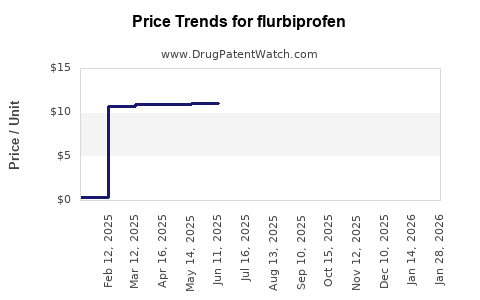
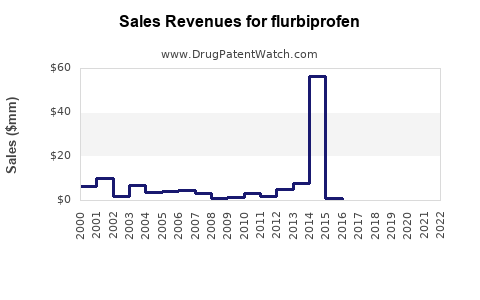
Public companies generally do not report flurbiprofen revenue separately. The drug’s financial trajectory is therefore best assessed through product status, dosage-form breadth, generic competition, pricing, and market access rather than through audited product-level sales.
What is flurbiprofen and how is it used?
Flurbiprofen is a propionic-acid NSAID that inhibits cyclooxygenase enzymes and reduces prostaglandin synthesis. It is used for pain and inflammation, but its role has narrowed as ibuprofen, naproxen, diclofenac, and newer prescription therapies compete for the same indications.
| Product category |
Common strength or form |
Primary use |
Commercial position |
| Oral tablets |
50 mg and 100 mg |
Osteoarthritis and rheumatoid arthritis |
Mature generic prescription market |
| Ophthalmic solution |
Flurbiprofen sodium 0.03% |
Inhibition of intraoperative miosis and ocular inflammation |
Specialized ophthalmic market |
| Throat lozenges |
8.75 mg |
Short-term sore-throat relief |
OTC market in several countries |
| Topical products |
Patches, gels, or creams depending on country |
Localized musculoskeletal pain |
Regional, formulation-driven market |
| Injectable products |
Country-specific |
Perioperative or acute pain |
Limited and fragmented availability |
The U.S. prescription label for flurbiprofen tablets identifies osteoarthritis and rheumatoid arthritis as indications and carries the standard NSAID warnings for gastrointestinal bleeding, cardiovascular events, renal toxicity, and hypersensitivity reactions (U.S. Food and Drug Administration [FDA], 2015a).
How large is the flurbiprofen market?
Flurbiprofen is a small product category relative to major NSAIDs. Its global market is fragmented and difficult to measure because sales occur under multiple brand names, generic labels, national registrations, hospital contracts, and OTC products.
The main market characteristics are:
- Prescription oral flurbiprofen is a low-growth generic category.
- Ophthalmic flurbiprofen is a stable but narrow surgical and ophthalmology product.
- OTC throat products provide the strongest consumer-facing commercial opportunity.
- Topical formulations create higher margins than standard tablets but are subject to local regulatory and brand competition.
- Revenue is concentrated in distributors, contract manufacturers, and regional brand owners rather than a single global originator.
Independent commercial market reports often combine flurbiprofen with broader NSAID or topical analgesic categories. Their estimates are not directly comparable because they vary in geographic scope, inclusion of OTC products, and treatment of hospital sales. A defensible public estimate of total global flurbiprofen revenue is not available.
What is the financial trajectory for flurbiprofen?
Flurbiprofen’s financial trajectory is mature to declining in conventional oral prescription products, with selective growth in differentiated OTC and topical formulations.
Prescription tablets
Oral tablets face intense generic substitution and low average selling prices. Demand is supported by:
- Established prescribing history
- Inclusion in national formularies
- Low manufacturing cost
- Familiarity among rheumatology and primary-care prescribers
- Use where a prescriber prefers flurbiprofen over other NSAIDs
Demand is constrained by:
- Generic price erosion
- Cardiovascular and gastrointestinal safety concerns
- Competition from ibuprofen, naproxen, diclofenac, celecoxib, and acetaminophen
- Reduced use of chronic NSAID therapy in higher-risk patients
- Limited promotional investment
Tablet revenue is likely to remain stable in unit terms in some markets but weak in value terms. The principal business opportunity is cost-efficient supply, not premium pricing.
Ophthalmic products
Flurbiprofen sodium ophthalmic solution has a more defensible commercial position because ophthalmic products require specialized manufacturing, sterile filling, validated packaging, and regulatory compliance. The product is used around cataract and other ocular procedures, although ophthalmic NSAID competition includes ketorolac, nepafenac, bromfenac, and diclofenac.
Ophthalmic demand is linked to:
- Cataract surgery volume
- Hospital and ambulatory surgery center formularies
- Ophthalmology procurement contracts
- Shortages or supply interruptions involving competing ophthalmic NSAIDs
- Generic availability and wholesale acquisition cost
The product has greater manufacturing barriers than tablets but remains exposed to generic competition and substitution.
OTC lozenges
Flurbiprofen 8.75 mg lozenges have a different economic profile. They compete in the consumer healthcare market against benzocaine, lidocaine, antiseptic lozenges, paracetamol, and ibuprofen products. In the United Kingdom and several other markets, flurbiprofen lozenges are sold under brands including Strefen and private-label equivalents.
OTC economics depend on:
- Brand recognition
- Retail distribution
- Advertising
- Shelf placement
- Flavor and packaging
- Country-specific OTC classification
- Retailer private-label strategy
OTC products can support higher gross margins than generic tablets, but consumer marketing and retailer deductions absorb part of the revenue advantage.
What companies manufacture or market flurbiprofen?
The market has no single global commercial owner. Manufacturers vary by country and dosage form.
Relevant commercial groups have included:
- Generic pharmaceutical manufacturers supplying flurbiprofen tablets
- Ophthalmic manufacturers producing flurbiprofen sodium solution
- Consumer-health companies marketing flurbiprofen lozenges
- Contract manufacturers supplying private-label or regional brands
- API manufacturers serving multiple finished-dose companies
The former U.S. branded oral product Ansaid was associated with Pharmacia and later Pfizer corporate ownership. The commercial importance of that brand declined as generic flurbiprofen became available. Current U.S. supply is principally generic, subject to the active-label and market-availability status of individual manufacturers (FDA, 2015a; National Library of Medicine, 2024a).
What is the FDA regulatory status of flurbiprofen?
Flurbiprofen has long-standing FDA approval as an oral prescription NSAID. Flurbiprofen sodium ophthalmic solution is also an established U.S. dosage form.
| FDA issue |
Current commercial implication |
| Oral tablets |
Generic prescription pathway; multiple potential ANDA suppliers |
| Ophthalmic solution |
Sterile ophthalmic manufacturing and product-specific approval requirements |
| OTC lozenges |
Availability depends on national regulatory status; U.S. OTC status should not be inferred from European approvals |
| Safety labeling |
Class NSAID warnings materially affect chronic-use demand |
| New drug exclusivity |
No meaningful current new-molecular-entity exclusivity |
| Biosimilar pathway |
Not applicable because flurbiprofen is a small molecule |
FDA labeling warns of increased risk of serious cardiovascular thrombotic events, gastrointestinal bleeding, ulceration, renal effects, and serious skin reactions. These warnings apply to the commercial positioning of all systemic flurbiprofen products (FDA, 2015a).
What patents protect flurbiprofen products?
The original compound and conventional oral formulations are old pharmaceutical technology. The core U.S. composition-of-matter and basic-use exclusivity are expired or no longer commercially relevant. Current value is more likely to reside in formulation, delivery, manufacturing, packaging, or local regulatory rights than in the flurbiprofen molecule itself.
Core molecule
Flurbiprofen was developed decades ago, and its foundational patent estate has expired. Generic manufacturers can generally enter the oral tablet market without a surviving compound patent blocking routine supply.
Formulation patents
Potentially relevant formulation protection may cover:
- Sustained-release or modified-release tablets
- Topical gels, creams, or patches
- Mucoadhesive throat formulations
- Taste-masked lozenges
- Ophthalmic vehicles and preservative systems
- Combination products
- Particle-size or solubility modifications
- Manufacturing processes that improve stability or sterile production
These rights are jurisdiction-specific and may not prevent ordinary immediate-release tablet entry. A formulation patent can protect a commercial product only if the accused generic practices the claimed formulation or delivery method.
Method-of-use patents
Method-of-use patents may address perioperative ophthalmic use, specific pain conditions, dosing schedules, or combinations with other agents. Their commercial effect is limited where:
- The relevant indication is not carved into a generic label
- Prescribers can use the generic for non-patented indications
- The patent is expired or unenforceable
- The dosage form is not technically covered by the claims
How many patents cover flurbiprofen?
There is no meaningful single global count. Patent families vary by jurisdiction, legal status, dosage form, and whether expired rights are included. A practical commercial assessment is:
| Patent category |
Commercial status |
| Original flurbiprofen compound patents |
Expired |
| Basic oral tablet patents |
Expired or commercially weak |
| Generic manufacturing patents |
Usually non-blocking unless process-specific |
| Ophthalmic formulation patents |
Potentially relevant, depending on product and jurisdiction |
| Topical delivery patents |
Potentially relevant for specific patches, gels, or creams |
| OTC lozenge formulation patents |
Product-specific and country-dependent |
| Method-of-use patents |
Narrow and subject to label and enforcement limits |
A current freedom-to-operate review must be conducted by product, jurisdiction, and claims. Treating every historical flurbiprofen patent as an active market barrier would overstate the estate.
When does flurbiprofen lose exclusivity?
The core molecule has already lost meaningful exclusivity. There is no current U.S. new-molecular-entity exclusivity period protecting ordinary flurbiprofen tablets.
For a specific product, effective exclusivity may end on different dates because of:
- Patent expiration
- FDA approval of an ANDA
- Loss of formulation or method-of-use protection
- Market withdrawal
- Expiration of country-specific rights
- Entry of private-label or authorized-generic competitors
The Orange Book must be reviewed at the specific product and dosage-form level. A discontinued branded reference product can have a different listing history from current generic approvals (FDA, 2024).
What is the Orange Book status of flurbiprofen?
The Orange Book is relevant to U.S. prescription products, including approved oral and ophthalmic dosage forms. It may identify reference listed drugs, approved abbreviated new drug applications, patent listings, and exclusivity information.
For flurbiprofen, the commercial expectation is:
- No active NCE exclusivity
- Generic approvals for established dosage forms
- Limited practical blocking power from old core patents
- Potential product-specific listings for certain formulations or methods
- Need to distinguish active listings from historical or discontinued products
Orange Book status should not be confused with availability. A drug can have an approved application but limited commercial supply, and a brand can remain listed while no longer receiving meaningful sales.
Are there Paragraph IV challenges to flurbiprofen?
Paragraph IV litigation is most relevant when an ANDA applicant certifies that a listed patent is invalid, unenforceable, or not infringed. Because conventional flurbiprofen tablets are mature generic products, the commercial value of new Paragraph IV litigation is limited unless a formulation or delivery product has meaningful revenue.
For standard oral flurbiprofen, the likely competitive pathway is ordinary generic approval rather than high-value patent litigation. A Paragraph IV case involving an ophthalmic, topical, or modified-release product would have greater strategic significance because sterile manufacturing and formulation barriers can support higher margins.
No broadly material, current U.S. Paragraph IV dispute is identified here as a central driver of the flurbiprofen market.
Which companies are challenging flurbiprofen exclusivity?
Generic manufacturers have challenged or bypassed historical exclusivity through ordinary ANDA approvals and international generic registrations. The market is too fragmented to identify one dominant challenger as the principal threat.
The competitive threat comes from:
- Low-cost oral generic suppliers
- Regional ophthalmic manufacturers
- Private-label OTC companies
- Topical NSAID brands
- Alternative NSAIDs with stronger formularies or better-known brands
For investors, the relevant question is not which company will first challenge a patent. It is whether a supplier can maintain FDA-compliant production, avoid shortages, and win distribution contracts at acceptable margins.
What patent litigation affects flurbiprofen?
Flurbiprofen is not known as a major current U.S. patent-litigation market comparable with high-value branded drugs. Litigation risk is more likely to arise from:
- Formulation patents
- Trade secrets involving sterile manufacturing
- Regulatory exclusivity for a newer delivery system
- Trademark disputes involving OTC products
- Product-liability claims
- Supply and quality disputes
The most material legal exposure is generally product liability rather than patent damages. Systemic NSAID warnings create potential litigation risk relating to cardiovascular, gastrointestinal, renal, and hypersensitivity events.
Does flurbiprofen have biosimilar risk?
No. Flurbiprofen is a chemically synthesized small molecule, so biosimilar regulation does not apply. Competition occurs through generic drugs, hybrid applications, national abridged applications, and OTC registrations.
This distinction matters financially. There is no biologic reference-product moat, interchangeability debate, or biosimilar substitution cycle. Price competition can begin once generic approval and supply capacity are available.
What manufacturing and intellectual-property barriers affect flurbiprofen?
The strongest barriers depend on dosage form.
Oral tablets
Barriers are low. Standard tablet production requires conventional solid-dose equipment, validated analytical methods, compliant API sourcing, and regulatory approval. The main risks are price compression, supplier concentration, and regulatory inspections.
Ophthalmic solution
Barriers are higher because manufacturers must manage:
- Sterility assurance
- Preservative control
- Container-closure integrity
- Particulate limits
- Stability after opening
- Extractables and leachables
- Specialized filling and packaging
These requirements reduce the number of credible suppliers and can support better pricing than ordinary tablets.
Lozenges and topical products
Barriers are moderate. Commercial differentiation can depend on taste, dissolution, skin delivery, packaging, consumer claims, and local OTC rules. Formulation patents and trademarks may have more value than molecule patents.
How does flurbiprofen compare with competing NSAIDs?
| Drug |
Core market position |
Patent strength |
Price pressure |
Differentiation |
| Flurbiprofen |
Mature prescription, ophthalmic, OTC niche |
Low for core molecule |
High |
Dosage-form and regional brand differences |
| Ibuprofen |
Very large prescription and OTC market |
Low |
Very high |
Strong consumer recognition and broad indications |
| Naproxen |
Major prescription and OTC NSAID |
Low |
High |
Longer duration and established OTC brands |
| Diclofenac |
Large global prescription and topical market |
Low for core molecule |
High |
Strong topical and regional brand presence |
| Celecoxib |
Higher-value prescription NSAID |
Some formulation and regulatory differentiation |
Moderate to high |
COX-2 positioning and branded history |
| Ketorolac |
Ophthalmic and short-term analgesic niche |
Low for core molecule |
Moderate |
Perioperative and ophthalmic use |
| Bromfenac and nepafenac |
Ophthalmic specialty products |
Formulation and product-specific protection may matter |
Moderate |
Ophthalmic positioning and dosing convenience |
Flurbiprofen is commercially weaker than ibuprofen, naproxen, and diclofenac in scale. It can be more defensible in selected ophthalmic or OTC formulations where manufacturing, branding, or distribution creates a local advantage.
What generic launch scenarios exist for flurbiprofen?
Base case: continued low-value generic supply
Generic oral tablets remain available, with declining or flat revenue and periodic supplier exits. Prices remain competitive, and manufacturing efficiency determines profitability.
Upside case: ophthalmic or OTC expansion
A manufacturer gains share through an approved sterile ophthalmic product, a private-label lozenge, or a differentiated topical formulation. Revenue improves through higher-value dosage forms rather than molecule-level exclusivity.
Downside case: supply disruption and substitution
A manufacturer faces a warning letter, recall, API interruption, or sterile-production failure. Hospitals and distributors shift to ketorolac, diclofenac, bromfenac, nepafenac, ibuprofen, or naproxen.
Regional case: sustained non-U.S. demand
Flurbiprofen retains value in countries where local brands, topical patches, lozenges, or hospital products have established distribution. International revenue can remain meaningful even when U.S. oral tablet sales are limited.
What licensing deals involve flurbiprofen?
Flurbiprofen has no widely recognized, current global licensing transaction comparable with major branded pharmaceutical alliances. Commercial arrangements are more likely to involve:
- Local distribution rights
- Contract manufacturing
- API supply
- Private-label OTC products
- Regional ophthalmic registrations
- Technology transfer for topical or modified-release delivery
Licensing value is therefore formulation-specific and geographic. A license covering ordinary flurbiprofen tablets would likely have limited economic value unless it includes regulatory approvals, established distribution, or a protected delivery system.
What revenue exposure does flurbiprofen create for pharmaceutical companies?
Flurbiprofen is unlikely to be a material revenue driver for diversified pharmaceutical companies. Exposure is more relevant for:
- Generic manufacturers with concentrated portfolios
- Ophthalmic companies with a limited product range
- Consumer-health businesses selling throat products
- API suppliers
- Contract manufacturers
- Regional distributors
Revenue risk is asymmetric. A large company can absorb flurbiprofen volatility, while a small supplier may face significant impact from a single contract loss, inspection failure, or price reduction.
Key Takeaways
- Flurbiprofen is a mature small-molecule NSAID with no biosimilar risk.
- Core compound exclusivity has expired, and conventional oral tablets are highly commoditized.
- The most defensible commercial segments are ophthalmic products, topical delivery systems, and OTC lozenges.
- Public product-level revenue is generally unavailable, so financial analysis must rely on dosage form, pricing, supply, and geographic reach.
- Generic competition is the main market force; current high-value Paragraph IV litigation is not a central feature of the category.
- Sterile ophthalmic manufacturing creates greater entry barriers than oral tablets.
- The financial trajectory is flat to declining for standard prescription tablets, with selective growth potential in differentiated formulations and consumer products.
- The key investment variables are regulatory compliance, manufacturing reliability, distribution access, and formulation-specific intellectual property.
FAQs about flurbiprofen market and patent exposure
Is flurbiprofen still commercially viable?
Yes, but mainly as a low-cost generic or as a differentiated ophthalmic, topical, or OTC product. Standard oral tablets offer limited margin potential.
Is flurbiprofen more valuable as an ophthalmic product than as a tablet?
Usually. Ophthalmic products require sterile manufacturing and specialized quality systems, which limit the number of capable suppliers and can support better pricing.
Can a generic manufacturer enter the flurbiprofen tablet market without a license from the original brand owner?
Generally, an approved generic manufacturer does not need a license to the expired core molecule rights. It must satisfy applicable regulatory, patent-certification, manufacturing, and labeling requirements.
What is the main substitute for flurbiprofen?
Substitutes include ibuprofen, naproxen, diclofenac, ketoprofen, ketorolac, celecoxib, acetaminophen, and newer ophthalmic NSAIDs, depending on the indication and dosage form.
Does flurbiprofen have meaningful acquisition value?
The molecule alone has limited acquisition value. A transaction could be commercially relevant if it includes an approved ophthalmic product, a strong OTC brand, protected delivery technology, reliable API capacity, or established distribution in an underpenetrated market.
References
-
U.S. Food and Drug Administration. (2015a). Flurbiprofen tablets, USP: Prescribing information. DailyMed.
-
U.S. Food and Drug Administration. (2024). Approved drug products with therapeutic equivalence evaluations: Orange Book. FDA.
-
National Library of Medicine. (2024a). DailyMed: Flurbiprofen sodium ophthalmic solution and flurbiprofen tablet labeling. U.S. National Library of Medicine.
-
U.S. Food and Drug Administration. (2022). Nonsteroidal anti-inflammatory drugs: Drug safety communication. FDA.
-
European Medicines Agency. (2006). Assessment report for non-steroidal anti-inflammatory medicines and cardiovascular and gastrointestinal risks. EMA.