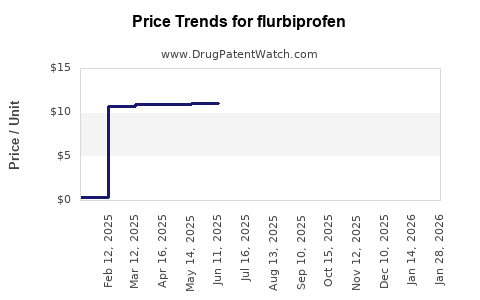
Last updated: February 20, 2026
What is the current market landscape for Flurbiprofen?
Flurbiprofen is a nonsteroidal anti-inflammatory drug (NSAID) primarily used in ophthalmology and as an oral analgesic. It is available in topical eye formulations and oral doses for arthritis-related pain. The drug was originally developed in the 1970s and has seen limited recent growth due to patent expiry and competition from newer NSAIDs.
Regulatory status and patent overview
- Initial approval: 1970s for oral use; later approved in ophthalmic formulations.
- Patent expirations: Brand patents expired in the early 2000s, leading to the proliferation of generic versions.
- Current approvals: Generic versions dominate; no recent new drug applications (NDAs) or amendments filed to extend patent protections.
Market segments
- Ophthalmic market: Used for pain and inflammation in post-surgical ocular procedures.
- Oral NSAID market: Used for arthritis and musculoskeletal pain, with drugs like ibuprofen and naproxen as primary competitors.
Key players
- Brand:
- Ocufen (Alcon) – ophthalmic use, withdrawn in certain markets.
- Generics: Multiple manufacturers produce oral and ophthalmic formulations, including Teva, Sandoz, and Mylan.
How does the competitive landscape influence pricing?
- Price erosion from generics has significantly reduced the cost of flurbiprofen.
- The ophthalmic segment sees prices ranging from $15 to $35 per bottle for branded versions, with generics priced at approximately 50% lower.
- Oral formulations are priced between $10 and $20 per package, depending on formulation and branding.
What are the current price levels and trends?
| Segment |
Brand Price Range (USD) |
Generic Price Range (USD) |
Key competitors |
| Ophthalmic (per bottle) |
$15 – $35 |
$7 – $17 |
Prednisolone, ketorolac, bromfenac |
| Oral NSAID (per package) |
$10 – $20 |
$5 – $12 |
Ibuprofen, naproxen, napadisylate |
- Prices for both segments have declined by approximately 25-35% over the past decade, reflecting increased generic competition and pricing pressures.
What are projections for the future market and pricing?
Market growth estimates
- The ophthalmic NSAID market is projected to grow at a CAGR of 3.1% from 2023 to 2030, driven by increased surgical procedures and aging populations.
- The oral NSAID segment experiences slow growth, with a CAGR of 1.2% due to market saturation and safety concerns associated with NSAIDs.
Pricing forecasts
- Ophthalmic formulations: Prices are expected to remain stable or decline slightly, averaging $13 to $17 per bottle through 2030.
- Generic oral formulations: Prices will likely stay within the $5 to $10 range due to high competition, with minor fluctuations based on raw material costs and manufacturing expenses.
Impact of patent status
- No current patent protections are in place; thus, new formulations or delivery methods are the primary paths for market expansion or price premium creation.
What factors influence pricing and market success?
- Regulatory approvals for new indications or formulations.
- Development of proprietary delivery systems (e.g., sustained-release eye drops).
- Competition from newer NSAIDs with improved safety profiles.
- Cost of manufacturing, raw material availability, and supply chain stability.
Conclusions
The flurbiprofen market remains a mature, highly commoditized segment with modest growth prospects and declining prices. The ophthalmic and oral segments are dominated by generics, with limited potential for premium pricing unless new indications or formulations are developed.
Key Takeaways
- The market for flurbiprofen is declining in price due to generic competition.
- The ophthalmic segment has prices ranging from $7 to $35 per bottle; oral products between $5 and $20 per package.
- Market growth is slow; prices are forecasted to stabilize.
- No current patents limit new entrant strategies; innovation centers on formulation and delivery.
FAQs
1. What is the primary use of flurbiprofen today?
It is used in ophthalmology for pain and inflammation management and as an oral NSAID for arthritis.
2. How has generic competition affected flurbiprofen’s prices?
It has caused a 25-35% decline over the past decade, leading to lower consumer and payer costs.
3. Are there new formulations or delivery systems under development?
There are ongoing research efforts but no significant recent approvals; innovation is mainly incremental.
4. Which regions have the highest market potential?
North America and Europe are mature markets; Asia-Pacific presents growth opportunities due to aging populations and increasing surgical procedures.
5. How affective are regulatory changes in shaping future pricing?
Regulatory approvals for new indications or formulations can create market differentiation, potentially supporting higher prices temporarily.
References
[1] U.S. Food and Drug Administration. (2022). Approved Drug Products with Therapeutic Equivalence Evaluations. 41st Edition.
[2] IQVIA. (2023). National Prescription Audit.
[3] Grand View Research. (2022). Ophthalmic Anti-Inflammatory Market Size, Share & Trends Analysis Report.