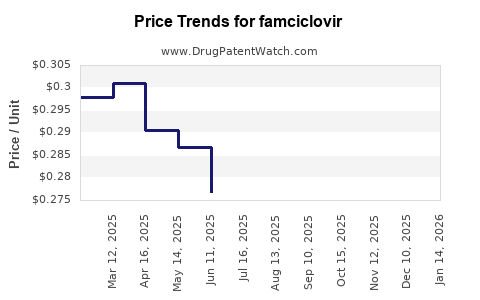
Last updated: September 7, 2026
Famciclovir is a mature, off-patent antiviral sold primarily as a low-cost generic for herpes zoster, recurrent genital herpes, and herpes labialis. Its commercial value has shifted from branded prescription revenue to high-volume, low-margin generic sales. The principal U.S. patent barriers expired years ago, no biosimilar pathway applies, and future market performance depends mainly on generic pricing, supply reliability, prescribing patterns, and competition from valacyclovir and acyclovir.
What is famciclovir and how is it used?
Famciclovir is an oral prodrug that is converted to penciclovir, an antiviral agent active against herpes simplex virus types 1 and 2 and varicella-zoster virus. The FDA approved Famvir, the original branded product, in 1994. Current U.S. labeling covers several indications:
| Indication |
Typical FDA-labeled use |
| Herpes zoster |
Treatment of shingles in immunocompetent adults |
| Recurrent genital herpes |
Episodic treatment in immunocompetent adults |
| Suppression of recurrent genital herpes |
Chronic suppressive therapy in adults |
| Herpes labialis |
Treatment of recurrent cold sores |
| Herpes zoster in selected immunocompromised patients |
Use under applicable labeling conditions |
Famciclovir is available primarily as 125 mg, 250 mg, and 500 mg tablets. The drug has a shorter dosing schedule than acyclovir in several indications, which supports continued clinical use despite generic competition. Its principal commercial substitutes are acyclovir, valacyclovir, and, for selected resistant infections, alternative antiviral therapies. [1][2]
When did famciclovir lose exclusivity?
Famciclovir lost practical market exclusivity in the United States after expiration of the core composition and formulation patents and the subsequent entry of generic products.
The principal exclusivity milestones are:
| Event |
Approximate timing |
Commercial effect |
| U.S. approval of Famvir |
1994 |
Began branded commercialization |
| Core compound patent protection |
Expired around 2010 |
Removed the main compound barrier |
| Later crystalline-form and process protection |
Expired during the mid-to-late 2010s |
Reduced residual formulation and manufacturing barriers |
| Generic approvals and launches |
From the late 2000s onward |
Initiated price competition |
| Current U.S. market |
Mature generic market |
Brand has limited economic significance |
Exact exclusivity dates depend on the patent family, terminal disclaimers, pediatric extensions, and the applicable product listing. The core U.S. commercial exclusivity period has long ended. FDA’s Orange Book and Drugs@FDA records should control any transaction-specific freedom-to-operate analysis. [3][4]
What patents protected Famvir and famciclovir?
The historical patent estate centered on the famciclovir molecule, pharmaceutical compositions, crystalline forms, and manufacturing methods. Representative U.S. patent records associated with famciclovir include:
| Patent |
Subject matter |
Historical relevance |
| U.S. Patent No. 5,246,937 |
Famciclovir-related antiviral compounds and pharmaceutical use |
Core composition protection |
| U.S. Patent No. 5,663,324 |
Famciclovir-related pharmaceutical and process technology |
Secondary protection |
| U.S. Patent No. 5,879,706 |
Famciclovir formulation or related solid-state technology |
Extended commercial protection |
| U.S. Patent No. 6,060,499 |
Crystalline or solid-form protection associated with famciclovir |
Later formulation barrier |
The relevant rights were associated with the original research and commercial organizations behind Famvir, including SmithKline Beecham and related corporate successors. Patent ownership and licensing changed through corporate transactions, making assignment-chain review important for litigation or licensing analysis.
The surviving estate is commercially weak because the core patents are expired. Any remaining rights would be limited to narrow jurisdictions, manufacturing processes, specific solid forms, or non-U.S. family members. A new U.S. entrant generally would not face a meaningful blocking patent position for ordinary famciclovir tablets.
How strong is the famciclovir patent estate?
The current patent estate is weak from a market-exclusion perspective.
Composition protection
Composition patents historically provided the strongest protection because they covered the active pharmaceutical entity or closely related compounds. Those patents expired long ago relative to the current generic market.
Formulation protection
Formulation and solid-state patents could have delayed generic entry or required design-around strategies. Their commercial value has declined because:
- generic manufacturers have had years to develop alternative processes;
- tablet formulations are relatively conventional;
- no complex delivery system is required;
- the product does not depend on a device, depot formulation, or specialized release technology.
Method-of-use protection
Famciclovir method-of-use claims covered treatment or suppression of herpes infections. These claims may have influenced labeling and litigation strategy during the branded period, but they are no longer a significant barrier to ordinary generic supply.
Manufacturing protection
Process patents could create technical or regulatory work for an active pharmaceutical ingredient supplier. They do not generally prevent market entry when alternative synthetic routes or licensed API sources are available. The main current manufacturing risk is supply-chain disruption rather than patent infringement.
What is the FDA regulatory status of famciclovir?
Famciclovir is an FDA-approved small-molecule prescription drug. It is not a biologic and does not use the abbreviated pathway for biosimilars.
Generic famciclovir products are approved through abbreviated new drug applications under the Hatch-Waxman framework. Generic manufacturers must demonstrate pharmaceutical equivalence and bioequivalence to the reference listed drug. FDA’s Orange Book identifies the reference product and approved generic equivalents. [3][4]
The regulatory profile is relatively straightforward:
| Regulatory issue |
Assessment |
| FDA status |
Approved small-molecule prescription drug |
| Reference product |
Famvir |
| Generic pathway |
ANDA |
| Biosimilar pathway |
Not applicable |
| Dosage form |
Immediate-release oral tablets |
| Main regulatory risks |
Bioequivalence, manufacturing quality, supply continuity |
| Pediatric exclusivity |
Historical relevance only |
| Current approval barrier |
Low relative to new chemical entities |
FDA approval does not guarantee commercial success. Generic manufacturers still face facility-inspection requirements, current good manufacturing practice compliance, product-quality obligations, and potential drug-shortage reporting requirements.
What is the Orange Book status of famciclovir?
Famciclovir’s Orange Book position is consistent with a mature generic product. The historical Famvir patents that once supported brand exclusivity are expired or no longer commercially blocking for standard generic tablets. FDA’s listing remains relevant for identifying:
- the reference listed drug;
- approved strengths;
- dosage-form equivalence;
- patent-history information;
- therapeutic-equivalence ratings for generic products.
The absence of a current blocking patent does not eliminate all litigation risk. A manufacturer could still face claims involving a narrow process patent, a specific crystal form, trade secrets, supplier agreements, or manufacturing data. Those risks are separate from the expired core product patents.
Were there Paragraph IV challenges to Famvir?
Generic entry for a mature oral antiviral commonly involves Paragraph IV certifications against listed patents. A Paragraph IV certification asserts that a listed patent is invalid, unenforceable, or not infringed. The certification can trigger patent litigation under the Hatch-Waxman statute and may create a 30-month stay of FDA approval in appropriate circumstances. [5]
Famciclovir’s principal Paragraph IV risk was historical rather than current. The commercial significance of any past challenge depended on:
- the patents listed for Famvir at the time;
- the applicant’s proposed launch date;
- the scope of the certification;
- whether the patent owner sued within the statutory period;
- whether the parties reached a settlement.
The mature generic market indicates that patent challenges did not preserve meaningful long-term brand exclusivity. Current generic applicants generally face a substantially lower patent risk than applicants did during the initial Famvir patent disputes.
What patent litigation affected famciclovir?
Famciclovir litigation has been less commercially prominent than disputes involving major oncology, autoimmune, or cardiovascular products. The key litigation period was the period surrounding generic entry and patent expiry.
Potential dispute categories included:
- infringement of compound or formulation patents;
- validity challenges to crystalline or solid-state claims;
- process-patent disputes involving API production;
- regulatory litigation concerning ANDA approval;
- settlement agreements governing generic launch dates.
No publicly established current litigation appears to create a broad U.S. barrier to generic famciclovir commercialization. Historical case review remains necessary for a party acquiring a specific patent, manufacturing process, or settlement right. Court dockets, FDA records, and patent assignments should be checked separately because Orange Book listings do not capture every possible IP claim. [3][5]
What generic entry risks exist for famciclovir?
The product has low legal entry risk but moderate operational risk.
Legal risk
Legal risk is low because the principal product patents have expired. Residual risk may arise from:
- narrow process patents;
- jurisdiction-specific patent rights;
- allegedly infringing crystal forms;
- confidential manufacturing know-how;
- supply agreements containing restrictions;
- labeling or promotional claims outside the approved use.
Regulatory risk
Regulatory risk is moderate. Generic manufacturers must maintain bioequivalence, process validation, stability, and manufacturing compliance. A quality action affecting a major API supplier can produce a meaningful market disruption even when multiple ANDA holders are approved.
Commercial risk
Commercial risk is high for a new entrant because the market is price-sensitive. Famciclovir has limited differentiation from valacyclovir and acyclovir. Retail and wholesaler contracting can compress margins quickly when several suppliers compete for the same prescriptions.
How does famciclovir compare with valacyclovir and acyclovir?
Valacyclovir is the closest branded-era competitor. It is also a prodrug, converted to acyclovir, and has strong physician familiarity. Acyclovir is generally cheaper and has extensive generic availability but often requires more frequent dosing.
| Factor |
Famciclovir |
Valacyclovir |
Acyclovir |
| Active antiviral form |
Penciclovir after conversion |
Acyclovir after conversion |
Acyclovir |
| Generic availability |
Broad |
Broad |
Very broad |
| Dosing convenience |
Often favorable |
Often favorable |
Less convenient in several uses |
| Brand differentiation |
Low today |
Low today |
Minimal |
| Patent strength |
Expired |
Expired for core product |
Expired |
| Price pressure |
High |
High |
Very high |
| Main competitive advantage |
Dosing and clinical familiarity |
Dosing and market recognition |
Low acquisition cost |
Famciclovir can retain prescriptions where clinicians prefer its dosing profile or prior patient response. It is unlikely to regain substantial branded pricing power without a new formulation, combination product, or evidence supporting a differentiated clinical use.
What is the financial trajectory of famciclovir?
Famciclovir’s financial trajectory follows the standard small-molecule lifecycle:
| Phase |
Financial profile |
| Branded launch |
High price, promotional investment, growing prescription base |
| Peak brand period |
Revenue supported by patent exclusivity and physician familiarity |
| Pre-generic period |
Brand defense, lifecycle management, patent litigation |
| Generic entry |
Rapid price erosion and prescription migration |
| Mature generic period |
High unit availability, low unit margins, fragmented suppliers |
Novartis and predecessor companies did not consistently report Famvir as a standalone current revenue line in public financial filings. The product was generally included within broader prescription pharmaceutical reporting, limiting reliable calculation of annual brand sales from company disclosures alone. [6]
The post-exclusivity economic model is different from the branded model:
- revenue depends on prescription volume rather than premium pricing;
- net sales are distributed across multiple generic manufacturers;
- wholesaler and pharmacy purchasing can reduce gross-to-net realization;
- API and tablet manufacturing costs determine margin more than clinical differentiation;
- brand revenue becomes small unless the manufacturer retains a niche channel or geographic franchise.
Public market estimates for the global famciclovir market vary substantially because providers use different definitions. Some count only branded and prescription sales; others include all generic channels and multiple countries. The absence of a separate reporting line from major manufacturers makes precise global revenue estimation unreliable without proprietary prescription and channel data.
Which companies manufacture or market famciclovir?
The product is supplied by multiple generic manufacturers and distributors across the United States and international markets. Supplier participation can change as manufacturers discontinue low-margin products, consolidate portfolios, or respond to API economics.
The original branded product was associated with Novartis and predecessor companies. The current commercial market is more fragmented, with generic manufacturers competing through ANDA approvals, contract manufacturing, wholesaler relationships, and national tender systems.
A company assessing entry should focus on:
- current ANDA holders;
- active marketing status;
- approved strengths;
- API source concentration;
- manufacturing-site inspection history;
- shortage data;
- wholesale acquisition cost and actual transaction pricing;
- state Medicaid and managed-care reimbursement.
What geographic markets remain attractive for famciclovir?
The United States is a mature generic market with limited pricing upside. Growth opportunities are more likely to arise from geographic expansion, supply reliability, or portfolio bundling than from patent exclusivity.
| Region |
Market condition |
| United States |
Mature generic market, intense price competition |
| European Union |
Generic and national reimbursement markets, country-specific pricing |
| Japan |
Regulatory and prescribing requirements differ; established antiviral competition |
| Latin America |
Variable generic penetration and private-pay demand |
| Asia-Pacific |
Volume opportunity but price and registration pressure |
| Emerging markets |
Access growth possible, but lower per-unit revenue |
International patent status must be analyzed country by country. U.S. patent expiry does not establish freedom to operate in Europe, China, Japan, or other markets. Regulatory approvals, local data requirements, import controls, and government tenders can be more important than patent barriers.
Is there biosimilar risk for famciclovir?
No. Famciclovir is a chemically synthesized small molecule, not a biologic. Biosimilar competition is therefore irrelevant. The applicable competition is generic competition through ANDAs or equivalent national procedures.
The competitive risk is stronger than biosimilar risk in one respect: multiple manufacturers can generally enter with chemically equivalent products after patent and regulatory barriers fall. This creates rapid price compression and makes supply economics central to the product’s value.
What is the outlook for famciclovir revenue?
Famciclovir revenue is likely to remain stable to declining on a nominal per-product basis, with unit demand providing partial support. The principal outlook factors are:
- continued herpes zoster and herpes simplex incidence;
- clinician preference for convenient oral dosing;
- substitution by valacyclovir and acyclovir;
- generic price erosion;
- API and finished-dose supply continuity;
- reimbursement policy;
- product discontinuations by low-margin suppliers.
The strongest commercial thesis is not a return to branded peak sales. It is dependable generic supply, efficient manufacturing, and portfolio economics across several mature anti-infective products.
Key Takeaways
- Famciclovir is a mature, FDA-approved generic antiviral.
- Famvir’s core U.S. patent protection expired years ago.
- Formulation and process patents no longer create a broad commercial barrier for ordinary tablets.
- Paragraph IV and patent litigation risks are primarily historical.
- Biosimilar competition does not apply because famciclovir is a small molecule.
- Valacyclovir and acyclovir are the main substitutes.
- Current economics depend on volume, price, manufacturing cost, and supply reliability.
- Standalone global revenue is difficult to verify because manufacturers generally do not report famciclovir separately.
- U.S. growth potential is limited; international markets and reliable supply offer the main commercial opportunities.
- The patent estate has low current exclusionary strength.
FAQs
Does famciclovir still have market exclusivity?
No. The original branded exclusivity period has ended, and generic famciclovir is widely available.
Can a company launch generic famciclovir without a Paragraph IV challenge?
Yes. An applicant may certify that listed patents have expired, will expire before launch, or do not require a Paragraph IV certification. The appropriate certification depends on the current Orange Book record and proposed launch timing.
Is famciclovir more commercially attractive than valacyclovir?
Usually not on a standalone basis. Both face generic competition. Famciclovir can be attractive as part of a broader antiviral portfolio, but it has limited pricing power and low product differentiation.
Are there formulation opportunities for famciclovir?
Potential opportunities include improved adherence formats, pediatric products, combination therapies, and alternative dosage forms. Each would require regulatory, clinical, manufacturing, and patent analysis. Ordinary immediate-release tablets have limited differentiation.
What is the biggest investment risk in famciclovir?
The main risk is margin compression rather than patent loss. A new supplier can face low prices, limited reimbursement leverage, API-cost volatility, and discontinuation pressure from competing generic manufacturers.
References
- U.S. Food and Drug Administration. (2023). Famciclovir prescribing information. FDA/DailyMed.
- National Library of Medicine. (2024). Famciclovir drug label. DailyMed.
- U.S. Food and Drug Administration. (2024). Approved drug products with therapeutic equivalence evaluations. FDA Orange Book.
- U.S. Food and Drug Administration. (2024). Drugs@FDA: Famvir and famciclovir product records.
- U.S. Code, 21 U.S.C. § 355(j). Abbreviated applications for new drugs.
- Novartis AG. (2000–2010). Annual reports and financial statements. Basel, Switzerland: Novartis.