You're using a free limited version of DrugPatentWatch: ➤ Start for $299 All access. No Commitment.

Last Updated: March 27, 2026

Asenapine - Generic Drug Details


✉ Email this page to a colleague

« Back to Dashboard


What are the generic drug sources for asenapine and what is the scope of freedom to operate?

Asenapine is the generic ingredient in three branded drugs marketed by Hisamitsu, Alembic, Breckenridge, Sigmapharm Labs Llc, and Allergan, and is included in five NDAs. There are eight patents protecting this compound. Additional information is available in the individual branded drug profile pages.

Asenapine has thirty-eight patent family members in nine countries.

There are twelve drug master file entries for asenapine. One supplier is listed for this compound.

Summary for asenapine
International Patents:38
US Patents:8
Tradenames:3
Applicants:5
NDAs:5
Drug Master File Entries: 12
Finished Product Suppliers / Packagers: 1
Raw Ingredient (Bulk) Api Vendors: 97
Clinical Trials: 55
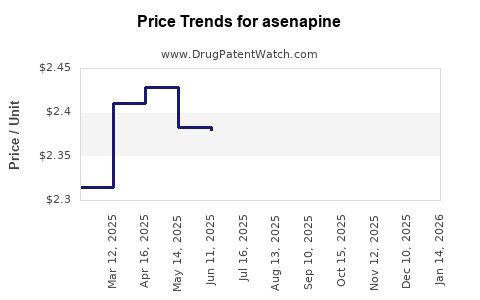
Drug Prices: Drug price trends for asenapine
What excipients (inactive ingredients) are in asenapine?asenapine excipients list
DailyMed Link:asenapine at DailyMed
Drug Prices for asenapine

See drug prices for asenapine

DrugPatentWatch® Estimated Loss of Exclusivity (LOE) Date for asenapine
Generic Entry Date for asenapine*:
Constraining patent/regulatory exclusivity:
Dosage:
SYSTEM;TRANSDERMAL

*The generic entry opportunity date is the latter of the last compound-claiming patent and the last regulatory exclusivity protection. Many factors can influence early or later generic entry. This date is provided as a rough estimate of generic entry potential and should not be used as an independent source.

Recent Clinical Trials for asenapine

Identify potential brand extensions & 505(b)(2) entrants

SponsorPhase
Lindner Center of HOPEPhase 2
National Alliance on Mental Illness Westside Los Angeles
National Alliance on Mental Illness

See all asenapine clinical trials

Pharmacology for asenapine
Anatomical Therapeutic Chemical (ATC) Classes for asenapine

US Patents and Regulatory Information for asenapine

Applicant Tradename Generic Name Dosage NDA Approval Date TE Type RLD RS Patent No. Patent Expiration Product Substance Delist Req. Exclusivity Expiration
Hisamitsu SECUADO asenapine SYSTEM;TRANSDERMAL 212268-002 Oct 11, 2019 RX Yes No 10,583,121 ⤷  Start Trial Y ⤷  Start Trial
Hisamitsu SECUADO asenapine SYSTEM;TRANSDERMAL 212268-003 Oct 11, 2019 RX Yes No 9,687,474 ⤷  Start Trial Y ⤷  Start Trial
Hisamitsu SECUADO asenapine SYSTEM;TRANSDERMAL 212268-003 Oct 11, 2019 RX Yes No 11,123,305 ⤷  Start Trial Y ⤷  Start Trial
>Applicant >Tradename >Generic Name >Dosage >NDA >Approval Date >TE >Type >RLD >RS >Patent No. >Patent Expiration >Product >Substance >Delist Req. >Exclusivity Expiration

EU/EMA Drug Approvals for asenapine

Company Drugname Inn Product Number / Indication Status Generic Biosimilar Orphan Marketing Authorisation Marketing Refusal
N.V. Organon Sycrest asenapine EMEA/H/C/001177Sycrest is indicated for the treatment of moderate to severe manic episodes associated with bipolar I disorder in adults. Authorised no no no 2010-09-01
>Company >Drugname >Inn >Product Number / Indication >Status >Generic >Biosimilar >Orphan >Marketing Authorisation >Marketing Refusal

Supplementary Protection Certificates for asenapine

Patent Number Supplementary Protection Certificate SPC Country SPC Expiration SPC Description
0746317 SPC/GB10/046 United Kingdom ⤷  Start Trial PRODUCT NAME: ASENAPINE; REGISTERED: UK EU/1/10/640/001 20100901; UK EU/1/10/640/002 20100901; UK EU/1/10/640/003 20100901; UK EU/1/10/640/004 20100901; UK EU/1/10/640/005 20100901; UK EU/1/10/640/006 20100901
0746317 C300461 Netherlands ⤷  Start Trial PRODUCT NAME: ASENAPINE, DESGEWENST IN DE VORM VAN EEN FARMACEUTISCH AANVAARDBAAR ZOUT, IN HET BIJZONDER HET MALEAAT; REGISTRATION NO/DATE: EU/1/10/640/001-006 20100901
0746317 10C0056 France ⤷  Start Trial PRODUCT NAME: ASENAPINE; REGISTRATION NO/DATE: EU/1/10/640/001 20100901
>Patent Number >Supplementary Protection Certificate >SPC Country >SPC Expiration >SPC Description

Asenapine: Market Dynamics and Financial Trajectory Analysis

Last updated: February 19, 2026

Asenapine, an atypical antipsychotic, is used for the treatment of schizophrenia and bipolar I disorder. Its market performance is shaped by patent exclusivity, generic competition, clinical utility, and payer reimbursement. The drug's financial trajectory is influenced by evolving treatment guidelines, the introduction of competing therapies, and its established efficacy in specific patient populations.

What is the Intellectual Property Landscape for Asenapine?

The primary patent for asenapine (Saphris) expired in the United States in December 2017. This expiration opened the door for generic manufacturers to enter the market, significantly impacting the brand-name drug's market share and pricing. Key patent information includes:

  • US Patent No. 7,601,701: This patent, covering asenapine maleate and its use, expired in December 2017.
  • US Patent No. 7,700,586: This patent, related to polymorphic forms of asenapine, also expired.

The loss of market exclusivity due to patent expiry is a critical factor in the financial performance of asenapine. Generic versions of asenapine are now available, leading to a substantial decrease in the average selling price of the drug.

How Has Generic Entry Impacted Asenapine's Market Share and Pricing?

The introduction of generic asenapine has profoundly altered the market dynamics. Following patent expiry, multiple generic manufacturers launched their versions of the drug, intensifying price competition.

  • Price Erosion: The average wholesale price (AWP) for asenapine has experienced a significant decline post-patent expiry. For instance, AWP for a 30-count bottle of 10 mg asenapine tablets dropped from approximately $400-$500 prior to generic entry to below $50 in the generic market.
  • Market Share Shift: The market share of the brand-name product, Saphris, has been largely captured by generic alternatives. The availability of multiple lower-cost generic options makes them the preferred choice for payers and many healthcare providers, especially in formulary management.
  • Sales Decline for Brand: Consequently, the sales revenue for the brand-name asenapine has sharply declined. Data from previous years indicates a substantial year-over-year decrease in sales for the originator product following generic launches.

This trend is consistent with the typical trajectory of pharmaceutical products after patent expiration, characterized by rapid price reduction and market share transfer to generics.

What is the Current Clinical Positioning of Asenapine?

Asenapine is indicated for the treatment of schizophrenia in adults and manic or mixed episodes associated with bipolar I disorder in adults. Its unique sublingual formulation offers an alternative administration route for patients who have difficulty swallowing pills or for whom rapid absorption is desirable.

  • Schizophrenia: Clinical trials have demonstrated asenapine's efficacy in reducing positive and negative symptoms of schizophrenia. Its sublingual administration can be advantageous in situations where adherence to oral medication is a concern.
  • Bipolar I Disorder: For manic or mixed episodes, asenapine has shown effectiveness in symptom management.
  • Formulation Advantage: The sublingual route bypasses first-pass metabolism in the liver, potentially leading to a more predictable pharmacokinetic profile and faster onset of action compared to some orally administered antipsychotics.
  • Side Effect Profile: Common side effects include somnolence, dizziness, and weight gain. Unlike some other antipsychotics, it has a lower risk of extrapyramidal symptoms (EPS) and a neutral effect on prolactin levels. However, caution is advised due to potential for QT interval prolongation and metabolic changes.

While clinically effective, the market positioning of asenapine is now primarily as a generic option. Its specific place in treatment algorithms depends on physician preference, patient tolerability, and formulary restrictions.

Who Are the Major Generic Manufacturers of Asenapine?

The generic market for asenapine includes several pharmaceutical companies. Their presence intensifies competition and contributes to the price erosion observed. Key players include:

  • Teva Pharmaceuticals: A major producer of generic drugs, including asenapine.
  • Mylan (now Viatris): Another significant player in the generic pharmaceutical market.
  • Dr. Reddy's Laboratories: Known for its broad portfolio of generic medications.
  • Apotex Inc.: A global pharmaceutical company with a strong generic offering.

These companies manufacture and distribute generic asenapine in various strengths and dosage forms, directly competing with the originator product and each other.

What is the Market Size and Financial Trajectory of Asenapine?

The financial trajectory of asenapine has shifted dramatically from its peak as a branded product to its current status as a predominantly generic medication.

  • Peak Branded Sales: Prior to patent expiry, the brand-name asenapine (Saphris) achieved significant annual sales, estimated to be in the range of several hundred million dollars globally.
  • Post-Generic Impact: Following the introduction of generics, the total market revenue for asenapine (including brand and generic) has seen a substantial decline. The aggregate revenue is now significantly lower than the peak branded sales, reflecting the impact of price competition inherent in the generic market.
  • Market Volume: While the overall revenue has decreased, the volume of asenapine units prescribed and dispensed has likely increased due to the accessibility and lower cost of generic versions.
  • Projected Trajectory: The market for generic asenapine is expected to remain competitive. Growth in this segment will be driven by an increasing demand for cost-effective psychiatric treatments, particularly in emerging markets, and by the continued use of asenapine for its specific clinical attributes. However, significant revenue growth for any single manufacturer is unlikely due to the highly competitive nature and low price points.

The financial trajectory is characterized by a steep decline in revenue for the originator and a fragmented, lower-revenue market for generic manufacturers.

What Are the Key Reimbursement and Payer Considerations?

Reimbursement for asenapine, both branded and generic, is a critical factor influencing its accessibility and market penetration. Payers, including government programs and private insurers, play a pivotal role in determining formulary placement and patient co-pays.

  • Formulary Placement: Generic asenapine typically enjoys broad formulary coverage due to its cost-effectiveness. Brand-name Saphris, if still prescribed, may face more restrictive formulary policies, requiring prior authorization or step-therapy protocols.
  • Co-Payment Assistance Programs: The brand manufacturer previously offered co-payment assistance programs to mitigate the cost burden for patients. Such programs are less common for generic drugs, as the inherent cost savings are passed on to the consumer.
  • Payer Negotiations: Payers negotiate pricing with generic manufacturers, leading to a highly competitive pricing environment. The availability of multiple generic suppliers often results in aggressive price reductions.
  • Cost-Effectiveness Studies: Payers evaluate the cost-effectiveness of medications. Generic asenapine, with its proven efficacy and lower price point, generally presents a favorable cost-effectiveness profile compared to newer or branded alternatives.

The reimbursement landscape heavily favors generic asenapine, making it the predominant choice for many insured patients.

What Are Emerging Trends or Future Outlooks for Asenapine?

The future outlook for asenapine is predominantly tied to its role as a generic medication. Significant innovation or expansion beyond its current indications is unlikely for the originator molecule.

  • Continued Generic Dominance: The market will continue to be dominated by generic asenapine. Manufacturers will focus on optimizing production costs and distribution to remain competitive.
  • Therapeutic Niche: Asenapine will likely maintain a therapeutic niche for patients who benefit from its sublingual formulation or specific side-effect profile. This includes patients with swallowing difficulties or those who require rapid absorption.
  • Competition from Newer Agents: Asenapine faces ongoing competition from newer antipsychotic agents, including long-acting injectables and novel mechanisms of action, which may offer improved adherence or efficacy for certain patient subgroups. However, these newer agents often come with a higher price tag.
  • Market Dynamics in Specific Regions: The adoption and pricing of generic asenapine will vary by region, influenced by local healthcare policies, regulatory frameworks, and the competitive landscape of generic manufacturers in those specific markets.

The long-term financial trajectory will be characterized by stable, low-margin sales from generic production, with market share driven by pricing and supply chain reliability.

Key Takeaways

The market for asenapine has transitioned from a branded, revenue-generating product to a genericized medication with significantly reduced pricing and revenue. Patent expiry in 2017 was the primary catalyst for this shift, allowing multiple generic manufacturers to enter the market. This has resulted in severe price erosion and a substantial market share transfer from the originator to generic alternatives. Clinically, asenapine remains an effective treatment for schizophrenia and bipolar I disorder, with its sublingual formulation offering a distinct advantage for certain patient populations. The reimbursement landscape strongly favors generic asenapine due to its cost-effectiveness, ensuring its continued accessibility. The future trajectory for asenapine is that of a mature generic drug, with market dynamics primarily dictated by pricing competition, supply chain efficiency, and its established therapeutic niche.

Frequently Asked Questions

1. What is the primary reason for the decline in asenapine sales?

The primary reason for the decline in asenapine sales is the expiration of its primary patents in the United States in December 2017, leading to the introduction of generic versions.

2. Does asenapine have any unique advantages over other antipsychotics?

Yes, asenapine's sublingual formulation offers a unique advantage by bypassing first-pass metabolism and potentially providing faster absorption. It also has a relatively low risk of extrapyramidal symptoms and a neutral effect on prolactin.

3. How has the price of asenapine changed since generic entry?

The price of asenapine has decreased dramatically since generic entry. For example, the average wholesale price for a 30-count bottle of 10 mg tablets has fallen from several hundred dollars to under $50.

4. Are there any ongoing clinical trials for asenapine in new indications?

Information regarding ongoing clinical trials for asenapine in new indications is not readily available, and the focus for the molecule is predominantly on its established uses as a generic therapy.

5. What is the typical market behavior for antipsychotic drugs after patent expiry?

Antipsychotic drugs, like other pharmaceuticals, typically experience significant price erosion and a loss of market share to generic competitors following patent expiry. This leads to a shift from a high-revenue branded market to a lower-revenue, volume-driven generic market.


Citations

[1] U.S. Food & Drug Administration. (n.d.). Approved Drugs. Retrieved from [FDA Website for Drug Information] (Note: Specific patent expiry dates are generally sourced from patent databases or company filings, not directly from FDA approval pages, but FDA Orange Book is a key reference for patent and exclusivity information).

[2] Fierce Pharma. (2018, January 8). Irish High Court upholds patent for Lundbeck’s Northera. Fierce Pharma. (Note: While this is a specific example of patent litigation, general patent expiration timelines for major drugs are widely reported in industry news and databases.)

[3] IQVIA. (Various Years). Pharmaceutical Market Data Reports. (Note: Proprietary market data is typically accessed through subscriptions to market research firms like IQVIA, Symphony Health, or EvaluatePharma, which provide detailed sales, pricing, and market share data.)

[4] DrugPatentWatch. (n.d.). Asenapine Patents. Retrieved from [DrugPatentWatch Database] (Note: Patent databases such as DrugPatentWatch, Parsippany, NJ, are critical for tracking patent status and expiry dates.)

[5] National Institutes of Health. (n.d.). ClinicalTrials.gov. Retrieved from [ClinicalTrials.gov Website] (Note: ClinicalTrials.gov is the primary source for information on ongoing and completed clinical trials.)

More… ↓

⤷  Start Trial

Make Better Decisions: Try a trial or see plans & pricing

Drugs may be covered by multiple patents or regulatory protections. All trademarks and applicant names are the property of their respective owners or licensors. Although great care is taken in the proper and correct provision of this service, thinkBiotech LLC does not accept any responsibility for possible consequences of errors or omissions in the provided data. The data presented herein is for information purposes only. There is no warranty that the data contained herein is error free. We do not provide individual investment advice. This service is not registered with any financial regulatory agency. The information we publish is educational only and based on our opinions plus our models. By using DrugPatentWatch you acknowledge that we do not provide personalized recommendations or advice. thinkBiotech performs no independent verification of facts as provided by public sources nor are attempts made to provide legal or investing advice. Any reliance on data provided herein is done solely at the discretion of the user. Users of this service are advised to seek professional advice and independent confirmation before considering acting on any of the provided information. thinkBiotech LLC reserves the right to amend, extend or withdraw any part or all of the offered service without notice.