Share This Page
Drug Sales Trends for WARFARIN SODIUM
✉ Email this page to a colleague
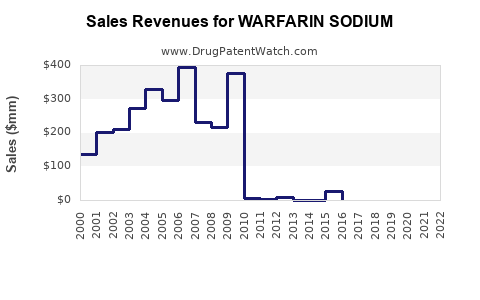
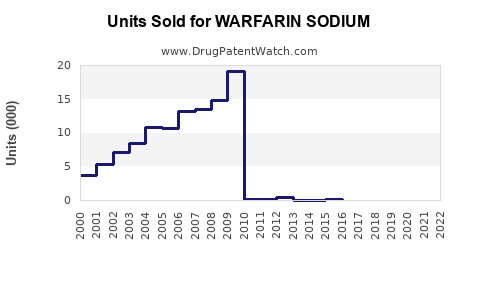
Annual Sales Revenues and Units Sold for WARFARIN SODIUM
| Drug Name | Revenues (USD) | Units | Year |
|---|---|---|---|
| WARFARIN SODIUM | ⤷ Start Trial | ⤷ Start Trial | 2022 |
| WARFARIN SODIUM | ⤷ Start Trial | ⤷ Start Trial | 2021 |
| WARFARIN SODIUM | ⤷ Start Trial | ⤷ Start Trial | 2020 |
| WARFARIN SODIUM | ⤷ Start Trial | ⤷ Start Trial | 2019 |
| WARFARIN SODIUM | ⤷ Start Trial | ⤷ Start Trial | 2018 |
| WARFARIN SODIUM | ⤷ Start Trial | ⤷ Start Trial | 2017 |
| >Drug Name | >Revenues (USD) | >Units | >Year |
Warfarin Sodium Market Analysis and Sales Projections
Warfarin sodium is a mature, multisource anticoagulant with declining use in high-income markets but durable demand in cost-sensitive health systems. The product has no meaningful remaining innovator exclusivity, no active U.S. patent barrier of commercial significance, and limited pricing power. Its market is supported by low acquisition cost, extensive clinical experience, availability of reversal protocols, and use in patients for whom direct oral anticoagulants are unsuitable or inaccessible.
Public manufacturers generally do not report warfarin sodium revenue separately. The projections below therefore use a market model based on prescription volume, tablet pricing, geographic demand, and continued substitution by direct oral anticoagulants such as apixaban, rivaroxaban, dabigatran and edoxaban.
What is the current market position of warfarin sodium?
Warfarin remains a high-volume generic anticoagulant, but its share of oral anticoagulant treatment has contracted materially since the expansion of direct oral anticoagulants.
Its principal indications include:
- Stroke prevention in nonvalvular and valvular atrial fibrillation
- Treatment and secondary prevention of deep-vein thrombosis
- Treatment and secondary prevention of pulmonary embolism
- Prevention of thrombosis in patients with mechanical heart valves
- Selected thrombophilia and recurrent thrombosis cases
Warfarin has a narrow therapeutic index. Treatment requires international normalized ratio monitoring, dose adjustment, dietary counseling and management of drug interactions. These requirements have shifted prescribing toward direct oral anticoagulants for many patients with nonvalvular atrial fibrillation and venous thromboembolism.
Warfarin retains a stronger position in mechanical heart valve patients. Direct oral anticoagulants are not approved substitutes for warfarin in this population, and the RE-ALIGN trial showed excess thromboembolic and bleeding events with dabigatran in mechanical valve patients.[1]
Warfarin sodium market profile
| Metric | Current market assessment |
|---|---|
| Product type | Generic small-molecule anticoagulant |
| U.S. regulatory status | Approved, multisource generic |
| U.S. innovator exclusivity | Expired |
| Main dosage forms | 1 mg, 2 mg, 2.5 mg, 3 mg, 4 mg, 5 mg, 6 mg, 7.5 mg and 10 mg tablets |
| Prescription characteristics | Chronic, frequently monitored therapy |
| Main growth market | Cost-sensitive and underdiagnosed anticoagulation markets |
| Main structural risk | Substitution by direct oral anticoagulants |
| Biosimilar exposure | None; warfarin is a small molecule |
| Pricing power | Low |
| Supply risk | Moderate, because production is concentrated among generic manufacturers |
How large is the warfarin sodium market?
No authoritative public source reports a single, audited global revenue figure for warfarin sodium. Commercial market-research estimates vary widely because some reports measure manufacturer revenue, while others include pharmacy sales, anticoagulation services, hospital procurement or the broader anticoagulant market.
A more useful approach is to separate market volume from market value.
In the United States, warfarin continues to account for millions of prescriptions annually, but its prescription share has declined as direct oral anticoagulants have expanded. The American College of Cardiology and American Heart Association recommend direct oral anticoagulants over warfarin for many patients with atrial fibrillation, except in settings such as mechanical heart valves or moderate-to-severe mitral stenosis.[2]
Estimated 2025 market value
| Market | Estimated annual market value | Confidence basis |
|---|---|---|
| United States generic product market | $100 million-$250 million | Low unit prices, declining prescription volume |
| Europe and other high-income markets | $150 million-$350 million | Persistent use in selected indications |
| Asia-Pacific, Latin America, Middle East and Africa | $250 million-$600 million | Higher reliance on low-cost anticoagulation |
| Global warfarin sodium product market | $500 million-$1.2 billion | Modeled range, not reported company revenue |
The global range refers primarily to product sales and pharmacy market value. It excludes INR testing, anticoagulation clinics, hospital monitoring, physician services and complications associated with over- or under-anticoagulation.
The commercial market is therefore much smaller than the total oral anticoagulant market. Global sales of direct oral anticoagulants are measured in the multibillion-dollar range, led by Eliquis, Xarelto and Pradaxa. Warfarin’s low price prevents it from capturing equivalent revenue even where prescription volume remains substantial.
What are the sales projections for warfarin sodium?
The base-case forecast is for gradual global revenue contraction, with sharper declines in the United States and Western Europe. Emerging markets should partially offset volume erosion because warfarin is substantially less expensive than direct oral anticoagulants.
Global warfarin sodium sales forecast
| Year | Bear case | Base case | Bull case |
|---|---|---|---|
| 2025 | $500 million | $800 million | $1.2 billion |
| 2026 | $465 million | $770 million | $1.18 billion |
| 2027 | $430 million | $740 million | $1.16 billion |
| 2028 | $400 million | $715 million | $1.15 billion |
| 2029 | $375 million | $695 million | $1.14 billion |
| 2030 | $350 million | $675 million | $1.13 billion |
| 2025-2030 CAGR | -6.8% | -3.3% | -1.2% |
The base case assumes continued direct oral anticoagulant substitution in developed markets, stable use in mechanical valve patients, modest volume growth in lower-income markets and limited generic price inflation.
The bull case assumes slower conversion to direct oral anticoagulants because of reimbursement limits, affordability barriers and supply constraints affecting newer agents. It does not assume meaningful price increases for warfarin.
U.S. sales projection
| Year | Estimated U.S. market value |
|---|---|
| 2025 | $150 million-$220 million |
| 2026 | $140 million-$210 million |
| 2027 | $130 million-$200 million |
| 2028 | $120 million-$190 million |
| 2029 | $110 million-$180 million |
| 2030 | $100 million-$170 million |
The expected U.S. decline is driven by:
- Continued conversion to apixaban and rivaroxaban.
- Reduced physician willingness to manage frequent INR monitoring.
- Expansion of anticoagulation pathways that favor fixed-dose oral therapy.
- Generic competition that limits revenue even when prescription volume remains stable.
Warfarin should remain commercially relevant in the United States because it is preferred or required in mechanical heart valve patients, remains an option for severe renal impairment, and is used when direct oral anticoagulants are unaffordable or clinically unsuitable.
Which companies manufacture or sell warfarin sodium?
The U.S. market is supplied by multiple generic manufacturers and contract manufacturers. Publicly identified U.S. suppliers have included:
- Teva Pharmaceuticals
- Zydus Pharmaceuticals
- Upsher-Smith Laboratories
- Taro Pharmaceuticals
- Mylan/Viatris-related generic operations
- Pharmaceutical companies supplying hospital and institutional channels
Market participation varies by dosage strength, label ownership, manufacturing site and distribution agreement. A company may hold an approved ANDA without being a major active supplier.
The historical branded products include Coumadin and Jantoven. Coumadin was associated with Bristol-Myers Squibb, while Jantoven has been associated with Upsher-Smith. Generic warfarin sodium tablets are the principal commercial products in the United States.
What patents protect warfarin sodium?
Warfarin sodium has no commercially meaningful active composition-of-matter patent protecting the molecule in the United States. The product was introduced decades ago, and its core patent estate expired long before the current generic market.
Patent and exclusivity position
| Protection category | Current position |
|---|---|
| Composition-of-matter patent | Expired |
| Original product patent | Expired |
| U.S. New Chemical Entity exclusivity | Expired |
| Generic ANDA pathway | Available |
| Formulation patents | No known blocking estate of material commercial scope |
| Method-of-use patents | Historical and expired or commercially nonblocking |
| Pediatric exclusivity | Not a current market barrier |
| Patent litigation risk | Low relative to newer anticoagulants |
The commercial competition is therefore based on FDA approval, manufacturing reliability, wholesaler access, tablet-strength coverage, quality history and contracting rather than patent differentiation.
What is the FDA and Orange Book status of warfarin sodium?
Warfarin sodium tablets are approved prescription products. The FDA Orange Book identifies reference-listed drug products and approved generic equivalents, but Orange Book listings do not create a continuing patent barrier where listed patents have expired or no relevant patent remains.
Warfarin is generally supplied through abbreviated new drug applications rather than new branded development programs. Generic applicants must demonstrate pharmaceutical equivalence and bioequivalence to the applicable reference product under the FDA’s ANDA framework.[3]
FDA regulatory considerations
The principal regulatory risks are product quality, dose uniformity, manufacturing consistency and supply continuity. Warfarin’s narrow therapeutic index increases the commercial effect of tablet-strength errors, labeling discrepancies and manufacturing deviations.
FDA labeling includes boxed warnings relating to major or fatal bleeding, fetal harm and the need for regular monitoring.[4] These warnings do not prevent generic competition but raise the operational burden for manufacturers and providers.
Are there Paragraph IV challenges for warfarin sodium?
Paragraph IV litigation is not a material current driver of the warfarin sodium market. The principal patents associated with the original products expired years ago, leaving no economically significant innovator patent position to defend against routine generic entry.
Generic manufacturers do not need to overcome a current patent cliff comparable to those affecting Eliquis, Xarelto or other newer anticoagulants. Any litigation involving warfarin today would more likely concern manufacturing, product liability, supply contracts, labeling, trademark issues or isolated formulation claims than core market exclusivity.
What formulations are protected by warfarin sodium patents?
Warfarin sodium is primarily marketed as immediate-release oral tablets in multiple strengths. The commercial value of the dosage-form estate is limited because the standard tablet formulation is old, well characterized and available from several suppliers.
Potential differentiation areas include:
- Tablet strength coverage
- Packaging designed to reduce dosing errors
- Color and imprint systems
- Combination packaging
- Patient adherence tools
- Point-of-care monitoring integration
- Specialized hospital distribution
- Compounded liquid formulations
These features can create commercial differentiation but generally do not establish durable patent protection or high switching costs.
How does warfarin compare with Eliquis, Xarelto and Pradaxa?
| Factor | Warfarin | Eliquis | Xarelto | Pradaxa |
|---|---|---|---|---|
| Active ingredient | Warfarin sodium | Apixaban | Rivaroxaban | Dabigatran etexilate |
| Monitoring | INR required | Routine monitoring generally not required | Routine monitoring generally not required | Routine monitoring generally not required |
| Price | Very low | High relative to warfarin | High relative to warfarin | High relative to warfarin |
| Mechanical heart valves | Established use | Not established substitute | Not established substitute | Not recommended |
| Generic competition | Extensive | Emerging or imminent depending on jurisdiction | Generic exposure expanding | Generic exposure expanding |
| Reversal options | Vitamin K, PCC | Andexanet alfa and PCC protocols | Andexanet alfa and PCC protocols | Idarucizumab |
| Main commercial advantage | Affordability and long experience | Convenience and efficacy profile | Convenience and broad use | Convenience and specific reversal agent |
| Main commercial weakness | Monitoring and interactions | Cost | Cost and bleeding concerns | Cost and gastrointestinal tolerability |
Warfarin’s competitive position is strongest where affordability, established clinical protocols or mechanical valve treatment dominate the purchasing decision. Its position is weakest in commercially insured populations with broad access to direct oral anticoagulants.
What generic entry risks exist for warfarin sodium?
Generic entry risk is already realized rather than prospective. The market has long operated under generic conditions, and further entrants would mainly increase price pressure or improve supply resilience.
Principal risks to incumbent suppliers
- Loss of contracts after a manufacturing deviation
- Wholesale price erosion
- FDA warning letters or import restrictions
- Shortages of specific tablet strengths
- Concentration of production in a small number of sites
- Substitution by direct oral anticoagulants
- Reduced hospital formulary use
- Product liability exposure from dosing and bleeding events
The strongest remaining commercial defenses are regulatory reliability and supply continuity. A manufacturer with uninterrupted availability across all major tablet strengths can win share even without patent protection.
What manufacturing and intellectual-property barriers affect warfarin?
Manufacturing barriers are more relevant than intellectual-property barriers. Warfarin sodium requires controlled production, reliable assay performance and dose uniformity across low-dose tablets. Small dosing errors can have clinically significant consequences because the therapeutic window is narrow.
Important operating capabilities include:
- Multi-strength tablet manufacturing
- Validated analytical methods
- Reliable active pharmaceutical ingredient supply
- Robust change-control systems
- Consistent dissolution and content uniformity
- Serialization and traceability
- Distribution to retail, hospital and mail-order channels
The active pharmaceutical ingredient is available from established suppliers, but disruptions can affect the entire market because generic margins are low and manufacturers may rationalize low-volume strengths.
What litigation and settlement agreements affect warfarin sodium?
There is no major active U.S. patent litigation campaign comparable to those surrounding newer anticoagulants. Historical litigation involving Coumadin, Jantoven, generic labeling, product liability and anticoagulation injuries does not create a current market-exclusivity barrier.
Settlement agreements are commercially less important than in patent-protected branded markets. Generic warfarin suppliers compete through ANDA approval, pricing, supply performance and channel access rather than authorized-generic or delayed-entry settlements.
What revenue exposure does warfarin create for pharmaceutical companies?
Warfarin has low revenue concentration at the manufacturer level. Its low unit price and generic competition mean that a single supplier typically has limited exposure compared with a branded anticoagulant franchise.
Revenue sensitivity is concentrated in:
- High-volume institutional contracts
- Government tenders
- Retail pharmacy supply
- Long-term-care formularies
- Markets with limited direct oral anticoagulant reimbursement
- Regions where mechanical valve surgery remains common
For investors, warfarin is primarily a defensive volume product. It offers predictable demand but limited margin expansion, limited patent optionality and modest strategic value unless bundled with a broader generic portfolio.
How strong is the warfarin sodium patent estate?
The warfarin sodium patent estate is weak from a current commercial perspective.
| Patent-estate factor | Assessment |
|---|---|
| Core molecule protection | None remaining |
| Formulation protection | Limited or nonblocking |
| Use patents | Historical, with limited current effect |
| Orange Book leverage | Low |
| Generic blocking potential | Minimal |
| Litigation leverage | Low |
| Manufacturing know-how | Moderate operational value |
| Regulatory execution | High practical value |
The absence of meaningful patent protection does not eliminate market value. It shifts the value from exclusivity to manufacturing, regulatory compliance and distribution.
When does warfarin sodium lose exclusivity?
Warfarin sodium lost meaningful U.S. market exclusivity decades ago. There is no upcoming exclusivity cliff comparable to a modern branded drug. The relevant commercial trend is gradual demand erosion rather than a single loss-of-exclusivity event.
In Europe and other jurisdictions, regulatory exclusivity and local patent records may differ, but the active ingredient is globally mature and widely supplied as a generic. Country-specific entry barriers can remain because of registration requirements, tender rules or local manufacturing preferences, not because of a broad global patent estate.
Key Takeaways
- Warfarin sodium is a mature generic anticoagulant with no meaningful current U.S. patent barrier.
- Estimated 2025 global product-market value is approximately $500 million to $1.2 billion, with a base case near $800 million.
- Base-case global sales decline is approximately 3.3% annually through 2030.
- U.S. sales are estimated at $150 million to $220 million in 2025 and are likely to decline faster than global sales.
- Direct oral anticoagulants are the principal source of volume and revenue erosion.
- Mechanical heart valve treatment, severe renal impairment, affordability constraints and health-system access support residual demand.
- Generic entry risk is already embedded in the market; future competition will focus on price and supply reliability.
- Manufacturing quality, tablet-strength availability and distribution are more valuable than patent rights.
- Warfarin is not subject to biosimilar competition because it is a small-molecule drug.
- The product remains strategically relevant but is unlikely to generate material revenue growth without geographic expansion or portfolio bundling.
FAQs About Warfarin Sodium Market Sales and Competition
Is warfarin sodium still profitable for generic manufacturers?
Yes, but profitability depends on manufacturing scale, supply reliability and portfolio economics. Unit prices are low, so standalone warfarin production generally offers limited margin expansion.
Will warfarin sales increase in emerging markets?
Volume may increase in selected emerging markets, but revenue growth is likely to remain modest because pricing is low and government procurement often emphasizes minimum cost.
Can a company obtain new patents on a warfarin delivery system?
A genuinely novel delivery system may be patentable, but it would need to provide an inventive technical improvement and achieve regulatory and commercial adoption. Conventional immediate-release tablets have little remaining exclusivity potential.
Is warfarin preferred for mechanical heart valves?
Yes. Warfarin remains the established oral anticoagulant for mechanical heart valve patients. Direct oral anticoagulants are not established replacements in this population.
What would cause a sudden warfarin sodium sales increase?
A sustained supply disruption affecting direct oral anticoagulants, reimbursement restrictions, major price increases for newer anticoagulants or broader use in cost-constrained health systems could increase warfarin demand. Such events would more likely produce temporary volume gains than durable pricing power.
References
-
Eikelboom, J. W., Connolly, S. J., Brueckmann, M., Granger, C. B., Kappeteyn, L. J., Mack, M. J., ... Van de Werf, F. (2013). Dabigatran versus warfarin in patients with mechanical heart valves. New England Journal of Medicine, 369(13), 1206-1214. https://doi.org/10.1056/NEJMoa1300615
-
Joglar, J. A., Chung, M. K., Armbrust, T., Benjamin, E. J., Chyou, J. Y., Cronin, E. M., ... Van Wagoner, D. R. (2024). 2023 ACC/AHA/ACCP/HRS guideline for the diagnosis and management of atrial fibrillation. Circulation, 149(1), e1-e156. https://doi.org/10.1161/CIR.0000000000001193
-
U.S. Food and Drug Administration. (2024). Abbreviated new drug application (ANDA) process. https://www.fda.gov/drugs/types-applications/abbreviated-new-drug-application-anda
-
U.S. Food and Drug Administration. (2024). Warfarin sodium prescribing information. https://www.accessdata.fda.gov/drugsatfda_docs/label/
More… ↓
