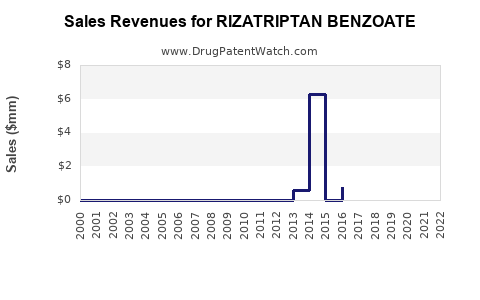
Last updated: September 18, 2026
Rizatriptan benzoate is a mature, off-patent triptan marketed originally by Merck & Co. as Maxalt and Maxalt-MLT. U.S. product exclusivity ended after the core patents expired, allowing multiple generic manufacturers to compete on price. The product retains clinical demand because it is effective for acute migraine treatment, but its commercial value has shifted from branded revenue to low-cost, high-volume generic supply. Growth is constrained by generic price erosion and competition from newer CGRP-targeting medicines.
What is the FDA regulatory status of rizatriptan benzoate?
Rizatriptan is an FDA-approved selective serotonin 5-HT1B/1D receptor agonist for the acute treatment of migraine with or without aura in adults and, at specified doses, in pediatric patients aged 6 to 17 years. It is not indicated for migraine prevention or for treatment of hemiplegic or basilar migraine.
The principal FDA-approved dosage forms are:
| Product |
Dosage form |
Typical strengths |
Historical brand |
| Rizatriptan benzoate tablets |
Oral tablet |
5 mg, 10 mg |
Maxalt |
| Rizatriptan benzoate orally disintegrating tablets |
Orally disintegrating tablet |
5 mg, 10 mg |
Maxalt-MLT |
The 10-mg dose is generally used in adults, while the 5-mg dose is used where dose reduction is appropriate, including certain drug-interaction settings. Propranolol increases rizatriptan exposure, and the FDA label limits the rizatriptan dose in patients receiving propranolol.[1]
The original U.S. New Drug Application was NDA 020864 for Maxalt. Maxalt-MLT was approved under a separate NDA associated with the orally disintegrating formulation. The products are small-molecule drugs, so biosimilar regulation does not apply.
When did rizatriptan lose market exclusivity?
U.S. market exclusivity ended after expiration of the patent estate protecting the original rizatriptan product and its orally disintegrating formulation. Generic rizatriptan entered the U.S. market in the early 2010s, ending Maxalt’s monopoly pricing and materially reducing Merck’s revenue.
The commercial sequence was:
| Period |
Market event |
Commercial effect |
| 1998 |
FDA approval of Maxalt |
Merck entered the acute migraine market with a second-generation triptan |
| 1999-2000 |
Introduction of Maxalt-MLT |
Expanded use among patients seeking a non-swallow tablet |
| Mid-2000s |
Peak branded adoption |
Maxalt generated several hundred million dollars annually for Merck |
| Around 2010-2011 |
Generic approvals and launches |
Branded price and volume began to decline |
| 2015-2018 |
Core patent and pediatric exclusivity period ended |
Generic competition became structurally established |
| 2020s |
Mature generic market |
Revenue concentrated in low-priced prescriptions and institutional supply |
The key commercial protection was patent-based rather than long-term regulatory exclusivity. Rizatriptan did not receive biologic exclusivity, orphan-drug exclusivity, or a durable device-based barrier.
What patents protected Maxalt and Maxalt-MLT?
The original rizatriptan patent estate included composition-of-matter and formulation-related protection. Historical U.S. patent records associated with Maxalt included the following patents:
| Patent |
Subject matter |
Historical relevance |
| U.S. Patent No. 5,814,652 |
Rizatriptan-related chemical and therapeutic claims |
Core composition and use protection |
| U.S. Patent No. 6,171,618 |
Formulation and pharmaceutical-composition protection |
Associated with later product protection and formulation claims |
Patent dates and Orange Book listings varied by product, formulation, and pediatric extensions. The effective commercial expiry occurred before the current mature generic market was established. The relevant patent term was extended by the Hatch-Waxman framework and, for applicable pediatric indications, by six months of pediatric exclusivity.[2][3]
The estate was commercially effective while active but was not comparable to the layered estates surrounding newer migraine products. It had limited lifecycle-management depth because rizatriptan was a conventional immediate-release small molecule with relatively simple oral formulations.
What formulations were protected by rizatriptan patents?
The principal formulation distinction was the orally disintegrating tablet, marketed as Maxalt-MLT. The formulation was designed to disintegrate on the tongue without water. Its commercial purpose was convenience and patient preference rather than a fundamentally different pharmacokinetic mechanism.
Formulation protection did not create a durable barrier after generic manufacturers developed equivalent orally disintegrating products. FDA-approved generic competition ultimately included both conventional tablets and orally disintegrating tablets, reducing the ability of the branded product to preserve a premium.
Were there Paragraph IV challenges to Maxalt?
Generic manufacturers used the Hatch-Waxman abbreviated new drug application pathway, including patent certifications relevant to the Maxalt patent estate. The generic launch process involved patent disputes and negotiated commercial timing rather than a prolonged post-expiry monopoly.
The core Paragraph IV dynamics were typical for a mature triptan:
- Generic applicants challenged listed patents before their nominal expiration dates.
- Merck had the opportunity to bring infringement litigation and obtain a 30-month stay of FDA approval where statutory requirements were met.
- Settlement or patent-term outcomes determined the first commercial launch date.
- Once the principal patents expired, multiple manufacturers entered and rapidly compressed prices.
No current Paragraph IV dispute is a central commercial constraint on rizatriptan. The product is now an established generic active ingredient, and the primary risks are price competition, manufacturer supply reliability, and substitution by newer migraine medicines.
What is the Orange Book status of rizatriptan?
Rizatriptan originated as an FDA-listed reference product with patent information for Maxalt and Maxalt-MLT. The practical Orange Book position has changed from an originator-protection tool to a historical record of the patents that supported generic entry timing.
The current commercial significance is limited because:
- Maxalt is no longer protected by an active market monopoly.
- Generic ANDAs are approved for the active ingredient and relevant dosage forms.
- No biosimilar pathway is involved.
- Formulation differentiation is weak.
- FDA-approved generic substitution is available subject to state pharmacy rules and product-specific labeling.
The Orange Book remains relevant for patent certification analysis, but it is no longer a meaningful barrier to broad generic access.[2]
How strong is the rizatriptan patent estate?
The rizatriptan patent estate was strong during the protected period and weak as a current commercial barrier.
| Patent-estate factor |
Assessment |
| Composition-of-matter protection |
Historically strong |
| Core clinical-use protection |
Historically meaningful |
| Orally disintegrating formulation |
Moderate, but vulnerable to equivalent generic development |
| Manufacturing protection |
Limited commercial relevance |
| Device or delivery-system protection |
Minimal |
| Current blocking power |
Low after expiry |
| Biosimilar barrier |
Not applicable |
| Lifecycle-management depth |
Limited |
The estate did not create the type of secondary patent thicket associated with complex injectables, long-acting delivery systems, combination products, or biologics. Generic manufacturers could reproduce the active ingredient and approved oral dosage forms without overcoming a technically complex manufacturing platform.
What is the financial trajectory of rizatriptan?
Maxalt generated several hundred million dollars in annual sales at its commercial peak. Merck reported Maxalt sales of approximately $300 million per year in the late 2000s, before generic erosion became material.[4]
A simplified trajectory is:
| Phase |
Revenue profile |
Main driver |
| Launch and adoption |
Rapid growth |
Physician adoption and triptan-class expansion |
| Mature brand period |
Approximately $300 million annually |
Established migraine demand and brand recognition |
| Generic entry |
Sharp decline |
Price compression and pharmacy substitution |
| Post-exclusivity |
Low branded revenue |
Generic replacement |
| Mature generic period |
Fragmented, low-margin sales |
Prescription volume and contracting |
The branded revenue decline was structurally irreversible. After generic entry, the economic value moved from manufacturer price premium to aggregate prescription volume. Generic rizatriptan can remain commercially viable because the active ingredient is inexpensive to manufacture, the dosage forms are established, and migraine treatment is recurrent.
Public-company reporting does not generally disclose global rizatriptan revenue as a standalone line item today. Market estimates therefore depend on prescription data, wholesaler sales, and generic manufacturer disclosures rather than a transparent branded revenue stream.
Which companies compete in the rizatriptan market?
The competitive field includes generic manufacturers and alternative migraine-drug companies.
Generic rizatriptan manufacturers
U.S. generic supply has included manufacturers such as:
- Teva Pharmaceuticals
- Mylan, now part of Viatris
- Dr. Reddy’s Laboratories
- Cipla
- Aurobindo Pharma
- Apotex
- Rising Pharmaceuticals and other abbreviated-application holders
The exact active supplier list changes because manufacturers discontinue products, transfer ANDAs, or become inactive in particular dosage forms. Competition is strongest for standard tablets and more selective for orally disintegrating tablets.
Competing branded therapies
Rizatriptan competes with:
- Sumatriptan
- Eletriptan
- Zolmitriptan
- Naratriptan
- Frovatriptan
- Ubrogepant
- Rimegepant
- Zavegepant
- Lasmiditan
Triptans retain a cost advantage and extensive clinical familiarity. CGRP receptor antagonists compete by offering treatment options for patients who do not respond adequately to triptans, cannot tolerate vasoconstrictive effects, or have cardiovascular risk concerns. These products generally carry higher prices and may face payer authorization requirements.[5]
How does rizatriptan compare with newer CGRP migraine drugs?
Rizatriptan has the lowest acquisition cost among major acute migraine treatments but has a narrower patient profile because it is a vasoconstrictive serotonin agonist. CGRP antagonists have a more recent patent position and higher commercial value, but payer access and cost remain significant constraints.
| Attribute |
Rizatriptan |
Ubrogepant or rimegepant |
| Drug class |
Triptan |
CGRP receptor antagonist |
| Market status |
Mature generic |
Branded, patent-protected |
| Price |
Low |
High relative to generics |
| Onset |
Rapid |
Product-dependent |
| Vasoconstriction |
Present |
Not the primary mechanism |
| Use in cardiovascular-risk patients |
Restricted or limited |
Often commercially attractive |
| Patent risk |
Minimal current risk |
Significant future expiry risk |
| Payer access |
Broad |
Often requires authorization |
Rizatriptan’s main defense is cost. Its main vulnerability is therapeutic substitution in patients with inadequate response, adverse effects, cardiovascular contraindications, or preference for newer non-triptan therapies.
What generic entry risks affect rizatriptan revenue?
Generic entry risk is effectively realized rather than prospective. The relevant commercial risks are:
- Continued price deflation as additional suppliers enter.
- Supply disruptions caused by low-margin manufacturing.
- Reduced pharmacy shelf presence for branded Maxalt.
- Prescriber migration to CGRP therapies.
- Reimbursement pressure on orally disintegrating products.
- Consolidation among generic suppliers and purchasing groups.
- Product discontinuation if net prices fall below manufacturing and distribution costs.
The residual opportunity is concentrated in reliable supply, authorized generic arrangements, hospital and clinic contracts, and selected international markets where generic penetration is less complete.
What geographic markets remain commercially relevant?
The United States is a mature generic market. Other regions have different commercial profiles because patent expiry dates, reimbursement systems, regulatory approvals, and generic penetration vary.
| Region |
Market condition |
| United States |
Mature generic competition and severe price pressure |
| European Union |
Generic competition established; country-level reimbursement determines volume |
| Japan |
Regulatory and reimbursement dynamics differ from the U.S. |
| Latin America |
Brand and generic coexistence varies by country |
| Emerging markets |
Lower prices but potential prescription-volume growth |
International revenue is more likely to depend on distributor relationships, local registration, tender access, and supply reliability than on patent exclusivity.
What manufacturing and intellectual-property barriers remain?
Manufacturing barriers are low to moderate. Rizatriptan is a small molecule with established synthetic chemistry and conventional oral dosage forms. The more important barriers are regulatory and commercial:
- Demonstrating pharmaceutical equivalence.
- Maintaining consistent dissolution and assay performance.
- Meeting stability requirements for tablets.
- Reproducing orally disintegrating tablet performance.
- Securing active pharmaceutical ingredient supply.
- Maintaining FDA, EMA, and local-market compliance.
- Achieving sufficient scale to compete after price reductions.
The orally disintegrating form creates greater process-control demands than a conventional tablet, but it does not create a durable barrier comparable to sterile injectables, inhaled products, depot formulations, or biologic manufacturing.
What licensing deals affected rizatriptan?
Rizatriptan’s commercial history was primarily controlled by Merck through Maxalt and Maxalt-MLT. No current high-value licensing structure is central to the market. After patent expiry, the economics shifted to ANDA approvals, manufacturer supply agreements, distributor contracts, and generic portfolio management.
The relevant business model today is transactional rather than innovation-led. Companies compete through manufacturing cost, regulatory execution, supply continuity, and pharmacy-channel access.
What is the outlook for rizatriptan revenue?
Rizatriptan revenue should remain stable to declining in nominal terms. Prescription demand is supported by the large migraine population and continued use of low-cost triptans. Revenue per prescription will remain under pressure from generic substitution and payer pricing.
The most likely market pattern is:
- Stable or modestly declining unit demand.
- Continued erosion in average selling price.
- Low branded revenue.
- Fragmented generic supply.
- Gradual substitution by CGRP-targeting products in selected patients.
- No meaningful patent-driven price recovery.
Rizatriptan remains commercially relevant as a low-cost acute migraine therapy, but it is no longer an attractive exclusivity asset. Its value is operational: dependable manufacturing, broad regulatory coverage, and efficient distribution.
Key Takeaways
- Rizatriptan benzoate is an FDA-approved acute migraine treatment marketed originally as Maxalt and Maxalt-MLT.
- Its U.S. composition and formulation patents expired, enabling broad generic competition.
- Generic entry began around 2010-2011 and eliminated the branded monopoly.
- Maxalt generated roughly $300 million annually during its late branded period.
- Current economics are driven by low-cost generic volume rather than patent protection.
- The orally disintegrating tablet provides product differentiation but not a durable market barrier.
- Biosimilar risk does not apply because rizatriptan is a small-molecule drug.
- CGRP antagonists are the principal branded competitive threat.
- Manufacturing complexity is modest, while regulatory compliance and supply reliability determine generic competitiveness.
- Future revenue is likely to remain flat or decline as price erosion offsets stable migraine-treatment demand.
FAQs About Rizatriptan Benzoate Patents and Market Value
Is Maxalt still patent protected?
No. The patent protection that supported Maxalt’s U.S. monopoly expired, and generic rizatriptan products are widely available.
Is rizatriptan a biologic or eligible for biosimilar competition?
No. Rizatriptan is a synthetic small-molecule drug approved through the conventional FDA drug pathway. Generic ANDAs, not biosimilar applications, govern competition.
Does Maxalt-MLT still have commercial patent value?
No meaningful blocking value remains in the United States. The orally disintegrating formulation has been subject to generic competition.
Which migraine drugs have stronger current patent estates than rizatriptan?
Ubrogepant, rimegepant, zavegepant, and certain migraine-prevention biologics have substantially stronger current patent positions because they remain newer, branded products.
Can a company still profit from generic rizatriptan?
Yes, but profitability depends on manufacturing scale, low production cost, reliable supply, regulatory compliance, and access to pharmacy or institutional purchasing channels. Patent-based pricing power is no longer available.
References
- U.S. Food and Drug Administration. (2024). Maxalt and Maxalt-MLT prescribing information. FDA.
- U.S. Food and Drug Administration. (2024). Approved drug products with therapeutic equivalence evaluations: Orange Book. FDA.
- U.S. Patent and Trademark Office. (2024). Patent term adjustment and patent term information. USPTO.
- Merck & Co., Inc. (2008-2011). Annual reports. Merck & Co.
- American Headache Society. (2021). The American Headache Society consensus statement: Update on integrating new migraine treatments into clinical practice. Headache, 61(7), 1021-1039.