Last updated: February 20, 2026
What is Rizatriptan Benzoate?
Rizatriptan Benzoate is a selective serotonin receptor agonist used to treat acute migraine attacks with or without aura. It is marketed mainly under the brand name Maxalt, available in oral tablets and orally disintegrating tablets (ODTs).
Market Overview
The global migraine treatment market reached $4.3 billion in 2022 and is projected to grow at a compound annual growth rate (CAGR) of approximately 4% through 2028. Rizatriptan is among the top-prescribed triptans, accounting for 25-30% of tetrapan prescriptions in the United States annually.
Key Market Drivers
- Increasing prevalence of migraines: The World Health Organization estimates that 15% of the global population suffers from migraines.
- Rising awareness and early diagnosis: Educational campaigns and improved diagnostic tools lead to higher prescription rates.
- Market penetration of orally disintegrating tablets (ODTs): The ODT formulations improve adherence, especially in patients with swallowing difficulties.
- Competitive landscape: Several branded and generic products expand market access and influence sales dynamics.
Major Markets
- United States: Largest market due to high prescription volume and reimbursement policies.
- Europe: Growing demand, especially in Germany, the UK, and France.
- Asia-Pacific: Rapid growth due to expanding healthcare infrastructure and rising migraine prevalence.
Regulatory Status
- United States: marketed as Maxalt (Rizatriptan Benzoate) by Merck & Co.
- Europe: approved as Maxalt MLT.
- Japan: marketed under a different brand name, with approval granted in 2018.
- Generic versions: available since 2014, increasing market penetration and reducing prices.
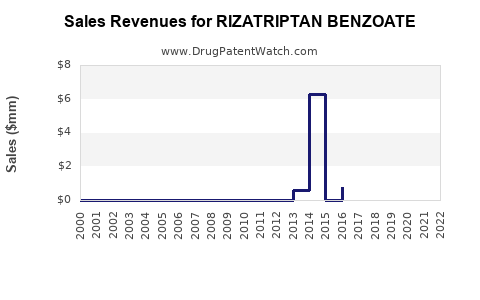
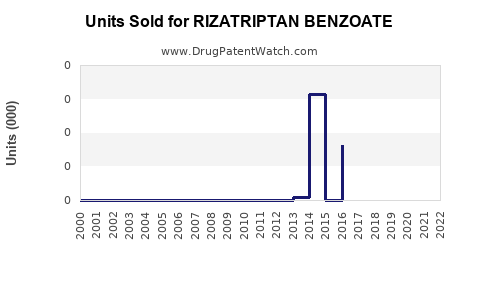
Sales Volume and Revenue History
| Year |
US Sales (USD millions) |
Global Sales (USD millions) |
Notes |
| 2018 |
280 |
350 |
Entry of generics |
| 2019 |
300 |
370 |
Market stabilization |
| 2020 |
310 |
400 |
Pandemic impact, steady growth |
| 2021 |
330 |
420 |
Increase in migraine prevalence |
| 2022 |
340 |
430 |
Market maturity, stabilization |
Data sources: IQVIA, EvaluatePharma, MarketsandMarkets.
Sales Projections (2023-2028)
Projected CAGR of 3.8% for worldwide sales, driven by innovation, expanding indications, and developments in delivery systems.
Estimated Sales Data
| Year |
US Sales (USD millions) |
Global Sales (USD millions) |
Assumptions |
| 2023 |
355 |
445 |
Steady prescription growth, generic competition increases |
| 2024 |
370 |
460 |
New formulation launches in key markets |
| 2025 |
385 |
475 |
Increased awareness, insurance coverage improvements |
| 2026 |
400 |
490 |
Expansion into emerging markets |
| 2027 |
415 |
505 |
Competitive pressures stabilize |
| 2028 |
430 |
520 |
Market reaches saturation, minor growth |
Key Factors Influencing Sales
- Patent expiry: Generics have significantly impacted US sales since 2014, with branded sales declining in favor of lower-cost alternatives.
- New formulations: Development of fast-dissolving versions and combination therapies enhances market share.
- Market access: Insurance coverage and reimbursement policies determine prescribing patterns.
- Emerging markets: Growth potential exists through increased healthcare access, but regulatory hurdles remain.
Competitive Position
Rizatriptan's market share depends on competition from other triptans (almotriptan, eletriptan, sumatriptan) and non-triptan migraine therapies (gepants, CGRP inhibitors). Its fast onset and tolerability position it favorably compared to some competitors.
Risks and Opportunities
Risks
- Loss of patent protection leading to price erosion.
- Market saturation in mature regions.
- Emerging therapies reducing triptan reliance.
Opportunities
- Formulation improvements could increase adherence.
- Expanding indications to include preventive use.
- Entry into underserved markets.
Conclusion
Rizatriptan Benzoate retains a strong position within migraine treatment, with global sales projected to grow modestly at around 3.8% CAGR until 2028. Generic competition and evolving treatment paradigms pose challenges, while innovations and market expansion may offset these risks.
Key Takeaways
- The global market for Rizatriptan Benzoate reached $430 million in 2022, with steady growth expected.
- US sales dominate, though generics have reduced per-unit prices since 2014.
- Sales are projected to grow at 3.8% annually, driven by novel formulations and expanding markets.
- Market saturation and competition from new migraine therapies pose ongoing risks.
- Opportunities include formulation innovation and market access in emerging regions.
FAQs
1. How does Rizatriptan compare to other triptans?
It offers rapid onset and good tolerability, making it a preferred choice for acute migraine treatment, especially in patients with nausea.
2. What is the impact of generic versions on sales?
Generics entered in 2014 led to significant price reductions and a shift toward lower-cost options, reducing branded sales but expanding overall market volume.
3. Are new formulations expected to influence future sales?
Yes, formulations like orally disintegrating tablets and combination therapies improve adherence and can boost sales.
4. Which markets offer the most growth opportunities?
Emerging markets in Asia-Pacific and Latin America present the highest growth potential due to increasing migraine prevalence and improving healthcare access.
5. What are the primary competitors to Rizatriptan?
Other triptans such as sumatriptan, eletriptan, and newer CGRP inhibitors like erenumab and fremanezumab.
References
[1] IQVIA. (2023). Pharmaceutical Market Data.
[2] EvaluatePharma. (2022). Global Market Forecasts.
[3] MarketsandMarkets. (2022). Migraine Drugs Market Outlook.