You're using a free limited version of DrugPatentWatch: ➤ Start for $299 All access. No Commitment.

Last Updated: March 26, 2026

PILOCARPINE - Generic Drug Details


✉ Email this page to a colleague

« Back to Dashboard


What are the generic sources for pilocarpine and what is the scope of patent protection?

Pilocarpine is the generic ingredient in eight branded drugs marketed by Epic Pharma Llc, Alcon, Sandoz, Amneal, Fdc Ltd, Rising, Somerset Theraps Llc, Orasis Pharms, Abbvie, Aurobindo Pharma Usa, Impax Labs, Innogenix, Lannett Co Inc, Padagis Us, and Advanz Pharma, and is included in seventeen NDAs. There are six patents protecting this compound. Additional information is available in the individual branded drug profile pages.

There are twelve drug master file entries for pilocarpine.

Summary for PILOCARPINE
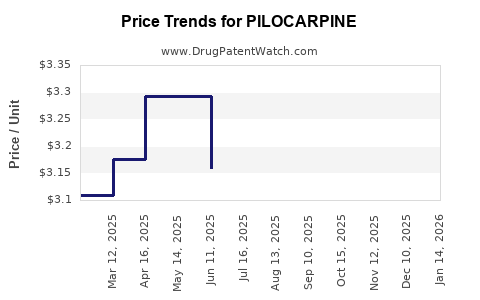
Drug Prices for PILOCARPINE

See drug prices for PILOCARPINE

Recent Clinical Trials for PILOCARPINE

Identify potential brand extensions & 505(b)(2) entrants

SponsorPhase
Southern College of OptometryPHASE4
Mansoura UniversityNA
Novus Vision LLCEARLY_PHASE1

See all PILOCARPINE clinical trials

Medical Subject Heading (MeSH) Categories for PILOCARPINE

US Patents and Regulatory Information for PILOCARPINE

Applicant Tradename Generic Name Dosage NDA Approval Date TE Type RLD RS Patent No. Patent Expiration Product Substance Delist Req. Exclusivity Expiration
Orasis Pharms QLOSI pilocarpine hydrochloride SOLUTION/DROPS;OPHTHALMIC 217836-001 Oct 17, 2023 RX Yes Yes ⤷  Start Trial ⤷  Start Trial Y ⤷  Start Trial
Somerset Theraps Llc PILOCARPINE HYDROCHLORIDE pilocarpine hydrochloride SOLUTION/DROPS;OPHTHALMIC 210384-001 Nov 25, 2019 AT RX No No ⤷  Start Trial ⤷  Start Trial ⤷  Start Trial
Padagis Us PILOCARPINE HYDROCHLORIDE pilocarpine hydrochloride TABLET;ORAL 076746-001 Nov 16, 2004 AB RX No No ⤷  Start Trial ⤷  Start Trial ⤷  Start Trial
>Applicant >Tradename >Generic Name >Dosage >NDA >Approval Date >TE >Type >RLD >RS >Patent No. >Patent Expiration >Product >Substance >Delist Req. >Exclusivity Expiration

PILOCARPINE Market Analysis and Financial Projection

Last updated: February 15, 2026

What Are the Market Dynamics for Pilocarpine?

Pilocarpine, a tertiary amine alkaloid derived primarily from Pilocarpus microphyllus, is a parasympathomimetic agent primarily used to treat glaucoma and xerostomia. Its market size and growth depend on various factors including drug patent status, approval landscape, competitive offerings, and disease prevalence.

Market Size and Growth Drivers

  • The global pilocarpine market stood at approximately $200 million in 2021, with projections reaching $250 million by 2026, reflecting a compound annual growth rate (CAGR) of nearly 4%.
  • Key growth drivers include increased prevalence of glaucoma (about 76 million cases worldwide in 2020, expected to rise to 111 million by 2040) and xerostomia linked to medications, radiotherapy, and Sjögren's syndrome.
  • The aging population influences demand, as glaucoma risk increases with age.

Market Segmentation

  • Application: 80% of sales stem from glaucoma treatment, while 20% comes from xerostomia management.
  • Formulation: Pilocarpine is available in ophthalmic solutions and oral tablets, with the ophthalmic form accounting for 60% of revenue.

Competitive Landscape and Regulatory Environment

  • Major manufacturers include MGI Pharma, Teva Pharmaceutical Industries, and generic producers.
  • Patent expirations for formulations across the early 2010s led to increased generic competition, exerting downward pressure on prices.
  • No recent major regulatory changes significantly alter approval pathways; however, approval for new formulations or delivery modes could open future markets.

Market Challenges and Opportunities

  • Challenges: Limited patent protection, the availability of alternative drugs such as prostaglandin analogs for glaucoma, and side effects like sweating and nausea that limit patient adherence.
  • Opportunities: Development of sustained-release formulations, combination therapies, and targeted delivery systems could enhance efficacy and adherence, enabling higher pricing and market share.

What Is the Financial Trajectory for Pilocarpine?

Revenue and Profitability Trends

  • Rivals' revenues indicate a mature but stable market. For example, in 2021, Teva’s ophthalmic glaucoma division recorded approximately $150 million, with pilocarpine contributing a significant share.
  • Price erosion due to generic competition reduces margins; profit margins declined from 30% pre-patent expiry to roughly 15-20% in recent years.
  • R&D investments are minimal, focusing on formulation improvements rather than new entity development.

Investment and R&D Outlook

  • Investors see limited growth prospects unless new delivery methods or indications expand the market.
  • Some private firms explore innovative delivery systems—like iontophoresis or sustained-release implants—that could command premium pricing.
  • Regulatory pathways for reformulations are straightforward, with 505(b)(2) pathways suitable for modified dosage forms, but they face competition from generics.

Licensing and Partnership Prospects

  • Collaborations with biotech firms developing drug delivery platforms can unlock new revenue streams.
  • Licensing agreements are common, typically providing upfront payments plus royalties (~10-15%) on sales.

Market Risks and Financial Sensitivities

  • The primary risks include patent challenges, regulatory hurdles for new formulations, and adverse side effects affecting usage rates.
  • Financial performance remains sensitive to generic price declines and shifts toward newer, alternative therapies.

Key Takeaways

  • The pilocarpine market is mature, with moderate growth driven by demographic factors.
  • Patent expiries and generic competition pressure prices and margins.
  • Innovations in delivery and combination therapies hold potential for extending market viability.
  • Revenue streams rely heavily on established applications, with limited R&D investment for novel indications.
  • Investors should monitor regulatory developments and emerging delivery technologies that could reframe market dynamics.

FAQs

1. What are the main therapeutic uses of pilocarpine?
Pilocarpine treats glaucoma by stimulating the parasympathetic nervous system, reducing intraocular pressure, and manages xerostomia by increasing salivary and sweat gland secretions.

2. How does patent expiration affect the pilocarpine market?
Patent expiration, which occurred in various markets during the early 2010s, led to the influx of generic versions, reducing prices and profit margins for brand-name products.

3. Are there emerging alternatives to pilocarpine?
Yes. In glaucoma, prostaglandin analogs like latanoprost and bimatoprost are increasingly preferred due to better tolerability. For xerostomia, agents like cevimeline are used; however, pilocarpine remains relevant where specific indications exist.

4. What regulations influence the approval of new pilocarpine formulations?
The U.S. FDA’s 505(b)(2) pathway facilitates approval for reformulations. Regulatory review focuses on bioavailability, safety, and efficacy compared to existing formulations.

5. What is the outlook for investment in pilocarpine-based therapies?
Stable but limited unless new delivery systems or indications emerge. Technological advancements in sustained-release systems or targeted drug delivery could create higher-value opportunities.


Sources:

  1. MarketsandMarkets. "Ophthalmic Drugs Market," 2022.
  2. World Health Organization. "Global glaucoma prevalence," 2020.
  3. IQVIA. "Pharmaceutical Market Data," 2021.
  4. U.S. Food and Drug Administration. "Drug Approval Pathways," 2022.
  5. Pharma Intelligence. "Generic Drug Market Trends," 2021.

More… ↓

⤷  Start Trial

Make Better Decisions: Try a trial or see plans & pricing

Drugs may be covered by multiple patents or regulatory protections. All trademarks and applicant names are the property of their respective owners or licensors. Although great care is taken in the proper and correct provision of this service, thinkBiotech LLC does not accept any responsibility for possible consequences of errors or omissions in the provided data. The data presented herein is for information purposes only. There is no warranty that the data contained herein is error free. We do not provide individual investment advice. This service is not registered with any financial regulatory agency. The information we publish is educational only and based on our opinions plus our models. By using DrugPatentWatch you acknowledge that we do not provide personalized recommendations or advice. thinkBiotech performs no independent verification of facts as provided by public sources nor are attempts made to provide legal or investing advice. Any reliance on data provided herein is done solely at the discretion of the user. Users of this service are advised to seek professional advice and independent confirmation before considering acting on any of the provided information. thinkBiotech LLC reserves the right to amend, extend or withdraw any part or all of the offered service without notice.