Last updated: September 5, 2026
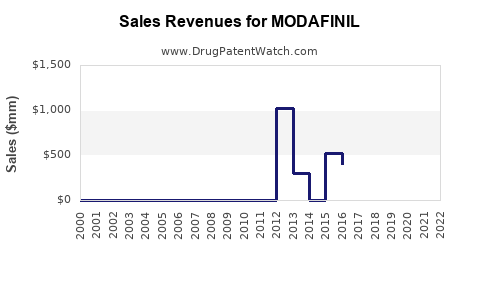
Modafinil is a mature, genericized central nervous system drug with limited remaining patent protection and declining branded economics. The product was approved in the United States in 1998 as Provigil for narcolepsy, obstructive sleep apnea-related excessive sleepiness, and shift-work sleep disorder. Its commercial peak occurred before generic entry, with U.S. Provigil sales exceeding $1 billion annually. Generic competition, patent settlements, and the shift from Cephalon ownership to Teva ownership materially reduced brand revenue after 2012.
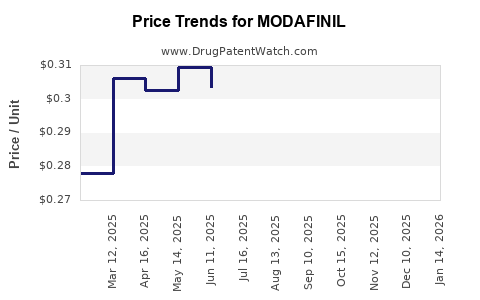
The market remains commercially relevant because modafinil is inexpensive to manufacture, prescribed across several sleep-related indications, and distributed through multiple generic suppliers. Its financial profile has shifted from branded pharmaceutical economics to high-volume, low-price generic economics.
What is the current market position of modafinil?
Modafinil is a mature prescription stimulant and wakefulness-promoting agent. In the United States, it is marketed primarily through generic manufacturers rather than as a branded product.
| Attribute |
Modafinil |
| Active ingredient |
Modafinil |
| Original U.S. brand |
Provigil |
| Original developer |
Lafon Laboratories |
| U.S. commercial owner |
Cephalon, later Teva |
| FDA approval |
1998 |
| Main indications |
Narcolepsy, obstructive sleep apnea-related sleepiness, shift-work sleep disorder |
| U.S. controlled-substance status |
Schedule IV |
| Primary dosage form |
Immediate-release oral tablets |
| Common strengths |
100 mg and 200 mg |
| Current competitive structure |
Multiple generic manufacturers |
| Biosimilar relevance |
None; modafinil is a small-molecule drug |
| Core commercial issue |
Price erosion after generic entry |
FDA labeling limits modafinil's approved use to improving wakefulness in patients with specified sleep disorders. It is not approved as a general cognitive-enhancement drug, although off-label use has contributed to demand and online distribution activity (U.S. Food and Drug Administration [FDA], 2015).
Public market-research estimates for the global modafinil market generally place annual sales in the several-hundred-million-dollar range, but estimates differ significantly. The variance reflects the treatment of generic sales, online pharmacy activity, hospital purchasing, and non-U.S. markets. Unlike the branded period, no single company discloses a complete global modafinil revenue base.
How did modafinil revenue develop over time?
Modafinil's financial trajectory has four stages: launch, branded expansion, patent-defense period, and generic erosion.
| Period |
Commercial development |
Financial effect |
| 1998-2003 |
Provigil launched and expanded across sleep indications |
Rapid branded growth |
| 2004-2008 |
Strong U.S. demand and broad physician awareness |
Annual sales approached or exceeded $1 billion |
| 2008-2011 |
Patent litigation and settlement activity |
Brand revenue protected but future erosion became visible |
| 2012 onward |
Authorized and independent generic competition |
Major price and volume shift from brand to generics |
| 2015 onward |
Broad generic availability |
Mature, low-price market |
| Current market |
Generic supply across U.S. and international markets |
Stable demand with limited pricing power |
Cephalon reported Provigil net sales of approximately $988 million in 2007, and the product remained one of the company's central revenue assets before Teva acquired Cephalon in 2011 (Cephalon, 2008; Teva Pharmaceutical Industries Ltd., 2012). Teva paid approximately $6.8 billion for Cephalon, a transaction that included Provigil, Nuvigil, and other specialty products.
The acquisition occurred while Provigil was still generating substantial revenue but faced a known loss-of-exclusivity event. Teva's transaction thesis depended on extending value through settlement arrangements, lifecycle products such as Nuvigil, and the broader Cephalon portfolio. Generic entry ultimately compressed Provigil revenue and shifted the asset from a high-margin branded product to a lower-margin generic category.
When did modafinil lose U.S. exclusivity?
Modafinil lost effective U.S. brand exclusivity through a combination of patent litigation settlements and later patent expiry. The main commercial barrier was a Cephalon formulation patent rather than a long-duration composition patent.
What patents protected Provigil?
The principal U.S. patents associated with Provigil included the following:
| Patent |
General subject matter |
Commercial relevance |
| U.S. Patent No. 4,927,855 |
Modafinil and related benzhydryl sulfinyl compounds |
Early composition protection |
| U.S. Patent No. 5,618,845 |
Pharmaceutical compositions containing modafinil, including particle-size limitations |
Principal later-life formulation protection |
| Pediatric exclusivity |
Regulatory extension attached to FDA exclusivity |
Extended protection beyond ordinary patent timing |
The '845 patent became the principal focus of generic challenges. Its claims related to modafinil formulations and particle-size characteristics, creating a formulation-based barrier after the earlier composition protection had weakened.
Generic applicants filed Paragraph IV certifications asserting that the relevant patents were invalid, unenforceable, or would not be infringed. Cephalon sued several applicants, including Teva, Mylan, Ranbaxy, and Watson, triggering the Hatch-Waxman litigation framework.
The core patent dispute did not produce a durable post-2015 exclusivity position. Modafinil is now a genericized small molecule, and the historical Provigil patents do not provide a meaningful current barrier to ordinary generic tablets.
What was the impact of Paragraph IV challenges and settlements?
Paragraph IV litigation delayed unrestricted generic competition but did not preserve long-term branded economics. Cephalon reached settlement agreements with several generic companies that permitted entry before the full expiration of the later Provigil patent.
The settlements became a major antitrust issue because the Federal Trade Commission alleged that Cephalon paid or otherwise compensated generic companies to delay market entry. The FTC's case focused on reverse-payment theories under the antitrust laws and became one of the most important pharmaceutical settlement disputes of the period.
The FTC alleged that the agreements delayed generic modafinil competition and caused substantial consumer overcharges. In 2015, Teva agreed to resolve the FTC litigation with a settlement valued at approximately $1.2 billion, including monetary relief and other obligations (Federal Trade Commission, 2015).
The commercial outcome was clear:
- Generic companies obtained defined entry rights.
- Cephalon and later Teva preserved branded sales for a limited period.
- The settlement structure created significant antitrust liability.
- Once generic entry broadened, Provigil pricing and market share deteriorated.
What is the Orange Book status of modafinil?
Modafinil has no current Orange Book patent position comparable to its branded-exclusivity period. The historical Provigil listings were tied to patents covering the active ingredient and formulation characteristics.
The Orange Book remains relevant for understanding the litigation history because it identified the patents that generic applicants had to address through Paragraph IV certifications. It is not a current indicator of meaningful commercial protection for generic modafinil tablets.
Modafinil's present competitive conditions are driven by:
- Multiple approved abbreviated new drug applications.
- Low manufacturing complexity for immediate-release tablets.
- Lack of active branded exclusivity.
- Established active pharmaceutical ingredient supply.
- Substitution at the pharmacy level.
- Limited differentiation among standard generic products.
Which companies compete in the modafinil market?
Competition is fragmented. U.S. generic supply has historically included Teva, Mylan, Ranbaxy, Watson/Actavis, Sandoz, and other approved manufacturers or distributors. Product availability can vary by wholesaler, manufacturing site, dosage strength, and supply conditions.
How does modafinil compare with armodafinil?
Armodafinil is the R-enantiomer of modafinil and was commercialized by Cephalon as Nuvigil. It received FDA approval in 2007 for the same broad sleep-related indications.
| Factor |
Modafinil |
Armodafinil |
| Product type |
Racemic compound |
R-enantiomer |
| Original brand |
Provigil |
Nuvigil |
| FDA approval |
1998 |
2007 |
| Generic availability |
Broad |
Broad after later patent expiry |
| Typical commercial positioning |
Lower-cost generic |
Historically premium branded alternative |
| Patent strategy |
Composition and formulation patents |
Enantiomer and formulation lifecycle protection |
| Current differentiation |
Price and availability |
Limited clinical differentiation in a generic market |
Nuvigil extended Cephalon's commercial position but did not prevent eventual generic erosion. The lifecycle strategy created a second revenue stream and delayed complete substitution of the Provigil franchise, but it did not create a durable premium market once armodafinil generics became available.
What regulatory issues affect modafinil demand?
Modafinil is a Schedule IV controlled substance in the United States under the Controlled Substances Act. The classification imposes prescribing, dispensing, recordkeeping, and distribution requirements. It also limits the commercial potential of direct-to-consumer and online-channel expansion.
FDA labeling contains important safety restrictions involving psychiatric symptoms, cardiovascular risk, serious rash, hypersensitivity reactions, and drug interactions. Modafinil can reduce the effectiveness of steroidal oral contraceptives, requiring alternative or supplemental contraception during treatment and for a specified period after treatment (FDA, 2015).
The drug is not approved for:
- General fatigue without an underlying approved indication.
- Routine productivity enhancement.
- Treatment of depression.
- Prevention of sleep deprivation.
- Treatment of substance-use disorders.
Regulatory enforcement against illegal online pharmacies and unapproved cognitive-enhancement claims affects the nontraditional market. Legitimate demand remains tied to diagnosed sleep disorders and physician prescribing.
What formulations and manufacturing technologies are protected?
The principal historical formulation protection involved particle-size characteristics in modafinil tablets. Such claims were commercially important because they targeted the finished pharmaceutical product rather than only the active ingredient.
The present manufacturing barriers are limited. Modafinil tablets require:
- Synthesis or procurement of modafinil API.
- Particle-size control.
- Blending with standard excipients.
- Compression into immediate-release tablets.
- Dissolution, assay, impurity, and stability testing.
- Controlled-substance distribution compliance.
The API process is more consequential than the tablet technology for supply continuity. A manufacturer that controls a reliable API source, maintains FDA-compliant facilities, and secures regulatory approvals can compete without needing a differentiated delivery system.
No major biologic, biosimilar, injectable, implantable, or complex-device issue applies to modafinil. That materially lowers entry barriers compared with biologic therapies and complex extended-release products.
What generic launch risks exist for modafinil?
Generic launch risk is high for any remaining branded modafinil product because the market has already crossed the principal loss-of-exclusivity threshold.
Generic entry scenarios
| Scenario |
Likely market effect |
| Additional approved generic supplier |
Further price competition, limited unit growth |
| API disruption |
Temporary shortages and selective price increases |
| Brand relaunch |
Difficult without a differentiated formulation or indication |
| New controlled-release product |
Potential premium pricing if clinically differentiated |
| Online-channel enforcement |
Reduced nontraditional demand, with limited effect on core prescriptions |
| Hospital or payer substitution |
Continued preference for low-cost generic supply |
The most likely commercial outcome is stable prescription demand with low average selling prices. Revenue growth would require either higher prescription volume, supply disruption affecting competitors, or a differentiated product that earns new intellectual-property protection.
How strong is the current modafinil patent estate?
The current patent estate is weak for standard modafinil tablets.
| Patent-strength factor |
Assessment |
| Composition protection |
Expired or commercially exhausted |
| Core formulation protection |
Expired or no longer a practical barrier |
| Method-of-use protection |
Limited impact because approved indications are mature and generic substitution is established |
| Delivery-system protection |
No dominant current platform |
| Manufacturing protection |
Process know-how may exist but is difficult to use against routine generic entry |
| Regulatory exclusivity |
Expired |
| Biosimilar protection |
Not applicable |
| Litigation exposure |
Low for ordinary generic tablets |
A new modafinil formulation could create a separate patent strategy, but it would need meaningful clinical or commercial differentiation. A minor excipient change would face substitution, reimbursement, and obviousness challenges.
What licensing deals and ownership changes shaped the market?
Cephalon acquired commercial control of Provigil after the product's original development and built the drug into a major specialty-pharmaceutical franchise. Teva acquired Cephalon in 2011 for approximately $6.8 billion. That transaction transferred Provigil and Nuvigil into Teva's portfolio while Teva was already a major generic manufacturer.
The ownership change created an unusual strategic position: Teva had both branded and generic capabilities. The company could manage the branded decline, participate in generic commercialization, and retain broader supply-chain control. The acquisition also exposed Teva to the litigation liabilities associated with the Provigil settlement strategy.
There is no current licensing arrangement that gives a single company durable control over the global modafinil market. Rights differ by territory, product presentation, and local regulatory approval.
What geographic markets remain commercially important?
The United States was the principal branded revenue market and the center of the patent litigation. After U.S. generic entry, commercial value became more geographically dispersed.
Important markets include:
- United States: high prescription volume, strong generic substitution, Schedule IV controls.
- European Union: national reimbursement and authorization systems, with country-specific generic competition.
- Canada: generic supply and provincial reimbursement influence.
- Japan and other Asian markets: distinct approval, prescribing, and controlled-substance rules.
- Emerging markets: lower prices but broader retail and online distribution variability.
Geographic patent protection is no longer the primary determinant of access in major markets. Regulatory approval, local reimbursement, API sourcing, and controlled-substance rules have greater commercial importance.
What is the outlook for modafinil revenue?
Modafinil revenue should remain structurally below the Provigil peak. The market has several durable demand supports:
- Chronic treatment of narcolepsy.
- Continued diagnosis and treatment of sleep apnea.
- Shift-work sleep disorder prescribing.
- Physician familiarity.
- Low generic cost.
- Broad manufacturer participation.
The principal constraints are:
- Minimal pricing power.
- Therapeutic competition from solriamfetol, pitolisant, stimulants, and armodafinil.
- Generic substitution.
- Controlled-substance compliance.
- Limited patent protection.
- Lack of a current premium branded franchise.
For manufacturers, modafinil is primarily a portfolio and supply-chain product rather than a high-growth innovation asset. Profitability depends on manufacturing efficiency, procurement, quality compliance, and market share. For investors, the drug has low standalone patent value but can contribute predictable, modest generic revenue when supply is reliable.
Key Takeaways
- Modafinil is a mature genericized drug with no meaningful current branded exclusivity.
- Provigil generated roughly $1 billion in annual sales before generic erosion.
- Teva acquired Cephalon in 2011 for approximately $6.8 billion, partly exposing it to Provigil's loss-of-exclusivity risk.
- Paragraph IV settlements delayed broad generic competition but produced major antitrust litigation and a reported $1.2 billion Teva settlement with the FTC.
- The principal historical formulation patent involved modafinil particle-size characteristics.
- Modafinil has no biosimilar risk because it is a small-molecule drug.
- Current economics are driven by generic volume, supply reliability, API sourcing, and price competition.
- A new commercial opportunity would require differentiated delivery, clinical positioning, or a new approved indication with defensible intellectual property.
FAQs About Modafinil Market and Patent Economics
Is modafinil still profitable for pharmaceutical manufacturers?
Yes, but primarily as a generic portfolio product. Profitability depends on production cost, API access, manufacturing reliability, and market share rather than patent-protected pricing.
Does Provigil still have market exclusivity?
No meaningful U.S. market exclusivity remains for standard modafinil tablets. Generic substitution has been established for years.
Is modafinil more commercially important than armodafinil?
Modafinil generally has broader generic penetration and lower pricing. Armodafinil historically had stronger lifecycle value as the branded Nuvigil product, but its commercial advantage narrowed after generic entry.
Can a new modafinil formulation receive patent protection?
A new formulation may be patentable if it has novel, non-obvious technical features and supports regulatory and commercial differentiation. Routine changes to excipients or tablet manufacture would face substantial validity and substitution risks.
What would increase the value of the modafinil market?
Higher diagnosed prevalence of approved sleep disorders, supply shortages that raise prices temporarily, or a clinically differentiated formulation could increase market value. Long-term revenue expansion remains constrained by generic competition.
References
Cephalon, Inc. (2008). 2007 annual report. U.S. Securities and Exchange Commission.
Federal Trade Commission. (2015). FTC approves settlement with Teva Pharmaceuticals resolving charges it violated antitrust laws by delaying generic competition to Provigil. https://www.ftc.gov
Teva Pharmaceutical Industries Ltd. (2012). 2011 annual report. U.S. Securities and Exchange Commission.
U.S. Food and Drug Administration. (2015). Provigil (modafinil) prescribing information. https://www.accessdata.fda.gov
U.S. Patent and Trademark Office. (1990). U.S. Patent No. 4,927,855: Benzhydryl sulfinyl derivatives.
U.S. Patent and Trademark Office. (1997). U.S. Patent No. 5,618,845: Pharmaceutical compositions containing modafinil.