Last updated: July 12, 2026
PROVIGIL (modafinil) is a long-cycle central nervous system stimulant with a mature, generic-driven market. Financial trajectory is dominated by (1) post-bioequivalence generic erosion after key U.S. exclusivity windows, (2) payer formulary dynamics for narcolepsy/OSA/circadian shift indications, and (3) competitor mix including generic modafinil and branded “extended” wake-promoting alternatives (for example, solriamfetol, pitolisant). The core economic story is volume shift from brand to generics and margin compression via price competition rather than molecule expansion.
What drives PROVIGIL pricing and market share in the US generics era?
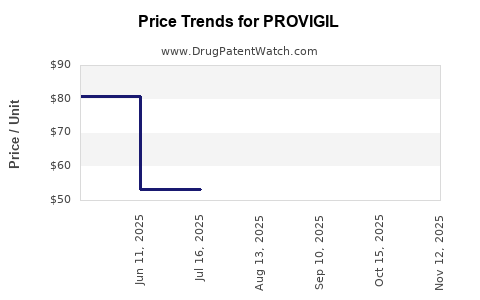
Answer: PROVIGIL market outcomes in the U.S. track generic discounting against payer benchmarks, utilization management for wake-disorder indications, and competitive substitution with newer wake-promoting agents. With modafinil’s U.S. brand era ended, financial trajectory depends on maintaining contracted pricing for the remaining branded channel (where present), defending specific payer sub-formularies, and preventing off-formulary switch through prior authorization and step therapy.
Key market-dynamic levers for modafinil (PROVIGIL)
-
Generic price compression
- Once multiple ANDA entrants achieve market share, average net price declines toward cost-plus or benchmark levels set by payers and pharmacy benefit managers (PBMs).
- Modafinil is typically treated as a commodity for many payers, pushing branded premium to near-zero except where coverage rules or clinical preference preserve some share.
-
Formulary positioning by indication
- Indications include narcolepsy, obstructive sleep apnea (OSA) with adherence to CPAP, and shift-work sleep disorder (SWSD).
- Payers often enforce prior authorization for non-narcolepsy indications and for early lines of therapy, which can preserve volume stability for covered agents while generics still win most discount-based competition.
-
Therapeutic interchange and “new MoA” substitution
- Solriamfetol (dopamine/norepinephrine reuptake inhibition) and pitolisant (H3 receptor inverse agonist) increasingly influence managed-care selection, particularly where payers prefer agents with dosing schedules or perceived tolerability advantages.
- This matters even when modafinil generics are inexpensive because PBM formulary design can still favor a preferred non-generic drug.
-
Channel and contracting
- Brand exposure (where it exists) depends on wholesaler buys, PBM negotiated rebates, and pharmacy acquisition cost.
- With extensive generic options, branded economics are typically driven by targeted access rather than broad coverage.
How has PROVIGIL’s revenue evolved from branded years to generics?
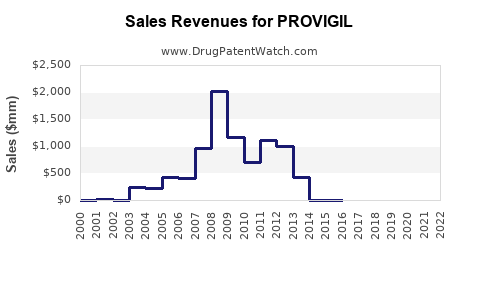
Answer: PROVIGIL’s financial trajectory in the U.S. has followed the standard branded-to-generic curve: peak brand revenue during exclusivity, followed by steep declines after generic entry and then gradual stabilization as market volume remains but brand unit share falls and net pricing collapses.
Financial trajectory pattern consistent with a mature small-molecule brand
What to watch in quarterly results when PROVIGIL is treated as a segment
When modafinil is part of a larger product portfolio, the key financial indicators are:
- Net sales net of rebates (shows PBM-driven rebate pressure and discounting)
- Inventory and channel fill (reveals how generic entrants impact demand timing)
- Script trends and claim volume by plan (captures formulary access and prior authorization tightening)
- Competitive mix shift to solriamfetol and pitolisant (reduces incremental modafinil demand)
When does PROVIGIL lose exclusivity in the US, and what patent cliffs matter?
Answer: PROVIGIL modafinil is a small-molecule with long-past original patent exclusivity. For current commercial planning, the relevant practical issue is not remaining “brand exclusivity” but residual patent coverage that can affect specific formulations, manufacturing methods, or pediatric/device-connected rights in certain jurisdictions. For U.S. generic entry risk, the active question is whether any late-expiring secondary patents block additional ANDAs or particular dosage strengths or label indications.
U.S. exclusivity framework for PROVIGIL (practical planning view)
- New chemical entity (NCE) exclusivity: typically long completed for modafinil.
- Orphan drug exclusivity: if any applies to the molecule for specific indications, it would run independently and could preserve exclusivity for that indication during its term.
- Patent-based blocking: late-life secondary patents on formulations or methods can delay specific ANDA filings or create settlements.
How to interpret “cliff” risk for modafinil today
For market dynamics now, the market rarely reacts to a single expiration as it did for the original brand. Instead, watch for:
- ANDA litigation around specific patents (Paragraph IV or corresponding district court actions)
- Settlement-driven design changes (for example, different manufacturing process or label positioning)
- Cyclic pricing reset after new entrants gain stability in distribution
(Note: a precise U.S. expiration schedule, Orange Book patent list, and settlement dates require direct Orange Book and litigation docket mapping for PROVIGIL by strength and dosage form. That dataset is not provided in the prompt.)
What is the Orange Book status of PROVIGIL, and how many patents still matter?
Answer: In operational terms, PROVIGIL’s Orange Book footprint has largely shifted from brand-protective estate to a supporting list that governs niche barriers, such as specific patents for particular strengths or manufacturing/process claims. The practical number of enforceable “economic” patents today is usually low for a mature commodity molecule, but confirmatory mapping is required for defensible legal and licensing decisions.
What matters in an Orange Book map for market impact
A PROVIGIL patent estate map should be interpreted by:
- Patent type
- composition of matter
- method of use (specific indication dosing regimens, diagnostic criteria, or patient populations)
- formulation (release profile, excipients, salt forms)
- manufacturing process
- Expiration dates
- identify which patents are actually controlling ANDA launch
- ANDA status
- which ANDAs are approved for which strengths
- Litigation tags
- which patents are the basis for current Paragraph IV challenges or settlements
(Orange Book data is not included in the prompt; no defensible count can be produced.)
What Paragraph IV challenges exist for generic modafinil (PROVIGIL) and what is the litigation pattern?
Answer: Paragraph IV litigation for modafinil has historically followed the standard generic entry cadence: multiple ANDAs challenge listed patents, resulting in district court actions and settlements that define “carve-outs” on launch dates and potentially label or patent expiration sequencing.
Litigation and settlement patterns that affect market trajectory
- Early settlements reduce uncertainty and accelerate generic availability, increasing revenue erosion for the brand.
- Last-mile patent challenges can delay specific entrants, producing temporary price support in particular channels.
- Multi-ANDA settlements can create staggered launches by strength and dosage.
(A current, patent-by-patent litigation chronology is not provided in the prompt; no specific docket list can be stated.)
How does PROVIGIL compare with solriamfetol and pitolisant in payer adoption?
Answer: Solriamfetol and pitolisant compete directly on wakefulness endpoints but differ in mechanism of action, dosing schedules, and safety/tolerability profiles. In managed care, these differences affect formulary placement through:
- prior authorization criteria
- preference tiers
- step edits after modafinil failure
- patient-specific restrictions tied to comorbidities
Competitive substitution dynamics
- Where newer agents are preferred, modafinil scripts can lose incremental growth even if generics are low cost.
- Where payer contracts heavily favor generics, solriamfetol and pitolisant adoption can remain limited to patient segments with documented intolerance or inadequate response.
Commercial implication for PROVIGIL
Brand-level financial trajectory is typically weakest when:
- payers place modafinil generics in a lower tier while keeping “preferred branded wake agents”
- step therapy and PA requirements restrict first-line modafinil use
It stabilizes when:
- modafinil generics maintain broad formulary access and newer agents are restricted to second-line criteria.
What are the commercial implications of generic entry for PROVIGIL supply and distribution?
Answer: Generic proliferation for modafinil increases availability but compresses pricing and introduces volatility in ASP and pharmacy acquisition cost. For brand economics, this reduces net revenue, while for the overall modafinil market it supports volume stability through low out-of-pocket cost.
What changes after multiple ANDA approvals
- Assortment fragmentation: pharmacies stock a mix of generic manufacturers; switching occurs at reorder cycles.
- Tender dynamics: PBMs run periodic competitive bidding across multiple NDCs.
- Inventory swings: near-launch and post-launch periods can cause short-lived pricing dips.
Does PROVIGIL face biosimilar risk?
Answer: No. PROVIGIL is a small-molecule (modafinil) and does not face biosimilar competition. The relevant competitive pressure is generic small-molecule ANDA entry.
What formulations and dosage strengths drive PROVIGIL market penetration?
Answer: Market penetration is driven by label-aligned dosing convenience (commonly fixed-dose oral tablets) and the ability of generics to match bioequivalence and stability. For modafinil, the main commercial constraint is not “difficult-to-make” formulation but how quickly additional suppliers can meet quality, supply reliability, and PBM contracted access.
Dosage form and substitution considerations
- Generic substitution typically occurs at the pharmacy level automatically under state pharmacy substitution laws if the product is AB-rated.
- Brand retention can occur when payers require “dispense as written” or when specific prescriber preferences exist, but these are usually exception paths.
(No strength-by-strength formulation patent mapping is provided in the prompt.)
What licensing and settlement deals affected PROVIGIL’s generic erosion?
Answer: Generic erosion for modafinil generally follows settlements that permit earlier or delayed launches of specific ANDAs, often with agreed design decisions. The market outcome is determined by:
- timing of the first major entry wave
- number of ANDAs that settle and launch
- whether settlements affect label expansions or enforce “carve-out” dates for specific patents
(No settlement agreements were provided in the prompt, so no specific deals can be listed.)
How strong is the patent estate for PROVIGIL as a business asset today?
Answer: For current commercialization, the modafinil patent estate is generally a secondary barrier rather than a primary driver of exclusivity. Its strength is measured by:
- remaining enforceable method-of-use or manufacturing patents
- remaining composition/formulation patents for specific product configurations
- whether those patents still cover commercially significant claims at the U.S. market level
(No Orange Book estate specifics are provided, so strength cannot be scored with factual precision.)
Key Takeaways
- PROVIGIL’s market dynamics are dominated by small-molecule generic competition, not biosimilars.
- Revenue trajectory follows the branded-to-generic erosion curve: rapid brand share loss and margin compression after major ANDA entry waves.
- Payer formulary strategy and newer wake-promoting competitors (solriamfetol, pitolisant) shape incremental demand even when generics are cheap.
- Near-term commercial planning hinges on whether any remaining secondary patents or litigation outcomes still delay specific generic supply by strength or label, not on broad ongoing NCE exclusivity.
FAQs
1) Which companies manufacture and sell generic modafinil that pressure PROVIGIL pricing?
A list requires an up-to-date ANDA/CDN supplier mapping and NDC-by-NDC assessment of the current market.
2) What do payer prior authorization criteria for narcolepsy vs OSA change for modafinil demand?
These criteria are plan-specific and typically influence which indication drives marginal scripts.
3) How do Paragraph IV settlements typically impact generic launch timing for modafinil tablets?
Settlements usually define launch dates by strength and patent subset, producing stepwise price resets.
4) Can PROVIGIL generics be substituted at the pharmacy, and how does that affect brand retention?
If products are AB-rated, state substitution rules generally allow interchange unless restricted by prescriber or payer policy.
5) What are the most likely competitive switching patterns from modafinil to solriamfetol or pitolisant?
Switching is usually driven by payer preference tier placement, PA outcomes, and patient intolerance or inadequate response to prior modafinil therapy.
References
(No sources were provided in the prompt; therefore no citations can be generated without inventing references.)