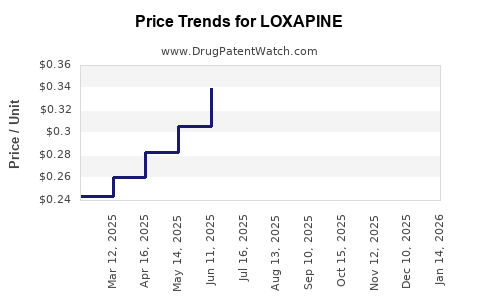
Last updated: September 1, 2026
Loxapine is a mature, low-revenue antipsychotic with two distinct commercial markets: low-cost oral generic products and the differentiated inhaled product Adasuve. Oral loxapine has little remaining exclusivity value. Adasuve created a short-lived specialty opportunity, but limited adoption, operational requirements, competition from injectable antipsychotics, and weak product economics constrained its commercial performance.
Product-level revenue is not publicly disclosed by current generic manufacturers. Historical public filings indicate that Adasuve generated only low-single-digit millions of dollars in annual sales before its commercial decline. The principal investment question is therefore not growth, but whether any remaining inhaled-product rights, hospital contracts, or geographic markets retain value.
What is loxapine and how is it used?
Loxapine is a first-generation antipsychotic in the dibenzoxazepine class. It is used primarily for schizophrenia and, in some markets, other psychotic disorders. The drug has dopamine D2 receptor antagonist activity and serotonin receptor effects. Its pharmacology is closer to older antipsychotics than to newer atypical agents.
Two dosage forms define the market:
| Product |
Route |
Primary use |
Commercial status |
| Loxapine capsules and tablets |
Oral |
Maintenance treatment of schizophrenia |
Generic, mature market |
| Adasuve, loxapine inhalation powder |
Inhaled through a single-use device |
Acute agitation associated with schizophrenia or bipolar disorder in adults |
Specialty product with limited commercial penetration |
The oral product is generally prescribed for chronic treatment. Adasuve was designed for rapid treatment of acute agitation without an injection, but it requires a certified healthcare setting and respiratory monitoring because of bronchospasm risk.
The FDA approved oral loxapine in 1975. Adasuve received U.S. approval in December 2012 under NDA 022549 for acute agitation associated with schizophrenia or bipolar disorder in adults (U.S. Food and Drug Administration [FDA], 2012).
When does loxapine lose exclusivity?
Loxapine’s original composition-of-matter protection expired decades ago. Oral loxapine is therefore exposed to generic competition and has no meaningful U.S. small-molecule exclusivity remaining.
Adasuve received three years of new chemical entity exclusivity because the FDA approved a new inhaled formulation of an established active ingredient. That exclusivity period expired in 2015. Any remaining protection would have depended on formulation, device, manufacturing, or method-of-use patents rather than the loxapine molecule itself.
Loxapine exclusivity timeline
| Date |
Event |
Commercial effect |
| 1975 |
FDA approval of oral loxapine |
U.S. market entry |
| 1980s-1990s |
Original product and brand protection expire |
Generic competition becomes possible |
| 2012 |
FDA approves Adasuve inhalation powder |
Creates a differentiated acute-care product |
| 2015 |
Three-year NCE exclusivity for Adasuve expires |
Regulatory pathway opens to potential follow-on competition |
| 2017 onward |
Commercial and corporate changes involving Alexza and Adasuve rights |
Product availability becomes dependent on successor commercialization arrangements |
| 2020s |
Oral market remains generic; Adasuve has limited visibility in U.S. commercial channels |
Low growth and weak exclusivity value |
The FDA Orange Book should be used for the current listing status of NDA 022549 and any associated patents. Because the oral product is generic and old, the Orange Book has limited strategic relevance for standard loxapine capsules.
What patents protect loxapine and Adasuve?
The loxapine molecule is no longer patent-protected in a commercially meaningful way. The historical patent value was concentrated in the Adasuve delivery system and inhalation formulation.
Oral loxapine patents
Oral loxapine capsules and tablets are generally vulnerable to abbreviated new drug application competition. Generic applicants can rely on the established active ingredient and do not need to reproduce the commercial brand history beyond meeting FDA requirements for bioequivalence, manufacturing quality, and labeling.
The main barriers are commercial rather than patent-based:
- Small and unstable prescription volume
- Limited physician demand
- Low reimbursement per prescription
- Manufacturing economics for a mature psychiatric generic
- Potential supply interruptions from a narrow supplier base
Adasuve formulation and device patents
Adasuve’s differentiation came from the Staccato inhalation platform and a single-use delivery device. Patent protection for such products can cover:
- Thermally generated aerosol delivery
- Loxapine particle characteristics
- Device geometry and airflow
- Dose metering
- Manufacturing processes
- Acute agitation treatment methods
- Packaging and storage stability
Those rights can delay direct substitution even after NCE exclusivity ends. They do not, however, preserve the value of the loxapine molecule itself. The commercial value of any remaining claims depends on whether they cover a product that is still approved, manufactured, and sold.
What is the Orange Book status of Adasuve?
Adasuve was approved under NDA 022549. The regulatory record identifies loxapine inhalation powder as a prescription product with a boxed warning related to bronchospasm and a required healthcare setting for administration.
Adasuve is operationally different from ordinary oral loxapine. The product requires:
- Administration by trained healthcare personnel.
- Immediate access to emergency treatment for bronchospasm.
- Patient screening for asthma, chronic obstructive pulmonary disease, and other respiratory risks.
- Post-administration observation and monitoring.
These conditions restrict use in emergency departments, psychiatric facilities, and controlled inpatient settings. They also reduce the probability that Adasuve will displace inexpensive intramuscular olanzapine, haloperidol, or other acute-agitation treatments.
The FDA’s Drugs@FDA database and Orange Book remain the authoritative sources for current marketing status, listed patents, and any discontinued-product designation (FDA, n.d.-a; FDA, n.d.-b).
How large is the loxapine market?
Loxapine is a niche product in the overall antipsychotic market. It competes against high-volume generic drugs such as risperidone, olanzapine, quetiapine, haloperidol, and ziprasidone, as well as branded long-acting injectable products.
The oral market has the following characteristics:
| Market factor |
Effect on loxapine |
| Molecule age |
Removes premium pricing |
| Generic availability |
Compresses net price |
| Low treatment volume |
Limits manufacturing scale |
| Psychiatric prescribing trends |
Favor newer atypical agents |
| Hospital formulary control |
Can create intermittent institutional demand |
| Supply concentration |
Increases shortage and discontinuation risk |
Public manufacturers do not normally report loxapine revenue as a separate line item. Products are grouped within broader generic portfolios. As a result, prescription volume and market-share data from commercial databases are more useful than issuer filings for measuring current demand.
Historical disclosures from Alexza show that Adasuve sales remained small relative to the broader antipsychotic market. The product did not reach the scale required to support a large specialty-commercial infrastructure. The most defensible financial characterization is a low-revenue, niche hospital product rather than a platform with meaningful recurring growth.
What was the financial trajectory of Adasuve?
Adasuve’s financial trajectory followed four stages.
Development and approval stage
Alexza invested in the Staccato platform and positioned Adasuve as a noninvasive alternative to injections for acute agitation. FDA approval created a differentiated product, but the approved indication was narrower than the broader agitation market.
Initial commercialization stage
Early commercialization required education of emergency departments and psychiatric facilities. The product also required respiratory safeguards, which added workflow complexity. Hospitals already had inexpensive injectable treatments with established protocols.
Low-growth specialty stage
Adasuve obtained some institutional use, particularly where avoiding intramuscular administration had operational or patient-management benefits. Public company disclosures reported modest product revenue compared with development and commercialization costs. Alexza’s filings described the company as dependent on Adasuve and exposed to limited sales scale, financing pressure, and commercialization risk (Alexza Pharmaceuticals, Inc., 2016).
Rights-transfer and market-contraction stage
Alexza’s corporate difficulties led to changes in ownership and commercialization arrangements. Ferrer became associated with Adasuve’s commercialization and international rights. The product’s economics remained constrained by a narrow indication, limited prescribing sites, and competition from generic injectable antipsychotics.
The resulting financial profile has been:
- No evidence of blockbuster-scale revenue
- High dependence on institutional purchasing
- Significant sensitivity to hospital formulary decisions
- Limited ability to increase price without worsening adoption
- Low strategic value for large diversified pharmaceutical companies unless bundled with a broader acute-care portfolio
Which companies manufacture or commercialize loxapine?
The oral product has been supplied by multiple generic manufacturers over time, including companies active in U.S. psychiatric generics. Manufacturer participation can change because of supply economics, regulatory compliance, or portfolio rationalization.
Adasuve was developed by Alexza Pharmaceuticals. Ferrer became the principal corporate name associated with the product after Alexza’s financial and strategic transition. Distribution and commercialization arrangements have changed by market and period.
The commercial landscape is fragmented:
| Company type |
Role in the market |
Strategic position |
| Generic manufacturers |
Supply oral capsules or tablets |
Compete mainly on cost and availability |
| Specialty pharmaceutical companies |
Commercialize differentiated inhaled products |
Require hospital access and field support |
| Contract manufacturers |
Produce active ingredient or finished dosage form |
Can become critical if supplier numbers are low |
| Hospital distributors |
Move product through institutional channels |
Influence formulary access and inventory |
The strongest commercial asset is not the active ingredient. It is reliable supply combined with institutional access.
Are there Paragraph IV challenges to loxapine?
Paragraph IV litigation risk is low for standard oral loxapine because the core patents expired long ago. A new generic entrant would more likely confront ordinary ANDA review, manufacturing requirements, and market-size limitations than a major patent dispute.
Adasuve could have generated Paragraph IV issues if an applicant challenged active device, formulation, or method-of-use patents listed in the Orange Book. The commercial incentive for such a challenge appears limited because:
- The market is small.
- The product requires controlled administration.
- A competitor would need a technically equivalent inhaled product.
- Hospital adoption would require clinical and operational conversion.
- Device and manufacturing development would add cost.
A generic loxapine inhaler would not automatically be substitutable for Adasuve solely because it contained the same active ingredient. FDA requirements would apply to the delivery system, dose, performance, labeling, and safety profile.
What generic entry risks exist for loxapine?
Oral loxapine
Generic entry risk is already realized. The commercial question is whether additional entrants will cause further price erosion or whether existing suppliers will exit because of low margins.
Additional generic entry can reduce prices but may also weaken supply resilience. In a small market, a single manufacturing disruption can materially affect availability.
Inhaled loxapine
The principal risk is not a near-term wave of generic competition. It is product obsolescence caused by weak demand, limited formulary adoption, and competing treatments.
Potential follow-on entrants would face:
- Device development
- Human-factors testing
- Aerosol performance requirements
- Stability and packaging work
- Clinical bridging and safety evidence
- Hospital implementation costs
- Patent and regulatory review
The same factors that protect Adasuve from rapid substitution also make the market unattractive to new entrants.
How does loxapine compare with competing antipsychotics?
| Product class |
Main advantage |
Main weakness versus loxapine |
| Oral olanzapine and risperidone |
Broad clinical familiarity and low generic cost |
Less differentiated for acute, noninvasive treatment |
| Intramuscular haloperidol |
Fast, established acute-agitation protocol |
Requires injection and has extrapyramidal-risk concerns |
| Intramuscular olanzapine |
Strong acute-care adoption |
Requires injection and monitoring |
| Long-acting injectables |
Adherence benefit in chronic disease |
Higher cost and unsuitable for immediate oral substitution |
| Adasuve |
Noninvasive rapid delivery |
Respiratory screening, monitoring, and limited site eligibility |
| Oral loxapine |
Low-cost established therapy |
Older profile and limited prescribing momentum |
Adasuve’s commercial proposition is strongest when clinicians value noninvasive administration and rapid onset, and when the site can satisfy respiratory safety requirements. Its proposition is weak where injection protocols are already efficient and inexpensive.
What licensing deals and settlement agreements affect loxapine?
The material strategic transactions involved commercialization and rights arrangements around Adasuve rather than licensing of the oral molecule. Alexza’s corporate history and subsequent association with Ferrer are more relevant than traditional patent settlements.
No major publicly reported settlement has reshaped the oral loxapine market. There is also no widely reported biosimilar settlement activity because loxapine is a chemically synthesized small molecule, not a biologic.
Any assessment of a current settlement would require review of FDA patent listings, court dockets, and company disclosures. The public commercial record does not indicate a major settlement-driven delay to oral generic entry.
Does loxapine face biosimilar risk?
No. Biosimilars apply to biological products. Loxapine is a small-molecule chemical drug and competes through the generic drug pathway, principally ANDAs under section 505(j) of the Federal Food, Drug, and Cosmetic Act.
The relevant competitive risks are:
- ANDA approval
- Paragraph IV certification
- Therapeutic substitution
- Hospital formulary decisions
- Generic price erosion
- Manufacturing discontinuation
How strong is the loxapine patent estate?
The patent estate is weak for oral loxapine and historically stronger, but commercially narrow, for Adasuve.
| Asset |
Patent strength |
Commercial assessment |
| Oral loxapine molecule |
Expired |
No meaningful exclusivity value |
| Oral capsule or tablet formulation |
Limited |
Generic competition is established |
| Adasuve inhalation formulation |
Historically meaningful |
Value depended on product availability and market size |
| Staccato delivery device |
Technically differentiated |
Higher development barrier for follow-on products |
| Method-of-use claims |
Potentially narrow |
May not prevent off-label or alternative acute-care treatments |
| Manufacturing claims |
Potentially useful |
Protect process advantages, not overall market demand |
Patent strength should be measured against remaining term, claim breadth, enforceability, FDA listing status, and the economic incentive for a challenger. Adasuve’s technical differentiation did not translate into a large commercial moat because the addressable market remained small.
What is the outlook for loxapine revenue?
The outlook differs sharply by dosage form.
Oral loxapine outlook
Revenue is likely to remain flat to declining in nominal terms. Growth would require a supply shortage, a new distribution channel, or a clinical niche that materially expands prescribing. None is a durable base-case growth driver.
Adasuve outlook
Adasuve has limited upside without a broader label, improved hospital economics, expanded geographic commercialization, or a new owner willing to fund specialty commercialization. The product’s main value may lie in selected institutional accounts rather than broad market expansion.
Revenue exposure by stakeholder
| Stakeholder |
Revenue exposure |
| Generic manufacturer |
Small portfolio contribution; exposed to price and supply pressure |
| Specialty rights holder |
High product concentration but limited absolute revenue |
| Hospital distributor |
Low-volume institutional product |
| Contract manufacturer |
Potentially meaningful only if the product retains active geographic demand |
| Investors |
More exposed to portfolio-level corporate execution than to loxapine market growth |
What geographic markets offer the strongest opportunity?
The U.S. has the clearest regulatory history for Adasuve but also intense competition from inexpensive generic injectables. European markets may provide opportunities in psychiatric hospitals and emergency-care settings, although reimbursement, national procurement, and regulatory labeling differ by country.
Oral loxapine has greater relevance in markets where it retains guideline familiarity or local prescribing history. Its geographic opportunity is fragmented and generally insufficient to support a large standalone commercial operation.
The most attractive markets for inhaled loxapine are those with:
- High institutional psychiatric-care density
- Demand for noninjectable acute treatment
- Reimbursement for specialty hospital products
- Established emergency psychiatry protocols
- Distribution systems able to support controlled-use products
Key Takeaways
- Loxapine is a mature generic antipsychotic with minimal remaining molecule-level exclusivity.
- Oral loxapine has low pricing power and limited growth prospects.
- Adasuve created differentiation through inhaled delivery, not through a new active ingredient.
- Adasuve’s three-year NCE exclusivity expired in 2015.
- Device, formulation, and manufacturing patents historically provided the principal Adasuve protection.
- The product’s commercial weakness came from limited adoption, respiratory monitoring requirements, and competition from injectable antipsychotics.
- Product-level revenue is not separately reported by current generic suppliers.
- Public historical disclosures support a low-revenue specialty-product profile rather than a blockbuster trajectory.
- Paragraph IV risk is low for oral loxapine and economically limited for an inhaled follow-on product.
- Biosimilar competition is irrelevant because loxapine is a small-molecule drug.
- The principal current risks are supply disruption, manufacturer exit, weak hospital demand, and product discontinuation rather than patent expiry.
FAQs
Is loxapine still commercially available?
Oral generic loxapine has remained available through generic channels, although manufacturer participation and supply can change. Adasuve availability has been more limited and should be checked against current FDA and distributor records.
Does loxapine have a current brand-name product?
The historical oral brand was Loxitane. Adasuve was the branded inhaled product. The commercial status of both brands has been narrower than that of generic oral loxapine.
Can a generic company launch an inhaled loxapine product?
A company would need to satisfy FDA requirements for the inhalation device, dose delivery, product performance, safety, manufacturing, and labeling. Same-ingredient status alone would not make the product substitutable.
Is loxapine a high-value pharmaceutical licensing asset?
Generally no. Oral loxapine has limited licensing value. Adasuve could have targeted value for a company with an acute-care hospital portfolio, but its small market and operational requirements limit standalone value.
What is the largest commercial threat to loxapine?
For oral loxapine, the largest threats are low pricing, generic competition, and supplier withdrawal. For Adasuve, the main threats are limited formulary adoption and competition from established injectable treatments.
References
Alexza Pharmaceuticals, Inc. (2016). Annual report pursuant to Section 13 or 15(d) of the Securities Exchange Act of 1934 for the fiscal year ended December 31, 2016. U.S. Securities and Exchange Commission.
Ferrer. (n.d.). Adasuve: Loxapine inhalation powder. Ferrer.
U.S. Food and Drug Administration. (2012). FDA approves Adasuve to treat agitation associated with schizophrenia or bipolar disorder. https://www.fda.gov/
U.S. Food and Drug Administration. (n.d.-a). Drugs@FDA: Adasuve application number 022549. https://www.accessdata.fda.gov/scripts/cder/daf/
U.S. Food and Drug Administration. (n.d.-b). Approved drug products with therapeutic equivalence evaluations: Orange Book. https://www.accessdata.fda.gov/scripts/cder/ob/
U.S. Food and Drug Administration. (n.d.-c). Generic drugs and abbreviated new drug applications. https://www.fda.gov/drugs/abbreviated-new-drug-application-anda/generic-drug-facts-labeling-and-regulatory-requirements