You're using a free limited version of DrugPatentWatch: Upgrade for Complete Access

Last Updated: December 19, 2025

ADASUVE Drug Patent Profile


✉ Email this page to a colleague

« Back to Dashboard


Which patents cover Adasuve, and what generic alternatives are available?

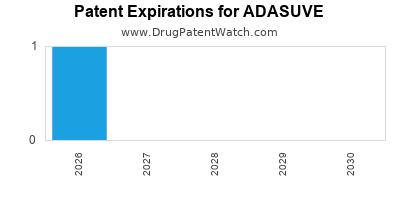
Adasuve is a drug marketed by Alexza Pharms and is included in one NDA. There is one patent protecting this drug.

This drug has twenty-one patent family members in six countries.

The generic ingredient in ADASUVE is loxapine. There are eight drug master file entries for this compound. Additional details are available on the loxapine profile page.

DrugPatentWatch® Generic Entry Outlook for Adasuve

By analyzing the patents and regulatory protections it appears that the earliest date for generic entry will be October 23, 2026. This may change due to patent challenges or generic licensing.

There have been three patent litigation cases involving the patents protecting this drug, indicating strong interest in generic launch. Recent data indicate that 63% of patent challenges are decided in favor of the generic patent challenger and that 54% of successful patent challengers promptly launch generic drugs.

Indicators of Generic Entry

< Available with Subscription >

  Get Started Free

AI Deep Research
Questions you can ask:
  • What is the 5 year forecast for ADASUVE?
  • What are the global sales for ADASUVE?
  • What is Average Wholesale Price for ADASUVE?
Summary for ADASUVE
Drug patent expirations by year for ADASUVE
Drug Prices for ADASUVE

See drug prices for ADASUVE

DrugPatentWatch® Estimated Loss of Exclusivity (LOE) Date for ADASUVE
Generic Entry Date for ADASUVE*:
Constraining patent/regulatory exclusivity:
NDA:
Dosage:
POWDER;INHALATION

*The generic entry opportunity date is the latter of the last compound-claiming patent and the last regulatory exclusivity protection. Many factors can influence early or later generic entry. This date is provided as a rough estimate of generic entry potential and should not be used as an independent source.

Recent Clinical Trials for ADASUVE

Identify potential brand extensions & 505(b)(2) entrants

SponsorPhase
Lee's Pharmaceutical LimitedPhase 3
Mount Sinai Hospital, ChicagoPhase 4
University of ArkansasPhase 4

See all ADASUVE clinical trials

US Patents and Regulatory Information for ADASUVE

ADASUVE is protected by one US patents.

Based on analysis by DrugPatentWatch, the earliest date for a generic version of ADASUVE is ⤷  Get Started Free.

This potential generic entry date is based on patent 8,387,612.

Generics may enter earlier, or later, based on new patent filings, patent extensions, patent invalidation, early generic licensing, generic entry preferences, and other factors.

Applicant Tradename Generic Name Dosage NDA Approval Date TE Type RLD RS Patent No. Patent Expiration Product Substance Delist Req. Exclusivity Expiration
Alexza Pharms ADASUVE loxapine POWDER;INHALATION 022549-001 Dec 21, 2012 RX Yes Yes 8,387,612 ⤷  Get Started Free Y ⤷  Get Started Free
>Applicant >Tradename >Generic Name >Dosage >NDA >Approval Date >TE >Type >RLD >RS >Patent No. >Patent Expiration >Product >Substance >Delist Req. >Exclusivity Expiration

Expired US Patents for ADASUVE

Applicant Tradename Generic Name Dosage NDA Approval Date Patent No. Patent Expiration
Alexza Pharms ADASUVE loxapine POWDER;INHALATION 022549-001 Dec 21, 2012 8,173,107 ⤷  Get Started Free
Alexza Pharms ADASUVE loxapine POWDER;INHALATION 022549-001 Dec 21, 2012 9,687,487 ⤷  Get Started Free
Alexza Pharms ADASUVE loxapine POWDER;INHALATION 022549-001 Dec 21, 2012 9,370,629 ⤷  Get Started Free
Alexza Pharms ADASUVE loxapine POWDER;INHALATION 022549-001 Dec 21, 2012 7,458,374 ⤷  Get Started Free
>Applicant >Tradename >Generic Name >Dosage >NDA >Approval Date >Patent No. >Patent Expiration

EU/EMA Drug Approvals for ADASUVE

Company Drugname Inn Product Number / Indication Status Generic Biosimilar Orphan Marketing Authorisation Marketing Refusal
Ferrer Internacional S.A. Adasuve loxapine EMEA/H/C/002400Adasuve is indicated for the rapid control of mild-to-moderate agitation in adult patients with schizophrenia or bipolar disorder. Patients should receive regular treatment immediately after control of acute agitation symptoms. Authorised no no no 2013-02-20
>Company >Drugname >Inn >Product Number / Indication >Status >Generic >Biosimilar >Orphan >Marketing Authorisation >Marketing Refusal

International Patents for ADASUVE

See the table below for patents covering ADASUVE around the world.

Country Patent Number Title Estimated Expiration
European Patent Office 2052753 Procédé de vaporisation d'un composé (Method for vaporizing a compound) ⤷  Get Started Free
Germany 60230609 ⤷  Get Started Free
Japan 2004529724 ⤷  Get Started Free
World Intellectual Property Organization (WIPO) 02094218 ⤷  Get Started Free
>Country >Patent Number >Title >Estimated Expiration

Supplementary Protection Certificates for ADASUVE

Patent Number Supplementary Protection Certificate SPC Country SPC Expiration SPC Description
1389098 1390040-2 Sweden ⤷  Get Started Free PRODUCT NAME: LOXAPIN; REG. NO/DATE: EU/1/13/823/001 20130220
1389098 C300609 Netherlands ⤷  Get Started Free PRODUCT NAME: LOXAPINE; REGISTRATION NO/DATE: EU/1/13/823/001-002 20130220
1389098 SPC/GB13/055 United Kingdom ⤷  Get Started Free PRODUCT NAME: LOXAPINE; REGISTERED: UK EU/1/13/823/001 20130220; UK EU/1/13/823/002 20130220
1389098 C01389098/01 Switzerland ⤷  Get Started Free PRODUCT NAME: LOXAPINUM; REGISTRATION NO/DATE: SWISSMEDIC-ZULASSUNG 65461 13.12.2016
>Patent Number >Supplementary Protection Certificate >SPC Country >SPC Expiration >SPC Description

Market Dynamics and Financial Trajectory for ADASUVE

Last updated: July 28, 2025

Introduction
ADASUVE, a proprietary formulation of inhaled loxapine, gained approval from the U.S. Food and Drug Administration (FDA) in 2012 for the treatment of agitation associated with schizophrenia or bipolar I disorder in adult patients. Its unique delivery method—a breath-actuated inhaler—sets it apart within the mental health treatment landscape, offering rapid onset of action with minimal systemic side effects. Understanding the market dynamics and financial trajectory of ADASUVE involves analyzing its therapeutic positioning, competitive landscape, regulatory environment, and commercial performance.


Market Landscape and Clinical Need
Agitation is a prevalent and acute symptom in psychiatric conditions such as schizophrenia and bipolar disorder, often necessitating immediate intervention. The global prevalence of schizophrenia affects approximately 20 million individuals, while bipolar disorder impacts around 45 million globally, underpinning a significant customer base for rapid-onset therapies like ADASUVE [1].

Traditional treatment options predominantly include intramuscular injectables or oral medications, which pose challenges regarding patient compliance, absorption time, and side effects. ADASUVE's inhalation delivery offers an attractive alternative for quick symptom control, with data indicating onset of action within 10 minutes [2]. Consequently, the drug addresses a notable clinical gap, creating potential for substantial market share among emergency and inpatient psychiatric settings.


Market Drivers
Several factors propel the market dynamics for ADASUVE:

  1. Rising Prevalence of Psychiatric Disorders: The global mental health burden is increasing, driven by stress, urbanization, and aging populations, increasing demand for effective agitation management [3].

  2. Need for Rapid and Safe Interventions: Healthcare providers prioritize treatments that deliver quick symptom relief without invasive procedures or significant systemic side effects. ADASUVE’s inhalation delivery aligns with these needs.

  3. Shift Towards Patient-Centric Delivery Modalities: The inhaled route offers a non-invasive, discreet, and portable option, improving patient and clinician acceptance.

  4. Regulatory Endorsement and Market Approvals: FDA approval, coupled with marketing authorizations in select international markets, facilitates adoption and reimbursement pathways.

  5. Growing Recognition of Pulmonary Drug Delivery: Advances in inhalation technology have expanded the therapeutic applications for pulmonary routes, increasing receptivity among prescribers.


Competitive Environment
ADASUVE faces competition from several existing treatment modalities:

  • Intramuscular (IM) Injectables: Midazolam, haloperidol combinations, and lorazepam are common for agitation, but these have longer onset times and may cause injection-related discomfort.

  • Oral and Liquid Formulations: Oral medications like risperidone or olanzapine are standard but are less suitable for acute agitation due to slower absorption.

  • Emerging Innovations: Novel inhalation products and alternatives such as nasal sprays are in developmental stages, promising to further influence market dynamics.

Despite its advantages, ADASUVE's adoption is hampered by concerns regarding pulmonary safety (notably, rare cases of bronchospasm), cost issues, and provider familiarity. These factors influence its market penetration trajectory.


Regulatory and Reimbursement Dynamics
Post-approval, ADASUVE's market expansion hinges on favorable coverage by payors and integration into treatment guidelines. However, reimbursement challenges exist, especially considering its specialized device and potential safety concerns, which contribute to variability in clinical adoption across health systems.

Regulatory agencies periodically review safety data; the pulmonary risks necessitate clear labeling and provider education, impacting prescribing habits and uptake.


Financial Trajectory and Commercial Performance
Since its launch, ADASUVE's commercial success has been modest. Factors such as market awareness, safety concerns, and competitive positioning shape its revenue trajectory.

  • Sales Data: The drug registered limited sales initially, with some reports indicating annual revenues below the $20 million mark in the early years post-launch [4].

  • Market Share: ADASUVE’s market share remains small within the psychiatric agitation segment, with studies citing a preference for traditional injectable agents among providers.

  • Pricing Strategy: The listed price per dose reflects its specialized delivery device and convenience, but high costs limit formulary placement and patient access.

  • Pipeline and Future Outlook: The commercial outlook depends on ongoing safety management, educational initiatives, and potential label expansions—such as additional indications or formulations—exploiting new market segments like emergency departments or correctional facilities.

Given current market conditions, projections suggest slow but steady growth if safety profile concerns are addressed and provider familiarity increases.


Future Opportunities and Challenges

Opportunities:

  • Expanding into international markets with unmet psychiatric care needs.
  • Developing second-generation inhalation devices enhancing safety and efficacy.
  • Broadening indications to include pediatric or geriatric populations under regulatory review.
  • Incorporating digital health tools for improved adherence and monitoring.

Challenges:

  • Safety concerns, particularly pulmonary adverse events, which may limit usage or necessitate post-market surveillance.
  • Competition from oral, injectable, and nasal alternatives that might be more cost-effective or better established.
  • Evolving healthcare policies favoring generic and biosimilar drugs, constraining pricing power.

Conclusion
ADASUVE occupies a niche in the agitation treatment market characterized by rapid onset and non-invasive delivery. Its market trajectory is marked by moderate sales growth constrained by safety concerns and limited provider appeal. Strategic focus on safety profile management, expanded clinical evidence, and educational outreach remains critical for its sustained financial performance. The future landscape will be shaped by technological innovations, regulatory developments, and evolving psychiatric care paradigms.


Key Takeaways

  • Market Potential: Growing prevalence of psychiatric disorders and demand for rapid, non-invasive agitation management sustain ADASUVE’s market relevance.
  • Competitive Positioning: Its inhalation route offers distinct advantages but faces stiff competition from injectable and oral agents.
  • Financial Outlook: Sales remain modest; future growth depends on safety improvements, expanded indications, and reimbursement strategies.
  • Strategic Focus: Addressing pulmonary safety concerns and increasing clinical adoption are essential to unlock full market potential.
  • Innovation and Expansion: Opportunities exist in technological enhancements, pipeline diversification, and international market entry, contingent on regulatory navigation.

FAQs

1. What are the primary clinical advantages of ADASUVE compared to traditional agitation treatments?
ADASUVE provides rapid onset within 10 minutes via inhalation, is non-invasive, and avoids the discomfort associated with injections. Its targeted pulmonary delivery reduces systemic side effects, enhancing patient compliance and emergency management efficiency.

2. What safety concerns are associated with ADASUVE, and how do they impact its market adoption?
The main safety concern involves rare cases of bronchospasm, leading to recommendations for screening and cautious use. These safety issues have limited prescribing, especially in patients with respiratory conditions, thereby constraining broader market penetration.

3. How does reimbursement landscape influence ADASUVE’s commercial success?
Reimbursement challenges stem from high drug costs and safety management requirements, affecting formulary placements. Variability in payor coverage reduces patient access, impacting revenue growth.

4. What are future prospects for ADASUVE in the context of emerging therapies?
Potential growth relies on safety profile improvements, increased clinical awareness, and pipeline developments that may include new inhalation devices, formulations, or indications, expanding its application scope.

5. Are there any regulatory developments that could influence ADASUVE’s market trajectory?
Post-market surveillance and safety label updates influence prescribing behaviors. Future approval of related inhaled antipsychotics or modifications to existing regulatory guidelines could positively or negatively impact market positioning.


References

[1] World Health Organization. (2019). Mental health factsheet.
[2] U.S. FDA. (2012). ADASUVE (loxapine inhalation aerosol) approval announcement.
[3] Global Burden of Disease Study. (2018). Mental Disorders data.
[4] Company Financial Reports. (2022). Sales figures for ADASUVE.

More… ↓

⤷  Get Started Free

Make Better Decisions: Try a trial or see plans & pricing

Drugs may be covered by multiple patents or regulatory protections. All trademarks and applicant names are the property of their respective owners or licensors. Although great care is taken in the proper and correct provision of this service, thinkBiotech LLC does not accept any responsibility for possible consequences of errors or omissions in the provided data. The data presented herein is for information purposes only. There is no warranty that the data contained herein is error free. We do not provide individual investment advice. This service is not registered with any financial regulatory agency. The information we publish is educational only and based on our opinions plus our models. By using DrugPatentWatch you acknowledge that we do not provide personalized recommendations or advice. thinkBiotech performs no independent verification of facts as provided by public sources nor are attempts made to provide legal or investing advice. Any reliance on data provided herein is done solely at the discretion of the user. Users of this service are advised to seek professional advice and independent confirmation before considering acting on any of the provided information. thinkBiotech LLC reserves the right to amend, extend or withdraw any part or all of the offered service without notice.