Last updated: November 6, 2026
Losartan potassium is a mature, low-cost angiotensin II receptor blocker (ARB) with extensive generic competition. Merck’s Cozaar and Hyzaar franchise generated multibillion-dollar global sales before patent expiry, but revenue declined sharply after U.S. generic entry. The current market is driven by prescription volume, tender pricing, manufacturing reliability, combination products, and regulatory controls on nitrosamine impurities rather than by branded pricing power.
What is the current market position of losartan potassium?
Losartan potassium is an oral ARB used primarily for hypertension, diabetic nephropathy in patients with type 2 diabetes and hypertension, and reduction of stroke risk in selected hypertensive patients with left ventricular hypertrophy. The FDA approved Cozaar, losartan potassium tablets, in 1995. Hyzaar, the losartan potassium and hydrochlorothiazide combination, followed in 1995. [1,2]
| Market attribute |
Current position |
| Active ingredient |
Losartan potassium |
| Drug class |
Angiotensin II receptor blocker |
| Original innovator |
Merck & Co. |
| Original brands |
Cozaar; Hyzaar |
| U.S. approval |
1995 |
| Dosage forms |
Tablets; immediate-release oral products |
| Main generic markets |
United States, Europe, Japan, China, India, Latin America |
| Regulatory status |
Generic products widely approved |
| Biosimilar exposure |
None; losartan is a small molecule |
| Primary commercial risk |
Price erosion and supply interruption |
| Primary clinical competitors |
Generic valsartan, irbesartan, candesartan, telmisartan, olmesartan and ACE inhibitors |
Losartan remains commercially relevant because hypertension is a chronic, high-volume indication. Its low acquisition cost supports use in public formularies, managed-care plans, hospitals and retail generic channels. The product is no longer an innovation-driven asset.
How has the financial trajectory of Cozaar and Hyzaar changed?
Merck’s losartan franchise followed the standard small-molecule lifecycle: rapid adoption after launch, expansion through hypertension and cardiovascular prescribing, patent-protected pricing, then a steep decline after generic entry.
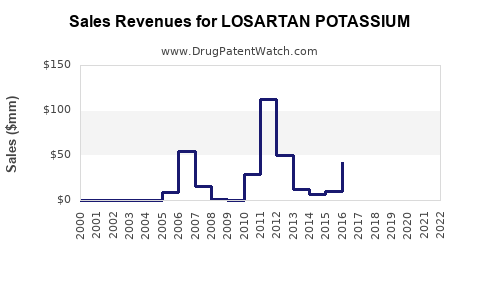
Merck reported Cozaar and Hyzaar as a combined commercial franchise in its annual filings. Global sales were in the multibillion-dollar range before major patent expiry. Revenue fell after generic competition entered the United States and other high-value markets. Merck’s public reporting later grouped or de-emphasized the products as they became less material to company performance. [3-5]
Losartan financial lifecycle
| Period |
Commercial event |
Financial effect |
| 1995-2000 |
U.S. launch and physician adoption |
High branded growth |
| 2000-2008 |
Broader ARB use and combination-product penetration |
Franchise reached multibillion-dollar global scale |
| 2009-2011 |
Patent expiry and generic approvals in major markets |
Rapid U.S. price and share erosion |
| 2012-2017 |
Generic normalization |
High volume, low unit economics |
| 2018-present |
Mature generic market and impurity-related recalls |
Revenue depends on supply continuity and contracts |
Branded revenue was concentrated in the period before generic entry. After loss of exclusivity, the economic value shifted from product differentiation to manufacturing scale, regulatory compliance, pharmacy contracts and reliable API procurement.
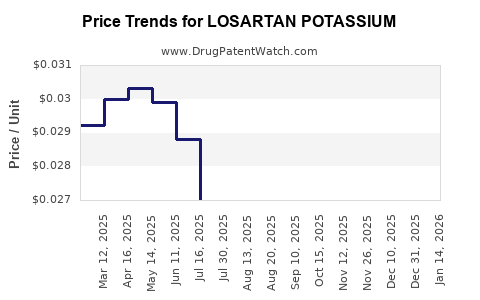
Standalone global market figures for generic losartan vary materially by methodology. Public manufacturers generally do not disclose losartan revenue separately because the product is sold within broader cardiovascular portfolios. The commercially relevant metric is therefore not total market size alone, but the combination of annual prescription volume, average selling price and supplier concentration.
When did losartan potassium lose exclusivity?
The principal U.S. compound patent protecting losartan was U.S. Patent No. 5,138,069, assigned to E.I. du Pont de Nemours and later associated with Merck’s Cozaar franchise. The patent covered losartan and related compounds and expired around 2010 after patent-term adjustments and applicable pediatric exclusivity. [6,7]
| Protection category |
Losartan status |
| Core compound patent |
Expired |
| U.S. regulatory exclusivity |
Expired |
| Cozaar brand protection |
Expired |
| Hyzaar combination protection |
Expired or commercially ineffective against generic substitution |
| Generic entry |
Established |
| Current patent barrier |
No meaningful composition-of-matter barrier |
The effective loss of exclusivity occurred when ANDA applicants received approval and commercial generic supply became available. Generic entry did not depend solely on the nominal expiration date. Paragraph IV litigation, settlements, regulatory review timing and commercial launch decisions affected the precise entry sequence.
What patents protect losartan potassium today?
No active U.S. patent materially protects the losartan potassium molecule as a standalone product. The original compound patent has expired. Historical protection centered on the active molecule and, later, on combination-product and formulation claims.
Historical patent estate
| Patent or protection type |
Relevance |
| U.S. Patent No. 5,138,069 |
Core losartan compound patent |
| Related compound and process claims |
Supported historical product and manufacturing protection |
| Cozaar labeling |
Protected through regulatory exclusivity and brand status, not current patent exclusivity |
| Hyzaar combination claims |
Covered losartan with hydrochlorothiazide and related commercial presentations |
| Pediatric exclusivity |
Extended the effective period of certain listed protections |
The current estate is commercially weak because any remaining narrow claims would not recreate the original product monopoly. Generic manufacturers can supply standard losartan tablets under approved ANDAs, subject to bioequivalence, current good manufacturing practice and labeling requirements.
How many patents cover generic losartan products?
The number depends on the specific product, dosage strength, jurisdiction and Orange Book listing date. The important distinction is between historical patents listed for Cozaar or Hyzaar and patents that remain enforceable against present-day generic tablets.
The FDA Orange Book historically listed patents for innovator losartan products. Those listings supported ANDA certification and Paragraph IV litigation during the original generic-entry period. Expired listings no longer block approval or substitution. [7]
For current U.S. generic losartan, the practical protection profile is:
- No active compound patent blocking ordinary losartan tablets.
- No biologic exclusivity or biosimilar pathway.
- Limited commercial value in narrow formulation or process claims.
- Regulatory obligations remain significant even without patent protection.
What was the Paragraph IV challenge and litigation history?
Generic applicants challenged the remaining Cozaar and Hyzaar patent protections through ANDAs containing Paragraph IV certifications. The challenges alleged that listed patents were invalid, unenforceable or would not be infringed by the proposed generic products.
The core litigation period occurred before and around the 2010 U.S. loss of exclusivity. Generic applicants included major suppliers such as Teva and other ANDA manufacturers. The commercial result was eventual generic availability rather than prolonged exclusion of all competitors.
| Litigation issue |
Commercial outcome |
| Validity of core losartan protection |
Patent protection expired |
| Generic ANDA certifications |
Supported market-entry litigation |
| Cozaar substitution |
Became broadly available after exclusivity |
| Hyzaar competition |
Generic losartan/hydrochlorothiazide entered |
| Post-expiry litigation value |
Limited for standard tablets |
Public litigation records should be reviewed case by case because losartan disputes involved different products, patents, defendants and jurisdictions. The strategic conclusion is clear: litigation did not preserve a durable branded monopoly.
What is the Orange Book status of losartan potassium?
The Orange Book remains relevant for historical reference, ANDA certification and product substitution. Cozaar and Hyzaar were listed reference products, while generic losartan and losartan/hydrochlorothiazide products were approved under abbreviated applications. [7]
Current commercial questions concern:
- Whether a generic product references Cozaar or Hyzaar.
- Whether the ANDA covers losartan alone or a combination with hydrochlorothiazide.
- Whether labeling matches the reference product.
- Whether a supplier has an active FDA-approved product and commercial inventory.
- Whether a product is subject to FDA manufacturing or recall action.
The absence of active core patents means that Orange Book status does not create a meaningful barrier to ordinary generic entry.
What formulations are protected by losartan patents?
The principal marketed formulations are immediate-release tablets containing losartan potassium at common strengths such as 25 mg, 50 mg and 100 mg. Combination products contain losartan potassium and hydrochlorothiazide in multiple dose ratios.
Historical protection focused on:
- The losartan active molecule.
- Salt forms and pharmaceutical compositions.
- Losartan with hydrochlorothiazide.
- Tablet formulations and manufacturing processes.
- Therapeutic use in hypertension and related cardiovascular conditions.
Formulation patents have limited strategic value today unless they cover a differentiated delivery system, a technically difficult manufacturing process or a new fixed-dose combination. Standard immediate-release losartan tablets are readily substitutable and are not protected by an effective exclusivity period.
What manufacturing and supply-chain barriers affect losartan?
Losartan has low technical complexity relative to complex injectables, inhaled products or biologics. The principal manufacturing requirements are control of API purity, impurity profiles, dissolution, stability, content uniformity and tablet production.
The major supply-chain risk is nitrosamine contamination. In 2018 and 2019, regulators identified nitrosamine impurities in several ARB products, including losartan lots. FDA testing found N-nitrosodimethylamine (NDMA) and, in some products, N-nitrosodiethylamine (NDEA) or other impurity concerns. Recalls affected selected manufacturers and lots rather than eliminating the losartan class. [8,9]
Manufacturing risk factors
| Risk |
Commercial impact |
| API supplier concentration |
Shortages or rapid price increases |
| Nitrosamine formation |
Recalls, testing costs and regulatory scrutiny |
| Solvent and catalyst controls |
Batch rejection and remediation |
| Dependence on Asian API production |
Freight, geopolitical and quality exposure |
| Low generic margins |
Limited incentive for redundant capacity |
| Public tender pricing |
Reduced supplier participation |
Manufacturers with validated impurity-control processes and diversified API sourcing have a competitive advantage. The regulatory burden is higher than the molecule’s low price might suggest because routine batch testing, supplier qualification and process controls are necessary.
Which companies compete in the losartan market?
The market is fragmented. Competition comes from multinational generic manufacturers, regional suppliers and vertically integrated API producers.
Relevant competitive groups include:
- Teva Pharmaceutical Industries.
- Sandoz.
- Viatris, including legacy Mylan products.
- Lupin.
- Torrent Pharmaceuticals.
- Aurobindo Pharma.
- Cipla.
- Zydus Lifesciences.
- Sun Pharmaceutical Industries.
- Hikma Pharmaceuticals.
- Regional manufacturers in China, Europe and Latin America.
Competition occurs at the product and contract level. Retail generic supply is influenced by pharmacy benefit managers, wholesalers, hospital purchasing groups, Medicaid and government tenders. The lowest listed price does not always determine share; supply reliability and approved manufacturing capacity are critical.
How does losartan compare with valsartan and other ARBs?
Losartan is usually positioned as a lower-cost, high-volume ARB rather than a premium product. Valsartan, irbesartan and candesartan compete for the same broad hypertension market, while telmisartan and olmesartan may have stronger positioning in selected treatment protocols.
| Drug |
Market characteristic |
Competitive position |
| Losartan |
First-in-class widely used generic ARB |
Strong volume, low price |
| Valsartan |
Large generic and branded history |
Major substitute; prior impurity recalls |
| Irbesartan |
Used in hypertension and diabetic nephropathy |
Direct clinical alternative |
| Candesartan |
Strong evidence in selected cardiovascular settings |
More differentiated in some guidelines |
| Telmisartan |
Long half-life and broad ARB use |
Competes on dosing convenience |
| Olmesartan |
Established hypertension product |
Competes on formulary placement |
Clinical substitution is constrained by physician preference, patient response, formulary rules and dose conversion. Economic substitution is aggressive because most products are generic.
What generic launch scenarios exist for losartan potassium?
The market has already passed the primary generic-entry event. Future competitive scenarios concern supplier changes rather than first entry.
Base case
Several manufacturers continue supplying tablets at low prices. Share shifts occur through tenders, wholesaler contracts and temporary supply disruptions.
Upside case for a supplier
A manufacturer gains share after a competitor exits, receives favorable formulary placement or secures a public-sector contract. Volume can rise even when prices remain low.
Downside case
An FDA warning letter, recall, manufacturing suspension or API impurity finding causes loss of supply. Competitors can capture demand, but replacement may be delayed by inventory and regulatory constraints.
Combination-product opportunity
Losartan/hydrochlorothiazide remains commercially useful because fixed-dose combinations improve adherence and reduce pill burden. The opportunity is incremental rather than equivalent to a new branded launch.
What is the biosimilar risk for losartan?
There is no biosimilar risk because losartan is a chemically synthesized small molecule. The relevant competitive threat is conventional generic substitution under the ANDA pathway.
This distinction matters commercially. Generic applicants rely on pharmaceutical equivalence and bioequivalence rather than the complex comparability, interchangeability and clinical development requirements applicable to biologics. Entry barriers are therefore lower, and price erosion is more severe.
What licensing deals affect losartan potassium?
The principal historical commercial relationship was Merck’s development and commercialization of losartan, originally discovered through research associated with DuPont. Merck marketed Cozaar and Hyzaar globally under its cardiovascular portfolio.
No current high-value licensing structure is required to commercialize standard generic losartan. Generic manufacturers typically rely on their own ANDAs, manufacturing approvals and supply agreements. Commercial arrangements may involve API sourcing, contract manufacturing, regional distribution and tender participation rather than royalty-bearing innovation licenses.
What is the regulatory status of losartan potassium?
Losartan potassium remains FDA-approved and widely available in generic form. Regulatory priorities are product quality, accurate labeling, bioequivalence, stability and impurity control.
FDA actions concerning ARB impurities increased testing expectations across the supply chain. Manufacturers must assess starting materials, solvents, catalysts, recycled materials and process conditions that can generate nitrosamines. [8,9]
Losartan remains a standard hypertension treatment, but individual product availability can change because of recalls, discontinuations or manufacturing constraints.
How strong is the losartan patent estate?
The patent estate is weak for the active ingredient and standard tablets.
| Estate component |
Strength today |
| Composition of matter |
Expired |
| Standard tablet formulation |
Low |
| Losartan/hydrochlorothiazide combination |
Low for ordinary generic products |
| Method of use |
Limited practical blocking power |
| Manufacturing process |
Potentially relevant only if narrow and enforceable |
| Regulatory exclusivity |
Expired |
| Biosimilar protection |
Not applicable |
The commercial moat is operational, not intellectual property-based. Scale, quality systems, API access and distribution determine profitability.
What revenue exposure remains for manufacturers?
For generic manufacturers, losartan revenue is volume-sensitive and margin-sensitive. A single product rarely represents a major share of a diversified company’s sales, but it can matter within a cardiovascular portfolio or regional tender business.
Revenue exposure is highest for manufacturers that:
- Depend heavily on public-sector tenders.
- Have concentrated API sourcing.
- Sell losartan as part of a narrow hypertension portfolio.
- Operate with limited manufacturing redundancy.
- Lack flexibility to transfer production after a recall.
For Merck, the strategic revenue exposure is historical. The company’s economic benefit came from the pre-expiry Cozaar and Hyzaar franchise, not from current generic sales.
Key Takeaways
- Losartan potassium is a mature, widely used generic ARB.
- Cozaar and Hyzaar generated multibillion-dollar global sales before patent expiry.
- The core U.S. patent, U.S. Patent No. 5,138,069, expired around 2010.
- Paragraph IV challenges and generic entry eliminated the original branded monopoly.
- No biosimilar pathway applies because losartan is a small molecule.
- Current competition is based on price, supply reliability, API quality and formulary access.
- Nitrosamine contamination and recalls remain the main regulatory and manufacturing risks.
- Standard losartan tablets have limited patent protection and low entry barriers.
- Losartan/hydrochlorothiazide combinations provide incremental commercial value but do not recreate branded exclusivity.
- The current market is financially attractive primarily through scale and supply continuity, not premium pricing.
FAQs
Is losartan potassium still profitable for generic manufacturers?
Yes, but profitability depends on manufacturing scale, contract volume, API costs and supply reliability. Unit margins are generally low because multiple suppliers compete for the same product.
Does losartan potassium have an active U.S. patent?
No active composition-of-matter patent materially blocks ordinary losartan potassium tablets in the United States. The original patent protection expired around 2010.
Can a company launch a new branded losartan product?
A company can launch a branded generic or differentiated combination, but standard losartan alone has limited pricing power. Commercial success would require distribution, formulary access or a meaningful formulation advantage.
Were all losartan products recalled because of NDMA?
No. FDA actions affected selected manufacturers and lots. The recalls reflected product-specific impurity findings and did not remove losartan as a therapeutic class.
Is losartan cheaper than valsartan?
Generic prices vary by country, strength, supplier and purchasing channel. Losartan is generally positioned as a low-cost ARB, but temporary shortages or tender changes can make valsartan or another ARB cheaper in a particular market.
References
- U.S. Food and Drug Administration. (1995). Cozaar (losartan potassium) prescribing information.
- U.S. Food and Drug Administration. (1995). Hyzaar (losartan potassium and hydrochlorothiazide) prescribing information.
- Merck & Co., Inc. (2008). Annual report.
- Merck & Co., Inc. (2009). Annual report.
- Merck & Co., Inc. (2010). Annual report.
- U.S. Patent and Trademark Office. (1992). U.S. Patent No. 5,138,069: Imidazole-5-acetic acid derivatives.
- U.S. Food and Drug Administration. (2024). Approved drug products with therapeutic equivalence evaluations, Orange Book.
- U.S. Food and Drug Administration. (2019). FDA updates on angiotensin II receptor blocker recalls, including losartan.
- U.S. Food and Drug Administration. (2023). Nitrosamine impurities in medications: Guidance and regulatory updates.