Last updated: September 7, 2026
Imiquimod is a mature, off-patent topical immunomodulator with durable demand in actinic keratosis, superficial basal cell carcinoma, and external genital or perianal warts. The market has shifted from branded Aldara and Zyclara toward generic 5% and 3.75% creams. Revenue growth is limited by low prices, generic substitution, and the absence of meaningful exclusivity. Commercial value remains in manufacturing scale, pharmacy distribution, formulation quality, contract supply, and dermatology-focused sales rather than in the active ingredient itself.
What is imiquimod used for?
Imiquimod is a topical immune-response modifier that activates toll-like receptor 7 and stimulates local cytokine production. FDA-approved products use imiquimod cream in three main settings:
| Indication |
Common strength |
Typical treatment pattern |
| Actinic keratosis |
2.5%, 3.75%, or 5% |
Intermittent topical treatment, depending on product |
| Superficial basal cell carcinoma |
5% |
Five applications per week for six weeks in the labeled regimen |
| External genital and perianal warts |
5% |
Three applications per week until clearance or the maximum treatment period |
Aldara, the original major branded product, was approved in 1997 for external genital and perianal warts. FDA later expanded its label to include actinic keratosis and superficial basal cell carcinoma. Zyclara, a lower-strength 3.75% formulation, was approved in 2010 for actinic keratosis of the face and scalp. A 2.5% formulation also received approval for actinic keratosis.[1][2]
Imiquimod is a small molecule, not a biologic. Biosimilar regulation therefore does not apply. Competitive entry occurs through abbreviated new drug applications, or ANDAs, for generic versions of the reference listed drug.
How large is the imiquimod market?
No major manufacturer currently discloses standalone global revenue for imiquimod. Aldara and Zyclara sales are generally aggregated within broader dermatology or prescription-product reporting. Third-party market estimates vary because some include only branded products, while others include all generic prescriptions, hospital use, and multiple strengths.
The commercial market has four defining characteristics:
- The active ingredient is mature and widely available.
- Generic 5% cream is the principal volume product.
- Retail pricing is substantially lower than historical branded pricing.
- Product differentiation depends on formulation, packaging, tolerability, and channel access.
The market remains clinically relevant because actinic keratosis and nonmelanoma skin cancer are common, recurrent conditions. Demand is supported by an aging population, greater dermatologic screening, and continued use of field-directed therapy for actinic keratosis. The financial impact of those trends is limited by generic price erosion.
What drives imiquimod demand?
Demand is concentrated in dermatology and primary care prescriptions for:
- Actinic keratosis field treatment
- Superficial basal cell carcinoma
- External genital and perianal warts
- Off-label treatment of selected viral or neoplastic skin conditions
The actinic keratosis segment is the largest commercial opportunity for lower-strength products, particularly 3.75% and 2.5% regimens designed for larger treatment areas. The 5% product has broader historical use and a larger generic supplier base.
Clinical selection is affected by treatment duration, local inflammatory reactions, lesion burden, cosmetic considerations, patient adherence, and reimbursement. Competing therapies include cryotherapy, photodynamic therapy, fluorouracil, diclofenac, tirbanibulin, and excisional or destructive procedures.
When did imiquimod lose exclusivity?
The principal composition-of-matter protection for imiquimod expired years ago. The original U.S. patent associated with imiquimod, U.S. Patent No. 5,238,944, was issued to the 3M-related inventors and covered imidazoquinoline compounds, including imiquimod. Its effective patent term ended in the early 2010s.[3]
The commercial consequences were substantial:
| Period |
Market condition |
| 1997-2010 |
Aldara held the principal branded position |
| 2010-2013 |
Zyclara added a lower-strength formulation and expanded the product architecture |
| Early 2010s onward |
Generic 5% imiquimod entered after core patent expiry |
| Mid-2010s onward |
Price competition increased and branded share declined |
| Current market |
Generic supply dominates routine prescribing |
Later patents covered formulation, concentration, treatment regimens, or product-specific delivery characteristics. Those patents did not restore broad exclusivity over imiquimod as an active ingredient. A generic 5% cream could enter after the core patent barriers fell, subject to FDA approval and any applicable listed-patent certifications.
What patents protect imiquimod products?
The historic patent estate consisted of several layers:
Core compound patents
The compound patent family provided the strongest early protection. U.S. Patent No. 5,238,944 is expired. It no longer blocks manufacture or sale of standard imiquimod products.
Formulation patents
Later patents addressed cream composition, concentration, vehicle, stability, packaging, and topical delivery. These patents were more relevant to branded products such as Zyclara than to the basic active ingredient.
The practical strength of formulation patents is narrower than that of a composition patent. A generic applicant can avoid infringement by using a different excipient system, concentration, packaging configuration, or manufacturing process, depending on the patent claims.
Method-of-use patents
Potential claim categories included:
- Treatment of actinic keratosis
- Treatment of superficial basal cell carcinoma
- Treatment of genital or perianal warts
- Specific dosing frequency
- Treatment area or treatment duration
- Use in particular patient groups
Method-of-use protection is commercially weaker when the underlying active ingredient is old and multiple indications are established. Generic labeling may omit patented uses through a section viii carve-out where permitted under the Hatch-Waxman framework.
Manufacturing and process protection
Manufacturing patents can address synthesis, impurity control, particle properties, cream homogenization, filling, and packaging. These rights may increase development and quality-control costs but generally do not prevent a technically capable manufacturer from entering the market.
What is the Orange Book status of imiquimod?
FDA’s Orange Book lists patents and regulatory exclusivity associated with approved reference products. For an old small-molecule topical product, Orange Book analysis must distinguish between:
- Expired patents associated with Aldara
- Any remaining listed patents associated with specific strengths or formulations
- Generic approvals for imiquimod cream
- Label differences among 2.5%, 3.75%, and 5% products
The Orange Book is not a complete record of every potentially relevant patent. It does not include all manufacturing patents, trade secrets, formulation know-how, or foreign rights. FDA’s Drugs@FDA records and current Orange Book entries should be used together when evaluating a particular ANDA or product strength.[4][5]
The central conclusion is clear: Orange Book-listed protection does not create a current broad monopoly over imiquimod cream. Any remaining patent risk is product-specific and claim-specific.
Which companies compete in the imiquimod market?
Competition includes branded rights holders, generic dermatology companies, specialty pharmaceutical suppliers, and contract manufacturers. Publicly visible participants have included Bausch Health and its historical subsidiaries or predecessors for Aldara and Zyclara, along with generic companies such as Teva, Perrigo, Taro, Glenmark, and other ANDA holders or label sponsors.
The supplier base can change through product discontinuations, label transfers, acquisitions, and national shortages. A company’s presence in FDA labeling or product databases does not prove current commercial availability in every channel.
| Competitive group |
Product position |
Main advantage |
| Historical branded products |
Aldara and Zyclara |
Physician familiarity, original clinical data, established labeling |
| Generic 5% cream suppliers |
Broad outpatient use |
Lower acquisition cost and payer substitution |
| Lower-strength suppliers |
2.5% and 3.75% products |
Treatment-area and tolerability positioning |
| Contract manufacturers |
API and finished dosage supply |
Scale, cost control, and technical execution |
| Alternative therapies |
Fluorouracil, tirbanibulin, photodynamic therapy, procedures |
Different duration, efficacy, convenience, or cosmetic profiles |
Are there Paragraph IV challenges for imiquimod?
Paragraph IV litigation was most relevant when generic manufacturers first sought approval for branded imiquimod products while listed patents remained in force. The largest commercial risk has already passed because the core patents have expired and generic 5% products have been available for years.
Current Paragraph IV risk is limited to:
- A newly developed formulation
- A lower-strength product with remaining listed patents
- A new dosing regimen
- A patent listed after approval of a later branded product
- A product-specific challenge involving Zyclara or another formulation
The existence of a Paragraph IV filing would not necessarily threaten the entire imiquimod market. It would affect the challenged strength, formulation, or indication.
What patent litigation and settlements affect imiquimod?
Imiquimod’s principal patent disputes were associated with generic entry against branded products during the initial loss-of-exclusivity period. The commercial significance of those disputes declined as the core compound patents expired and multiple generic suppliers entered.
There is no current broad patent barrier comparable to the litigation profile of a recently approved specialty drug. Any settlement analysis should focus on:
- The specific reference listed drug
- The exact strength and dosage form
- The ANDA filer
- The challenged patent claims
- The agreed launch date
- Whether the agreement includes a license, supply arrangement, or other restriction
Historical litigation involving an expired core patent does not establish present-day exclusionary power. FDA approval status, current Orange Book entries, and court docket activity must be reviewed at the product level.[4][6]
How does imiquimod compare with competing actinic keratosis drugs?
| Product |
Active ingredient |
Key commercial position |
Main competitive issue |
| Generic imiquimod 5% |
Imiquimod |
Low-cost, established treatment |
Long or burdensome regimen; inflammation |
| Zyclara-type 3.75% |
Imiquimod |
Larger-area field treatment |
Higher cost than generic 5% in some markets |
| Efudex and generics |
Fluorouracil |
Low-cost field therapy |
Local reaction and treatment burden |
| Picato |
Ingenol mebutate |
Short treatment course historically |
U.S. marketing withdrawal |
| Klisyri |
Tirbanibulin |
Short five-day regimen |
Higher branded cost and newer market position |
| Photodynamic therapy |
Procedure-based |
Office-administered field treatment |
Scheduling, equipment, and procedure cost |
| Cryotherapy |
Procedure-based |
Focal lesion treatment |
Less suitable for broad treatment fields |
Imiquimod’s strongest commercial defense is its established clinical role and generic affordability. Its main weakness is treatment burden. Newer products can charge a premium by reducing treatment duration or improving convenience, but they must overcome imiquimod’s extensive physician familiarity and payer cost advantage.
What is the financial trajectory for imiquimod?
Imiquimod has moved through four financial phases:
Branded growth
Aldara generated value through first-mover status, broad clinical adoption, and patent protection. Revenue depended on branded pricing and expanding indications.
Lifecycle extension
Zyclara introduced lower-strength formulations and a different treatment approach for actinic keratosis. This created a product-level extension, but it did not recreate compound exclusivity.
Generic erosion
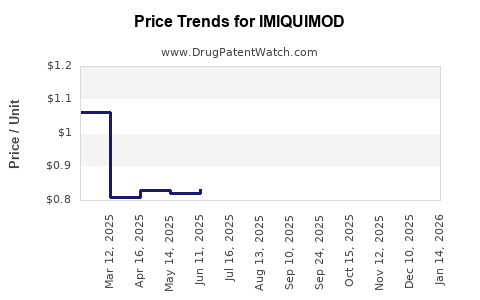
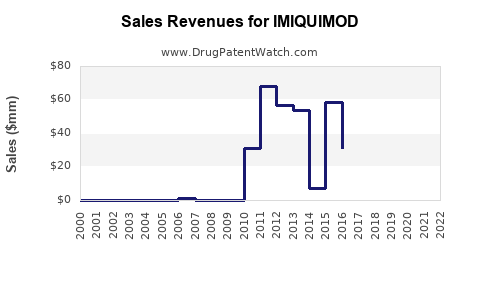
After core patent expiry, generic entry reduced average selling prices and shifted prescribing economics toward payer and pharmacy substitution. Branded products lost leverage unless they retained differentiated coverage, packaging, or physician preference.
Mature-market stabilization
Current revenue is likely driven by prescription volume rather than price expansion. The product has a durable but low-growth profile. Manufacturers with efficient API sourcing, automated filling, low complaint rates, and broad wholesaler access can earn acceptable returns despite modest unit prices.
No authoritative public source provides a consolidated global revenue forecast for all imiquimod products. Company filings should be used for branded-product revenue, while prescription databases and market research are required to quantify total market value. The financial trajectory is therefore best characterized qualitatively as high historical value followed by steep post-expiry erosion and a stable mature generic base.
What generic launch risks exist for imiquimod?
Generic manufacturers face limited patent risk but meaningful execution risk.
Regulatory risk
FDA review may focus on therapeutic equivalence, product sameness, inactive ingredients, dosage form, and labeling. Topical products can present complex equivalence issues because formulation attributes influence drug release and local exposure.[7]
Manufacturing risk
Critical controls include:
- Particle-size distribution
- API uniformity
- Cream viscosity
- Homogeneity
- Microbial limits
- Preservative performance
- Fill weight
- Container-closure integrity
- Long-term stability
Commercial risk
The market can become unattractive if too many suppliers enter. Price erosion may reduce margins, while pharmacy benefit managers and wholesalers favor suppliers with reliable fulfillment and competitive net pricing.
Clinical and labeling risk
A generic may obtain approval for fewer indications than the reference product or use a restricted label. This can affect substitution, physician adoption, and reimbursement.
How strong is the imiquimod patent estate?
The current patent estate is weak against standard generic 5% cream and stronger only at the margins.
| Patent category |
Current strength |
| Core imiquimod compound |
Expired |
| Standard 5% cream |
Low broad blocking power |
| Specific formulation |
Potentially relevant, claim-dependent |
| 3.75% or 2.5% products |
More product-specific protection historically |
| Dosing regimen |
Narrow and vulnerable to design-around |
| Manufacturing process |
Commercially useful but rarely market-blocking |
| Trade secrets |
Potentially important for cost and quality, not legal exclusivity over the drug |
For investors, the principal value is operational rather than patent-based. A supplier with a protected process, reliable API access, strong dermatology distribution, and low manufacturing cost may outperform a company that relies on legacy brand recognition alone.
What is the geographic coverage of imiquimod protection?
Core patent protection has expired in major markets, including the United States and Europe. The remaining legal position varies by country because patent grants, supplementary protection certificates, national litigation, and regulatory data-exclusivity rules differ.
Commercial competition is most mature in the United States and Europe. Emerging markets may have fewer suppliers, different registration requirements, and greater dependence on local distributors. Patent expiry does not guarantee immediate generic access because each jurisdiction requires national authorization, local pharmacovigilance, and compliant manufacturing.
Key Takeaways
- Imiquimod is a mature topical immunomodulator with established use in actinic keratosis, superficial basal cell carcinoma, and genital warts.
- The core U.S. compound patent, including U.S. Patent No. 5,238,944, expired in the early 2010s.
- Generic 5% cream now dominates routine market economics.
- Remaining patent value is concentrated in specific formulations, concentrations, regimens, and manufacturing processes.
- Imiquimod has no biosimilar exposure because it is a small molecule.
- Branded Aldara and Zyclara have limited ability to sustain premium pricing against generic substitution.
- Financial performance is tied to prescription volume, manufacturing efficiency, payer access, and supply reliability.
- The main competitive threats are low-cost generic erosion and newer actinic keratosis treatments with shorter regimens.
- Current commercial risk is operational and pricing-based rather than driven by broad patent exclusion.
FAQs
Is imiquimod still under patent in the United States?
The core imiquimod compound patent is expired. Certain formulation or product-specific patents may have applied to later products, but they do not create broad exclusivity over standard imiquimod cream.
Is Aldara still commercially important?
Aldara retains clinical recognition, but generic imiquimod has materially reduced its commercial importance. Current value depends on brand coverage, supply availability, and physician or payer preference.
Can a generic manufacturer launch imiquimod without a Paragraph IV lawsuit?
Yes. A generic applicant may enter after patent expiration, use a section viii labeling strategy where applicable, or certify that relevant patents do not block the proposed product. Litigation depends on the patents listed for the specific reference product and strength.
Does imiquimod have biosimilar competition?
No. Imiquimod is a chemically synthesized small molecule. Generic approval under the ANDA pathway, rather than biosimilar approval under the Public Health Service Act, is the relevant regulatory route.
Which product has the strongest future commercial position: imiquimod or tirbanibulin?
Imiquimod has the stronger cost and historical-use position. Tirbanibulin has a convenience advantage because of its short treatment course but remains exposed to branded pricing, reimbursement limits, and competition from low-cost generic field therapies.
References
-
U.S. Food and Drug Administration. (1997). Aldara (imiquimod) cream: Original approval and prescribing information. FDA Drugs@FDA.
-
U.S. Food and Drug Administration. (2010). Zyclara (imiquimod) cream: Approval history and prescribing information. FDA Drugs@FDA.
-
United States Patent and Trademark Office. (1993). U.S. Patent No. 5,238,944: Imidazoquinoline derivatives. U.S. Department of Commerce.
-
U.S. Food and Drug Administration. (2024). Approved drug products with therapeutic equivalence evaluations: Orange Book. FDA.
-
U.S. Food and Drug Administration. (2024). Drugs@FDA: FDA-approved drug products. FDA.
-
U.S. Courts. (2024). PACER case locator and federal patent litigation records. Administrative Office of the United States Courts.
-
U.S. Food and Drug Administration. (2022). Product-specific guidance for generic drug development: Imiquimod topical cream. FDA.