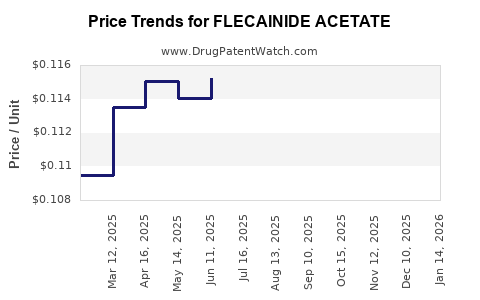
Last updated: April 24, 2026
What is flecainide acetate and where does it sit in the drug market?
Flecainide acetate is an oral antiarrhythmic (Class Ic) used for rhythm control, typically for atrial arrhythmias and certain ventricular arrhythmias under cardiology protocols. Commercially, its market is shaped less by ongoing patent exclusivity and more by generic penetration, hospital and payer formularies, and the stability of demand for chronic rhythm management.
Market structure
- Mature, generic-dominated product category: Flecainide is widely available as generics across major markets, which compresses pricing and limits revenue growth to population demand, persistence, and periodic formulary inclusion shifts.
- Low-to-moderate innovation cycle: The drug is not a late-stage “innovation-led” franchise; revenue is driven by continued use within established clinical pathways rather than new claims that expand the addressable population.
Demand drivers
- Cardiology volume and guideline adherence: Flecainide use tracks with cardiology outpatient and inpatient demand, plus guideline-defined use cases.
- Switching costs are moderate: Generic substitution reduces brand switching friction, but prescriber comfort and tablet strengths can slow substitution at the local level.
- Safety and monitoring requirements: Class Ic agents require careful patient selection and monitoring. That tends to stabilize demand but constrains usage expansion.
How do patents and exclusivity shape financial trajectory for flecainide acetate?
Flecainide acetate’s financial trajectory is primarily a function of early patent expiry and subsequent generic approvals rather than future exclusivity extensions.
Patent reality for the molecule
- The flecainide family is long past initial patent terms in major jurisdictions.
- Current commercial outcomes are consistent with an “off-patent” market profile: price erosion, pack-size competition, and margin pressure rather than blockbuster-style growth.
Implication for revenue
- After generic entry, the revenue curve typically shows:
- Rapid share transfer from originators to lowest-cost entrants.
- Pricing compression that stabilizes only after fewer suppliers remain for each market and strength.
- Continued but capped volume-driven sales, with net sales growth limited by population and adherence.
What are the core market dynamics that drive pricing and volume?
Flecainide’s dynamics combine off-patent price competition with cardiology-specific prescribing behavior.
1) Generic competition compresses net prices
- Generic manufacturers compete on acquisition cost to wholesalers, pharmacy benefit managers, and health systems.
- Once multiple generics exist, payers and procurement teams use interchangeability and tendering to drive unit pricing down.
Commercial consequence
- The market tends to show volume growth offsetting pricing decline only modestly. Net sales growth is typically slower than utilization growth.
2) Formulary mechanics determine share
- Hospital systems and payer formularies strongly influence share because cardiology prescribing is protocolized.
- When a formulary tier changes (preferred status, prior authorization rules, step edits), share shifts can occur even when clinical use remains stable.
3) Product presentation impacts substitution
- Flecainide comes in defined strengths and tablet formats; substitution is easier when the generic has identical strengths and reliable supply.
- Supply interruptions can temporarily support higher realized prices or preserve share for certain suppliers.
4) Safety scrutiny stabilizes but limits expansion
- The requirement for appropriate patient selection and monitoring reduces experimentation and new-to-therapy adoption.
- That typically keeps the drug in a stable utilization band rather than a fast-growing adoption curve.
What is the financial trajectory pattern for flecainide acetate in mature markets?
Without branded monopoly economics, the financial trajectory is shaped by generic penetration phases.
Likely revenue shape (typical off-patent pattern)
- Post-expiry phase: steep decline in originator sales, followed by generic share capture.
- Mid-transition phase: net sales track volume, but unit price continues to drift downward as additional competitors enter.
- Mature phase: net sales stabilize with low single-digit growth at best, driven by:
- population and age-related arrhythmia prevalence
- adherence and refill persistence
- localized formularies that preserve preferred supplier status
Margins
- Supplier gross margins generally remain compressed due to:
- heavy tendering and procurement pressure
- price matching across strengths
- manufacturing and quality compliance costs that do not scale with price
Where does flecainide acetate face competitive pressure beyond generics?
Even in a generic-heavy category, competitive pressure also comes from therapeutic alternatives.
Direct competitive set
- Other antiarrhythmics and rhythm-control strategies can substitute depending on patient phenotype, efficacy, and tolerability.
- For some cohorts, clinicians may prefer drugs with different safety and monitoring profiles or may shift toward different endpoints (rate control vs rhythm control).
Clinical pathway pressure
- Changes in guideline emphasis and clinical practice can shift demand across the antiarrhythmic class, even when flecainide remains an established option.
What does the supply and regulatory landscape imply for commercialization economics?
Because flecainide acetate is an established generic product, economics hinge on manufacturing continuity and regulatory compliance rather than patent timelines.
Regulatory continuity
- Ongoing generic approvals and maintenance of quality systems keep supply competitive.
- The presence of multiple suppliers reduces single-point risk, but price discovery still follows procurement cycles.
Manufacturing scale
- Large generics players gain advantage through scale efficiencies, which can improve survivability during price wars.
What market indicators should investors or R&D leaders monitor for flecainide acetate?
To track financial trajectory in an off-patent cardiology drug, monitor levers that move pricing and share.
Commercial indicators
- Wholesaler and pharmacy benchmark prices for flecainide tablets by strength.
- PBM formulary status changes in major reimbursement channels.
- Tender award outcomes in health system procurement.
- Supplier count and market concentration for each strength (fewer competitors often lifts realized prices).
- Supply continuity metrics (fill rate and backorder events can affect realized demand and market share).
Clinical demand indicators
- Arrhythmia incidence trends in aging populations.
- Hospital outpatient cardiology throughput.
- Guideline or label interpretation shifts that modify rhythm-control decisions.
How should this be positioned versus other antiarrhythmics?
Flecainide’s competitive positioning is typically:
- less protected by exclusivity,
- more dependent on stable routine prescribing,
- and more sensitive to generic procurement cycles than to brand-level marketing.
In investor terms, the opportunity set for flecainide acetate is more about supply-chain and market-structure execution than about breakthrough clinical differentiation.
Key Takeaways
- Flecainide acetate is a mature, generic-dominated antiarrhythmic market where financial outcomes track formularies, procurement, supplier competition, and stable cardiology utilization rather than late-stage innovation.
- The off-patent structure produces a typical trajectory: rapid originator share loss after expiry, persistent unit price compression, and stabilization of net sales driven mostly by volume.
- Pricing and share outcomes hinge on generic competition intensity by strength, tender and PBM dynamics, and supply continuity, while clinical safety and monitoring constraints limit expansion.
- For business planning, the highest-signal metrics are realized pricing benchmarks, formulary status changes, tender results, supplier concentration, and supply continuity.
FAQs
1) Is flecainide acetate currently a patent-protected branded product?
No. Its commercial profile is consistent with an off-patent, generic-dominated market, where revenue is driven by generic share, procurement pricing, and utilization.
2) What most affects flecainide acetate net sales after generic entry?
Net sales typically move with realized pricing from procurement and payer contracting, and with volume shifts driven by formulary inclusion and ongoing cardiology prescribing.
3) Does flecainide’s safety profile reduce demand growth?
It tends to constrain expansion by limiting use to appropriate patients and requiring monitoring, which keeps utilization stable rather than rapidly growing.
4) What are the biggest risks to financial performance in a generic flecainide market?
Price compression from additional entrants, unfavorable formulary or tender outcomes, and supply interruptions at key strengths.
5) What is the most actionable diligence focus for investors?
Track strength-level realized pricing, competitor count and supplier stability, and payer or health system formulary/tender decisions that determine share.
References
[1] DailyMed. “Flecainide Acetate Tablets.” U.S. National Library of Medicine. https://dailymed.nlm.nih.gov/
[2] U.S. Food and Drug Administration. “Drug Approval Reports and Approved Drug Products (Orange Book).” https://www.accessdata.fda.gov/scripts/cder/daf/
[3] FDA. “Approved Drug Products with Therapeutic Equivalence Evaluations (Orange Book).” https://www.accessdata.fda.gov/scripts/cder/ob/