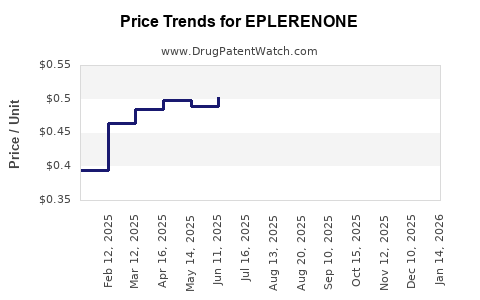
Last updated: September 7, 2026
Eplerenone is a mature, genericized mineralocorticoid receptor antagonist marketed originally as Inspra by Pfizer. Its commercial profile shifted from branded cardiovascular product to low-cost generic after loss of core patent protection in the mid-2010s. Demand remains supported by heart-failure guidelines, post-myocardial-infarction use, and hypertension, but revenue growth is limited by generic price erosion and competition from spironolactone, finerenone, and newer heart-failure therapies.
What is eplerenone and how is it used?
Eplerenone is a selective aldosterone receptor antagonist approved in the United States for hypertension and for improving survival in patients with left-ventricular dysfunction and heart failure after myocardial infarction.
The drug blocks mineralocorticoid receptors while producing less androgen and progesterone receptor activity than spironolactone. That selectivity reduces gynecomastia and some endocrine adverse effects, but eplerenone remains subject to hyperkalemia and renal-function restrictions.
| Attribute |
Eplerenone |
| Original brand |
Inspra |
| Originator |
Pharmacia, later acquired by Pfizer |
| Active ingredient |
Eplerenone |
| Drug class |
Selective mineralocorticoid receptor antagonist |
| Initial U.S. approval |
2002 |
| Main indications |
Hypertension; post-MI left-ventricular dysfunction and heart failure |
| Dosage forms |
25 mg and 50 mg tablets |
| U.S. market status |
Generic and branded products |
| Biosimilar exposure |
None; eplerenone is a small-molecule drug |
| Principal competitors |
Spironolactone, finerenone, ACE inhibitors, ARBs, ARNI therapy and SGLT2 inhibitors |
The evidence base for eplerenone includes the EPHESUS trial in post-MI heart failure and the EMPHASIS-HF trial in patients with mild symptomatic systolic heart failure. EPHESUS demonstrated lower mortality and cardiovascular hospitalization with eplerenone, while EMPHASIS-HF showed reduced cardiovascular death or heart-failure hospitalization in selected patients with reduced ejection fraction.[1][2]
When did eplerenone lose exclusivity?
Eplerenone lost its principal U.S. market protection during the mid-2010s. The key composition-of-matter patent, U.S. Patent No. 5,981,528, was associated with the original Inspra franchise and had an effective term ending in the 2015 period, subject to applicable patent-term adjustments and regulatory exclusivity.
The practical commercial transition began when generic manufacturers received FDA approval and entered the market. After entry, eplerenone pricing declined sharply because the product is an oral tablet with relatively simple manufacturing requirements and multiple potential suppliers.
Eplerenone exclusivity timeline
| Event |
Approximate date |
| Original U.S. approval for hypertension |
2002 |
| U.S. approval for post-MI heart failure indication |
2003 |
| Core patent protection |
Mid-2010s |
| Generic approvals and market entry |
Mid-2010s |
| Current market structure |
Predominantly generic |
FDA small-molecule exclusivity for the original product expired long before the current market period. Eplerenone does not have biologic exclusivity, orphan-drug exclusivity, or a regulatory framework comparable to biosimilar interchangeability.
What patents protect eplerenone?
The original eplerenone estate centered on the active compound and related pharmaceutical compositions. The principal historically relevant U.S. patent was U.S. Patent No. 5,981,528, assigned to the originator organization associated with Pharmacia and later Pfizer.
Core patent categories
| Patent category |
Commercial relevance |
| Compound patent |
Protected eplerenone as a selective aldosterone receptor antagonist |
| Pharmaceutical composition patents |
Covered tablet formulations and excipient combinations where applicable |
| Process patents |
Could cover synthesis, purification or crystallization methods |
| Method-of-use patents |
Related to hypertension or cardiovascular conditions, but generally provided less durable protection than the compound patent |
| Regulatory exclusivity |
Expired and no longer limits generic substitution |
The patent estate is now commercially weak because the core compound protection has expired and generic manufacturers have established supply. Residual process or formulation claims would have limited value unless they were necessary to make the marketed tablets, which is unlikely for a conventional immediate-release product.
What is the Orange Book status of eplerenone?
The Orange Book historically listed Inspra patents and later identified approved generic equivalents. The relevant commercial distinction is between the discontinued or low-volume brand product and FDA-approved generic eplerenone tablets.
Orange Book-listed patents can support Paragraph IV litigation during the protected period. That mechanism is no longer a major barrier to routine generic supply because the central patents have expired. Current competition is therefore driven mainly by abbreviated new drug application approvals, manufacturing capacity, pharmacy contracting and price.
Eplerenone tablets are not a complex drug-delivery system. They do not present the device, injection, depot, inhalation or biologic comparability issues that can delay generic entry.
Were there Paragraph IV challenges to Inspra?
Generic applicants historically used the ANDA pathway to challenge or circumvent the listed Inspra patents. Paragraph IV certifications can trigger patent litigation before generic approval, but the commercial impact was temporary because the underlying patent term ended during the mid-2010s.
The principal consequences were:
- Earlier litigation risk for the originator.
- Potential settlement or launch-date negotiations between Pfizer and generic applicants.
- A concentrated generic-entry period after patent expiry.
- Rapid price competition once multiple suppliers entered.
Publicly available sources do not support treating current eplerenone sales as materially constrained by unresolved Paragraph IV litigation. The relevant competitive risk is post-expiry generic substitution rather than pending patent enforcement.
What formulations are protected by eplerenone patents?
Eplerenone is marketed primarily as immediate-release oral tablets in 25 mg and 50 mg strengths. The formulation has limited technical complexity compared with extended-release, transdermal, inhaled or injectable products.
Potential formulation claims may cover:
- Tablet composition.
- Particle size or crystalline form.
- Dissolution characteristics.
- Manufacturing and compression parameters.
- Stability under defined storage conditions.
These claims have modest strategic value. A generic applicant can often design around narrow formulation claims while maintaining bioequivalence. There is no established high-value lifecycle product, such as a once-weekly formulation or long-acting injectable, that has materially extended eplerenone exclusivity.
How strong is the eplerenone patent estate?
The historical estate was commercially strong while the core compound patent remained enforceable. Its current strength is low.
| Factor |
Assessment |
| Core compound protection |
Expired |
| Formulation protection |
Limited practical value |
| Method-of-use protection |
Limited after widespread generic use |
| Manufacturing barriers |
Low to moderate |
| Regulatory complexity |
Low for standard tablets |
| Generic substitutability |
High |
| Biosimilar risk |
Not applicable |
| Current litigation leverage |
Low |
The main remaining barrier is compliance with FDA quality, bioequivalence and manufacturing requirements. That is a regulatory execution issue rather than a durable intellectual-property barrier.
How does eplerenone compare with spironolactone and finerenone?
Eplerenone occupies a middle position between low-cost spironolactone and newer, patent-protected finerenone.
| Drug |
Positioning |
Patent status |
Key advantage |
Key limitation |
| Spironolactone |
Established generic MRA |
Expired |
Very low cost and broad clinical familiarity |
Endocrine adverse effects |
| Eplerenone |
Selective generic MRA |
Expired |
Better endocrine tolerability than spironolactone |
Higher cost than spironolactone; hyperkalemia |
| Finerenone |
Nonsteroidal MRA |
Active branded franchise during the 2020s |
Diabetic kidney disease and cardiovascular evidence |
High branded price and reimbursement dependence |
Finerenone, marketed as Kerendia by Bayer, is the main newer competitive threat in chronic kidney disease associated with type 2 diabetes. It is not a direct patent-expired substitute in every indication, but it competes for prescriber attention and payer budgets in patients at risk of renal and cardiovascular events.[3]
Spironolactone remains the largest economic threat because it is inexpensive and familiar. Physicians often select eplerenone when adverse endocrine effects, tolerability or guideline-based post-MI therapy justify the price difference.
What is the FDA regulatory status of eplerenone?
Eplerenone is an FDA-approved small-molecule prescription drug. Generic products are approved through ANDAs demonstrating pharmaceutical equivalence and bioequivalence to the reference product.
Key regulatory characteristics include:
- Oral tablet dosage form.
- No biosimilar pathway.
- No need for clinical immunogenicity testing.
- Established safety monitoring for serum potassium and renal function.
- Generic substitution potential subject to state pharmacy laws and product-level FDA ratings.
The principal safety issue is hyperkalemia. Concomitant potassium supplements, potassium-sparing diuretics, renal impairment and certain renin-angiotensin system medicines can increase risk. These safety considerations can limit uptake in vulnerable heart-failure and chronic-kidney-disease populations.
What is the financial trajectory for eplerenone?
Eplerenone’s financial trajectory follows a standard small-molecule lifecycle:
1. Branded growth phase
Inspra benefited from two clinical use cases: hypertension and heart failure after myocardial infarction. Its strongest commercial differentiation was selective mineralocorticoid receptor blockade with less gynecomastia than spironolactone.
2. Mature branded phase
Before generic entry, revenue was supported by guideline adoption, physician familiarity and continued use in heart failure. Pfizer did not establish eplerenone as a major standalone growth product compared with its largest cardiovascular franchises.
3. Generic erosion phase
After patent expiry, generic manufacturers reduced net prices. Pharmacy substitution weakened the brand, and eplerenone became a volume product rather than a high-margin branded asset.
4. Stable generic phase
The current market is characterized by recurring prescription demand, low unit economics and supplier competition. Revenue growth depends on prescription volume, payer coverage and manufacturing scale rather than price increases.
Pfizer’s public financial reporting does not generally disclose standalone current revenue for Inspra. That prevents a reliable current brand-level revenue series. The more relevant financial conclusion is structural: eplerenone has retained clinical demand but lost the pricing power required to generate material branded growth.
What generic entry risks exist for eplerenone?
Generic entry risk is no longer a future event. It is the defining feature of the market.
| Risk |
Current impact |
| Additional generic suppliers |
Further price pressure |
| Pharmacy substitution |
Lowers brand retention |
| Contracting by wholesalers and PBMs |
Compresses net prices |
| Manufacturing concentration |
Can create temporary shortages |
| Low-cost spironolactone |
Limits premium pricing |
| Finerenone adoption |
Diverts selected high-value patients |
| Guideline changes |
Can shift treatment sequencing |
The most important commercial variable is not whether generic entry will occur, but whether suppliers can maintain reliable inventory while earning acceptable margins. Low prices can reduce supplier participation, creating periodic shortages or procurement volatility even when long-term supply is adequate.
What patent litigation and settlements affect eplerenone?
The meaningful litigation window occurred before and around generic entry. Patent disputes involving ANDA applicants could delay approval or establish negotiated entry dates. Those disputes have limited current relevance because the core patent estate is no longer blocking routine generic commercialization.
There is no current commercial thesis based on a major pending settlement that would materially change the eplerenone market. Any future litigation is more likely to involve manufacturing quality, antitrust allegations, product liability or supply issues than restoration of compound-level exclusivity.
What is the geographic market outlook for eplerenone?
Eplerenone has broad international availability, but market dynamics differ by country.
- United States: Generic substitution and payer contracting dominate.
- Europe: National reimbursement systems and tendering create sustained price pressure.
- Japan: Generic penetration and local reimbursement controls limit brand economics.
- Emerging markets: Demand is linked to cardiovascular disease prevalence, physician access and local generic manufacturing.
The United States remains commercially important because of prescription volume and established heart-failure treatment pathways, but it is not a high-growth branded market.
What are the main commercial opportunities?
The best opportunities are operational rather than patent-driven:
- Low-cost, reliable generic supply.
- Regional registration and distribution in underpenetrated markets.
- Hospital and health-system contracting.
- Combination treatment protocols in heart failure.
- Patient-support tools focused on potassium monitoring and adherence.
- Contract manufacturing where quality systems and supply reliability are differentiated.
A reformulation strategy could create incremental value only if it solves a meaningful adherence, tolerability or dosing problem. A conventional new tablet strength would have limited protection and weak commercial differentiation.
Key Takeaways
- Eplerenone is a mature generic cardiovascular drug originally marketed as Inspra.
- Its core U.S. patent protection ended during the mid-2010s.
- Generic competition has permanently reduced brand pricing and Pfizer’s direct revenue opportunity.
- The market has no biosimilar risk because eplerenone is a small molecule.
- Spironolactone is the primary low-cost competitor; finerenone is the main newer branded competitor.
- The patent estate has low current strength, and formulation or process claims are unlikely to create substantial market exclusivity.
- Financial performance depends on prescription volume, supply reliability and contracting rather than price expansion.
- The most attractive commercial strategy is efficient generic manufacturing and distribution, not patent-based lifecycle extension.
FAQs About Eplerenone Market Exclusivity and Competition
Is eplerenone still protected by a patent?
The principal compound patent protecting the original Inspra franchise expired during the mid-2010s. Current sales are primarily exposed to generic competition.
Is eplerenone a biologic or biosimilar product?
No. Eplerenone is a synthetic small molecule approved as an oral tablet. Generic manufacturers use the ANDA pathway rather than the biosimilar pathway.
Why is eplerenone more expensive than spironolactone?
Eplerenone is more selective for the mineralocorticoid receptor and has fewer endocrine adverse effects. That clinical distinction can support a price premium even after generic entry, although the premium has narrowed substantially.
Can finerenone replace eplerenone?
Finerenone may compete for patients with type 2 diabetes, chronic kidney disease and cardiovascular risk, but it is not a universal replacement. Indication, evidence, formulary status, renal function and potassium risk determine product selection.
Does eplerenone have a significant shortage risk?
The drug has low technical manufacturing complexity, but generic markets can experience temporary shortages when low prices reduce supplier participation or when one manufacturer encounters quality or production problems. The risk is supply-chain related, not patent related.
References
-
Pitt, B., Remme, W., Zannad, F., Neaton, J., Martinez, F., Roniker, B., Bittman, R., Hurley, S., Kleiman, J., & Gatlin, M. (2003). Eplerenone, a selective aldosterone blocker, in patients with left ventricular dysfunction after myocardial infarction. New England Journal of Medicine, 348(14), 1309-1321.
-
Zannad, F., McMurray, J. J. V., Krum, H., van Veldhuisen, D. J., Swedberg, K., Shi, H., Vincent, J., Pocock, S. J., & Pitt, B. (2011). Eplerenone in patients with systolic heart failure and mild symptoms. New England Journal of Medicine, 364(1), 11-21.
-
Bakris, G. L., Agarwal, R., Anker, S. D., Pitt, B., Ruilope, L. M., Rossing, P., Joseph, A., Kolkhof, P., Nowack, C., Schloemer, P., & Filippatos, G. (2020). Effect of finerenone on chronic kidney disease outcomes in type 2 diabetes. New England Journal of Medicine, 383(23), 2219-2229.
-
U.S. Food and Drug Administration. (2002). Inspra (eplerenone) prescribing information. FDA.
-
U.S. Food and Drug Administration. (2024). Approved drug products with therapeutic equivalence evaluations: Orange Book. FDA.
-
Pfizer Inc. (2024). Annual report. Pfizer.