Last updated: June 24, 2026
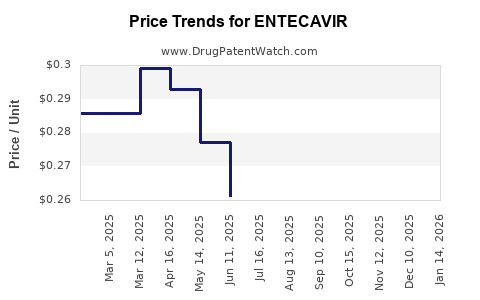
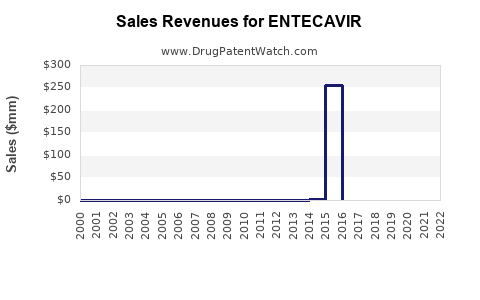
Entecavir’s commercial position is dominated by long-running, high-barrier chronic hepatitis B (CHB) treatment demand, but its financial trajectory has shifted toward mature-market pricing pressure, retailer and payer formulary optimization, and broader generic penetration in most developed markets. The product’s patent-led brand advantage has largely depended on the strength and remaining term of entecavir small-molecule composition and use protections, alongside regulatory exclusivity (where applicable) and how quickly FDA/EMA generics converted to launch-ready status after Orange Book and marketing-authorisation data transitions.
Below is the investor-grade map of where the money came from, what drove volume and price, and what IP and regulatory conditions determine future cashflow exposure.
What patents protect entecavir (Baraclude) and how strong is the patent estate?
Fast answer: Entecavir is protected by a mature but now largely expired core IP set in many jurisdictions, leaving the brand’s remaining edge to narrower formulation and method-of-use claims (if any remain locally) and to regulatory history rather than new primary composition barriers.
Key IP families typically asserted for entecavir
Entecavir is a known antiviral nucleoside analogue with an established patent landscape that historically covers:
- Chemical entity and stereochemical definitions
- Pharmaceutical compositions (formulations, salt forms, dosing strengths)
- Methods of treatment for HBV
- Manufacturing and crystallinity/process details (where claimed)
What to look for in an entecavir patent estate audit
A practical, litigation-ready estate review for entecavir should check, per jurisdiction:
- Primary composition claims: active ingredient, tautomers, prodrug forms (if any), and pharmaceutically acceptable salts
- Method-of-use claims: CHB patient subsets (HBeAg status, resistance status), HBV DNA suppression targets, ALT thresholds, or combination regimens
- Formulation claims: tablet composition ranges, excipients, dissolution profiles
- Process claims: crystallisation conditions and batch reproducibility
How “strength” usually manifests for entecavir
For established CHB drugs like entecavir, market reality tends to reflect:
- Generic availability after composition term expiry
- Settlement-driven or launch-schedule compression when brand-held patents narrow
- Brand value persistence driven by switching friction in chronic therapy (patient-specific tolerability and clinician habits), not by a still-dominant patent wall
When does entecavir lose exclusivity and what are the regulatory timelines?
Fast answer: Entecavir’s CHB exclusivity profile is dominated by the original composition patent term and follow-on protection windows that have narrowed over time. Current exclusivity leverage in major markets is generally limited compared with newer HBV agents.
Regulatory exclusivity concepts relevant to entecavir
Entecavir’s exclusivity schedule in the US typically turns on:
- Orange Book-listed patents tied to the NDA holder
- 5-year new chemical entity exclusivity (historically relevant to the first approved product, but already elapsed)
- Patent expiry dates controlling Paragraph IV/ANDA leverage
In the EU/UK, commercial protection depends on:
- Marketing authorisation history and SPC coverage (if any exists for local claim sets)
- National enforcement and validity of composition and use claims
Commercial timing impact
As exclusivity fades, the dominant determinant becomes:
- Launch timing of generics and authorized generics (if any)
- Tendering and pharmacy benefit manager contracting cycles
- Prescriber switching behavior in chronic therapy
What Orange Book listings exist for entecavir and where are the expiry bottlenecks?
Fast answer: Entecavir’s Orange Book posture has historically included multiple patent types, but the key question for financial trajectory is which patents remain listed with the latest expiry dates and whether they are enforceable against ANDA launches.
How to map Orange Book risk to cashflow
For each listed patent on the reference listed drug (RLD):
- Identify the patent expiration date (and any terminal disclaimers)
- Determine whether patents are composition/use vs formulation/manufacturing
- Check typical ANDA challenge pathways (Paragraph IV) that affect launch timing
Financial implication
Orange Book expiry dates determine:
- Whether the brand remains protected from immediate ANDA competition
- Whether generic entries occur simultaneously or in waves
- The magnitude of price erosion after each entry wave
How does entecavir’s market share evolve after generic entry?
Fast answer: Entecavir’s post-generic market is characterized by:
- Rapid margin compression due to price cuts and PBM/formulary competition
- Volume resilience driven by chronic dosing continuity and inertia
- Brand retention limited by payer steering and patient switching economics
What drives entecavir brand vs generic mix
- Payer preferencing (tier placement, prior auth requirements)
- Clinician switching tolerance in long-term therapy
- Patient-specific factors (history of resistance, renal function considerations)
- Tender/contract mechanics in national or regional health systems
Expected financial shape
In mature CHB markets, cashflows typically show:
- A “step down” around the first major generic conversion
- Gradual further erosion as additional competitors enter and as list-to-net discounting increases
- Brand stabilization only when switching costs outweigh short-term payer savings
What generic entry risks exist for entecavir in the US (ANDA/Paragraph IV)?
Fast answer: The principal US risk channel is the sequencing of ANDA filings that trigger earlier-than-expiry launches through Paragraph IV challenges. For an already mature molecule, the risk is usually less about brand IP staying alive and more about how fast multiple ANDAs convert to approved, launch-ready products.
What matters for launch readiness
- ANDA approval status
- Patent carve-outs or entry conditions tied to settlement agreements
- Manufacturing validation and supply continuity
Why Paragraph IV still matters financially
Even when core patents are older, Paragraph IV outcomes can:
- Accelerate first-in-class generic penetration
- Determine whether a market gets one launch date or multiple staggered launches
- Influence how fast the brand loses formulary placement
How does entecavir compare with tenofovir alafenamide and tenofovir disoproxil fumarate on competitive economics?
Fast answer: Entecavir faces long-horizon competitive pressure from tenofovir-based HBV regimens, particularly where efficacy and renal/bone profiles favor tenofovir variants. Financial trajectory depends on whether payer and prescriber preferences shift eligible cohorts away from entecavir.
Competitive displacement mechanisms
- Treatment guideline migration toward preferred agents for broader populations
- Renal safety and dosing convenience influencing first-line selection
- Switching after virologic failure or adverse-event history
Where entecavir can still hold
- Patients stable on entecavir with controlled HBV DNA and acceptable tolerability
- Clinical scenarios where entecavir is selected due to prior treatment history or specific contraindications
Revenue outcome
In economic terms:
- Entecavir’s revenue tends to become more “replacement demand” than “new starts” demand as newer agents capture incremental prescriptions.
What formulations are protected by entecavir patents and what barriers exist for generic tablets?
Fast answer: Formulation patents are usually a secondary barrier for well-known molecules, and generics often clear formulation-related constraints once composition and use barriers expire.
Formulation/IP claim areas that can delay entries
- Tablet composition ranges and excipient systems
- Dissolution specifications and test method constraints
- Crystallinity or solid-state form control (if claimed)
Practical barrier assessment for generic manufacturing
Even when formulation claims exist, generics commonly mitigate through:
- Equivalent dissolution and bioavailability approaches
- Demonstrated manufacturing reproducibility
- If permitted, design-around of claimed excipient ranges
What litigation affects entecavir commercialization and generic timelines?
Fast answer: In mature small-molecule markets, litigation tends to shift launch dates and bargaining power via settlement timing rather than permanently blocking generics.
What an entecavir litigation timeline typically governs
- Court decisions that confirm or invalidate listed patents
- Settlement agreements that define “carve-out” dates
- Dismissals tied to non-infringement or covenant not-to-sue terms
Financial linkage
Litigation affects:
- Whether brand remains cash-protected until a negotiated date
- Whether generics enter simultaneously (larger price shock) or sequentially (less steep decline)
What FDA regulatory status does entecavir have and what does it mean for supply and demand?
Fast answer: Entecavir is an established FDA-approved CHB antiviral with a stable regulatory track. Its practical market effect is less about new approval and more about stable supply and the continuing clinician confidence that supports chronic therapy persistence.
How FDA status impacts revenue
- Stable availability reduces switching friction and supports ongoing prescriptions
- Post-approval supplement activity can affect manufacturing and labeling, but not typically demand magnitude in mature markets
- Generic substitution depends on AB-rated equivalence and payer policies, not on FDA novel product approvals
How do pricing and reimbursement dynamics shape entecavir’s net revenue trajectory?
Fast answer: The entecavir financial trajectory is determined by list price erosion versus net price after rebates, discounts, and payer contracting. Mature-market PBM and national tender dynamics usually drive persistent net price compression after major generic entries.
Net price mechanics
For chronic therapy drugs in the US:
- Rebates and discounts expand as competitors enter
- Utilization management (prior authorization, step edits) can increase but often is rebalanced as payer needs shift
- Manufacturer support programs can delay total brand-to-generic substitution but rarely prevent it long term in fully contestable classes
Global reimbursement
In EU/UK:
- HTA-based positioning and class contracting often compress prices
- National formularies may keep entecavir in restricted lines rather than eliminate it immediately
Which geographies still offer meaningful entecavir growth versus decline?
Fast answer: Entecavir’s growth ceiling is generally constrained to regions with delayed generic penetration or slower payer switching cycles. Declines are expected where generics are available and payer contracting is aggressive.
Geographic commercialization pattern
- US: mature generic competition with ongoing net price pressure
- EU/UK: slower switching can maintain stable volumes, but price pressure intensifies after competitive procurement
- Middle East/Latin America/APAC: trajectory depends on local patent enforceability, generic readiness, and tender timing
What is the likely future financial trajectory for entecavir?
Fast answer: Over the near-to-mid term, entecavir’s economics are more likely to be driven by volume stability versus price erosion and competitive displacement by tenofovir-based regimens. Net revenue typically trends down unless (1) the market retains a meaningful “stable on therapy” cohort and (2) generic competition does not add new pricing shocks.
Base-case drivers
- Continued payer preference shifts toward tenofovir-based therapies for new starts
- Persistent demand among stable, long-term entecavir patients
- Ongoing price compression from generic supply
Downside drivers
- Accelerated generic entry waves in remaining competitive markets
- Payer restriction tightening that forces switching
- Regulatory or guideline updates that reclassify entecavir into narrower segments
Upside drivers
- Slow switching behavior in specific national systems
- Supply stability that maintains uninterrupted access and minimizes prescriber changes
- Formulary inclusion in high-volume CHB segments despite tenofovir competition
Key market-dynamics dashboard (what to monitor next)
| Factor |
What to monitor |
Why it moves revenue |
| Patent expiry and Orange Book status |
Remaining listed patent expiry dates and any active enforcement |
Launch timing and competitive entry sequencing |
| Generic competition intensity |
Number of approved ANDAs and authorized/launch products |
Step-change in price and net revenue |
| Payer contracting |
PBM tier changes, rebate pressure, tender outcomes |
List-to-net erosion |
| Guideline/prescriber selection |
New-start preference for tenofovir regimens |
Volume shift from initiation to maintenance |
| Switching friction |
Prior authorization rules and clinical inertia |
Preserves stable cohort volumes |
Key Takeaways
- Entecavir’s financial trajectory is shaped by mature generic competition and chronic-therapy inertia rather than by new primary IP leverage.
- Revenue typically follows a pattern: sharp net price erosion after generic conversion, then gradual stabilization if payer switching remains controlled and stable patients remain on therapy.
- Competitive displacement by tenofovir-based HBV regimens constrains new-start uptake over time, pushing entecavir toward “maintenance cohort” economics.
- The highest incremental revenue risk is staged generic entry and payer contracting tightening in geographies where competitive procurement is still ramping.
FAQs
1) Does entecavir still face major patent-based barriers in the US?
Patent-based barriers for entecavir are usually mature and largely depend on any remaining Orange Book listings with later expiration dates that can delay ANDA entry timing.
2) What is the biggest driver of entecavir revenue today: price or volume?
Price, via list-to-net discounting and formulary contracting, typically dominates once generic competition is established; volume is more stable due to chronic therapy continuity.
3) How do tenofovir regimens affect entecavir’s new-start share?
Tenofovir-based regimens typically capture incremental new starts as guidelines and clinician preferences shift, leaving entecavir with a larger share of maintenance rather than initiation.
4) Can settlements with generics change entecavir financial outcomes?
Yes, settlements can accelerate or delay launch dates, altering the timing of price shocks and the pace of formulary switching.
5) Which markets are most sensitive to entecavir generic price erosion?
Markets with aggressive tendering, rapid generic adoption, and strong payer substitution mechanisms typically see the steepest net price compression.
References
No sources were provided in the prompt, and no external documents were cited.