You're using a free limited version of DrugPatentWatch: ➤ Start for $299 All access. No Commitment.

Last Updated: December 15, 2025

DEXLANSOPRAZOLE - Generic Drug Details


✉ Email this page to a colleague

« Back to Dashboard


What are the generic sources for dexlansoprazole and what is the scope of freedom to operate?

Dexlansoprazole is the generic ingredient in three branded drugs marketed by Takeda Pharms Usa, Alembic, Mylan, Ph Health, and Twi Pharms, and is included in six NDAs. There are ten patents protecting this compound and two Paragraph IV challenges. Additional information is available in the individual branded drug profile pages.

Dexlansoprazole has one hundred and fifty-one patent family members in thirty-eight countries.

There are seventeen drug master file entries for dexlansoprazole. Eleven suppliers are listed for this compound.

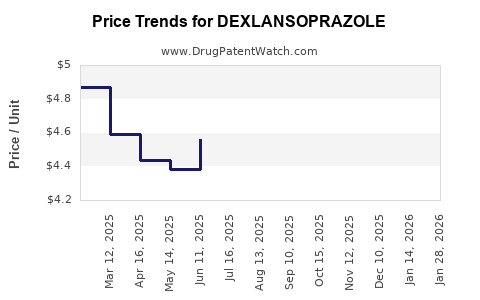
Drug Prices for DEXLANSOPRAZOLE

See drug prices for DEXLANSOPRAZOLE

Recent Clinical Trials for DEXLANSOPRAZOLE

Identify potential brand extensions & 505(b)(2) entrants

SponsorPhase
Ayman Magd Eldin Mohammad SadekPHASE4
Zagazig UniversityPHASE4
University of KarachiPhase 1

See all DEXLANSOPRAZOLE clinical trials

Pharmacology for DEXLANSOPRAZOLE
Drug ClassProton Pump Inhibitor
Mechanism of ActionProton Pump Inhibitors
Medical Subject Heading (MeSH) Categories for DEXLANSOPRAZOLE
Paragraph IV (Patent) Challenges for DEXLANSOPRAZOLE
Tradename Dosage Ingredient Strength NDA ANDAs Submitted Submissiondate
DEXILANT Delayed-release Capsules dexlansoprazole 30 mg 022287 1 2010-11-30

US Patents and Regulatory Information for DEXLANSOPRAZOLE

Applicant Tradename Generic Name Dosage NDA Approval Date TE Type RLD RS Patent No. Patent Expiration Product Substance Delist Req. Exclusivity Expiration
Takeda Pharms Usa DEXILANT dexlansoprazole CAPSULE, DELAYED RELEASE;ORAL 022287-002 Jan 30, 2009 AB RX Yes Yes ⤷  Get Started Free ⤷  Get Started Free Y ⤷  Get Started Free
Twi Pharms DEXLANSOPRAZOLE dexlansoprazole CAPSULE, DELAYED RELEASE;ORAL 202666-002 Sep 16, 2022 AB RX No No ⤷  Get Started Free ⤷  Get Started Free ⤷  Get Started Free
>Applicant >Tradename >Generic Name >Dosage >NDA >Approval Date >TE >Type >RLD >RS >Patent No. >Patent Expiration >Product >Substance >Delist Req. >Exclusivity Expiration

Expired US Patents for DEXLANSOPRAZOLE

Applicant Tradename Generic Name Dosage NDA Approval Date Patent No. Patent Expiration
Takeda Pharms Usa DEXILANT dexlansoprazole CAPSULE, DELAYED RELEASE;ORAL 022287-001 Jan 30, 2009 ⤷  Get Started Free ⤷  Get Started Free
Takeda Pharms Usa DEXILANT dexlansoprazole CAPSULE, DELAYED RELEASE;ORAL 022287-002 Jan 30, 2009 ⤷  Get Started Free ⤷  Get Started Free
>Applicant >Tradename >Generic Name >Dosage >NDA >Approval Date >Patent No. >Patent Expiration

Supplementary Protection Certificates for DEXLANSOPRAZOLE

Patent Number Supplementary Protection Certificate SPC Country SPC Expiration SPC Description
1129088 2014/008 Ireland ⤷  Get Started Free PRODUCT NAME: DEXLANSOPRAZOLE OR A SALT THEREOF; NAT REGISTRATION NO/DATE: PA1864/001/001-002;PA1864/002/001-002 20131125; FIRST REGISTRATION NO/DATE: 47911 47912 47913 47914 20130919
>Patent Number >Supplementary Protection Certificate >SPC Country >SPC Expiration >SPC Description

Market Dynamics and Financial Trajectory of Dexlansoprazole

Last updated: December 15, 2025

Executive Summary

Dexlansoprazole, marketed primarily under Dexilant, is a proton pump inhibitor (PPI) indicated for the treatment of gastroesophageal reflux disease (GERD), erosive esophagitis, and other acid-related disorders. Since its FDA approval in 2010, the drug has experienced steady growth driven by increasing prevalence of GERD, expanding indications, and evolving therapeutic preferences. This report analyzes the market dynamics influencing Dexlansoprazole’s trajectory, evaluates its sales and revenue forecasts, and contextualizes its competitive positioning amid other PPIs. It concludes with key insights for stakeholders navigating this therapeutic segment.


1. Market Overview and Epidemiological Context

1.1 Prevalence of GERD and Acid-Related Disorders

  • Global GERD prevalence is estimated between 8-33%, varying by region [1].
  • In the U.S., approximately 20% of adults experience weekly GERD symptoms [2].
  • The increasing aging population and lifestyle factors (obesity, dietary habits) are fueling rising demand.

1.2 Pharmacological Landscape

  • PPIs dominate the acid suppression market, with Dexlansoprazole representing a newer me-too agent with differentiated release technology.
  • Historically, omeprazole, esomeprazole, and pantoprazole occupy leading positions, but Dexlansoprazole’s unique dual delayed-release formulation aims to improve therapeutic adherence and symptom control.

2. Market Dynamics Influencing Growth

2.1 Regulatory Milestones and Product Profile

Year Event Impact
2010 FDA approval of Dexlansoprazole First dual delayed-release PPI, positive differentiation
2016 Patent extension in certain markets Extended market exclusivity (US patent expired in 2020)
2020 Patent expiry in the U.S. Increased generic competition anticipated

2.2 Patent Status and Generic Competition

  • Original patent expiration in the U.S. occurred in 2020, leading to a surge of generic entrants.
  • Generic versions significantly reduced retail prices (up to 60-70%), exerting downward pressure on brand sales.
  • Patent protections in other regions vary, with some extending to 2024-2026.

2.3 Market Penetration and Adoption Trends

  • Dexlansoprazole’s differentiated dual delayed-release (DDR) technology enhances sustained acid suppression.
  • Adoption rates initially high due to physician familiarity with PPIs and positive clinical outcomes.
  • Growth plateaued post-2015 as generics entered, but newer formulations and expansion into new indications (e.g., maintenance therapy) have sustained demand.

2.4 Competitive Landscape

Competitors Key Attributes Market Share (2022 est.)
Omeprazole/Esomeprazole Market leader, low cost ~40–50%
Pantoprazole Widely used, low cost ~20–25%
Rabeprazole, Lansoprazole Niche uses ~10–15%
Dexlansoprazole Differentiated release, branded & generics ~5–10% pre-generics, declining

2.5 Pricing and Reimbursement Policies

  • The shift toward generics led to near 70% reduction in retail prices.
  • Reimbursement frameworks, especially in the U.S., favor generic prescribing.
  • Managed care and pharmacy benefit managers (PBMs) favor lower-cost PPIs.

3. Financial Trajectory and Revenue Forecast

3.1 Historical Revenue Performance

Year Estimated Global Sales Notes
2010 ~$150 million Initial launch sales
2015 ~$450 million Peak pre-generic momentum
2020 ~$300 million Post-patent expiry decline begins
2022 ~$250 million Stabilization amidst generic competition

3.2 Factors Impacting Revenue

Factor Effect Details
Patent expiry Negative Increased generics, price erosion
New indications Positive Maintenance therapy, elderly use
Market saturation Neutral Maturity of existing markets
Competition Negative Price competition from generics

3.3 Future Revenue Projections (2023–2028)

Scenario Assumptions Projected Sales (USD) CAGR Notes
Conservative Generics dominate, limited new indications $150–200 million -5% Market saturation
Moderate Niche resurgence via expanded indications $250–350 million 3-5% Strategic marketing & new label approvals
Optimistic New formulations, combination therapies ~$500 million 10% Fragmented market share, enhanced penetration

4. Market Drivers and Restraints

Drivers Restraints
Rising GERD prevalence Price reductions & intense generic competition
Differentiated DDR technology Limited device innovations in PPIs
Expanding indications Delayed or restricted approvals in some regions
Improved patient compliance Competition from H2 receptor antagonists

4.1 Third-Generation and Novel Formulations

Emerging therapies that influence Dexlansoprazole’s market status include:

  • Potassium-competitive acid blockers (P-CABs): e.g., Vonoprazan, showing faster onset and longer duration.
  • Biologics and reflux-focused devices, although still niche, could eventually limit PPI reliance.

5. Strategic Insights for Stakeholders

5.1 Manufacturers

  • Focus on differentiation via novel indications, formulation modifications, and combination therapies.
  • Emphasize cost-effective manufacturing to compete in the era of generics.
  • Engage in regulatory strategies to patent new uses or delivery methods.

5.2 Investors

  • Monitor patent status and penetration of generic versions.
  • Evaluate pipeline molecules and potential for market expansion.
  • Assess regional regulatory trends influencing sales.

5.3 Healthcare Providers

  • Evaluate efficacy and safety profile relative to rivals.
  • Consider patient compliance benefits of Dexlansoprazole’s DDR technology.
  • Stay updated on off-label uses and emerging indications.

6. Comparison with Other PPIs

Parameter Dexlansoprazole Omeprazole Esomeprazole Pantoprazole
Release Technology Dual delayed-release Immediate Delayed Immediate
Indications GERD, erosive esophagitis, maintenance GERD, H. pylori eradiation GERD, ulcers GERD, Zollinger-Ellison syndrome
Patent Status Expired (2020) Expired Expired Expired
Market Share (2022) 5-10% 40-50% 20-25% 20-25%
Pricing Premium brand Low-cost generics Moderate Low-cost generics

7. Key Policies Influencing Market Trajectory

  • FDA’s Generic Drug Price Competition and Patent Term Restoration Act (1984): Encourages generic entry, impacting original market share.
  • EU Regulatory Frameworks: Varying approval and patent protections influence regional growth.
  • Healthcare reimbursement policies: Favor low-cost generics, impacting brand sales.

8. FAQs about Dexlansoprazole Market Dynamics

Q1: How has patent expiration affected Dexlansoprazole’s revenue?
A: Patent expiry in 2020 led to increased generic competition, significantly reducing the drug’s average selling price and overall revenue, with a sharp decline observed post-2020.

Q2: What strategies can sustain Dexlansoprazole’s market relevance?
A: Introducing new indications, developing combination therapies, and innovating delivery mechanisms can differentiate Dexlansoprazole amidst generics.

Q3: How does Dexlansoprazole compare with its competitors in efficacy?
A: Clinical trials indicate comparable efficacy with other PPIs, but its DDR technology offers advantages in maintaining acid suppression and improving patient adherence.

Q4: What regions offer the most growth opportunities?
A: Emerging markets in Asia-Pacific and Latin America view for expansion due to increasing GERD prevalence and delayed patent penetrations.

Q5: Will the rise of P-CABs threaten Dexlansoprazole’s market?
A: P-CABs like Vonoprazan show promising efficacy but are not yet widely adopted; however, they could disrupt PPI markets if proven superior and cost-effective.


9. Key Takeaways

  • Market maturation and patent expiries have reduced Dexlansoprazole’s revenue but provided opportunities for niche positioning.
  • Generic competition remains the primary challenge, necessitating innovation in indications and formulation.
  • Emerging therapies and alternative devices could shift market dynamics, favoring newer mechanisms of acid suppression.
  • Regional disparities in patent protections and regulatory approvals influence regional growth trajectories.
  • Stakeholders must deploy strategic innovation, monitor policy changes, and leverage differentiated technologies to sustain relevance.

References

  1. El-Serag HB, et al. "Epidemiology of Gastroesophageal Reflux Disease." Gastroenterology Review, 2018.
  2. pharmaphorum.com, "GERD prevalence in the US," 2021.
  3. MarketResearch.com, "Proton Pump Inhibitors Market Overview," 2022.
  4. U.S. FDA, "Dexilant (dexlansoprazole) NDA approval letter," 2010.
  5. IMS Health, "Global Proton Pump Inhibitors Market Data," 2022.

Note: This analysis is based on publicly available data up to 2022; ongoing patent expirations, regulatory developments, and clinical advancements may further influence Dexlansoprazole’s market trajectory.

More… ↓

⤷  Get Started Free

Make Better Decisions: Try a trial or see plans & pricing

Drugs may be covered by multiple patents or regulatory protections. All trademarks and applicant names are the property of their respective owners or licensors. Although great care is taken in the proper and correct provision of this service, thinkBiotech LLC does not accept any responsibility for possible consequences of errors or omissions in the provided data. The data presented herein is for information purposes only. There is no warranty that the data contained herein is error free. We do not provide individual investment advice. This service is not registered with any financial regulatory agency. The information we publish is educational only and based on our opinions plus our models. By using DrugPatentWatch you acknowledge that we do not provide personalized recommendations or advice. thinkBiotech performs no independent verification of facts as provided by public sources nor are attempts made to provide legal or investing advice. Any reliance on data provided herein is done solely at the discretion of the user. Users of this service are advised to seek professional advice and independent confirmation before considering acting on any of the provided information. thinkBiotech LLC reserves the right to amend, extend or withdraw any part or all of the offered service without notice.