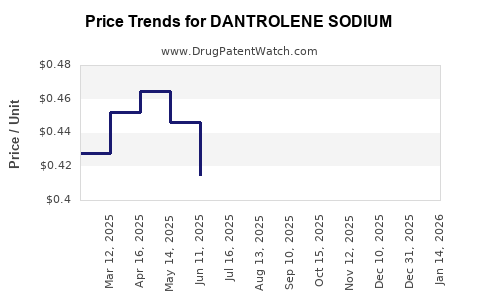
Last updated: August 14, 2026
Dantrolene sodium is a mature, low-volume emergency medicine with durable demand because it is the primary FDA-approved treatment for malignant hyperthermia, a rare but potentially fatal anesthetic reaction. The U.S. market divides into generic oral capsules, conventional intravenous products, and Ryanodex, a higher-priced rapid-reconstitution formulation marketed by Eagle Pharmaceuticals.
The commercial profile is unusual: unit demand is limited, hospital preparedness requirements support recurring purchases, and product differentiation is concentrated in storage, reconstitution speed, vial count, and supply reliability rather than in new clinical indications. Public financial disclosures do not separately report dantrolene revenue, preventing a reliable product-level revenue series. The market is best analyzed as a small, strategically important hospital product category rather than a conventional high-growth pharmaceutical franchise.
What is dantrolene sodium used for?
Dantrolene sodium is a skeletal-muscle relaxant that reduces calcium release from the sarcoplasmic reticulum. Its principal emergency use is treatment of malignant hyperthermia, a pharmacogenetic reaction triggered by volatile anesthetics or succinylcholine. The FDA labeling for intravenous dantrolene requires rapid administration when malignant hyperthermia is suspected, followed by continued dosing as clinically indicated.[1-3]
Oral dantrolene is approved for chronic spasticity associated with upper motor neuron disorders, including spinal cord injury, stroke, cerebral palsy, and multiple sclerosis. Oral products are not substitutes for intravenous products in an acute malignant-hyperthermia event because absorption and onset are too slow.[1]
Dantrolene sodium product categories
| Product |
Dosage form |
Primary use |
Commercial position |
| Dantrium |
Oral capsules; historical intravenous product |
Chronic spasticity; malignant hyperthermia |
Legacy brand and generic category |
| Revonto |
Intravenous injection |
Malignant hyperthermia |
Conventional injectable formulation |
| Generic dantrolene sodium |
Oral and intravenous |
Spasticity and malignant hyperthermia |
Price-oriented competition |
| Ryanodex |
Intravenous injectable suspension |
Malignant hyperthermia |
Rapid-reconstitution differentiated product |
Ryanodex contains 250 mg of dantrolene sodium in a single vial and is reconstituted with 5 mL of sterile water. Conventional dantrolene products generally require substantially more vials and larger volumes of diluent for an equivalent initial dose.[2,3]
How large is the dantrolene sodium market?
The U.S. dantrolene sodium market is niche and hospital-centered. Public market reports often combine dantrolene with broader anesthesia, emergency medicine, muscle-relaxant, or hospital-injectable categories, producing estimates that are not directly comparable.
A reliable product-level market size is difficult to establish because:
- Malignant hyperthermia is rare.
- Hospitals stock dantrolene for preparedness rather than routine daily use.
- Purchasing data are split across branded, authorized-generic, and generic National Drug Code products.
- Manufacturers do not consistently report dantrolene revenue as a separate line item.
- Ryanodex revenue is embedded within Eagle Pharmaceuticals’ broader product portfolio.
The economic value is therefore driven by stocking requirements and product availability rather than treatment volume alone. Hospitals, ambulatory surgery centers, and other facilities that administer triggering anesthetic agents must maintain immediate access to dantrolene under applicable professional and institutional standards.[4]
Demand drivers
The strongest demand drivers are:
- Continued use of volatile anesthetics and succinylcholine.
- Malignant-hyperthermia preparedness requirements.
- Hospital and ambulatory surgery center stocking policies.
- Replacement of expired inventory.
- Preference for faster reconstitution during a time-critical event.
- Supply continuity concerns following shortages of conventional injectable products.
Demand is relatively insensitive to ordinary economic cycles. Hospitals cannot easily eliminate dantrolene inventory without increasing clinical and regulatory risk. That supports recurring baseline demand even though actual emergency utilization is infrequent.
What is the financial trajectory for dantrolene sodium?
Dantrolene sodium has a mature, stable financial profile rather than a volume-driven growth profile. The main commercial changes have come from formulation mix and pricing.
Historical trajectory
The market developed through three stages:
| Period |
Financial and commercial characteristics |
| Legacy oral and conventional IV era |
Broad generic competition, low unit prices, established clinical use |
| Conventional injectable supply-constrained era |
Greater sensitivity to shortages, hospital purchasing pressure, and inventory availability |
| Ryanodex era |
Premium pricing based on rapid preparation, lower reconstitution burden, and operational convenience |
Ryanodex shifted part of the market from a commodity injectable model to a differentiated hospital product model. Its economic proposition is based on reducing preparation time and the number of vials required during an emergency. That positioning can support a price premium despite the same active ingredient.
No public filing establishes a standalone annual revenue figure for Ryanodex or total U.S. dantrolene sodium sales. Eagle Pharmaceuticals reports at the company level and has historically provided product and portfolio commentary without consistently breaking out Ryanodex revenue in a way that permits a full independent market reconstruction.[5]
Revenue outlook
The likely financial trajectory is:
- Stable underlying demand from mandatory or protocol-driven hospital stocking.
- Limited growth in treated patient volume because malignant hyperthermia remains rare.
- Potential revenue migration from conventional IV products to Ryanodex where hospitals value rapid preparation.
- Generic price pressure in oral and conventional injectable products.
- Periodic revenue volatility from shortages, tenders, contract changes, and inventory restocking.
- Higher gross-margin potential for differentiated Ryanodex units than for commodity generic capsules.
The main downside risk is substitution. Hospitals with adequate preparation time, established protocols, or cost-focused formularies may favor lower-priced conventional products. The main upside risk is operational differentiation: if hospital systems place greater weight on emergency readiness and labor efficiency, Ryanodex can gain share without requiring expansion of the overall patient population.
What is the FDA regulatory status of dantrolene sodium?
Dantrolene sodium is an FDA-approved drug with multiple approved dosage forms and products. The principal regulatory distinction is between oral products for chronic spasticity and intravenous products for malignant hyperthermia.
FDA status by formulation
| Formulation |
Regulatory use |
Key FDA issue |
| Oral capsules |
Chronic spasticity |
Generic competition and mature labeling |
| Conventional IV injection |
Malignant hyperthermia |
Reconstitution burden and supply reliability |
| Ryanodex IV suspension |
Malignant hyperthermia |
Product-specific formulation and administration advantages |
Ryanodex received FDA approval in 2014 under New Drug Application 204579, according to FDA approval information and product labeling.[2,6] The product’s clinical and regulatory differentiation is primarily pharmaceutical and operational, not based on a new active ingredient.
FDA approval does not eliminate state, hospital, or professional requirements governing malignant-hyperthermia preparedness. The Malignant Hyperthermia Association of the United States recommends that facilities using triggering anesthetic agents maintain adequate dantrolene supplies and equipment for rapid treatment.[4]
What patents protect dantrolene sodium products?
Most basic dantrolene sodium composition and oral-use patents expired years ago. The relevant remaining intellectual-property issues have centered on newer injectable formulations, manufacturing processes, and product-specific claims rather than on dantrolene sodium itself.
Patent estate by product category
| Category |
Patent position |
Commercial effect |
| Oral dantrolene sodium |
Core composition and conventional formulation protection is expired |
Broad generic competition |
| Legacy conventional IV products |
Older product patents are generally expired |
Generic and multisource competition |
| Ryanodex |
Formulation and delivery-related patents may provide later-dated protection |
Potential premium and market differentiation |
| Manufacturing and process claims |
May remain relevant depending on scope and validity |
Possible barrier for direct formulation substitution |
Eagle has publicly identified U.S. patent protection for Ryanodex, including formulation-related patents listed in connection with the product.[5] Patent scope must be assessed claim by claim because a formulation patent may cover a specific concentration, suspension system, reconstitution profile, vial configuration, or manufacturing method without covering all dantrolene products.
What formulations are protected by Ryanodex patents?
Ryanodex protection is directed principally to its injectable formulation and administration characteristics. The commercial distinction includes:
- A 250 mg single-vial presentation.
- A concentrated injectable suspension.
- Reconstitution with a small volume of sterile water.
- Rapid preparation compared with conventional dantrolene products.
- Product-specific physical and chemical characteristics.
These features can create a meaningful barrier to a therapeutically equivalent generic even when the active ingredient is old. A competitor must satisfy FDA requirements for pharmaceutical equivalence, bioequivalence or other applicable standards, stability, sterility, container closure, and labeling. It may also need to address listed patents through a Paragraph IV certification.
When does dantrolene sodium lose exclusivity?
The basic dantrolene sodium molecule has already lost meaningful exclusivity. The key exclusivity question concerns individual branded formulations, especially Ryanodex, rather than dantrolene sodium as an active ingredient.
Exclusivity timeline
| Milestone |
Timing |
| Original dantrolene clinical and commercial use |
Decades old |
| Generic oral and conventional IV competition |
Established |
| Ryanodex FDA approval |
2014 |
| Potential formulation-patent expiry |
Depends on the specific listed patent and pediatric or regulatory adjustments |
| Current market structure |
Generic base products plus differentiated branded IV formulation |
FDA regulatory exclusivity and patent expiry are separate. Ryanodex’s New Chemical Entity exclusivity would not apply because dantrolene sodium was previously approved. Any continuing protection therefore depends primarily on formulation patents, regulatory exclusivities that may attach to specific supplements, and commercial barriers such as manufacturing complexity.
A definitive generic-entry date cannot be inferred from the active ingredient’s age. It requires review of current Orange Book patent listings, patent-term adjustments, terminal disclaimers, pediatric exclusivity, litigation, and any settlements.
What is the Orange Book status of dantrolene sodium?
The Orange Book contains product-specific entries for approved prescription products and may list patents for eligible branded products. The key distinction is between:
- Products with no meaningful listed patent barrier.
- Products with formulation or method-of-use patents.
- Products facing Paragraph IV certifications.
- Products with patents that may be expired, delisted, disclaimed, or subject to litigation.
Ryanodex is the relevant branded product for current formulation-patent analysis. Dantrium and conventional dantrolene products represent the mature genericized segment. Orange Book status can change through patent listing updates, delisting requests, new approvals, or court decisions.[7]
Which companies are competing in the dantrolene sodium market?
Competition is fragmented across branded and generic suppliers. Eagle Pharmaceuticals is the principal branded innovator associated with Ryanodex. Other suppliers have marketed generic oral or injectable dantrolene products over time, including companies operating through abbreviated new drug applications, authorized-generic arrangements, or hospital-distribution channels.
Competitive landscape
| Competitor type |
Product strategy |
Competitive advantage |
| Eagle Pharmaceuticals |
Ryanodex |
Rapid preparation and differentiated presentation |
| Generic manufacturers |
Oral capsules and conventional IV products |
Lower acquisition cost |
| Legacy brand or authorized-generic suppliers |
Established products |
Familiarity and contracting |
| Hospital distributors |
Inventory and emergency supply access |
Availability and logistics |
The market is more sensitive to reliable supply than many mature generic categories. A supplier with a low price but inconsistent availability may lose hospital contracts to a higher-priced supplier that can support emergency stock requirements.
Are there Paragraph IV challenges or patent lawsuits?
Dantrolene sodium has a long history of generic competition, but the most consequential patent activity is tied to branded formulation products rather than to the base active ingredient.
A Paragraph IV challenge against Ryanodex would typically allege that a listed patent is invalid, unenforceable, or not infringed. If a generic applicant files an ANDA with a Paragraph IV certification and the patent holder sues within the statutory period, FDA approval may be subject to a 30-month stay, subject to statutory exceptions and litigation outcomes.[8]
The commercial effect of a challenge depends on:
- Number and scope of listed patents.
- Whether claims cover the entire commercial formulation or only specific characteristics.
- Patent validity under obviousness, written description, enablement, and anticipation standards.
- Availability of a noninfringing alternative formulation.
- Hospital willingness to switch from Ryanodex.
- Settlement terms, including a possible agreed launch date.
No broad biosimilar risk applies. Dantrolene sodium is a small-molecule drug, so competitive entry proceeds through generic-drug pathways rather than the biosimilar pathway.
What manufacturing and intellectual-property barriers affect dantrolene sodium?
The principal manufacturing barriers are higher for injectable products than for oral capsules. A competitor must manage:
- Sterile manufacturing.
- Particle-size control.
- Suspension uniformity.
- Reconstitution performance.
- Stability and shelf life.
- Container-closure integrity.
- Compatibility with diluents and administration equipment.
- Emergency-use labeling and packaging.
Ryanodex’s commercial advantage depends on more than concentration. A rival must reproduce the product’s clinically relevant preparation characteristics while satisfying FDA quality requirements. This raises development cost and execution risk compared with an ordinary oral generic.
Manufacturing interruptions can have an outsized commercial effect because hospitals maintain finite emergency inventories. A shortage can shift purchasing quickly among suppliers, but share gains may reverse when supply normalizes.
How does dantrolene sodium compare with competing malignant-hyperthermia treatments?
Dantrolene sodium has no direct pharmacologic replacement with equivalent regulatory and clinical positioning for malignant hyperthermia. Supportive measures, cooling, anesthesia discontinuation, and intensive care are essential, but they do not replace dantrolene’s role in reversing the underlying skeletal-muscle calcium-release abnormality.[1-4]
The commercially relevant comparison is between dantrolene presentations:
| Attribute |
Conventional IV dantrolene |
Ryanodex |
| Active ingredient |
Dantrolene sodium |
Dantrolene sodium |
| Emergency indication |
Malignant hyperthermia |
Malignant hyperthermia |
| Reconstitution burden |
Higher |
Lower |
| Vials required for an initial 2.5 mg/kg dose |
Often many |
Fewer |
| Acquisition cost |
Generally lower |
Generally higher |
| Operational positioning |
Cost and availability |
Speed and preparation efficiency |
Ryanodex can justify premium pricing where emergency preparation time, pharmacy workload, storage space, and vial handling are prioritized. Conventional products remain competitive where acquisition cost dominates.
What generic entry risks exist for Ryanodex?
Generic-entry risk is moderate to high over the long term but depends on the enforceability and remaining term of formulation patents. The active ingredient provides little protection because dantrolene sodium is longstanding and widely genericized.
Risk factors
- Expiry or invalidation of formulation patents.
- A generic formulation that avoids asserted claims.
- FDA acceptance of an ANDA with a Paragraph IV certification.
- Hospital pressure to reduce injectable acquisition costs.
- Expansion of generic sterile manufacturing capacity.
- Product shortages that encourage formulary substitution.
Offsetting defenses
- Formulation complexity.
- Emergency-use switching costs.
- Established hospital protocols.
- Brand familiarity.
- Supply reliability.
- Potential patent settlement terms.
- Manufacturing know-how not fully disclosed in public patents.
The largest commercial risk is not a collapse in total dantrolene demand. It is erosion of Ryanodex’s premium and conversion of hospitals to lower-cost conventional products.
What licensing deals affect dantrolene sodium?
Dantrolene sodium has not generated the licensing activity associated with newer oncology, immunology, or rare-disease assets. The commercial model is primarily direct product marketing, generic supply, and hospital distribution.
Any licensing, authorized-generic, or distribution arrangement should be evaluated for:
- Territory.
- Product rights by dosage form.
- Supply obligations.
- Minimum purchase commitments.
- Pricing and rebate terms.
- Patent enforcement responsibilities.
- Shortage allocation rights.
- Termination provisions.
The absence of major publicly disclosed licensing transactions limits the strategic value of partnership analysis. The key asset remains product access and formulation differentiation.
What is the revenue exposure to dantrolene sodium?
Revenue exposure is concentrated in companies with a differentiated injectable product. For generic manufacturers, dantrolene is likely a small portfolio product and contributes limited absolute revenue. For Eagle Pharmaceuticals, Ryanodex has greater strategic relevance than its market size would suggest because it is a branded, hospital-focused product with formulation differentiation.[5]
The financial risks are asymmetric:
- Downside comes from generic entry, price compression, supply disruption, and hospital conversion.
- Upside comes from Ryanodex share gains, higher stocking adoption, and premium pricing.
- Market expansion from increased malignant-hyperthermia incidence is unlikely to be material.
- Revenue stability depends on recurring inventory replacement rather than prescription growth.
Key Takeaways
- Dantrolene sodium is a mature small-molecule drug with stable, niche hospital demand.
- The principal clinical use is emergency treatment of malignant hyperthermia.
- Oral and conventional intravenous products face established generic competition.
- Ryanodex is the main differentiated product and competes through rapid reconstitution and reduced vial burden.
- The basic active ingredient has no meaningful remaining exclusivity.
- Current patent risk centers on Ryanodex formulation and manufacturing claims.
- No biosimilar pathway applies because dantrolene sodium is a small molecule.
- Public companies do not separately disclose enough information to establish a reliable product-level revenue figure.
- Financial growth is more likely to come from product mix and premium pricing than from increased treatment volume.
- Generic entry would primarily threaten Ryanodex pricing and market share, not the existence of the dantrolene sodium category.
FAQs
Is dantrolene sodium still commercially important despite rare use?
Yes. Hospitals and surgery centers must maintain rapid access to dantrolene because malignant hyperthermia requires immediate treatment. Low utilization does not eliminate recurring inventory demand.
Is Ryanodex interchangeable with generic dantrolene sodium?
Ryanodex and conventional products contain dantrolene sodium, but presentation, reconstitution volume, preparation time, labeling, and purchasing economics differ. Interchangeability depends on FDA designation, institutional policy, and clinical protocol.
Does dantrolene sodium have biosimilar competition?
No. Dantrolene sodium is a small-molecule drug. Competition is governed mainly by generic-drug approval pathways, including ANDAs and potential Paragraph IV certifications.
Why can Ryanodex command a premium over generic dantrolene?
Ryanodex reduces the number of vials and the amount of diluent required during emergency preparation. Hospitals may value this operational advantage even when the active ingredient is identical.
What would most likely reduce Ryanodex revenue?
A successful formulation-generic launch, patent expiry or invalidation, sustained supply of lower-priced conventional IV products, and hospital formulary conversion would create the greatest revenue pressure.
References
- U.S. Food and Drug Administration. (2022). Dantrium capsules prescribing information. FDA.
- Eagle Pharmaceuticals, Inc. (2023). Ryanodex prescribing information. Eagle Pharmaceuticals.
- U.S. Food and Drug Administration. (2023). Dantrolene sodium for injection prescribing information. FDA.
- Malignant Hyperthermia Association of the United States. (2024). Dantrolene availability and malignant hyperthermia preparation recommendations. MHAUS.
- Eagle Pharmaceuticals, Inc. (2024). Annual report pursuant to Section 13 or 15(d) of the Securities Exchange Act of 1934. U.S. Securities and Exchange Commission.
- U.S. Food and Drug Administration. (2014). Drugs@FDA: Ryanodex, NDA 204579. FDA.
- U.S. Food and Drug Administration. (2024). Approved drug products with therapeutic equivalence evaluations, 44th ed. FDA.
- U.S. Code, 21 U.S.C. § 355(j). (2024). Abbreviated applications for new drugs.