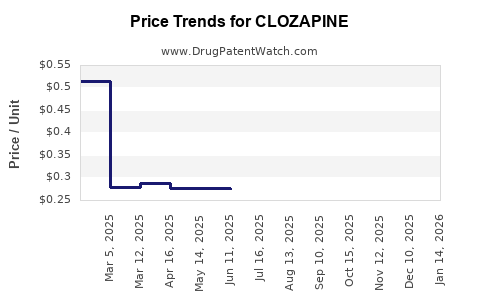
Last updated: September 18, 2026
Clozapine is a mature, genericized antipsychotic with low unit pricing but durable clinical demand. Its market is constrained by treatment-resistant schizophrenia, mandatory blood-monitoring requirements, prescriber reluctance, and manufacturing interruptions rather than by patent exclusivity. The commercial outlook improved after the FDA removed the Clozapine REMS program in 2025, although absolute revenue growth remains limited because multiple generic suppliers compete in a relatively narrow patient population. [1]
What is the current market position of clozapine?
Clozapine is the principal antipsychotic for treatment-resistant schizophrenia and is also indicated in the United States to reduce recurrent suicidal behavior in patients with schizophrenia or schizoaffective disorder. It is available as conventional tablets, orally disintegrating tablets, and an oral suspension. [2]
The product differs from most antipsychotics because its use is concentrated in patients who have failed other therapies. This creates a smaller but clinically defensible market.
| Market characteristic |
Clozapine position |
| Therapeutic class |
Atypical antipsychotic |
| Primary use |
Treatment-resistant schizophrenia |
| Additional U.S. indication |
Reduction of recurrent suicidal behavior |
| Originator brand |
Clozaril |
| Generic status |
Widely genericized |
| U.S. dosage forms |
Tablets, orally disintegrating tablets, oral suspension |
| Patent status |
Core compound exclusivity expired |
| Biosimilar exposure |
None; clozapine is a small molecule |
| Main commercial barrier |
Monitoring, safety management, and limited prescribing |
| Main supply risk |
Few qualified manufacturers and intermittent shortages |
Clozapine is not a mass-market antipsychotic. Its addressable population is limited by the prevalence of treatment-resistant disease and by the number of patients who can be maintained safely on therapy. The drug nevertheless has high clinical persistence because alternatives are less effective for many eligible patients.
How large is the clozapine market?
Public companies generally do not report clozapine revenue as a separate line item. Sales are usually included within broader generic, specialty-pharmaceutical, or mature-brand portfolios. As a result, published global market estimates vary substantially depending on whether they include hospital purchasing, retail prescriptions, branded formulations, and compounded or ex-U.S. products.
The financial profile is more accurately described through market structure than through a single global market-size figure:
- The active ingredient is inexpensive to manufacture relative to innovative medicines.
- Generic tablets account for most volume.
- Specialized formulations retain higher pricing but serve smaller patient groups.
- Monitoring and distribution infrastructure raises operating costs.
- Shortages can temporarily increase prices and shift market share among suppliers.
In the United States, clozapine is a low-revenue product relative to newer branded antipsychotics such as long-acting aripiprazole, lumateperone, and cariprazine. Its economic value is concentrated in reliable supply, formulation differentiation, and institutional contracts rather than in patent-protected pricing.
What is the financial trajectory for clozapine?
Clozapine revenue followed a conventional pharmaceutical lifecycle:
| Period |
Financial phase |
Main driver |
| 1970s-1980s |
Originator development |
Clinical differentiation in schizophrenia |
| 1989-1990s |
Brand expansion |
U.S. approval and growth in treatment-resistant use |
| Late 1990s-2000s |
Generic erosion |
Expiration of compound and formulation protection |
| 2010s |
Mature generic market |
Multiple suppliers and low unit prices |
| 2020-2024 |
Volatile mature market |
Shortages, supply disruptions, and monitoring burden |
| 2025 onward |
Operational normalization potential |
Removal of the U.S. Clozapine REMS program |
Novartis no longer benefits from a conventional branded monopoly for the active ingredient. Brand Clozaril has remained relevant in certain jurisdictions because of physician familiarity, supply reliability, and established monitoring systems, but it does not command the commercial position of a patented branded antipsychotic.
The most attractive revenue opportunities are in:
- Oral suspension products.
- Orally disintegrating tablets.
- Low-volume markets with limited generic competition.
- Hospital and public-sector supply contracts.
- Contract manufacturing and reliable API supply.
- Patient-support systems that reduce treatment discontinuation.
The main limitation is that clozapine demand is relatively inelastic but narrow. A supplier cannot easily expand volume through broad physician promotion because the drug is reserved for defined clinical circumstances.
When did clozapine lose exclusivity?
The original clozapine compound patent expired decades ago. Clozapine entered the U.S. market under the Clozaril brand in 1989, and generic products became available in the 1990s. The active ingredient therefore has no meaningful remaining composition-of-matter exclusivity in the United States or major European markets.
The exclusivity timeline is:
| Protection category |
Status |
| Active ingredient patent |
Expired |
| Original U.S. brand exclusivity |
Expired |
| Generic tablet entry |
Established |
| Orally disintegrating tablet protection |
Expired or commercially bypassed through generic competition |
| Oral suspension protection |
Product-specific and formulation-dependent |
| Current market protection |
Regulatory, manufacturing, and supply-chain barriers rather than compound patents |
Clozapine’s commercial protection is now based on product execution. A company with a technically reliable formulation can retain share even without broad patent protection, particularly where competing suppliers experience shortages.
What patents protect clozapine products?
The core chemical entity is no longer patent protected. Later patents historically focused on dosage forms, delivery systems, manufacturing processes, and product-specific formulations.
Formulation patents
Clozapine has been marketed in several formulations:
- Conventional immediate-release tablets.
- Orally disintegrating tablets, including the former FazaClo product.
- Oral suspension, including Versacloz.
- Compounded suspensions and institution-specific preparations.
Formulation patents may cover excipient combinations, particle size, taste masking, disintegration behavior, stability, or suspension characteristics. These rights do not recreate composition-of-matter exclusivity and generally have narrower commercial scope.
The most commercially relevant formulation strategy is an oral suspension for patients who cannot swallow tablets or require administration through feeding tubes. A formulation with reproducible dose uniformity and shelf stability can command a premium over standard generic tablets.
Method-of-use patents
Clozapine method-of-use protection has historically focused on psychiatric treatment protocols, patient selection, dose management, and suicide-risk reduction. Most clinical-use value now comes from FDA labeling and treatment guidelines rather than enforceable exclusivity.
Because the principal indications are established and generic manufacturers can rely on approved labeling pathways, method-of-use patents provide limited ability to prevent broad generic competition. A narrow method patent could still affect a particular indication or dosing protocol, but it is unlikely to restore originator-level pricing.
Manufacturing and API protection
Manufacturing know-how is more important than patent exclusivity. Relevant barriers include:
- Consistent API purity.
- Control of impurities and degradation products.
- Tablet content uniformity at low strengths.
- Stability of oral suspensions.
- Supply of specialized packaging.
- Validation of automated dispensing and monitoring systems.
These barriers can reduce the number of commercially dependable suppliers even when several companies hold regulatory approvals.
What is the FDA regulatory status of clozapine?
The FDA approved Clozaril in 1989 for severe schizophrenia in patients who failed standard therapy. The agency later expanded the label to include reduction of recurrent suicidal behavior in patients with schizophrenia or schizoaffective disorder. [2]
The principal regulatory burden was the risk of severe neutropenia. For many years, the Clozapine REMS program required prescribers, pharmacies, and patients to follow blood-monitoring and reporting procedures.
The FDA removed the Clozapine REMS program on February 24, 2025. The agency stated that prescribers should continue to monitor patients for neutropenia and follow the prescribing information, but pharmacies and prescribers no longer need to comply with the centralized REMS program. [3]
The change has several commercial effects:
- Lower administrative cost for prescribers and pharmacies.
- Fewer delays in dispensing.
- Reduced risk of treatment interruption caused by database or reporting problems.
- Potential expansion of prescribing in community settings.
- Lower differentiation for branded products that previously supported monitoring infrastructure.
The change does not remove the medical risk associated with neutropenia. It shifts monitoring responsibility back to routine clinical practice.
What is the Orange Book status of clozapine?
The FDA Orange Book identifies approved clozapine products and any listed patents or exclusivity claims associated with specific applications. For the mature tablet market, Orange Book listings do not create a practical barrier to generic entry because generic clozapine products are already approved and commercially distributed.
Product-specific formulation listings can still matter for:
- Oral suspension products.
- Orally disintegrating tablets.
- New strengths or delivery systems.
- Narrowly claimed formulation technologies.
A Paragraph IV challenge would have the greatest commercial relevance against a current formulation patent protecting an oral suspension or specialty delivery system. It would have limited relevance to ordinary clozapine tablets, where generic competition is already established.
Which companies compete in the clozapine market?
Competition varies by country and dosage form. In the United States, the market has included the originator Clozaril brand, generic manufacturers, and specialized formulation suppliers. Major generic-company participation has included firms such as Teva, Mylan or Viatris, Par Pharmaceutical, and other FDA-approved manufacturers, although product availability changes over time.
| Competitor category |
Competitive advantage |
| Originator brand |
Historical physician recognition and established supply systems |
| Large generic manufacturers |
Scale, purchasing leverage, and broad distribution |
| Specialty formulation companies |
Oral suspension or orally disintegrating technology |
| Hospital suppliers |
Institutional contracting and continuity of supply |
| API manufacturers |
Cost control and supply-chain leverage |
The market is vulnerable to supplier concentration. A product can be legally genericized but commercially fragile if only a few manufacturers maintain active production.
What generic entry risks exist?
Generic entry risk is already realized for conventional clozapine tablets. The relevant question is not whether generics can enter, but whether existing suppliers can maintain uninterrupted supply and whether new entrants can capture share.
The highest competitive risks are:
- Price compression in standard tablets.
- Hospital tenders favoring the lowest qualified bidder.
- Substitution from brand to generic after monitoring requirements decline.
- New oral suspension products entering under abbreviated or product-specific pathways.
- Consolidation among API and finished-dose manufacturers.
The principal countervailing risk is shortage-driven repricing. A manufacturer with available inventory can gain temporary share and improve net pricing when competitors face production delays or regulatory interruptions.
Are biosimilars a risk for clozapine?
No. Clozapine is a chemically synthesized small molecule, not a biologic. Biosimilar regulation does not apply. Competition proceeds through generic-drug approval pathways, including abbreviated new drug applications in the United States and equivalent generic mechanisms in Europe and other markets.
The relevant technical issues are bioequivalence, dissolution, formulation performance, stability, and manufacturing consistency.
What patent litigation and settlement activity affect clozapine?
Clozapine has not generated the level of high-value patent litigation associated with newer antipsychotics. The compound is long off patent, and conventional tablet competition is mature.
Potential disputes are more likely to involve:
- Formulation patents.
- Orange Book certifications.
- Product labeling and carve-outs.
- Supply contracts.
- Shortage-related allocation.
- Manufacturing quality or regulatory compliance.
Large reverse-payment settlements are less likely than in markets with a recently expired blockbuster patent because the basic clozapine market has already undergone extensive generic erosion.
How strong is the clozapine patent estate?
The patent estate is weak for the active ingredient and conventional tablets but can be moderate for specialized formulations.
| Asset type |
Patent strength |
Commercial relevance |
| Compound patent |
None remaining |
Very low |
| Standard tablet |
Low |
High volume, limited pricing power |
| Orally disintegrating tablet |
Low to moderate |
Patient convenience and adherence |
| Oral suspension |
Moderate if technically narrow |
Higher pricing and differentiated access |
| Manufacturing process |
Variable |
Can limit dependable supply |
| Method of use |
Low to moderate |
Narrow indication or protocol protection |
The strongest defensible position is usually a combined formulation, regulatory, and supply position rather than a single broad patent claim.
How does clozapine compare with newer antipsychotics?
| Factor |
Clozapine |
Newer branded antipsychotics |
| Patent status |
Mostly expired |
Often active or recently expired |
| Unit price |
Low for generics |
High for branded products |
| Patient population |
Treatment-resistant or high-risk disease |
Broad schizophrenia and bipolar populations |
| Monitoring |
Historically intensive; reduced after 2025 REMS removal |
Generally less burdensome |
| Clinical differentiation |
Strong in treatment resistance |
Differentiation varies by product |
| Revenue outlook |
Stable, low-growth |
Higher but exposed to patent cliffs |
| Supply risk |
Meaningful because of limited suppliers |
Varies by product and manufacturer |
Clozapine is commercially defensive but not a high-growth asset. Newer antipsychotics generate more revenue per patient but face larger patent-cliff exposure and greater promotional competition.
What is the outlook for clozapine revenue?
Revenue should remain stable to modestly positive in volume, with limited pricing growth. The main potential volume catalyst is reduced administrative friction after removal of the U.S. REMS program. That benefit may be offset by generic substitution and continued clinician concern about neutropenia, myocarditis, seizures, constipation, and metabolic effects.
The strongest commercial scenarios are:
- A reliable generic supplier gains share during a shortage.
- A specialty company expands oral suspension use in patients unable to take tablets.
- Monitoring simplification increases community prescribing.
- Hospital systems consolidate purchasing with dependable suppliers.
- A manufacturer secures exclusive or preferred distribution for a differentiated formulation.
The weakest scenario is continued price erosion in conventional tablets combined with rising manufacturing costs and no durable formulation differentiation.
Key Takeaways
- Clozapine is a mature, genericized antipsychotic with durable demand in treatment-resistant schizophrenia.
- Core compound and conventional tablet patents have expired.
- The main commercial barriers are monitoring, prescriber reluctance, manufacturing complexity, and supplier concentration.
- FDA removal of the Clozapine REMS program in 2025 reduces administrative friction and may improve access.
- Conventional tablets have limited pricing power; oral suspension and other specialized formulations offer greater commercial differentiation.
- Clozapine has no biosimilar risk because it is a small molecule.
- Product-level revenue is generally not disclosed by major manufacturers, so financial analysis depends on market structure, product availability, and formulation mix.
- The asset is commercially defensive but unlikely to deliver blockbuster growth.
FAQs
Is clozapine still profitable after generic competition?
Yes, but profitability depends on scale, supply reliability, formulation differentiation, and institutional contracts rather than on patent pricing.
Can a new company launch a generic clozapine tablet?
A company can pursue generic entry through the applicable abbreviated regulatory pathway, but commercial success depends on bioequivalence, manufacturing capacity, supply continuity, and market access.
Does clozapine have a long-term patent in the United States?
No broad active patent protects the original clozapine molecule. Some product-specific formulation or delivery patents may remain relevant depending on the formulation and application.
Will removing the Clozapine REMS increase clozapine sales?
It may increase prescribing and reduce dispensing delays, but the effect is likely to be gradual because clinical monitoring and adverse-event concerns remain.
Which clozapine formulation has the strongest commercial potential?
Oral suspension has the strongest differentiation potential because it addresses administration barriers that conventional tablets do not solve. Its market is smaller, but pricing and patient-specific utility can be higher.
References
- U.S. Food and Drug Administration. (2025). FDA removes Clozapine REMS program.
- U.S. Food and Drug Administration. (2024). Clozaril prescribing information.
- U.S. Food and Drug Administration. (2025). Clozapine REMS program removal communication.
- U.S. Food and Drug Administration. (2024). Approved drug products with therapeutic equivalence evaluations.
- Novartis AG. (2024). Annual report 2023.