Last updated: July 27, 2026
Jazz Pharmaceuticals is a mid-cap specialty pharma focused on CNS, hematology, and sleep-related disorders, with a portfolio anchored by high-revenue brands that are defended by a mix of regulatory exclusivities and layered patent estates. Competitive risk is concentrated in (1) expiring brand exclusivities and key Orange Book patents, (2) biosimilar or generic substitution threats in adjacent therapeutic options, and (3) payer-driven channel dynamics that compress net pricing even when legal exclusivity holds.
Which products drive Jazz’s market position in 2024–2026?
Jazz’s competitive positioning is tied to a small set of revenue-dominant commercial franchises rather than broad portfolio scale. The firm’s market influence comes from differentiated mechanisms, established safety-and-efficacy footprints, and negotiated payer access around its core indications.
Core commercial franchises and competitive roles
1) Xyrem / Xywav (sodium oxybate formulations)
- Competitive role: platform franchise in narcolepsy and idiopathic hypersomnia treatment pathways in multiple geographies (U.S. market structure under REMS and controlled-substance rules).
- Key competitive dynamic: alternative oxybate-like approaches and behavioral/sleep-disorder care pathways compete for payer coverage and prescriber mindshare.
2) Epidiolex (cannabidiol)
- Competitive role: category leader in Dravet syndrome and Lennox-Gastaut syndrome (with dosing and caregiver access mechanisms that matter for outcomes and adherence).
- Key competitive dynamic: pipeline-driven pressure from next-generation cannabinoid and non-cannabinoid anti-seizure therapies, plus health plan scrutiny around cost-effectiveness.
3) Zepzelca (lurbinectedin)
- Competitive role: oncology entry supporting a hemato-oncology strategy where biomarker positioning and combination regimens matter.
- Key competitive dynamic: rapidly evolving second-line small-cell lung cancer and later-line regimens.
4) Vyxeos (liposomal daunorubicin and cytarabine)
- Competitive role: differentiated formulation in AML, where regimen standard-of-care status and supply capacity matter.
- Key competitive dynamic: AML induction and consolidation competition (including newer targeted agents and combinations).
Market position summary
- Jazz’s competitive strength is most durable where it has (a) narrow label specificity plus strong clinical differentiation and (b) a defended IP-and-regulatory stack that slows substitution.
- The highest structural risk sits where (a) competitors have multiple mechanisms rather than a single “drop-in” alternative and (b) payer formularies can steer without waiting for patent expiration.
How strong is Jazz’s patent estate for its blockbuster brands?
Jazz’s patent strength typically comes from layered claims across:
- drug substance/compound (primary composition),
- specific formulations and dosage forms,
- method-of-use (indication/dosing regimens),
- manufacturing/process improvements,
- REMS-related or controlled-release delivery architecture where applicable.
How to read patent strength for Jazz in litigation and licensing contexts
For commercial risk modeling, patent estate strength is not a single metric. It is driven by:
- Claim coverage breadth: whether generic manufacturers can design around without infringing.
- Jurisdictional coverage: U.S. Orange Book patents drive FDA substitution timing, while EPO and national patents control Europe entry.
- End-of-life timing: whether brand life extensions come from later-expiring patents versus earlier patents invalidated by design-arounds.
Patent estate structure by franchise (what to map)
For each key brand, investors and litigators typically map:
- U.S. listed Orange Book patents (drug product and method-of-use),
- litigation histories (ANDA or “Hatch-Waxman” challenges, if any),
- relevant exclusivity windows (3-year, 5-year NCE, pediatric exclusivity extensions where applicable),
- likely design-around routes (different salt form, different formulation technology, or different dosing regimen).
When does Jazz lose exclusivity for Xyrem/Xywav, Epidiolex, and other key products?
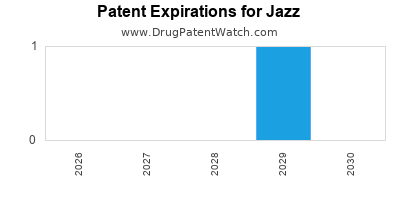
Exclusivity loss drives the competitive inflection point even when patent litigation is unresolved. The critical question in any Jazz product life-cycle plan is: when does FDA substitution become legally possible?
What timelines determine generic entry risk
In the U.S., substitution risk typically depends on:
- Orange Book patent expiration (or successful litigation against the listed patents),
- regulatory exclusivity (NCE, 3-year new clinical investigation, 7-year orphan where applicable, 5-year GDUFA-related exclusivity where applicable),
- pediatric exclusivity (6-month extension when triggered),
- REMS constraints for controlled-substance products (can slow practical entry even after legal permission).
Practical takeaway on Jazz’s risk timing
- Jazz’s highest near-to-midterm entry risk concentrates in products where the Orange Book stack is thinner or where method-of-use claims have weaker enforceability.
- Where Jazz has broad formulation/process claims, competitors face both legal and technical barriers.
What patents protect Xyrem and Xywav oxybate formulations?
Jazz’s oxybate franchise sits at the intersection of formulation IP and controlled-substance regulatory structure. Competitive threats include:
- generic oxybate versions attempting design-around,
- reformulated products with different delivery technologies,
- competing narcolepsy treatments that can displace patients at the margin.
Patent estate mapping focus for oxybate
- Drug product patents covering formulation technology and dosage form,
- Method-of-use patents covering dosing regimens and patient subsets,
- Manufacturing and stability claims that can constrain generic equivalence pathways.
Which patents protect Epidiolex (cannabidiol) and its indications?
Epidiolex is a high-visibility target for generic or alternative-therapy competition because its active ingredient is complex and label-specific. Competitive risk is driven by:
- whether claims cover only the compound versus also dosing methods and patient populations,
- whether patent claims can be designed around via alternative salt form, formulation platform, or altered dosing regimen.
Patent estate mapping focus for Epidiolex
- Composition claims covering CBD and specific formulation parameters,
- Method-of-use claims for Dravet syndrome and Lennox-Gastaut syndrome dosing protocols,
- Formulation/process patents that can block an FDA “bioequivalence” path.
What patent litigation affects Jazz’s competitive landscape?
Patent litigation is the key mechanism that turns legal exclusivity into market protection or, conversely, into early entry. For each Jazz product, litigation analysis should track:
- whether challenges are filed via ANDA or 505(b)(2) pathways,
- how courts rule on claim construction and infringement,
- whether settlements include “carve-outs” that allow earlier launch.
How litigation changes competitive outcomes
- If Jazz wins on core claims, competitors typically delay launch or shift to alternative formulations.
- If Jazz loses key claims or courts narrow coverage, generic manufacturers can accelerate entry planning.
What is the Orange Book status of Jazz products (and how does it drive generic entry)?
Orange Book status dictates the exclusivity and patent listing that constrains FDA approval approvals. Competitive planning requires mapping:
- which patents are listed by Jazz and related assignees,
- which patents expire first,
- which patents are “use patents” versus product patents,
- any pediatric exclusivity extensions.
Orange Book-driven competitive model
- Entry windows open when the ANDA/505(b)(2) applicant can certify for each listed patent (Paragraph I, II, III, IV) and litigation outcomes eliminate blocking patents.
- Even with patents expiring, practical entry depends on supply chain readiness, REMS capability (where applicable), and payer negotiations.
How do Jazz’s products compare with competing brands in pricing and access?
Jazz competes in therapeutic areas where payer decisions can change faster than exclusivity timelines.
Pricing and access levers shaping competition
- Specialty pharmacy distribution and patient support programs,
- Outcomes-based contracting and formulary placement,
- Prior authorization and step edits that steer patients to specific brands.
Competitive reality
- Even if legal barriers hold, competitor presence in payer ecosystems can erode market share via incremental patient capture.
- Channel dynamics matter most for high-cost therapies where plan pharmacy and medical benefit coordination determines net price.
What generic entry risks exist for Jazz brands like Xyrem/Xywav and Epidiolex?
Generic entry risk is not binary. It is graded by:
- legal ability to launch (patent and exclusivity status),
- regulatory ability to obtain approval (bioequivalence and formulation requirements),
- market ability to win (payer coverage, prescriber acceptance, supply reliability).
Generic entry risk drivers
- Patent coverage depth: layered method-of-use and formulation patents can slow entry even after base composition claims expire.
- Technical equivalence: controlled-release and complex formulations can create non-trivial CMC hurdles.
- Regulatory pathway alignment: controlled-substance and REMS frameworks increase time-to-commercial readiness.
How does Jazz’s oncology positioning (e.g., Zepzelca and Vyxeos) affect competitive threats?
In oncology, brand success is driven by regimen selection, combination partnerships, and sequencing against standard-of-care. Competitive threats come from:
- trial results that shift guidelines,
- biomarker-defined competitors that capture subpopulations,
- payer restrictions based on response rate and cost per response.
Oncology competitive dynamics specific to Jazz
- Zepzelca competition: second-line and later-line treatment landscapes move quickly with new agents and combination regimens.
- Vyxeos competition: AML treatment remains crowded; formulation differentiation and hospital procurement decisions shape uptake.
Which companies are most likely to challenge Jazz in Hatch-Waxman or biosimilar-style disputes?
For platform defenses in CNS and specialized therapies, the most credible challenges usually come from large generic firms with:
- formulation capability,
- strong ANDA litigation teams,
- established hospital and specialty distribution channels.
For biologic or biosimilar risk, the analysis depends on whether Jazz has biologics exposure in its portfolio and whether competitors can enter via a biosimilar regulatory pathway.
Competitive challenge pattern
- Generic challenge targets are typically the most economically meaningful patents and those that, if cleared, unlock earlier approval.
- If Jazz’s Orange Book listings include broad method-of-use claims, challengers often focus on claim invalidity or non-infringement and design-around.
How do FDA regulatory pathways and exclusivities shape Jazz’s competitive outlook?
FDA pathway choice affects exclusivity and timing:
- 505(b)(2) can preserve exclusivity based on reference product and new clinical investigation elements.
- ANDA entry requires bioequivalence and certification logic tied to Orange Book.
Key exclusivity categories that matter for timing models
- New Molecular Entity (NCE) exclusivity (5 years in relevant cases),
- 3-year exclusivity for new clinical investigations,
- orphan exclusivity (7 years in relevant cases),
- pediatric exclusivity (6-month extensions).
What commercial exposure does Jazz face if exclusivity breaks?
Revenue exposure can be segmented into:
- brand-level revenue at risk,
- indication-level exposure where method-of-use patents protect smaller patient pools,
- channel-level exposure where payer contracts can accelerate substitution after legal clearance.
Modeling substitution impact
Competitive substitution tends to be fastest when:
- payer coverage is generic-friendly,
- prescriber comfort exists with the substitutable alternative,
- product availability is reliable and comparable.
Key Takeaways
- Jazz’s competitive position is driven by a narrow set of high-impact specialty franchises defended by layered IP and regulatory exclusivities.
- Competitive risk is concentrated in exclusivity and Orange Book-driven entry windows rather than in short-term competitor trial wins.
- Patent estate strength depends on claim coverage across formulation, dosing/method-of-use, and manufacturing, not just the earliest-expiring compound patents.
- Litigation outcomes and settlements can materially shift the effective launch window beyond the bare expiration dates.
- Payer channel dynamics can erode brand performance even before legal barriers fully fall.
FAQs
- How do Paragraph IV certifications against Jazz’s Orange Book patents translate into launch timing?
- Which Jazz brands have the highest substitution risk from payer-driven formulary switching?
- What manufacturing and formulation barriers typically slow generic entry for complex specialty products like oxybate and seizure therapies?
- How do pediatric exclusivity extensions change the generic and 505(b)(2) entry calendar for Jazz products?
- What is the typical settlement structure in Hatch-Waxman disputes affecting Jazz brand market entry?
References (APA)
- FDA. (n.d.). Orange Book: Approved Drug Products with Therapeutic Equivalence Evaluations. U.S. Food and Drug Administration.
- FDA. (n.d.). Hatch-Waxman Drug Patent and Exclusivity Information. U.S. Food and Drug Administration.
- U.S. Patent and Trademark Office. (n.d.). Patent assignment and publication records. USPTO.