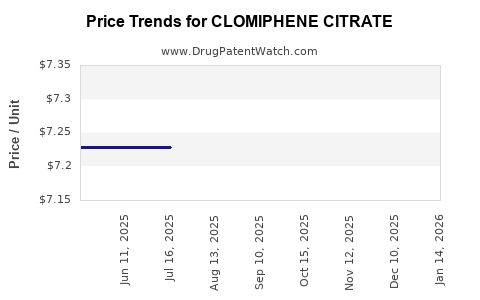
Last updated: August 11, 2026
Clomiphene citrate is a mature, low-cost generic fertility drug with limited branded revenue, no meaningful U.S. exclusivity, and minimal patent barriers to entry. Its commercial value comes from persistent demand in ovulation induction, widespread generic availability, and off-label use in male infertility and hypogonadism. Financial growth is constrained by low prices, multisource competition, substitution by letrozole in many female infertility protocols, and the absence of a differentiated formulation or delivery platform.
What is the current FDA status of clomiphene citrate?
Clomiphene citrate is an orally administered selective estrogen receptor modulator approved in the United States for ovulatory failure in patients seeking pregnancy. The original branded product was Clomid, historically associated with Merrell, Serono and later EMD Serono and Merck-related commercial structures.
The FDA-approved product is supplied primarily as 50 mg tablets. The approved labeling covers ovulatory dysfunction, while use in men is generally off-label. FDA labeling states that treatment should be limited to patients with demonstrated ovulatory dysfunction and excludes use in patients who are already ovulating normally.[1]
| Regulatory item |
Status |
| Active ingredient |
Clomiphene citrate |
| Dosage form |
Oral tablet |
| Common strength |
50 mg |
| Original U.S. approval |
1967 |
| Original branded product |
Clomid |
| Primary approved use |
Ovulation induction |
| U.S. generic status |
Multiple approved generic products |
| Current regulatory pathway |
Abbreviated New Drug Application, or ANDA, for generics |
| Biosimilar pathway |
Not applicable |
| FDA exclusivity |
None expected for the mature product |
| Prescription status |
Prescription drug |
The product is regulated as a small-molecule prescription drug, not a biologic. Biosimilar competition therefore does not apply. Generic competition proceeds through the ANDA pathway, generally requiring demonstration of pharmaceutical equivalence and bioequivalence rather than new clinical efficacy trials.
When does clomiphene citrate lose exclusivity?
Clomiphene citrate lost practical market exclusivity decades ago. The original product was approved in the 1960s, and any foundational compound, formulation and use patents would have expired long before the modern 20-year patent term became relevant.
The commercial exclusivity profile is therefore different from that of a recently launched fertility drug:
| Exclusivity category |
Current position |
| New chemical entity exclusivity |
Expired |
| Orphan-drug exclusivity |
None |
| Pediatric exclusivity |
None material to current market access |
| New formulation exclusivity |
No material U.S. protection identified |
| Method-of-use exclusivity |
No material active exclusivity identified |
| Patent term extension |
Not relevant to current products |
| Generic entry barrier |
Low |
The original indication does not create a present-day commercial barrier. Generic manufacturers can market clomiphene citrate tablets once they obtain FDA approval, subject to ordinary labeling, manufacturing and compliance requirements.
What patents protect clomiphene citrate?
No active U.S. Orange Book patent estate appears to protect the basic clomiphene citrate tablet market. The original active-ingredient and product rights are historical rather than commercially enforceable today.
The relevant patent categories are:
Active ingredient patents
The foundational rights covering clomiphene and its citrate salt date to the early development period of selective estrogen receptor modulators. Those rights expired many years ago. They do not prevent generic manufacture or sale.
Formulation patents
No commercially significant, active U.S. formulation patent has established a differentiated clomiphene citrate market. Approved products are conventional immediate-release tablets. This limits the ability of a sponsor to preserve pricing through extended-release tablets, transdermal delivery, implants or other protected dosage forms.
Method-of-use patents
Clomiphene is used off-label in male infertility, secondary hypogonadism and testosterone-related treatment protocols. Off-label clinical use does not automatically create an enforceable commercial monopoly. A later method-of-use patent would need to satisfy patentability requirements and would face substantial validity and infringement challenges, particularly where the underlying use is clinically established or obvious.
Manufacturing and process patents
Manufacturing knowledge can create quality, yield or supply advantages, but it does not appear to create a durable public-facing barrier for clomiphene citrate. The active ingredient is an old, chemically defined small molecule with multiple potential suppliers and established analytical methods.
What is the Orange Book status of clomiphene citrate?
The Orange Book is relevant primarily to approved branded and generic products with listed patents or exclusivity. For clomiphene citrate, the principal commercial conclusion is that the market is multisource and lacks a current, high-value Orange Book patent barrier.
The Orange Book does not capture every possible intellectual-property right. It generally does not provide a complete inventory of manufacturing know-how, foreign patents, trade secrets, trademarks, clinical practice rights or patents that are not listed against a particular approved product. For the U.S. tablet market, however, the absence of a meaningful active listing is consistent with the product's generic status.[2]
How many patents cover clomiphene citrate?
No meaningful active U.S. patent count supports a branded exclusivity thesis for conventional clomiphene citrate tablets. Historical patents may still appear in patent databases, but their expiration dates make them irrelevant to current U.S. market exclusion.
A practical patent-risk assessment is:
| Patent category |
Current commercial risk |
| Core molecule |
Very low |
| Citrate salt |
Very low |
| Immediate-release tablet |
Very low |
| Ovulation-induction use |
Very low |
| Male infertility use |
Low for the molecule; potentially higher only for a novel, claim-specific regimen |
| Manufacturing process |
Low to moderate for a specific supplier, but not a market-wide barrier |
| Novel delivery system |
Depends on future development |
| Foreign-market rights |
Generally low for the mature product, subject to jurisdiction |
The main risk is not patent litigation. It is product quality, supply continuity, regulatory compliance and pricing pressure.
Which companies are challenging clomiphene citrate?
Clomiphene citrate has already undergone the normal generic challenge cycle. The relevant competitors are generic manufacturers and distributors rather than current Paragraph IV challengers to a protected brand.
Manufacturers and suppliers historically associated with clomiphene citrate tablets have included large generic companies and specialty suppliers such as:
- Teva Pharmaceuticals
- Rising Pharmaceuticals
- Prasco Laboratories
- Perrigo
- Wockhardt
- Par Pharmaceutical and related commercial entities
- Other ANDA holders and contract manufacturers
The precise supplier roster can change as applications are transferred, discontinued or relabeled. Product-level FDA records should be used to confirm current ANDA holders and marketing status.[3]
What Paragraph IV challenges affect clomiphene citrate?
No active, economically significant Paragraph IV dispute is central to the U.S. clomiphene citrate market. Paragraph IV litigation is generally associated with a generic applicant challenging an unexpired listed patent. Clomiphene citrate's foundational patents expired long ago, leaving little basis for a new, high-value challenge against an incumbent brand.
Any future Paragraph IV filing would most likely concern:
- A new branded formulation
- A novel fixed-dose combination
- A newly patented treatment regimen
- A specialized delivery system
- A repurposed indication with a narrowly drafted method-of-use patent
Such a dispute would concern the new product or method, not the ordinary 50 mg generic tablet.
What patent litigation affects clomiphene citrate?
No major current U.S. patent litigation appears to threaten the ordinary clomiphene citrate tablet market. Litigation exposure is more likely to arise from regulatory or commercial disputes, including:
- ANDA approval or manufacturing-site issues
- Product-quality allegations
- Labeling disputes
- Trademark conflicts involving the Clomid name
- Distribution or supply agreements
- Compounding or telehealth marketing practices
- Advertising claims for male use
The litigation profile is materially lower than for newer fertility products, long-acting injectables or biologic reproductive-health therapies.
How strong is the clomiphene citrate patent estate?
The patent estate is weak from a branded-defense perspective and strong from a freedom-to-operate perspective for standard generic tablets.
| Dimension |
Assessment |
| Core composition protection |
Expired |
| Formulation protection |
Limited or absent |
| Method-of-use protection |
Limited for approved ovulation induction |
| Generic freedom to operate |
High |
| Ability to sustain premium pricing |
Low |
| Litigation leverage |
Low |
| Manufacturing differentiation |
Possible, but not patent-driven |
| Lifecycle-management potential |
Moderate only with a genuinely differentiated product |
A company seeking to commercialize clomiphene citrate would compete primarily through supply reliability, regulatory execution, channel access and cost control.
What drives clomiphene citrate demand?
Demand is linked to fertility treatment volumes, reproductive-age demographics, physician prescribing behavior and access to reproductive healthcare.
Female infertility
Clomiphene induces ovulation by blocking estrogen feedback at the hypothalamus and pituitary. It remains familiar to reproductive endocrinologists and general obstetricians and gynecologists, particularly where cost is a major consideration.
Its competitive position has weakened in some settings because letrozole is now widely preferred for many patients with polycystic ovary syndrome. The American Society for Reproductive Medicine recommends letrozole over clomiphene for ovulation induction in women with polycystic ovary syndrome and anovulatory infertility without other infertility factors.[4]
Male infertility and hypogonadism
Men may receive clomiphene off-label to stimulate endogenous testosterone production while attempting to preserve fertility. This use supports demand outside the FDA-approved indication. The market is fragmented among urologists, endocrinologists, fertility clinics, telehealth providers and compounding pharmacies.
Off-label male use has commercial value but does not provide the regulatory pricing power associated with an approved indication. It also creates labeling, evidence and promotional-compliance constraints.
Fertility-clinic economics
Clomiphene is often a low-cost component of a broader fertility-treatment episode. The larger economic value frequently resides in consultations, laboratory testing, ultrasound monitoring, intrauterine insemination and in vitro fertilization rather than the drug itself. This limits the ability of a manufacturer to capture substantial revenue from the active ingredient.
How does clomiphene citrate compare with letrozole?
Letrozole is the principal pharmacologic competitor in ovulation induction, particularly for polycystic ovary syndrome. Both products are inexpensive generic oral drugs, but their clinical positioning differs.
| Factor |
Clomiphene citrate |
Letrozole |
| Drug class |
Selective estrogen receptor modulator |
Aromatase inhibitor |
| FDA-approved fertility indication |
Yes, historically approved for ovulatory failure |
Fertility use is generally off-label in the U.S. |
| Common fertility use |
Ovulation induction |
Increasingly preferred in PCOS |
| Generic availability |
Broad |
Broad |
| Pricing power |
Low |
Low |
| Main commercial advantage |
Long clinical history and approved indication |
Guideline preference in many PCOS cases |
| Key limitation |
Anti-estrogenic effects and multiple-gestation risk |
Off-label fertility status and aromatase-inhibitor safety considerations |
Clomiphene retains an advantage in regulatory labeling and historical familiarity. Letrozole has gained clinical share in important fertility segments, which limits volume growth for clomiphene.
What is the financial trajectory for clomiphene citrate?
Clomiphene citrate has the financial profile of a mature generic rather than an innovative pharmaceutical.
| Financial driver |
Expected effect |
| Generic price erosion |
Sustained downward pressure |
| Volume demand |
Stable to modestly growing in selected fertility segments |
| Brand revenue |
Minimal relative to the historical Clomid period |
| Off-label male use |
Supports demand but not premium reimbursement |
| Manufacturer margins |
Dependent on scale, procurement and supply reliability |
| Gross market value |
Fragmented and difficult to attribute to one company |
| Revenue visibility |
Low because suppliers do not usually report product-level sales |
| Long-term trajectory |
Flat to declining pricing, with episodic volume resilience |
Public company filings generally do not report clomiphene citrate revenue as a separate line item. The product is usually included within broader generic pharmaceutical or specialty-pharmaceutical segments. As a result, precise global revenue estimates from commercial market reports should be treated cautiously unless supported by prescription-volume, transaction or manufacturer data.
The most defensible financial conclusion is that clomiphene citrate remains commercially relevant but economically modest at the molecule level. Revenue is distributed across multiple ANDA holders, wholesalers, pharmacies and contract manufacturers. A single supplier can generate attractive returns through efficient manufacturing or a temporary supply disruption, but the product does not support durable monopoly pricing.
What generic launch risks exist for clomiphene citrate?
Generic launch risk is low on intellectual property but moderate on execution.
Regulatory risk
Applicants must establish bioequivalence, comply with current good manufacturing practice requirements and maintain reliable tablet content uniformity. FDA approval does not guarantee uninterrupted commercial supply.
Supply risk
Active pharmaceutical ingredient sourcing, manufacturing concentration, quality recalls and wholesaler inventory policies can create temporary shortages. These events may improve pricing for remaining suppliers, but they are usually episodic and can attract rapid competitive response.
Commercial risk
The product is subject to pharmacy substitution, formulary pressure and low retail prices. New entrants need meaningful cost advantages or dependable supply to gain share.
Clinical substitution risk
Letrozole's position in PCOS-related ovulation induction creates a structural volume risk. Clomiphene use can remain stable while losing share in protocols where clinical guidelines favor letrozole.
What licensing deals involve clomiphene citrate?
No major current licensing transaction appears to define the clomiphene citrate market. Historical brand commercialization involved corporate transfers and licensing arrangements associated with the original developers and later pharmaceutical companies. Those arrangements do not create a current barrier to generic supply.
Potential commercial transactions today would more likely involve:
- ANDA transfers
- Contract manufacturing
- Authorized-generic supply
- Regional distribution
- Pharmacy-channel agreements
- Compounded-product supply relationships
These are operational arrangements rather than high-value innovation licenses.
What geographic markets offer the greatest opportunity?
The United States has high generic penetration and low unit pricing. Its attractiveness comes from prescription volume, established fertility services and predictable FDA standards, not premium pricing.
Other markets differ in access and prescribing practice:
| Region |
Commercial profile |
| United States |
Mature generic market; strong substitution and low prices |
| Europe |
Generic availability varies by country; fertility access is reimbursement-dependent |
| India |
Broad use and manufacturing capacity; intense price competition |
| Latin America |
Demand supported by private fertility services; regulatory fragmentation |
| Middle East |
Fertility-clinic demand with variable reimbursement |
| Southeast Asia |
Growing assisted-reproduction infrastructure; local registration required |
Geographic expansion is primarily a regulatory-registration and distribution exercise. It is unlikely to generate the economics of a patented fertility therapy.
Is clomiphene citrate a biosimilar risk?
No. Clomiphene citrate is a chemically synthesized small molecule. Biosimilar competition does not apply. The competitive threat comes from conventional generic tablets, branded generics, authorized generics and compounded preparations.
Key Takeaways
- Clomiphene citrate is a mature generic fertility drug with U.S. approval dating to 1967.
- Core composition, formulation and original use patents are expired or commercially irrelevant.
- The current U.S. market has no meaningful Orange Book patent barrier for standard 50 mg tablets.
- Paragraph IV litigation and biosimilar risk are not material to the ordinary product.
- Generic competition keeps prices low and distributes revenue across multiple suppliers.
- Off-label male infertility and hypogonadism use supports demand but does not create branded exclusivity.
- Letrozole is the principal clinical competitor and is preferred in many PCOS-related ovulation-induction protocols.
- Financial performance depends on manufacturing efficiency, supply continuity and channel access rather than patent protection.
- Product-level revenue is generally not disclosed by public companies, making precise market-size estimates difficult to validate.
- The commercial outlook is stable in volume, pressured in price and limited in long-term margin expansion.
FAQs About Clomiphene Citrate Market and Patent Risk
Is Clomid still commercially important?
Clomid retains brand recognition, but most current U.S. volume is supplied through generic clomiphene citrate products. Its commercial importance is clinical rather than branded.
Can a company obtain a new patent on clomiphene citrate?
A company could seek protection for a genuinely novel formulation, delivery system, combination or treatment method. A new patent would not automatically protect the conventional generic tablet.
Does clomiphene citrate require a new clinical trial for generic approval?
Generally, no. An ANDA applicant usually relies on the reference product and demonstrates pharmaceutical equivalence and bioequivalence rather than repeating full efficacy trials.
Is clomiphene citrate being replaced by letrozole?
Letrozole has displaced clomiphene in important patient groups, especially many patients with PCOS. Clomiphene remains in use because of its long clinical history, approved fertility labeling and low cost.
Can generic clomiphene manufacturers raise prices substantially?
Only temporarily in most circumstances. Supply interruptions can improve pricing, but the presence of multiple generic suppliers and pharmacy substitution limits durable price increases.
References
-
U.S. Food and Drug Administration. (2012). Clomid (clomiphene citrate) tablets prescribing information. FDA. https://www.accessdata.fda.gov/drugsatfda_docs/label/2012/016131s026lbl.pdf
-
U.S. Food and Drug Administration. (2024). Approved drug products with therapeutic equivalence evaluations: Orange Book. FDA. https://www.fda.gov/drugs/drug-approvals-and-databases/approved-drug-products-therapeutic-equivalence-evaluations-orange-book
-
U.S. Food and Drug Administration. (2024). Drugs@FDA: FDA-approved drugs database. FDA. https://www.accessdata.fda.gov/scripts/cder/daf/
-
American Society for Reproductive Medicine. (2021). Evidence-based treatments for couples with unexplained infertility: A guideline. Fertility and Sterility, 116(5), 1255-1268. https://www.asrm.org/||||