Share This Page
Drug Price Trends for CLOMIPHENE CITRATE
✉ Email this page to a colleague
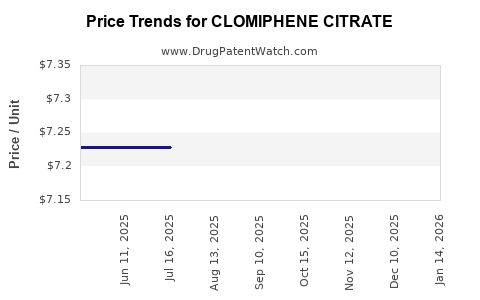
Average Pharmacy Cost for CLOMIPHENE CITRATE
| Drug Name | NDC | Price/Unit ($) | Unit | Date |
|---|---|---|---|---|
| CLOMIPHENE CITRATE 50 MG TAB | 16729-0723-44 | 5.08462 | EACH | 2026-07-22 |
| CLOMIPHENE CITRATE 50 MG TAB | 16729-0723-51 | 5.08462 | EACH | 2026-07-22 |
| CLOMIPHENE CITRATE 50 MG TAB | 64980-0690-01 | 5.08462 | EACH | 2026-07-22 |
| CLOMIPHENE CITRATE 50 MG TAB | 64980-0690-03 | 5.08462 | EACH | 2026-07-22 |
| CLOMIPHENE CITRATE 50 MG TAB | 64980-0690-90 | 5.08462 | EACH | 2026-07-22 |
| >Drug Name | >NDC | >Price/Unit ($) | >Unit | >Date |
Clomiphene Citrate: Market Analysis and Price Projections
This report analyzes the global market for clomiphene citrate, a selective estrogen receptor modulator (SERM) primarily used for ovulation induction in women and testosterone replacement therapy in men. The analysis includes current market drivers, patent landscape, competitive landscape, regulatory environment, and price projections to 2030.
What is Clomiphene Citrate and Its Primary Applications?
Clomiphene citrate is a non-steroidal triphenylethylene derivative. Its primary mechanism of action involves binding to estrogen receptors in the hypothalamus and pituitary gland, which downregulates negative feedback of estrogen. This leads to increased secretion of gonadotropin-releasing hormone (GnRH), follicle-stimulating hormone (FSH), and luteinizing hormone (LH) [1].
The drug's principal therapeutic applications are:
- Ovulation Induction: It is a first-line treatment for infertility in women with ovulatory dysfunction, including polycystic ovary syndrome (PCOS) [2]. By stimulating ovulation, it enhances the chances of conception.
- Hypogonadotropic Hypogonadism (Male Infertility): Clomiphene citrate is used off-label in men to stimulate spermatogenesis and increase testosterone levels by enhancing LH and FSH release from the pituitary gland [3].
Other less common or investigational uses include management of gynecomastia and certain types of breast cancer.
What are the Key Market Drivers for Clomiphene Citrate?
Several factors are driving the global demand for clomiphene citrate:
- Rising Infertility Rates: Global infertility rates have been increasing due to factors such as delayed childbearing, lifestyle changes, environmental factors, and rising incidences of conditions like PCOS [4]. This directly fuels demand for ovulation induction therapies.
- Growing Awareness and Access to Fertility Treatments: Increased awareness about fertility options and greater accessibility to assisted reproductive technologies (ART) are expanding the market for drugs like clomiphene citrate.
- Off-Label Use in Male Hypogonadism: The increasing diagnosis and treatment of male hypogonadism, often linked to lifestyle factors and aging populations, is contributing to the off-label use and market growth of clomiphene citrate as a testosterone-boosting agent [3].
- Cost-Effectiveness: Compared to more advanced ART procedures such as in vitro fertilization (IVF), clomiphene citrate offers a more affordable and less invasive treatment option for many patients, making it a preferred choice, especially in regions with limited healthcare budgets [5].
- Generic Availability: The availability of numerous generic versions of clomiphene citrate has made it widely accessible and affordable, further contributing to its market penetration.
What is the Patent Landscape for Clomiphene Citrate?
Clomiphene citrate is a well-established drug with its original patents long expired. The primary patents covering the synthesis and initial therapeutic uses of clomiphene citrate were granted in the mid-20th century. For instance, the original U.S. patent for clomiphene was filed in the 1950s.
Key aspects of the patent landscape:
- Expired Core Patents: The fundamental patents for clomiphene citrate have expired, allowing for widespread generic manufacturing and sales.
- Limited Novel Patenting Activity: There is minimal activity in patenting new chemical entities or novel formulations of clomiphene citrate itself. Research and development are more focused on new indications or combination therapies.
- Focus on Manufacturing Processes and Formulations: Any recent patent filings are more likely to pertain to specific manufacturing processes, improved polymorphic forms, or novel drug delivery systems designed to enhance bioavailability, reduce side effects, or simplify administration. However, these are less likely to create significant market exclusivity against existing generic products.
- Exclusivity for Branded Products: While the core drug is off-patent, any specific branded formulations (e.g., Clomid®, Serophene®) may have had some limited patent protection on their specific formulations or manufacturing methods which have also largely expired or are nearing expiration.
Table 1: Clomiphene Citrate Patent Status Summary
| Patent Category | Status | Impact on Market |
|---|---|---|
| Original Composition of Matter | Expired | Open for generic competition |
| Primary Therapeutic Uses | Expired | Open for generic competition |
| Manufacturing Processes | Varied (some expired, some active for specific methods) | Limited impact on broad market entry; can affect specific producers |
| Novel Formulations | Limited active filings; some expired | Minimal impact on market unless breakthrough formulation |
Who are the Key Players in the Clomiphene Citrate Market?
The clomiphene citrate market is characterized by a fragmented landscape dominated by generic manufacturers. The market is not driven by a few large pharmaceutical companies holding significant market share for the active pharmaceutical ingredient (API) or finished dosage forms, but rather by numerous generic producers globally.
Major Market Participants (API and Finished Dosage Forms):
- Generic Pharmaceutical Manufacturers: These companies form the backbone of the market, producing both the API and finished tablets. Examples include companies operating across North America, Europe, Asia, and Latin America.
- Asia-Pacific: India and China are significant producers of clomiphene citrate API due to lower manufacturing costs and strong chemical synthesis capabilities. Companies like Sun Pharmaceutical Industries, Cipla, and Dr. Reddy's Laboratories (though not exclusively clomiphene citrate focused) are representative of the type of players in these regions.
- North America and Europe: While also having generic manufacturers, the focus here might be more on finished dosage forms and distribution, with some API sourcing from Asia. Companies like Teva Pharmaceutical Industries, Mylan (now Viatris), and numerous smaller regional generic players.
- Branded Product Holders (Historical/Niche):
- Sanofi: Previously held rights to branded clomiphene citrate products like Clomid®. Their market presence for clomiphene citrate has diminished with the rise of generics.
- Other Regional/Specialty Brands: Various smaller companies may market clomiphene citrate under different brand names in specific geographic regions.
- Contract Manufacturing Organizations (CMOs): Several CMOs are involved in the synthesis of clomiphene citrate API or the manufacturing of finished dosage forms for other pharmaceutical companies.
The competitive intensity is high due to the generic nature of the drug, leading to price-based competition. Market share is distributed across a large number of entities, with no single company dominating the global market.
What is the Current Regulatory Environment for Clomiphene Citrate?
Clomiphene citrate is approved for marketing in many countries worldwide by major regulatory bodies, including the U.S. Food and Drug Administration (FDA), the European Medicines Agency (EMA), and others.
Key Regulatory Considerations:
- Approval Status: Approved for ovulation induction in women by most major health authorities. Its use in men for hypogonadism is often considered off-label, though it is widely prescribed for this indication.
- Manufacturing Standards: Manufacturers must adhere to Good Manufacturing Practices (GMP) to ensure product quality, safety, and efficacy. Regulatory agencies conduct regular inspections of manufacturing facilities.
- Labeling and Prescribing Information: Prescribing information must detail indications, contraindications, warnings, precautions, adverse reactions, and drug interactions. Specific warnings often include the risk of multiple pregnancies, ovarian hyperstimulation syndrome (OHSS), and visual disturbances.
- Controlled Substance Status: Clomiphene citrate is not typically a controlled substance, but its prescription status varies by country, generally requiring a prescription from a qualified healthcare professional.
- Post-Marketing Surveillance: Regulatory bodies mandate post-marketing surveillance to monitor for adverse events and ensure continued safety.
- Generic Drug Approval Pathways: Generic manufacturers must demonstrate bioequivalence to the reference listed drug to gain approval in most markets.
Table 2: Regulatory Approvals and Requirements
| Aspect | Description |
|---|---|
| Approving Agencies | FDA (USA), EMA (Europe), MHRA (UK), Health Canada, TGA (Australia), PMDA (Japan), etc. |
| Primary Indication | Ovulation induction in women with ovulatory dysfunction. |
| Off-Label Use | Widely used for male hypogonadism; requires physician discretion and appropriate informed consent. |
| Quality Standards | Adherence to GMP, pharmacopeial standards (USP, EP, JP). |
| Prescription Status | Prescription-only drug in most jurisdictions. |
| Risk Management | Mandatory inclusion of boxed warnings (e.g., OHSS, multiple pregnancy) and other safety information. |
What are the Price Trends and Projections for Clomiphene Citrate?
The pricing of clomiphene citrate is heavily influenced by its status as an off-patent, widely available generic drug.
Current Pricing Dynamics:
- Low Cost of API: The cost of manufacturing the clomiphene citrate API is relatively low, especially in regions with established generic API production.
- Intense Generic Competition: The high number of generic manufacturers leads to significant price competition for both API and finished dosage forms.
- Geographic Variations: Prices can vary significantly by country due to local market dynamics, distribution costs, regulatory fees, and local competition.
- Formulation and Dosage: While standard 50mg and 100mg tablets are most common, any specific novel formulations or extended-release versions, if they emerge, could command premium pricing, though currently, such significant innovations are rare.
- Wholesale vs. Retail: Wholesale prices for clomiphene citrate tablets are generally very low, often in the range of $0.10 to $0.50 per tablet. Retail prices can be higher, depending on insurance coverage, pharmacy markups, and geographic location.
Price Projections to 2030:
The market for clomiphene citrate is expected to remain stable, with gradual price erosion or marginal increases driven by inflation and manufacturing costs rather than by significant market growth or patent-driven price hikes.
- Price Stability with Slight Erosion: The average selling price (ASP) of clomiphene citrate is projected to remain relatively stable. A slight downward trend in real terms (adjusted for inflation) is possible due to ongoing competition, particularly in well-established generic markets.
- Inflationary Pressures: Manufacturing and raw material costs, influenced by global economic conditions and energy prices, may exert slight upward pressure on absolute prices.
- Demand Stability: The consistent demand for fertility treatments and management of male hypogonadism will underpin the market, preventing drastic price drops.
- Emerging Markets: As healthcare access improves in emerging economies, clomiphene citrate's affordability will drive its adoption, potentially creating localized demand growth, but global pricing is unlikely to be significantly impacted.
- No Major Disruptions Expected: Without significant new patent filings for novel clomiphene citrate applications or breakthrough formulations, no major price increases are anticipated. The drug's utility is well-understood, and alternative treatments, while more expensive, exist for specific patient populations.
Projected Price Range (Average Wholesale Price per Tablet):
- 2024: $0.15 - $0.40
- 2027: $0.14 - $0.38
- 2030: $0.14 - $0.36
Note: These are average wholesale price ranges and do not reflect retail prices or prices in highly specific or regulated markets.
Table 3: Clomiphene Citrate Price Projection (Average Wholesale Price per Tablet)
| Year | Projected ASP Range (USD) | Key Influencing Factors |
|---|---|---|
| 2024 | $0.15 - $0.40 | Current generic competition, manufacturing costs |
| 2027 | $0.14 - $0.38 | Sustained competition, slight inflationary pressures |
| 2030 | $0.14 - $0.36 | Mature generic market, continued stable demand |
What are the Key Takeaways?
- Clomiphene citrate is a vital, cost-effective treatment for infertility and male hypogonadism, with demand supported by rising infertility rates and increased awareness of hormonal therapies.
- The drug's market is entirely generic, with core patents having expired decades ago, leading to intense price competition among numerous global manufacturers, primarily from Asia.
- Regulatory oversight ensures product quality and safety, with approved indications focusing on ovulation induction, while off-label use in men is widespread.
- Price projections indicate continued stability with a slight downward trend due to sustained generic competition, moderated by manufacturing costs and stable demand, with no significant price escalations anticipated.
Frequently Asked Questions
Is clomiphene citrate still considered a first-line treatment for infertility?
Yes, clomiphene citrate remains a first-line therapy for ovulation induction in women with ovulatory dysfunction, including PCOS, due to its efficacy, affordability, and oral administration.
What are the primary risks associated with clomiphene citrate use?
The primary risks include the potential for multiple pregnancies (twins, triplets), ovarian hyperstimulation syndrome (OHSS), and visual disturbances. Patients require careful monitoring by healthcare professionals.
Are there significant differences in efficacy between various generic brands of clomiphene citrate?
As long as generic brands meet bioequivalence standards set by regulatory agencies like the FDA, their efficacy is considered comparable to the reference drug and other generic brands. Differences may arise from excipients or minor manufacturing variations, but these typically do not impact clinical outcomes significantly.
Can clomiphene citrate be used for long-term testosterone replacement?
While clomiphene citrate can increase testosterone levels in men with hypogonadism, it is generally not considered a primary long-term testosterone replacement therapy. It works by stimulating the body's own hormone production. For men with permanent pituitary or testicular failure, exogenous testosterone therapy might be more appropriate.
What is the projected market growth rate for clomiphene citrate?
The market for clomiphene citrate is expected to exhibit low single-digit growth, driven by stable demand from its established indications and increasing adoption in emerging markets, rather than by significant expansion into new therapeutic areas or novel product launches.
Cited Sources
[1] Adashi, E. Y., & Rock, J. A. (1998). Medical therapy of ovulatory dysfunction. In Gynecology and Obstetrics (Vol. 3, pp. 1-13). JB Lippincott.
[2] American College of Obstetricians and Gynecologists. (2017). Committee Opinion No. 725: The Use of Oral Selective Estrogen Receptor Modulators for the Induction of Ovulation. Obstetrics & Gynecology, 130(4), e156-e161.
[3] Shabsigh, R., & Kang, J. (2007). Off-label use of clomiphene citrate for male hypogonadism. Journal of Urology, 178(3), S50-S54.
[4] Global Nutrition Report. (2023). Global Nutrition Report 2023: Transformative choices for food, health and the planet. International Food Policy Research Institute.
[5] Practice Committee of the American Society for Reproductive Medicine. (2006). Role of ovulation induction in anovulatory infertility. Fertility and Sterility, 85(Supplement 1), S307-S315.
More… ↓
