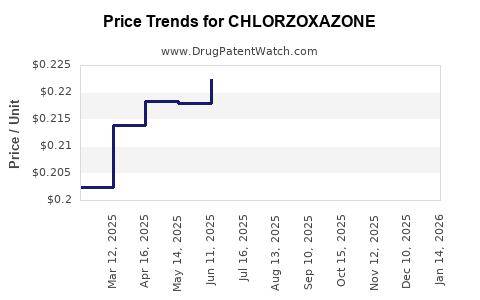
Last updated: August 24, 2026
Chlorzoxazone is a mature, low-cost skeletal-muscle relaxant with limited commercial differentiation, minimal patent protection, and no publicly reported standalone revenue. Its market is driven by generic availability, regional prescribing practices, price, and continued use for short-term relief of painful musculoskeletal conditions. Financial upside is limited, while supply continuity and manufacturing economics determine commercial performance.
What is the current FDA status of chlorzoxazone?
Chlorzoxazone is an FDA-approved prescription skeletal-muscle relaxant used as an adjunct to rest, physical therapy, and other measures for acute painful musculoskeletal conditions. U.S. products are generally supplied as 250 mg and 500 mg tablets. The FDA labeling identifies chlorzoxazone as a centrally acting agent, with a warning for rare but serious hepatotoxicity.[1]
| Item |
Status |
| Active ingredient |
Chlorzoxazone |
| Therapeutic class |
Centrally acting skeletal-muscle relaxant |
| U.S. dosage forms |
Immediate-release tablets, generally 250 mg and 500 mg |
| Prescription status |
Prescription-only |
| Primary use |
Short-term treatment of painful musculoskeletal conditions |
| FDA pathway |
Legacy NDA and subsequent abbreviated generic approvals |
| Biologic status |
Not applicable |
| Biosimilar pathway |
Not applicable |
| Controlled-substance status |
Not federally scheduled |
| Key safety issue |
Rare serious liver injury |
| Current commercial model |
Generic, multi-manufacturer supply |
DailyMed contains current U.S. labeling for chlorzoxazone tablets marketed by generic manufacturers.[1] Product availability can vary by manufacturer, wholesaler inventory, and national drug shortages.
How large is the chlorzoxazone market?
The market is small relative to newer muscle relaxants and is fragmented across low-priced generic products. Public companies do not usually report chlorzoxazone revenue separately, so a reliable global market value cannot be derived from company filings.
Commercial demand is shaped by five factors:
- Continued treatment of acute back pain, neck pain, strains, and spasms.
- Low generic acquisition cost.
- Physician familiarity in markets where chlorzoxazone remains established.
- Competition from cyclobenzaprine, tizanidine, methocarbamol, baclofen, and carisoprodol.
- Safety concerns involving liver injury and central nervous system effects.
Chlorzoxazone has a narrower commercial profile than the largest generic muscle relaxants. It is prescribed primarily where clinicians and formularies retain familiarity with the product. In the United States, the drug competes in a mature market with limited promotional investment and little opportunity to build premium pricing.
Which regions have the strongest commercial demand?
Demand is likely concentrated in markets where chlorzoxazone has long-standing regulatory recognition and is included in local treatment practice. The United States, India, selected Middle Eastern markets, and parts of Asia have historically had commercial availability, but product registration and market share differ by jurisdiction.
International revenue is difficult to compare because:
- Brand names differ by country.
- Products may be sold through private pharmacies or hospital channels.
- Some markets use combination products.
- Regulatory databases do not consistently publish sales data.
- Generic manufacturers may distribute through local licensees.
The product’s geographic opportunity is therefore a registration and distribution question rather than a patent-expansion opportunity.
When does chlorzoxazone lose exclusivity?
Chlorzoxazone lost meaningful U.S. market exclusivity decades ago. The active ingredient was introduced in the 1950s, and generic competition has existed for many years. Any original composition-of-matter protection has expired.
| Exclusivity category |
Current position |
| Original active-ingredient patent |
Expired |
| New chemical entity exclusivity |
Expired |
| Original brand exclusivity |
Expired |
| Generic market exclusivity |
No current strategic significance identified |
| Pediatric exclusivity |
No material current protection identified |
| Orphan exclusivity |
Not applicable |
| Patent term extension |
No commercially relevant current protection identified |
The principal commercial question is not when exclusivity ends. It is whether a manufacturer can maintain reliable supply at acceptable margins.
What patents protect chlorzoxazone?
No active U.S. patent estate is generally associated with the basic chlorzoxazone molecule. The original molecule is old, and the commercial product is a conventional immediate-release tablet.
Potential patent categories include:
- Historical composition-of-matter patents, which are expired.
- Manufacturing-process patents, if separately developed and still enforceable.
- Formulation patents, if a manufacturer creates a novel delivery system.
- Use patents, if a sponsor develops a patentable indication or dosing regimen.
- Packaging or device patents, which have limited relevance for standard tablets.
No widely recognized Orange Book patent barrier currently protects routine chlorzoxazone tablets. FDA Orange Book searches should be performed by product, applicant, dosage form, and strength because legacy approvals and applicant names can differ.[2]
How strong is the patent estate for chlorzoxazone?
The patent estate is weak for conventional products.
| Patent-risk factor |
Assessment |
| Composition-of-matter protection |
None of practical current value |
| Standard tablet formulation |
Low protection |
| Method-of-use protection |
No broadly recognized blocking position |
| Manufacturing know-how |
Potentially relevant but difficult to assess publicly |
| Litigation leverage |
Low |
| Generic substitution risk |
High |
| Premium pricing support |
Minimal |
A differentiated formulation could create a new patent position, but it would require clinical, regulatory, and commercial investment that may be disproportionate to the size of the underlying market.
What is the Orange Book status of chlorzoxazone?
Chlorzoxazone products may appear in FDA approval and labeling systems under different applicants and product identifiers. Orange Book relevance is limited because the molecule is an old generic active ingredient and does not have a known current patent thicket comparable to products such as extended-release branded medicines.[2]
For a prospective abbreviated new drug application, the key regulatory issues are likely to include:
- Reference listed drug selection.
- Bioequivalence for the applicable tablet strength.
- Product quality and dissolution.
- Labeling consistency.
- Manufacturing-site compliance.
- Drug Master File support for the active pharmaceutical ingredient.
A Paragraph IV challenge would have limited commercial value unless directed at a newly developed formulation, method of use, or other narrow patent. A conventional chlorzoxazone tablet does not present the same litigation economics as a recently approved small-molecule brand.
Which companies are challenging chlorzoxazone patents?
No major, publicly prominent Paragraph IV litigation campaign is associated with conventional chlorzoxazone tablets. The generic market is already established, and the drug does not have a high-value remaining patent position that would justify extensive challenger litigation.
Potential entrants would more likely file ordinary ANDAs or seek approval in non-U.S. jurisdictions without publicizing a patent dispute. Litigation risk is therefore operational rather than intellectual-property driven:
- FDA inspection findings.
- Product recalls.
- Manufacturing interruptions.
- API contamination or quality failures.
- Labeling disputes.
- Distribution-contract termination.
What formulations are protected by chlorzoxazone patents?
The standard immediate-release tablet is not generally protected by an active, commercially important formulation patent. A new formulation could include:
- Modified release.
- Fixed-dose combinations.
- Abuse-deterrent delivery.
- Improved hepatic-safety positioning.
- Pediatric or liquid formulations.
- Topical or localized delivery.
Each concept would face a different development burden. Modified-release or alternative-delivery products would need pharmacokinetic and potentially clinical evidence. A fixed-dose combination would need justification that the combination improves treatment or adherence. A topical formulation could reduce systemic exposure but would require proof of adequate local delivery.
The most plausible route to commercial differentiation would be a reformulated product with a clinically meaningful safety or convenience advantage. Even then, the addressable market would remain limited unless reimbursement and prescriber adoption supported a premium price.
Are there method-of-use patents for chlorzoxazone?
No broadly recognized, commercially blocking method-of-use patent position is associated with established chlorzoxazone use for acute painful musculoskeletal conditions. The core indication is old and medically conventional.
Potential future method-of-use strategies could target:
- A defined pain subtype.
- A specific treatment duration.
- Combination treatment with an anti-inflammatory agent.
- A patient population with documented treatment benefit.
- A reduced-dose regimen intended to limit adverse effects.
Such claims would face validity and infringement challenges because chlorzoxazone has a long history of use. Patentability would depend on new clinical evidence and claim specificity.
How does chlorzoxazone compare with competing muscle relaxants?
Chlorzoxazone competes mainly on generic price and familiarity rather than clinical novelty.
| Drug |
Commercial position |
Key competitive characteristic |
| Chlorzoxazone |
Mature generic |
Low price, legacy use, liver-safety concern |
| Cyclobenzaprine |
Large established generic market |
Broad prescribing familiarity |
| Methocarbamol |
Established generic |
Strong primary-care and emergency-care presence |
| Tizanidine |
Established generic |
Use in spasticity and muscle spasm |
| Baclofen |
Established generic |
Stronger position in spasticity |
| Carisoprodol |
Generic but more restricted |
Abuse and dependence concerns |
| Orphenadrine |
Regional and legacy use |
Anticholinergic tolerability considerations |
Chlorzoxazone’s competitive disadvantage is that clinicians have multiple low-cost alternatives. Its advantage is continued recognition in markets where it is already part of prescribing practice.
What is the financial trajectory for chlorzoxazone?
The financial trajectory is best characterized as stable-to-declining unit economics with occasional supply-driven price volatility.
Revenue profile
No major manufacturer publicly reports chlorzoxazone revenue as a standalone line item. The product is typically embedded in broader generic portfolios. Financial performance is therefore assessed through market structure rather than company-specific revenue disclosure.
| Financial variable |
Expected direction |
| Unit demand |
Stable or gradually declining in mature markets |
| Average selling price |
Low, with periodic supply-related volatility |
| Gross margin |
Thin for commoditized tablets |
| Promotional spending |
Minimal |
| Patent-related margin |
None of practical significance |
| Manufacturing importance |
High |
| Revenue concentration |
Distributed across generic suppliers |
| Investor relevance |
Low unless linked to a broader generic platform |
Manufacturers can improve returns through low-cost API sourcing, efficient tablet production, contract manufacturing, and reliable wholesaler access. Margins can deteriorate quickly if several suppliers compete for the same tenders or pharmacy contracts.
What factors could improve revenue?
Revenue growth would require one of four developments:
- A supply disruption affecting competing manufacturers.
- Entry into an underpenetrated geographic market.
- A differentiated formulation with regulatory approval.
- A fixed-dose combination that earns stronger prescribing or reimbursement.
The first factor can increase short-term prices but is not a durable growth strategy. The third and fourth require clinical and regulatory investment that may not be justified by the base product’s modest market size.
What factors could reduce revenue?
Downside risks include:
- Further substitution by cyclobenzaprine or methocarbamol.
- Greater clinician concern about hepatotoxicity.
- Formulary removal.
- API or excipient shortages.
- FDA manufacturing enforcement.
- Pharmacy consolidation and purchasing pressure.
- Reduced use of skeletal-muscle relaxants for acute pain.
- Competition from nonpharmacologic treatment and newer pain-management protocols.
What generic launch scenarios exist for chlorzoxazone?
Base case
Existing generic manufacturers continue supplying 250 mg and 500 mg tablets. Prices remain low, volumes remain fragmented, and no major patent litigation occurs.
Upside case
A manufacturer secures a differentiated formulation, combination product, or new geographic registration. Revenue increases through product differentiation rather than the legacy tablet.
Downside case
Manufacturing exits or quality problems reduce supplier count. Short-term prices rise, but sustained demand declines as prescribers shift to alternative muscle relaxants.
Generic entry risk
For a branded or reformulated chlorzoxazone product, generic-entry risk would be high because:
- The active ingredient is old.
- The therapeutic category has multiple substitutes.
- Standard tablet manufacturing is technically accessible.
- Patent protection for the basic molecule is not a meaningful barrier.
- Payers generally favor low-cost alternatives.
What manufacturing and intellectual-property barriers exist?
Manufacturing barriers are moderate at the operational level but low at the scientific level. Chlorzoxazone tablets do not require complex biologic production, specialized delivery devices, or advanced cell-based manufacturing.
The relevant barriers are:
- Qualified API supply.
- Consistent impurity control.
- Dissolution and content uniformity.
- FDA-compliant manufacturing.
- Stability data.
- Reliable packaging and distribution.
- Regulatory maintenance across jurisdictions.
Intellectual-property barriers are limited. A company with an efficient manufacturing network can compete, but a company relying on premium pricing without product differentiation is unlikely to sustain attractive margins.
What licensing deals affect chlorzoxazone?
No major recent licensing transaction is widely associated with the conventional chlorzoxazone tablet market. Commercial arrangements are more likely to involve:
- Local marketing rights.
- Contract manufacturing.
- API supply agreements.
- Regional registrations.
- Private-label distribution.
- Hospital or tender contracts.
These transactions are usually not disclosed in public filings unless material to the seller or buyer. The absence of a prominent licensing event is consistent with the product’s mature generic status.
What patent litigation affects chlorzoxazone?
No major active patent litigation is broadly associated with conventional chlorzoxazone products. The more relevant legal risks are product liability, labeling, quality, and regulatory enforcement.
The FDA label warns that chlorzoxazone can cause rare but serious liver injury. Manufacturers must maintain compliant labeling and pharmacovigilance systems.[1] A safety-driven regulatory action could affect the entire category more than a patent dispute involving one supplier.
Key Takeaways
- Chlorzoxazone is a mature generic skeletal-muscle relaxant with low commercial differentiation.
- Original molecule and brand exclusivity have expired.
- Conventional 250 mg and 500 mg tablets have no widely recognized current patent barrier.
- Orange Book and Paragraph IV issues are limited compared with newer branded drugs.
- Biosimilar risk is not applicable because chlorzoxazone is a small molecule.
- Standalone revenue is not publicly reported by major manufacturers.
- Financial performance depends on manufacturing cost, supply reliability, tender access, and regional demand.
- The principal commercial opportunity is a differentiated formulation or geographic expansion.
- The principal downside risks are substitution, hepatotoxicity concerns, supplier exits, and generic price compression.
- Patent strength is low; operational execution is more important than intellectual-property protection.
FAQs
Is chlorzoxazone still commercially available in the United States?
Yes. U.S. availability exists through generic prescription products, although stock can vary by manufacturer, wholesaler, and pharmacy.
Is chlorzoxazone a high-revenue pharmaceutical product?
No. It is generally a low-revenue generic product, and manufacturers do not usually disclose it as a separate revenue category.
Can a company obtain new patents on chlorzoxazone?
Potentially, but protection would likely require a novel formulation, delivery system, combination, manufacturing process, or narrowly defined method of use. The basic molecule cannot support new composition-of-matter exclusivity.
Does chlorzoxazone face biosimilar competition?
No. Biosimilars apply to biologic products. Chlorzoxazone is a conventional small-molecule drug and competes through generic drug approval pathways.
What is the main investment risk in chlorzoxazone?
The main risk is weak pricing power. A manufacturer can face margin erosion from generic competition, limited prescriber differentiation, supply costs, and substitution by other skeletal-muscle relaxants.
References
- DailyMed. (n.d.). Chlorzoxazone tablet: U.S. prescribing information. U.S. National Library of Medicine. https://dailymed.nlm.nih.gov/dailymed/search.cfm?query=chlorzoxazone
- U.S. Food and Drug Administration. (n.d.). Approved drug products with therapeutic equivalence evaluations: Orange Book. https://www.accessdata.fda.gov/scripts/cder/ob/index.cfm