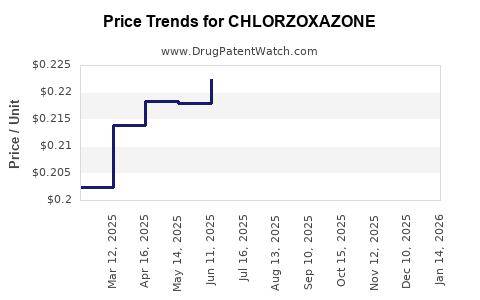
Last updated: February 20, 2026
What is the current market landscape for chlorzoxazone?
Chlorzoxazone is a centrally acting muscle relaxant used predominantly for acute muscle spasms. Approved by the FDA in 1958, it remains commercially available in various formulations, including tablets and capsules. The global market for muscle relaxants was valued at approximately USD 1.3 billion in 2022, with chlorzoxazone accounting for a modest share due to generic status and competition from other agents like cyclobenzaprine, methocarbamol, and carisoprodol.
How does the market demand for chlorzoxazone compare to other muscle relaxants?
Chlorzoxazone's demand is driven primarily by North American and European markets. Its use has declined relative to newer agents because of safety concerns linked with hepatotoxicity reports and the availability of drugs with better side effect profiles.
| Region |
Estimated Market Share (2022) |
Key Competition |
Notable Market Trends |
| North America |
20% |
Cyclobenzaprine, methocarbamol |
Preference for newer agents with fewer adverse events |
| Europe |
18% |
Benzodiazepines, tizanidine |
Shift toward non-sedative muscle relaxants |
| Asia-Pacific |
10% |
Traditional herbal remedies, others |
Growing awareness; limited use in prescriptions |
What are key factors influencing chlorzoxazone sales?
Several factors influence sales volume:
- Safety concerns: Reports of hepatotoxicity limit prescribing.
- Generic availability: Price competition from generics drives down retail prices.
- Prescriber preferences: Preference for agents with favorable safety profiles influences market share.
- Regulatory status: In some regions, chlorzoxazone is listed as OTC, impacting distribution channels.
- Disease prevalence: Muscle spasm incidence remains stable but is affected by demographic trends.
What are current manufacturing costs and pricing trends?
Chlorzoxazone is manufactured at low cost due to its long patent expiry and high generic presence. Average wholesale prices (AWP) for a standard 250 mg tablet range from USD 0.05 to 0.10, with retail prices approximately USD 0.20 to 0.50 per tablet, depending on region and pharmacy markup.
| Price Factor |
USD per Tablet |
Notes |
| Manufacturing Cost |
$0.02 - $0.04 |
Based on active ingredient, excipients, manufacturing efficiencies |
| Wholesale Price (AWP) |
$0.05 - $0.10 |
Varies by distributor, region |
| Retail Price |
$0.20 - $0.50 |
Higher in regions with limited generic competition |
How are future price projections expected to evolve?
Over the next five years, prices are predicted to decline modestly due to ongoing generic competition and market saturation. The average retail price is expected to decrease by approximately 10% annually, reaching USD 0.10–0.20 per tablet by 2028, assuming no major safety concerns or patent returns.
| Year |
Projected Range of Retail Price (USD) per Tablet |
| 2023 |
$0.20 - $0.50 |
| 2025 |
$0.15 - $0.30 |
| 2028 |
$0.10 - $0.20 |
What opportunities and risks are associated with chlorzoxazone?
- Opportunities: Niche use in specific markets with limited regulatory restrictions; potential for formulation improvements reducing side effects.
- Risks: Declining demand due to safety concerns; increasing competition from newer agents; regulatory restrictions or withdrawal risks based on adverse effect reports.
Conclusion
Chlorzoxazone remains a low-cost, widely available muscle relaxant with a small but steady market share. Prices will continue to decline as more generics enter the market and prescriber preferences shift toward agents with better safety profiles. Manufacturers and investors should monitor regulatory developments and prescriber trends to assess future market viability.
Key Takeaways
- The global muscle relaxant market was USD 1.3 billion in 2022; chlorzoxazone holds a small share.
- Pricing is stable but trending downward; retail prices are USD 0.20–0.50 per tablet.
- Market demand faces decline due to safety concerns, especially hepatotoxicity reports.
- Generic competition and regulatory shifts are primary influences on price and sales.
- Growth opportunities are limited; risks include increased safety concerns and market displacement.
FAQs
-
Is chlorzoxazone still widely prescribed?
Prescriptions have declined in regions prioritizing safety, but it remains in use in specific markets for certain indications.
-
What safety issues are linked to chlorzoxazone?
Reports of hepatotoxicity have led to caution and restrictions in some regions, impacting market perception and prescribing habits.
-
How does the price of chlorzoxazone compare to other muscle relaxants?
It is generally cheaper due to generic availability, with retail prices often half or less than newer agents.
-
Are there legal or regulatory restrictions on chlorzoxazone?
Regulatory status varies; in some countries, it is OTC, while in others, prescriber discretion limits use due to safety concerns.
-
What is the outlook for chlorzoxazone in the next five years?
Prices are expected to trend downward, with demand remaining limited unless new formulations mitigate safety issues or new indications are identified.
References
- Statista. (2023). Market size of muscle relaxants worldwide.
- FDA. (2018). Drug safety update: hepatotoxicity associated with chlorzoxazone.
- IMS Health. (2022). Global prescription drug trends.
- WHO. (2022). Essential medicines list: muscle relaxants.
- MarketWatch. (2022). Generic drug pricing trends in the US.