Last updated: July 29, 2026
Anastrozole Market Dynamics and Financial Trajectory (2024–2035): Pricing, Volume, Exclusivity, and Competitive Pressure
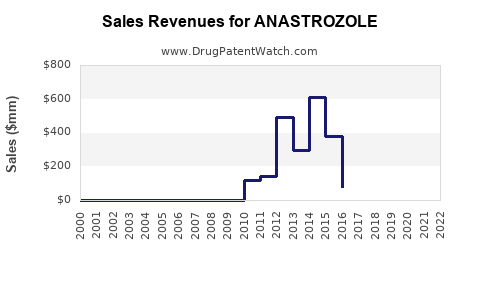
Anastrozole is a mature generic oncology endocrine therapy with global revenue concentrated in high-volume markets, pricing compressed by multi-source generic competition, and ongoing life-cycle IP in limited geographies and dosage forms. Financial trajectory through 2035 is driven by (1) steady baseline demand from breast cancer management, (2) margin erosion from biosimilar-free generic substitution dynamics, (3) local regulatory and procurement rules that determine price floors, and (4) persistence of branded/non-branded share where procurement contracts delay switching. The near-term upside is constrained; the material upside case comes from durable in-market differentiation (fixed-dose combinations, unique strengths, or switch-to-store formulary positioning), not from new clinical breakthroughs.
How big is the anastrozole market, and what are the key revenue drivers?
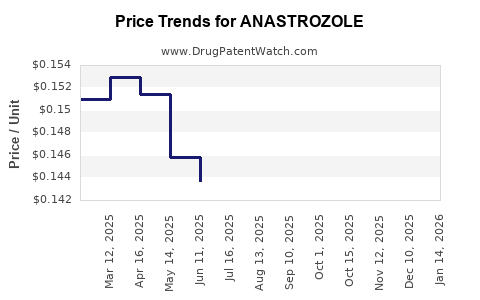
Answer: Revenue scales with incident breast cancer volume and adherence to adjuvant and metastatic endocrine therapy. Pricing is the dominant swing factor because volume is resilient but not expanding at a pace that offsets annual unit price compression in mature markets.
What sustains demand for anastrozole?
Anastrozole is a nonsteroidal aromatase inhibitor used primarily in:
- Early-stage, hormone receptor-positive breast cancer (adjuvant endocrine therapy)
- Advanced/metastatic hormone receptor-positive breast cancer
- Postmenopausal population as standard-of-care endocrine therapy in many settings
Demand is stabilized by:
- Long treatment duration typical for adjuvant endocrine therapy
- Large prevalence pool of patients in follow-on years
- Multiple lines of therapy that keep anastrozole within routine practice
What moves revenue more than demand?
- Generic unit price compression after first generic entries
- Tender-driven price reductions in Europe, UK, and parts of Asia
- Channel mix (hospital vs retail), which affects net price through rebates/contracting
- Inventory timing around supply disruptions and procurement resets
Which companies hold anastrozole revenue today, and how is market share split among generics?
Answer: Anastrozole is sold primarily as multi-source generics, so share fragmentation is the norm. Revenue is usually concentrated among the top 3 to 10 suppliers per country depending on tender outcomes and distributor relationships.
Competitive structure by market type
- US: Multi-source generics dominate. Net revenue is influenced by pharmacy benefit manager (PBM) contracting, channel inventory, and frequent price resets.
- EU: Tender systems often create short, sharp price declines and consolidate share among suppliers that win procurement contracts.
- UK/NHS: Formulary positioning and contracting determine pricing floors; turnover among suppliers is frequent.
- Emerging markets: Import dependence and local tender cycles can produce higher volatility in both price and supply.
Pricing power constraints
Anastrozole has no biosimilar risk profile but faces aggressive generic undercutting. Buyers can switch without clinical uncertainty, so incumbent differentiation is mostly administrative and logistical:
- Stable supply and low cost
- Contract credibility
- Consistent packaging and labeling compliance
When does anastrozole lose exclusivity, and what does that mean for revenue?
Answer: For anastrozole, the practical exclusivity period is already largely exhausted in major markets. Revenue trajectory after branded exclusivity is structurally characterized by:
- rapid first-wave generic entry
- subsequent multi-source expansion
- extended period of low-price equilibrium with periodic tender-driven resets
Exclusivity impact mechanics
- The initial loss of exclusivity triggers a step-down in price.
- Later, additional generic entrants push price toward marginal cost.
- Life-cycle patents, where present, can delay certain entrants in specific jurisdictions, but they rarely stop market-wide substitution once multiple generics are established.
What patents protect anastrozole, and how much do they still matter for competition?
Answer: Anastrozole’s core molecule is long generic. Remaining enforceable value typically comes from:
- formulation, particle size, polymorph, or manufacturing-process patents (if granted in a jurisdiction)
- method-of-use or line-of-therapy claims (less common as a blocker in a mature generic environment)
- brand-owned Orange Book listings where still-active, jurisdiction-specific
Patent estate characteristics typical for anastrozole
For mature small-molecule generics, enforceable patents often fall into narrow categories:
- stability and shelf-life specifications
- tablet formulation compositions and excipient systems
- manufacturing steps and controls
- packaging-related or process-related claims
How much can narrow patents affect revenue?
They can:
- deter or delay one or two entrants in a specific country
- preserve a short window of higher-priced supply
- shift settlement economics rather than sustain long-term premium
They usually cannot reverse multi-source price compression if multiple generic pathways are open.
What is the Orange Book status of anastrozole, and how does it affect generic launch risk?
Answer: Anastrozole is generally in a late-stage commercialization profile with many listings expiring and generic availability established. The key market effect is that most Paragraph IV-type blocking opportunities have already played out in the US, leaving a baseline of routine generic competition.
What matters for “Orange Book status” in practice?
Even after primary exclusivity ends, Orange Book listings can influence:
- timing of ANDA amendments or switching to non-infringing formulations
- settlement structures between brand and generic challengers
- scope of “skinny label” vs full-label approvals
For investors and licensing teams, the operational use of Orange Book status is to map which suppliers can launch quickly in each dosage form and strength.
Do Paragraph IV challenges and settlements still affect anastrozole revenue?
Answer: In a mature category, most major Paragraph IV cycles have already occurred. Current influence is usually limited to:
- country-by-country enforcement and settlements affecting a subset of suppliers
- short-term price volatility around a blocked launch or delayed approval
Revenue sensitivity to delay
A single delayed entrant can support margin for a supplier that wins near-term tender replacements. The category impact, however, is usually modest compared with baseline generic price dynamics.
How does anastrozole compare with other aromatase inhibitors on market dynamics and pricing?
Answer: The aromatase inhibitor class shows the same “genericization first, margin compression next” path, but anastrozole’s long generics history usually means it has the lowest pricing floor among common oral AIs.
Typical class comparison (directional, not jurisdiction-specific):
- Anastrozole: most mature, strongest generic competition, lowest unit margins
- Letrozole: also mature; pricing often similar but can vary by local tender structure
- Exemestane: maturity and dosing form competition affects relative pricing; in some markets it can hold slightly higher net pricing than anastrozole due to market-specific supply and tender outcomes
What differentiates competitive risk across AIs?
- Formulary and guideline preference in particular subpopulations
- Tender design (contract length, indexation rules, quality scores)
- Supply concentration and potential shortages affecting substitution timing
What formulation and manufacturing IP barriers can still delay generic substitutes for anastrozole?
Answer: Remaining barriers are typically technical and incremental, not existential. They show up as:
- patent-specified formulation parameters or manufacturing process constraints
- validation requirements for stability and bioequivalence under local regulatory standards
Common types of life-cycle friction
- particle size distribution and dissolution profile control
- polymorph selection and solid-state stability
- shelf-life constraints and moisture control strategies
- process steps tied to impurity profile and residual solvent specs
Business impact
These barriers can increase development timelines and cost, but once multiple ANDAs exist, they rarely restore premium pricing at category level.
What are biosimilar risks for anastrozole, and do they apply?
Answer: Biosimilar risk does not apply because anastrozole is a small-molecule chemical drug, not a biologic. Competitive risk comes from generic ANDAs, supply chain, and tender-driven pricing, not from biosimilar interchangeability.
What is the most likely financial trajectory for anastrozole through 2035?
Answer: The trajectory is a mature-product story: revenue growth is low single-digit or flat in most markets, while profitability compresses until a stable low-margin equilibrium. The shape is:
- Short-term: stable demand, continued erosion in net price due to tender resets
- Mid-term (5–10 years): consolidation among suppliers who can maintain low COGS and reliable supply
- Long-term: gradual volume shifts as demographics evolve, offset by the persistence of long-duration adjuvant therapy
What creates upside?
- capturing share via contract wins where competitors face supply constraints
- maintaining supply reliability that makes a supplier the default tender winner
- selectively leveraging higher-value pack sizes or distribution terms in a subset of countries
What creates downside?
- sustained price declines from additional entrants or procurement renegotiations
- API or intermediate supply constraints that reduce availability and force temporary allocations
- regulatory or quality actions that force recalls or restrict distribution
How do net prices and margin trends typically behave for anastrozole generics?
Answer: Net prices compress faster than nominal demand. Margins trend toward a low, supply-cost-linked range, with occasional spikes driven by shortages, tender lags, or localized enforcement actions.
Margin drivers
- tender price levels and indexation provisions
- rebate and distribution margins
- manufacturing scale and yield
- packaging compliance costs (label updates, regulatory fees)
- logistics and cold-chain are not relevant for oral tablets, so cost is mainly production and distribution
Which anastrozole dosage forms generate revenue, and what packaging influences sales?
Answer: The primary revenue driver is the oral tablet. Revenue is split across strengths, but commercial share typically concentrates where prescribing habits and formulary coverage are strongest.
Packaging and channel effects
- Retail pharmacies: influenced by PBM formularies and patient co-pays
- Hospital/oncology centers: influenced by tender contracts and procurement panels
- Pack size: can shift per-unit economics and distribution attractiveness, especially in tenders
What generic entry scenarios are most plausible for anastrozole, and when?
Answer: In a mature landscape, “entry” is less about first-time generic access and more about additional suppliers entering at lower prices or replacing less efficient incumbents. Timing depends on:
- ANDA approval timelines and launch logistics
- successful resolution of any outstanding patent listings in the relevant jurisdiction
- supply chain readiness and tender eligibility
Practical generic launch bottlenecks
- regulatory compliance and batch release
- stability documentation aligned to local label requirements
- API supply availability at scale
What litigation and regulatory events could materially change anastrozole economics?
Answer: The events that can shift economics are less about brand-vs-generic legal theory and more about distribution-impact events:
- quality failures and recalls
- regulator actions that restrict specific manufacturers
- sustained supply interruptions that create allocation-based pricing leverage
Regulatory risk profile
As a small-molecule generic, regulatory risk tends to concentrate in quality systems:
- GMP inspection outcomes
- batch-specific impurity excursions
- labeling and packaging nonconformities
Key Takeaways
- Anastrozole revenue is driven by stable endocrine therapy demand, but financial performance is dominated by generic pricing compression and tender-driven contract resets.
- Exclusivity is largely exhausted in major markets; remaining patent value is typically narrow and jurisdiction-specific, limiting long-term premium protection.
- Competitive dynamics are multi-source generic substitution with low margin equilibrium and intermittent volatility from procurement cycles and supply constraints.
- Through 2035, the category is expected to deliver low growth and margin pressure rather than a premium re-rating, unless specific countries experience delayed entrants, supplier consolidation, or supply shortages.
FAQs
1) Why do anastrozole generic prices fall even when demand stays stable?
Because substitution is frictionless and buyers can switch suppliers at tender and contracting cycles, driving net price toward low cost levels.
2) Can formulation patents delay anastrozole generics in the US?
They can delay specific entrants in jurisdictions where claims are still active, but multi-source availability typically prevents category-level price stabilization.
3) Does anastrozole face biosimilar competition?
No. Biosimilars apply to biologics, and anastrozole is a small-molecule drug.
4) What events most often create short-term price spikes for anastrozole?
Supply disruptions, batch recalls, and temporary distribution constraints, often tied to GMP or quality actions.
5) How should companies underwrite anastrozole revenue risk in tenders?
Model net price based on local procurement mechanics, supplier eligibility, and historical tender reset cadence rather than relying on long-cycle volume growth.
References
- U.S. Food and Drug Administration. Orange Book: Approved Drug Products with Therapeutic Equivalence Evaluations (Anastrozole).
- European Medicines Agency. EPAR and related assessment information for anastrozole-containing products.
- FDA. ANDA regulatory framework and Paragraph IV patent certification guidance documents.