Last updated: August 7, 2026
Acitretin is a mature, off-patent oral retinoid used primarily for severe psoriasis. Its commercial profile is defined by generic competition, strict reproductive-risk controls, low prescribing volume relative to biologic psoriasis therapies, and limited remaining intellectual-property protection. The branded product Soriatane has little strategic value as a growth asset, while generic manufacturers compete mainly on supply reliability, pharmacy access, and pricing.
What is the current FDA status of acitretin?
Acitretin is FDA-approved in capsule strengths of 10 mg, 17.5 mg, and 25 mg for the treatment of severe psoriasis in adults who are candidates for systemic therapy or phototherapy.[1]
| Attribute |
Acitretin status |
| Active ingredient |
Acitretin |
| Original U.S. brand |
Soriatane |
| Dosage form |
Oral capsule |
| FDA indication |
Severe psoriasis in adults |
| U.S. approval |
1996 |
| Original sponsor |
Hoffmann-La Roche |
| Current market structure |
Generic-dominated |
| Biosimilar exposure |
None |
| Prescription category |
Retinoid with major reproductive-risk restrictions |
| Orange Book role |
Reference listed drug and generic-equivalence reference |
The FDA label warns against pregnancy during treatment and for three years after discontinuation. Acitretin also carries risks involving hepatotoxicity, hyperlipidemia, skeletal abnormalities, intracranial hypertension, psychiatric effects, and pancreatitis.[1]
The three-year post-treatment pregnancy restriction is a major commercial and clinical barrier. It narrows the addressable population, increases prescriber monitoring requirements, and makes acitretin less attractive than non-retinoid systemic therapies for many patients.
When does acitretin lose exclusivity?
Acitretin lost meaningful U.S. market exclusivity many years ago. The original new chemical entity exclusivity and any associated development exclusivity expired in the late 1990s or early 2000s, depending on the specific regulatory protection applied. The active ingredient is now available from multiple generic manufacturers.
The relevant commercial conclusion is clear: acitretin has no remaining branded exclusivity that can support premium pricing in the United States.
Acitretin exclusivity timeline
| Period |
Event |
Commercial effect |
| 1980s to early 1990s |
Acitretin developed as a systemic retinoid |
Pre-commercial development |
| 1996 |
FDA approved Soriatane |
Branded monopoly began |
| Late 1990s to early 2000s |
Regulatory exclusivity expired |
Generic entry became legally possible |
| 2000s onward |
Generic acitretin entered the U.S. market |
Price and market-share pressure |
| Current market |
Generic supply with limited brand differentiation |
Mature, low-growth category |
Because the product is a small-molecule drug, its competitive transition is governed by ANDA generic approval rather than the biosimilar pathway.
What patents protect acitretin?
No active U.S. composition-of-matter patent is understood to protect commercial acitretin today. The core molecule and original formulation rights are historically expired.
The relevant patent categories were:
- Composition-of-matter patents covering acitretin or related aromatic retinoids.
- Pharmaceutical-composition patents covering capsule formulations.
- Manufacturing and chemical-process patents.
- Method-of-use claims covering treatment of psoriasis or other keratinization disorders.
These rights no longer create a meaningful barrier to ordinary generic acitretin capsules. Any surviving process patent would need to cover a commercially necessary manufacturing route and be enforceable against the specific generic process. That is a much weaker barrier than a valid composition patent.
What is the Orange Book status of Soriatane?
Soriatane remains the reference product for acitretin capsules, but the commercial importance of its Orange Book listing is limited because the product has no material market exclusivity.
The Orange Book establishes therapeutic equivalence standards and identifies the reference listed drug. It does not preserve a monopoly after patents and regulatory exclusivity have expired.[2]
A generic manufacturer seeking approval generally relies on an ANDA demonstrating bioequivalence to the reference product. The principal legal risks are therefore ordinary generic-approval and product-liability risks rather than infringement of a valuable active patent estate.
How many patents cover acitretin?
The number of historically issued patents relating to acitretin is less important than the number of unexpired, enforceable patents that could block a generic capsule. That number is effectively zero for the core U.S. product.
| Patent category |
Current blocking value |
| Acitretin molecule |
None expected from expired core rights |
| Standard capsule formulation |
Low to none |
| Psoriasis method of use |
Low, because generic labels can use carve-outs where permitted |
| Manufacturing process |
Potentially relevant only if a live, essential process claim exists |
| Delivery technology |
Limited relevance to current commercial product |
| Pediatric or new-indication patents |
No established blocking role |
The patent estate is therefore weak from a licensing, litigation, and valuation perspective. Any investment thesis based on acitretin patent exclusivity would require a specifically identified live patent and a commercially differentiated formulation.
Are there Paragraph IV challenges involving acitretin?
Acitretin is not a high-value current Paragraph IV battleground. The most important patent disputes would have occurred during the original generic-entry period, when the product still generated branded revenue. The mature market has little economic incentive for repeated patent litigation.
A Paragraph IV certification is relevant only when an ANDA applicant challenges a listed patent as invalid, unenforceable, or not infringed. With no meaningful active Orange Book patent barrier for standard acitretin capsules, current generic competition is more likely to proceed through ordinary ANDA pathways.
No major ongoing U.S. patent litigation materially constraining generic acitretin access is broadly established in the public record reviewed for this analysis.
What formulations are protected by acitretin patents?
The commercially relevant dosage forms are immediate-release oral capsules. There is no widely adopted extended-release, transdermal, injectable, or long-acting acitretin product with a significant market position.
Potential formulation differentiation could involve:
- Improved bioavailability.
- Reduced food-effect variability.
- Lower capsule burden.
- Reduced lipid-related adverse effects.
- Alternative excipients for patients with tolerability or absorption concerns.
The commercial obstacle is that acitretin is already an inexpensive generic therapy and is used in a narrow patient population. A reformulated product would need a clinically meaningful advantage to justify new development, reimbursement negotiations, and manufacturing investment.
Which companies are challenging or competing with acitretin?
Acitretin competes across two distinct groups: generic manufacturers and alternative psoriasis therapies.
Generic competitors
Generic acitretin capsules are supplied by manufacturers that compete through ANDA approvals, wholesale pricing, channel access, and inventory continuity. The market is generally fragmented rather than controlled by a single premium supplier.
Generic supplier participation can change over time because of:
- Low margins.
- Small prescription volumes.
- Active pharmaceutical ingredient availability.
- Manufacturing-site remediation.
- Wholesale channel economics.
- Pharmacist substitution and payer formulary behavior.
Therapeutic competitors
| Competitor |
Class |
Competitive effect |
| Methotrexate |
Antimetabolite immunosuppressant |
Low-cost systemic alternative |
| Cyclosporine |
Calcineurin inhibitor |
Effective short-term systemic alternative |
| Isotretinoin |
Oral retinoid |
Overlapping retinoid expertise, different principal uses |
| Biologic TNF, IL-17, IL-23 inhibitors |
Targeted biologics |
Strong efficacy and convenience advantage in moderate-to-severe psoriasis |
| Phototherapy |
Non-drug treatment |
Alternative for selected patients |
| Topical retinoids and corticosteroids |
Topical therapy |
Used in less severe disease |
Biologics have the strongest structural impact on acitretin demand. They offer higher efficacy for many patients, though their acquisition costs are materially greater and their use can be restricted by payer step therapy.
How strong is the acitretin patent estate?
The acitretin patent estate is weak for standard oral capsules and has low strategic value.
Strength assessment
| Factor |
Assessment |
| Composition patent |
Expired |
| Formulation protection |
Limited commercial significance |
| Method-of-use protection |
Narrow and generally avoidable through labeling strategy |
| Manufacturing barriers |
Possible in theory, not a demonstrated market block |
| Regulatory exclusivity |
Expired |
| Generic substitution risk |
High |
| Litigation leverage |
Low |
| Licensing value |
Low unless tied to a new formulation or indication |
Acitretin’s principal barriers are regulatory and clinical rather than intellectual-property barriers. The three-year pregnancy restriction, laboratory monitoring, and tolerability profile constrain demand more than patents do.
What is the financial trajectory of acitretin?
Acitretin’s financial trajectory is consistent with a late-life generic drug:
- Branded sales declined after generic entry.
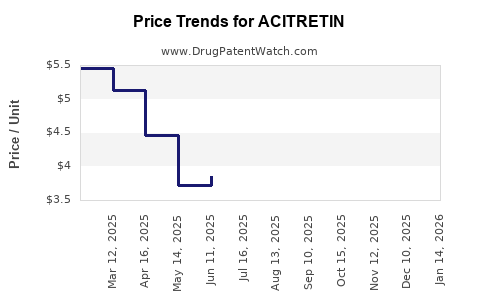
- Average selling prices compressed.
- Revenue became distributed among generic suppliers.
- Prescription demand stabilized at a lower level.
- Industry revenue became sensitive to shortages and supplier exits rather than innovation.
Public companies generally do not report acitretin revenue as a separate line item. Acitretin sales are usually aggregated into broader generic, dermatology, or established-products portfolios. As a result, there is no reliable public drug-level revenue series comparable to a major branded biologic.
Revenue drivers
| Driver |
Directional impact |
| Generic substitution |
Negative for branded revenue |
| Severe psoriasis prevalence |
Supports baseline demand |
| Biologic uptake |
Negative for systemic retinoid share |
| Low acquisition cost |
Supports use where biologics are inaccessible |
| Reproductive restrictions |
Limits eligible patients |
| Supply shortages |
Can temporarily increase supplier revenue |
| Payer step therapy |
Can preserve use before biologics |
| Dermatology specialist prescribing |
Supports continued niche demand |
Acitretin can retain a role in patients who cannot use immunosuppressive therapies, in some biologic-ineligible populations, and where cost controls favor older systemic drugs. Its low price also limits revenue upside. Volume growth would not necessarily translate into material market expansion.
What generic launch scenarios exist for acitretin?
The most likely generic-market scenarios are operational rather than patent-driven.
Base case
Multiple generic suppliers remain active, pricing stays competitive, and acitretin prescriptions decline gradually as biologics and newer systemic therapies gain share.
Supply-concentration case
One or more manufacturers exit because of low margins or production issues. A smaller supplier group gains temporary pricing power, but the market remains vulnerable to substitution and procurement intervention.
Reformulation case
A company develops a formulation with demonstrably improved tolerability, absorption, or reproductive-risk management. This could support a new patent position, but it would require clinical differentiation that the current product does not provide.
Demand-contraction case
Payers and dermatologists increasingly favor IL-17 and IL-23 inhibitors after treatment failure or intolerance. Acitretin remains available but moves toward a narrow second- or third-line role.
What patent litigation affects acitretin?
No current litigation is broadly recognized as a material constraint on U.S. acitretin availability or generic commercialization. Historic disputes would have centered on:
- Validity of the original molecule or formulation patents.
- ANDA certifications.
- Generic entry timing.
- Labeling and method-of-use claims.
- Manufacturing-process allegations.
The litigation economics are unfavorable for a new branded challenge because acitretin’s revenue base is small relative to the cost of patent litigation. A generic manufacturer would more likely allocate resources to supply reliability, regulatory compliance, and portfolio scale.
Are there biosimilar risks for acitretin?
No. Acitretin is a chemically synthesized small molecule, not a biologic. Biosimilar competition under section 351(k) of the Public Health Service Act does not apply.
The relevant competitive risk is generic substitution under the ANDA pathway. This distinction matters for valuation: acitretin does not require biologic comparability studies, interchangeability negotiations, or reference-product exclusivity management.
What licensing deals involve acitretin?
Acitretin has limited current licensing value. Historical commercial rights were associated with the original brand and dermatology portfolios, but the product’s mature generic status reduces the economic rationale for new licensing transactions.
A potentially financeable transaction would need to include one of the following:
- A patented formulation.
- A new dermatology indication.
- A combination product.
- A region with limited generic competition.
- Manufacturing or distribution rights in a supply-constrained market.
A license for ordinary U.S. acitretin capsules would likely generate limited upfront value and modest ongoing royalties because the product lacks exclusivity and has low differentiation.
How does acitretin compare with competing psoriasis drugs?
| Drug category |
Patent position |
Typical commercial profile |
Main advantage over acitretin |
| Acitretin |
Expired |
Low-cost, mature generic |
Non-immunosuppressive mechanism |
| Methotrexate |
Expired |
Low-cost generic |
Familiar systemic option |
| Cyclosporine |
Expired |
Generic, often short-term use |
Rapid immunosuppressive effect |
| TNF inhibitors |
Product-specific patents and exclusivities |
High-value biologics |
Established efficacy and broader systemic use |
| IL-17 inhibitors |
Active or recently expired rights vary by product |
Premium specialty drugs |
High efficacy and rapid response |
| IL-23 inhibitors |
Stronger contemporary patent estates |
Premium specialty drugs |
Durable efficacy and convenient dosing |
| Phototherapy |
No drug patent estate |
Procedure-based treatment |
Avoids systemic drug exposure |
Acitretin’s defensible niche is clinical: non-immunosuppressive treatment, relatively low cost, and utility in selected severe psoriasis patients. Its commercial weakness is the combination of adverse-effect monitoring, reproductive restrictions, and lower efficacy or convenience compared with modern biologics.
What geographic markets offer the greatest acitretin opportunity?
The strongest commercial opportunity is not necessarily in the largest pharmaceutical markets. It is in regions where:
- Biologics are reimbursed narrowly.
- Generic medicines dominate prescribing.
- Dermatology infrastructure supports systemic retinoid monitoring.
- Acitretin is included in national formularies.
- Local manufacturing or distribution is reliable.
The United States and Western Europe have mature generic markets and strong biologic competition. Emerging markets may support stable volume but can have lower prices, variable regulatory enforcement, and greater supply-chain risk.
Acitretin’s global value is therefore more likely to come from portfolio scale and distribution efficiency than from price premium or intellectual property.
What manufacturing and IP barriers affect acitretin?
The main manufacturing risks are compliance and supply continuity. Acitretin requires controlled production of a retinoid active ingredient, pharmaceutical-grade encapsulation, stability testing, and regulatory documentation. These requirements are manageable for established generic manufacturers but can be difficult for small suppliers with limited quality infrastructure.
Potential barriers include:
- API sourcing concentration.
- Retinoid contamination controls.
- Batch-release testing.
- Stability and dissolution performance.
- Manufacturing-site inspections.
- Packaging and labeling compliance for reproductive warnings.
- Pharmacovigilance obligations.
These barriers can produce temporary supply tightness but do not create durable market exclusivity.
What is the investment outlook for acitretin?
Acitretin is a defensive, low-growth generic asset rather than an innovation or patent-expiry opportunity.
Its investment profile has four characteristics:
- Low legal risk from active composition patents.
- Limited revenue growth potential.
- Moderate supply-chain and manufacturing risk.
- High exposure to therapeutic substitution by psoriasis biologics.
The asset may be attractive within a broader generic dermatology portfolio if the buyer has manufacturing scale, established payer access, and the ability to manage low-volume products. It is less attractive as a standalone branded investment or as the basis for a major patent strategy.
Key Takeaways
- Acitretin is an FDA-approved systemic retinoid for severe psoriasis.
- Soriatane’s U.S. exclusivity expired long ago, and generic acitretin dominates the market.
- No active composition patent is expected to block standard generic acitretin capsules.
- Orange Book relevance is primarily as a reference-product and therapeutic-equivalence record.
- Paragraph IV litigation is not a major current market constraint.
- Biosimilar risk is irrelevant because acitretin is a small molecule.
- Revenue is likely stable to declining, with no reliable publicly reported drug-level sales series.
- Biologics, especially IL-17 and IL-23 inhibitors, exert the greatest long-term demand pressure.
- Supply reliability, not patent protection, is the principal generic-market differentiator.
- New commercial value would require a differentiated formulation, indication, or geographic distribution strategy.
FAQs
Is acitretin still patented in the United States?
The core acitretin molecule and original commercial rights are expired. Standard generic acitretin capsules do not face a meaningful active composition-patent barrier.
Can generic acitretin be substituted for Soriatane?
FDA-approved generic acitretin products may be therapeutically equivalent to the reference listed drug when the FDA assigns the applicable equivalence code. Pharmacy substitution also depends on state law, payer rules, and product availability.[2]
Why is acitretin still prescribed despite biologic competition?
Acitretin is non-immunosuppressive, inexpensive, and useful for selected patients with severe psoriasis who cannot use or access biologic therapies.
Does acitretin have orphan-drug exclusivity?
Acitretin’s principal U.S. psoriasis indication is not generally treated as an orphan-drug market protected by current orphan exclusivity. Its commercial position comes from established clinical use rather than orphan designation.
Could a new acitretin formulation receive patent protection?
Yes. A genuinely novel formulation or delivery system could qualify for patent protection if it satisfies patentability requirements. Commercial success would still depend on proving meaningful clinical or pharmacokinetic advantages over inexpensive generic capsules.
References
-
U.S. Food and Drug Administration. (2020). Soriatane (acitretin) capsules: Prescribing information. FDA.
-
U.S. Food and Drug Administration. (2024). Approved drug products with therapeutic equivalence evaluations: Orange Book. FDA.
-
U.S. Food and Drug Administration. (2024). Drugs@FDA: FDA-approved drugs. FDA.
-
U.S. National Library of Medicine. (2024). Acitretin capsule: Drug information and labeling. DailyMed.
-
U.S. Food and Drug Administration. (2022). Abbreviated new drug application approvals and therapeutic equivalence evaluations. FDA.