Last updated: September 23, 2026
Executive summary: Repatha (evolocumab), Amgen’s PCSK9 inhibitor, has developed from a slow-launch specialty product into a multibillion-dollar cardiovascular franchise. Global sales increased from about $348 million in 2018 to $1.41 billion in 2023, driven by broader reimbursement, lower pricing, greater physician adoption, and expanded use in patients with established atherosclerotic cardiovascular disease. The main medium-term risks are Medicare pricing pressure, competition from Praluent and Leqvio, and potential biosimilar entry after the core U.S. regulatory exclusivity period and patent barriers begin to weaken.
Repatha Market Dynamics, Financial Trajectory, Patent Exclusivity, and Competitive Outlook
How much revenue does Repatha generate?
Repatha generated approximately $1.41 billion in global product sales in 2023, according to Amgen’s annual report. Sales increased approximately 31% from 2022, reflecting higher unit demand and continued expansion of access in the United States and international markets (Amgen, 2024).
| Fiscal year |
Estimated global Repatha sales |
Approximate annual growth |
| 2018 |
$348 million |
70% |
| 2019 |
$559 million |
61% |
| 2020 |
$896 million |
60% |
| 2021 |
$1.10 billion |
22% |
| 2022 |
$1.08 billion |
Flat to low single digits |
| 2023 |
$1.41 billion |
31% |
The trajectory reflects a typical specialty-biologic launch pattern. Early sales were limited by restrictive payer policies, high list pricing, physician caution, and uncertainty about the clinical value of PCSK9 inhibition. Growth accelerated after Amgen reduced the U.S. list price and secured broader reimbursement.
Repatha remains strategically important to Amgen because it combines recurring chronic-use revenue with a large addressable population. The drug is administered continuously, usually every two weeks or monthly, creating durable prescription volume when patients remain adherent.
What is driving Repatha market growth?
Repatha growth is being driven by five commercial factors:
- Broader payer coverage for high-risk cardiovascular patients.
- Lower annual pricing compared with the original launch price.
- Cardiovascular outcomes data supporting reduction in major adverse cardiovascular events.
- Expanded use in familial hypercholesterolemia and established atherosclerotic cardiovascular disease.
- Higher diagnosis and treatment rates among patients who remain above low-density lipoprotein cholesterol targets despite statin therapy.
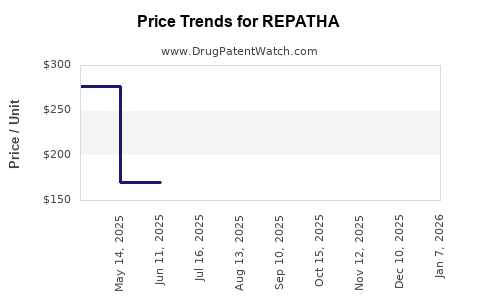
Repatha initially launched in the United States in 2015 at an annual list price of approximately $14,000. Amgen later reduced the list price to about $5,850 per year for several presentations, including the SureClick autoinjector. The price reduction was intended to improve payer access and increase utilization (Amgen, 2018).
The commercial trade-off was clear: lower price per patient reduced potential gross revenue, but increased eligible patient volume and improved formulary access. Repatha’s revenue growth after the price reduction indicates that the volume effect has been material.
How does Repatha compare with Praluent and Leqvio?
Repatha competes directly with Sanofi and Regeneron’s Praluent and indirectly with Novartis’s Leqvio.
| Product |
Active ingredient |
Company |
Mechanism |
Typical dosing |
Commercial position |
| Repatha |
Evolocumab |
Amgen |
PCSK9 monoclonal antibody |
Every two weeks or monthly |
Market leader in PCSK9 antibody class |
| Praluent |
Alirocumab |
Sanofi/Regeneron |
PCSK9 monoclonal antibody |
Every two or four weeks |
Direct antibody competitor |
| Leqvio |
Inclisiran |
Novartis |
PCSK9 small interfering RNA |
Initial doses, then approximately every six months |
Longer-interval administration |
Repatha and Praluent have similar clinical positioning and compete on formulary status, net price, injection devices, physician familiarity, and patient support. Repatha has benefited from strong Amgen commercialization and broad availability across dosage options.
Leqvio has a different commercial model. Its twice-yearly maintenance dosing may improve adherence and reduce the burden of self-injection. Its administration by health-care professionals can also support buy-and-bill reimbursement, particularly in Medicare settings. Uptake has been slower than some initial expectations, partly because practice infrastructure, reimbursement mechanics, and clinical workflow remain important barriers.
Repatha has the stronger established revenue base, while Leqvio presents the greater long-term threat to the injectable PCSK9 antibody category if outcomes data, access, and administration economics become favorable.
What FDA approvals and indications support Repatha sales?
The FDA approved Repatha in August 2015. Its principal U.S. indications include:
- Adults with primary hyperlipidemia, including heterozygous familial hypercholesterolemia, as an adjunct to diet and statin therapy.
- Adults and adolescents with homozygous familial hypercholesterolemia.
- Reduction of the risk of myocardial infarction, stroke, and coronary revascularization in adults with established cardiovascular disease.
The cardiovascular outcomes indication is commercially important because it shifts Repatha from a lipid-lowering treatment toward secondary prevention in patients at high clinical risk. The FOURIER trial showed that evolocumab reduced major cardiovascular events when added to statin therapy, although the trial’s effect was driven primarily by reductions in nonfatal events rather than cardiovascular mortality (Sabatine et al., 2017).
Repatha’s clinical value is greatest in patients with residual cardiovascular risk, severe hypercholesterolemia, familial hypercholesterolemia, or inadequate response to maximally tolerated statin therapy. Treatment guidelines generally position PCSK9 inhibitors after statins and ezetimibe, which limits immediate first-line use but preserves a large pool of undertreated high-risk patients.
When does Repatha lose U.S. exclusivity?
Repatha’s U.S. regulatory exclusivity began with FDA approval on August 27, 2015. The 12-year reference-product exclusivity period for a biological product is generally expected to end on August 27, 2027, subject to statutory and regulatory interpretation.
This date does not guarantee immediate biosimilar launch. Commercial entry also depends on:
- Biosimilar development and FDA approval.
- Patent litigation under the Biologics Price Competition and Innovation Act.
- Patent-term adjustment or patent-term extension.
- Settlement agreements.
- Manufacturing capacity and interchangeability status.
- Payer willingness to switch established patients.
Biosimilar applicants could begin submitting applications after the four-year statutory submission bar expired in 2019. FDA approval before the end of the 12-year reference-product exclusivity period would not permit commercial marketing absent an applicable legal resolution.
What patents protect Repatha?
Repatha’s protection is based on patents covering evolocumab antibodies, antibody binding characteristics, compositions, and related pharmaceutical formulations. The principal U.S. patent family associated with the product includes patents such as U.S. Patent No. 8,829,165 and related continuation patents.
Public patent records and regulatory disclosures should be reviewed separately because patent expiration dates vary by claim scope, patent-term adjustment, terminal disclaimers, and jurisdiction. The core antibody patents are generally associated with expiration in the late 2020s, while later formulation or manufacturing patents may extend into the early 2030s.
| Protection category |
Relevance to Repatha |
Commercial impact |
| Antibody composition claims |
Cover specific anti-PCSK9 antibodies or sequences |
Primary barrier to biosimilar or follow-on antibody entry |
| Binding and functional claims |
Cover interaction with PCSK9 and LDL receptor pathways |
Can complicate design-around strategies |
| Formulation patents |
Cover concentration, excipients, stability, or delivery format |
May delay particular presentations without blocking all products |
| Device and presentation rights |
Cover autoinjector or prefilled-device configurations |
More relevant to product differentiation than molecule-wide exclusivity |
| Manufacturing claims |
Cover cell culture, purification, or process parameters |
May increase biosimilar development costs |
Because Repatha is a biologic, the relevant patent landscape is not equivalent to the conventional small-molecule Orange Book model. Biologic reference products are primarily tracked through the FDA Purple Book, while product patents and patent disputes can be identified through USPTO records, court dockets, FDA disclosures, and company filings.
What is the Orange Book status of Repatha?
Repatha is not regulated as a conventional small-molecule drug, so its core biologic exclusivity and biosimilar reference-product status are not determined through the standard Orange Book framework used for abbreviated new drug applications.
The Purple Book is the more relevant FDA reference for licensed biological products and biosimilar interchangeability. Patent information may still appear in FDA-related disclosures or litigation records, but the legal pathway for a Repatha biosimilar is the BPCIA rather than a traditional Paragraph IV ANDA process.
Are there Paragraph IV challenges to Repatha?
A conventional Paragraph IV challenge is not the expected pathway for Repatha because evolocumab is a biologic. A biosimilar applicant would instead use the BPCIA patent-information exchange and litigation process.
No widely reported commercial biosimilar launch or resolved U.S. biosimilar settlement for Repatha had been publicly established through the end of the available reporting period. The principal near-term competitive issue is therefore preparation for biosimilar filings and potential litigation as the 2027 regulatory exclusivity date approaches.
What patent litigation affects Repatha?
The most significant PCSK9 patent dispute involving Amgen was Amgen v. Sanofi and Regeneron. The dispute concerned broad antibody patent claims related to PCSK9 inhibition and culminated in a 2017 U.S. Supreme Court decision affirming that Amgen’s enablement disclosure was inadequate for the full scope of its claims (Amgen Inc. v. Sanofi, 2017).
The case did not eliminate Repatha’s product-specific patent protection, but it affected the legal environment for broad genus claims covering large classes of therapeutic antibodies. The decision increased the importance of sequence-specific claims, functional limitations, and detailed disclosure in biologic patent prosecution.
Future Repatha litigation is more likely to involve biosimilar applicants, formulation patents, manufacturing claims, and patent-term disputes than the broad antibody genus issue addressed in Amgen v. Sanofi.
How strong is the Repatha patent estate?
Repatha has a commercially meaningful but time-limited patent estate.
Its strengths include:
- A first-mover position in the PCSK9 antibody class.
- Multiple patent families covering antibody composition and function.
- A biologic manufacturing process that is difficult to replicate.
- Regulatory exclusivity extending beyond the earliest core patent expirations.
- High development and manufacturing costs for biosimilar competitors.
Its weaknesses include:
- A finite 12-year U.S. biologic exclusivity period.
- The absence of small-molecule-style automatic Orange Book substitution controls.
- Potential biosimilar competition after 2027.
- Clinical and manufacturing complexity that can support biosimilar differentiation but does not guarantee a long market monopoly.
- Competition from a different modality, particularly inclisiran.
The practical strength of the estate is therefore moderate to strong through the late 2020s, with increasing erosion risk in the early 2030s.
What generic or biosimilar entry risks exist?
Repatha will not face conventional generic substitution. It will face biosimilar or potentially interchangeable-biologic competition.
The likely entry sequence is:
| Period |
Expected market event |
| 2024-2026 |
Biosimilar development, analytical characterization, manufacturing preparation, and possible patent activity |
| 2027 |
End of the 12-year U.S. reference-product exclusivity period |
| 2027-2029 |
Potential FDA biosimilar approvals and patent settlements |
| Early 2030s |
Greater risk from multiple biosimilars, formulation workarounds, and price competition |
A first biosimilar may launch with a substantial discount but not necessarily the 80% to 90% discounts seen in some mature small-molecule markets. Manufacturing complexity, limited interchangeability, physician familiarity, and payer contracting will shape net-price erosion.
A more realistic initial scenario is moderate price compression combined with increased use. Amgen may preserve a portion of revenue through contracting, new delivery formats, patient services, international pricing, and lifecycle management.
How do Medicare and pricing policy affect Repatha?
Repatha is exposed to U.S. Medicare and commercial payer pricing pressure because its main population is older patients with cardiovascular disease.
The Inflation Reduction Act’s Medicare drug-price negotiation program initially targeted selected high-spend small molecules and does not directly place Repatha in the earliest negotiation cohorts. As a biologic, its risk may increase in later cycles depending on statutory treatment of biologic products and market timing.
Repatha’s more immediate financial pressures are:
- Part D rebate negotiations.
- Formulary preference arrangements.
- Prior authorization and step-therapy rules.
- Competition from Praluent and Leqvio.
- Biosimilar discounts after the exclusivity period.
- Channel mix between retail pharmacy and specialty distribution.
The lower list price has improved access but also established a lower pricing reference point for future negotiations.
What licensing deals support Repatha commercialization?
Repatha originated from antibody technology associated with Abgenix, which Amgen acquired in 2006. Evolocumab was developed using antibody discovery capabilities derived from the XenoMouse platform.
The key commercial relationship is therefore Amgen’s ownership and internal development of the product rather than a recent external licensing deal. Publicly disclosed licensing arrangements have not been the central driver of Repatha’s current revenue model.
What is Repatha’s geographic market coverage?
The United States is the largest and most commercially important Repatha market. Amgen also markets the product in Europe, Japan, and other international territories, subject to local reimbursement and regulatory requirements.
Geographic performance differs because:
- U.S. access is shaped by rebates and prior authorization.
- European pricing is more tightly controlled.
- Japan has distinct reimbursement and prescribing dynamics.
- Familial hypercholesterolemia diagnosis rates vary substantially by country.
- Self-injection infrastructure and specialty-pharmacy systems affect persistence.
International expansion reduces dependence on U.S. pricing but generally produces lower net prices than the U.S. market.
What is the outlook for Repatha revenue?
The near-term outlook remains positive because Repatha has a large untreated or undertreated target population and established cardiovascular outcomes evidence. Revenue growth should continue to depend more on patient volume than price increases.
The principal scenarios are:
| Scenario |
Market outcome |
Financial implication |
| Base case |
Continued volume growth through 2027, followed by gradual biosimilar erosion |
Revenue reaches a durable peak before declining moderately |
| Upside case |
Greater guideline adoption, improved adherence, and slower biosimilar entry |
Repatha maintains multibillion-dollar sales for longer |
| Downside case |
Aggressive payer controls, faster biosimilar uptake, and Leqvio adoption |
Earlier revenue plateau and sharper post-exclusivity decline |
Repatha’s revenue exposure is material but manageable within Amgen’s broader portfolio. The product is unlikely to replicate the scale of Amgen’s largest oncology and immunology franchises, but it has become one of the company’s most important cardiovascular products.
Key takeaways
- Repatha sales reached approximately $1.41 billion globally in 2023.
- Growth has been driven by access expansion, lower pricing, cardiovascular outcomes data, and increased use in high-risk patients.
- U.S. biologic exclusivity began in 2015 and is generally expected to end in August 2027.
- Repatha faces biosimilar risk rather than conventional generic or Paragraph IV ANDA risk.
- The core patent estate is strongest through the late 2020s, with formulation and manufacturing patents potentially extending into the early 2030s.
- Praluent is the closest antibody competitor; Leqvio is the most important alternative-modality threat.
- Revenue is likely to peak before biosimilar entry and then decline gradually rather than collapse immediately.
FAQs
Is Repatha a biologic or a small-molecule drug?
Repatha is a biologic monoclonal antibody. Its active ingredient is evolocumab, a fully human IgG2 antibody that inhibits PCSK9.
Will Repatha face generic substitution?
No. Repatha will face biosimilar competition under the BPCIA pathway. Automatic substitution would depend on FDA interchangeability determinations and state pharmacy laws.
What is Repatha’s annual list price?
Amgen reduced the U.S. list price to approximately $5,850 annually for key presentations, down from the original price of about $14,000 per year. Net prices vary by payer, rebates, and distribution channel.
Does Repatha reduce cardiovascular mortality?
The FOURIER trial demonstrated a reduction in major cardiovascular events, including myocardial infarction, stroke, and coronary revascularization. The trial did not establish a statistically significant reduction in cardiovascular mortality as the primary commercial claim.
Is Leqvio a stronger long-term threat than Praluent?
Leqvio may represent the stronger long-term modality threat because its maintenance dosing occurs approximately every six months. Praluent remains the more direct near-term competitor because it is another PCSK9 monoclonal antibody with a similar clinical and reimbursement profile.
References
Amgen Inc. (2018). Amgen announces lower list price for Repatha (evolocumab) to improve patient access. Amgen.
Amgen Inc. (2024). 2023 annual report. Amgen.
Amgen Inc. v. Sanofi, 872 F.3d 1367 (Fed. Cir. 2017), aff’d, 139 S. Ct. 1668 (2019).
Food and Drug Administration. (2015). FDA approves Repatha to treat high cholesterol. U.S. Department of Health and Human Services.
Food and Drug Administration. (2024). Purple Book: Database of licensed biological products. U.S. Department of Health and Human Services.
Sabatine, M. S., Giugliano, R. P., Keech, A. C., et al. (2017). Evolocumab and clinical outcomes in patients with cardiovascular disease. New England Journal of Medicine, 376(18), 1713-1722.