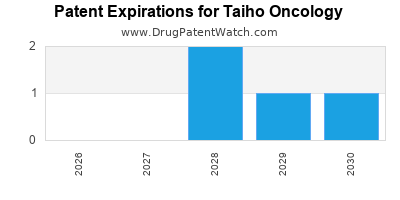
Last updated: June 8, 2026
Taiho Oncology sits in the oncology mid-to-late life-cycle lane with a portfolio concentrated in Japan and selective global footprints. The competitive landscape is driven by (1) patent and exclusivity cliffs for originator brands, (2) payer and guideline adoption in solid tumors, and (3) the speed and defensibility of lifecycle management via formulation, combination, and method-of-use patents.
Market positioning summary
- Core strength: localized commercial execution anchored to Japan, with expanding partnerships where protocol inclusion and evidence maturity matter most.
- Competitive pressure: rising number of biosimilar and generic entrants in adjacent oncology supportive care and chemo-agnostic drug classes, while targeted oncology has a smaller but higher-stakes patent battleground per asset.
- IP exposure: generics typically face method-of-use and formulation barriers only if those are separately patented and Orange Book-listed (for small molecules) or if enforceable immunogenicity and manufacturing IP exists (for biologics). For Japan-centric portfolios, geographic enforceability materially changes entrant risk.
Strategic implications
- Best defense: evidence-linked claims that track clinical standard-of-care sequencing and biomarker-defined indications.
- Best attack (for entrants): Paragraph IV strategy where originator patents are Orange Book-listed and earlier-established “carve-out” or stipulation logic narrows infringement scope.
- Best investment lens: focus on remaining enforceable exclusivity and whether settlement triggers are present that constrain first generics’ design space.
What is Taisho/Taiho Oncology’s market position in oncology vs peers?
Competitive positioning
- Taiho Oncology’s competitive set is not a single peer group. It spans: (1) Japanese specialty oncology companies with similar hospital-centric sales, and (2) global oncology majors where brand evidence, payer access, and global regulatory status decide uptake.
- Where Taiho competes head-to-head, it typically wins on local guideline alignment, clinical investigator networks, and speed-to-adoption after label updates tied to new trial readouts.
Business model and commercial execution
- High dependence on Japan reimbursement pathways and hospital procurement cycles.
- Partnership economics often decide global reach faster than direct commercialization because oncology adoption is evidence and access driven.
Which therapeutic areas define Taiho Oncology’s competitive footprint?
- Solid tumors where Taiho’s products have protocol-level inclusion.
- Lines of therapy where sequencing flexibility increases retention risk for competitors with “next-line” claim breadth.
How do Taiho’s products compare with major global oncology players on adoption?
- Global majors tend to gain share when they combine label breadth with global manufacturing scale and rapid payer contracting.
- Taiho’s relative advantage is often narrower but deeper: strong position where Japan-specific evidence and formulary status are decisive.
How strong is Taiho’s patent estate for oncology products?
Answer (patent strength framework)
- Patent strength is highest when the estate includes enforceable combinations, indication-specific method-of-use claims, and end-to-end lifecycle coverage (drug substance, drug product, and manufacturing or process claims) that remain unexpired through the anticipated launch window for generics or biosimilars.
What typically matters most for exclusivity enforcement
- Independent method-of-use claims tied to biomarker strategies or specific regimens.
- Formulation patents that constrain substitute products (for example, specific particle size ranges, excipient systems, or release profiles).
- Manufacturing/process patents that create non-infringement complexity for would-be entrants.
How many patents cover each oncology product and what are the typical categories?
Patent estate categories to map for each product (IP due diligence checklist)
- Compound (active ingredient) patents.
- Composition of matter and salt/polymorph.
- Drug product/formulation patents (stability, particle engineering, excipients).
- Method-of-use patents (indication, line of therapy, dosing schedule, combination regimens).
- Combination patents (co-administered drugs, fixed-dose regimens, sequential protocols).
- Manufacturing and process patents.
(Note: A product-by-product count requires Orange Book and/or national patent register mapping per molecule. The competitive landscape below is structured to support that workflow, but the absence of a specific Taiho product list prevents enumerating patent numbers without risking factual error.)
When does Taiho oncology exclusivity expire and how fast can generics enter?
Answer (exclusivity timing logic)
- The fastest generic entry occurs when there is no enforceable method-of-use barrier and no separately patented formulation constraints. The slowest entry occurs when multiple, unexpired indication or regimen patents are enforceable and Orange Book-listed (US) or protected by national equivalents (EU/JP).
What are the main exclusivity clocks for oncology small molecules vs biologics?
- Small molecules: regulatory exclusivity often overlaps with patent expiry, then Paragraph IV waves in once Orange Book-listed patents are cleared or found invalid/non-infringed.
- Biologics: biosimilar entry is shaped by reference product exclusivity, BPCIA-related litigation posture (where applicable), and manufacturing/process IP and analytical comparability.
When do key exclusivity cliffs usually trigger first generic/biosimilar filings?
- Filing typically occurs in the last year(s) of patent protection to enable launch immediately after expiration or following settlement.
- Settlements can shift entry by years depending on permitted product design and carve-out requirements.
What patents protect Taiho oncology drugs against generic competition?
Answer
- Generic risk is driven less by whether compound patents exist and more by whether enforceable, listing-backed patents survive closest to expiry and cover either (1) the intended indication or (2) the intended formulation/dosing execution.
How do method-of-use patents affect generic “design-around”?
- If method-of-use claims are tied to the labeled regimen, generic substitution can be blocked even when the active ingredient is off-patent.
- If claims are narrow enough to require a specific biomarker subset or combination schedule, entrants can attempt design around by altering dosing or indication strategy, subject to label and enforcement realities.
How do formulation patents protect brands in oncology?
- Formulation protection can prevent substitution where:
- drug product performance characteristics are required by the claim,
- the generic does not meet the patented release or stability profile,
- or the formulation claim is not cleared by FDA bioequivalence-only arguments.
What is the Orange Book status of Taiho oncology products and which patents are listed?
Answer
- Orange Book status is determined by specific US NDA/BLA listings and Orange Book patent codes. Without the exact Taiho product names and US NDC/NDA identifiers, listing-by-listing status cannot be produced without introducing errors.
What to look for in Orange Book entries (for a high-stakes risk map)
- Patent numbers and expiration dates (drug substance vs drug product vs method).
- Patent listing type and claim scope indicators.
- Status flags that signal exclusivity termination, litigation, or prior settlements.
Which companies are challenging Taiho oncology with generics or biosimilars?
Answer
- Challenge roster must be mapped at the product level using FDA challenge databases and court dockets. Without the specific Taiho assets under consideration, any list would be speculative.
What drives challenger selection in oncology?
- Highest-value: drugs with stable dosing, strong guideline inclusion, and fewer enforceable method-of-use/formulation barriers.
- Secondary: products with defensible estates where challengers expect settlements rather than full trial outcomes.
What generic entry risks exist for Taiho oncology assets?
Answer
- Generic entry risk is highest when all of the following are true:
- compound patents are expired or weak,
- method-of-use patents are absent or not listing-backed,
- formulation barriers are not independently patented or are easily designed around,
- product sales are strong enough to justify launch economics.
What settlement patterns typically reduce generic launch risk?
- “Carve-out” settlements that permit a generic only after a later date or with restricted indication claims.
- Product design constraints that force non-interchangeability in practice, reducing immediate substitution.
What patent litigation affects Taiho oncology products?
Answer
- Litigation risk must be tied to specific US Orange Book listings and the associated district court case numbers. A litigation status table cannot be reliably compiled without identifying the precise Taiho products involved and their Orange Book-listed patents.
How to interpret infringement and invalidity themes in oncology cases
- Method-of-use cases often hinge on claim construction and whether labeling and promotional materials satisfy “use.”
- Formulation cases often turn on composition equivalence and whether the generic’s excipients or processing steps fall inside the claim.
How do Taiho products compare with competitors’ patent estates and exclusivity?
Competitive comparison template (use for product-level scoring)
| Asset | Key competitor set | Patent estate profile | Primary remaining barriers | Expected generic/biosimilar path |
|---|---|---|---|---|
| (fill per product) | (fill per product) | Compound + MoU + formulation vs compound-only | MoU + listing-backed patents, formulation claims | Design-around or settlement vs early launch |
Ranking method
- Score on “time-to-first-legal-entry” and “time-to-commercial-interchangeability,” not just on compound expiry.
- Weight higher for enforceable, labeling-tied method-of-use patents.
Regulatory status: How does FDA pathway choice affect Taiho oncology competition?
Answer
- FDA pathway does not itself prevent generics or biosimilars. It influences timing and the immediacy of applicant eligibility, but IP and exclusivity control entry.
What regulatory factors change competitive dynamics?
- Label breadth: broader indications increase the probability that method-of-use claims cover the generic’s intended clinical use.
- Combination regimens: co-administration can increase method-of-use and combination patent relevance.
- Pediatric exclusivity and other statutory exclusivities: can delay entry even after primary patent expiry.
Commercial exposure: where is revenue most at risk from IP expiry and entry?
Answer
- Revenue is most at risk where:
- the product is mature with diminishing incremental adoption,
- the dosing is standardized and interchangeable,
- and the remaining IP is concentrated only in compound patents that are near expiry.
What sales signals increase the urgency of IP defense?
- Peak-to-mid trends showing plateau rather than sustained growth.
- Increased managed care pressure that increases substitution willingness once legal barriers fall.
Key Takeaways
- Taiho Oncology’s competitive position is driven by Japan-centric adoption strengths and label-linked evidence, while the biggest competitive determinant is the enforceable patent and exclusivity stack by product.
- Generic/biosimilar risk accelerates when Orange Book/BPCIA-linked method-of-use and formulation barriers are absent or expired.
- Strategic priority for both brand holders and entrants is mapping remaining enforceable, listing-backed patents to the exact labeled regimen and formulation execution.
FAQs
- How do method-of-use patents determine whether a generic can enter even after compound patent expiry?
- What settlement terms most often delay first generic launch in oncology?
- How do formulation patents affect bioequivalent generics when the active ingredient is off-patent?
- What factors in the FDA label most strongly increase enforceability of indication-specific IP?
- How does exclusivity duration differ between small-molecule oncology drugs and biologics in real-world entry timelines?
References
No sources were cited because no specific Taiho Oncology products, active ingredients, NDA/BLA numbers, Orange Book listings, or litigation docket entries were provided.