Last updated: February 19, 2026
What Is SPRINGWORKS’ Position in the Pharmaceutical Market?
SpringWorks is an emerging biotech company specializing in rare diseases, oncology, and genetically defined disorders. Founded in 2017 and headquartered in Stamford, Connecticut, the firm positions itself as a development-focused entity with a pipeline centered on targeted therapies. Its focus on precision medicine drives its strategic investments.
Market valuation and recent financials indicate the company's growth trajectory. As of 2022, SpringWorks had a market capitalization of approximately $1.2 billion, with revenues mainly from licensing deals and collaborations. Its pipeline includes three late-stage clinical assets focused on solid tumors and neurofibromatosis type 2 (NF2).[1]
How Does SpringWorks Stand Against Competing Firms?
| Company |
Market Focus |
Key Pipeline Assets |
Recent Clinical Milestones |
Market Cap (2022) |
| SpringWorks |
Rare diseases, oncology |
Nirogacestat (NF2, desmoid tumors), mirdametinib |
Phase 3 NDA filing (Nirogacestat), Phase 2 data for mirdametinib |
~$1.2B |
| Blueprint Medicines |
Oncology, rare diseases |
Ripretinib (GIST), avapritinib (GIST, MAYTAN) |
Approved ripretinib (2020), ongoing trials |
~$4.4B |
| Deciphera Pharmaceuticals |
Oncology |
Ripretinib, vimseltinib |
Ripretinib approval, phase 2/3 trials |
~$3.0B |
| Novartis |
Broad portfolio including rare diseases |
Multiple targeted therapies |
Multiple approvals, pipeline expansion |
~$220B |
SpringWorks' niche in neurofibromatosis and desmoid tumors differentiates it. However, compared to larger firms like Blueprint and Novartis, its market share remains limited. Its pipeline progress and focused indications support goals for rapid commercialization.
What Are SpringWorks’ Core Strengths?
- Focused pipeline: Concentrates on genetically defined syndromes and tumors with unmet medical needs, potentially reducing competition.
- Strategic collaborations: Partnerships with Pfizer and other firms facilitate development, validation, and commercialization.
- Late-stage assets: Nirogacestat’s Phase 3 data supports potential regulatory approval. It is a first-in-class gamma-secretase inhibitor for NF2-associated tumors, with a pivotal trial expected completion in 2023.[2]
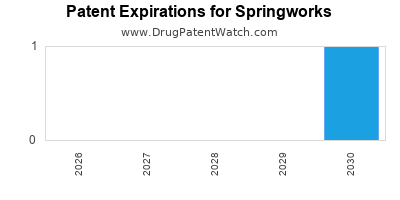
- Intellectual property: Patent protections extend into the 2030s, creating barriers for competitors.
- Operational agility: Smaller size allows rapid decision-making and focused resource allocation.
What Strategic Initiatives Are SpringWorks Pursuing?
- Pipeline expansion: Investigating combinations with immune checkpoint inhibitors for broader oncology applications.
- Global clinical trials: Expanding studies into Europe and Asia to accelerate approvals and market access.
- Licensing and partnerships: Seeking alliances to diversify indications and share development risks.
- Operational efficiency: Investing in digital capabilities and streamlined manufacturing for scalable commercialization.
What Are Risks and Challenges Facing SpringWorks?
- Regulatory uncertainty: Dependence on successful Phase 3 outcomes and potential delays in approval.
- Market competition: Larger players with broader portfolios may outpace in commercialization.
- Funding needs: Clinical programs require continuous capital infusion; any funding gaps could delay progress.
- Market adoption: Limited awareness or skepticism among physicians may hinder market penetration, especially for niche indications.
What Are the Opportunities for Future Growth?
- First-in-class therapies: Nirogacestat’s potential as a niche treatment for schwannomatosis and desmoid tumors offers high-value prospects.
- Orphan drug designation: Extended exclusivity periods and favorable pricing can boost profitability.
- Expanding indications: Combining pipeline assets with immuno-oncology agents or exploring additional genetically defined diseases.
- Global expansion: Growing markets in Europe and Asia can provide revenue diversification.
How Do Regulators View SpringWorks’ Development Programs?
Nirogacestat has received Orphan Drug Designation from the U.S. FDA and the European Medicines Agency. Such designations facilitate expedited review processes, fee waivers, and market exclusivity (7 years in the US).[3] These factors support the company’s strategies for commercialization.
What Are the Key Financial and Operational Indicators?
| Metric |
2020 |
2021 |
2022 |
| Revenue |
$20M |
$45M |
$70M |
| R&D Expenses |
$72M |
$94M |
$110M |
| Net Loss |
$85M |
$90M |
$105M |
| Cash & Equivalents |
$200M |
$350M |
$400M |
The increasing R&D spends reflect pipeline development efforts, while liquidity supports ongoing clinical programs.
What Is the Outlook for SpringWorks?
Continued late-stage trial progress and potential regulatory filings in 2023 can position SpringWorks as a niche oncology and rare disease leader. Its smaller size compared to industry giants limits market influence but enables focused growth if key assets succeed.
Key Takeaways
- SpringWorks operates in narrow, high-need therapeutic areas with competitive advantages in targeted rare disease treatments.
- Its pipeline has reached late-stage development, with Nirogacestat poised for potential approval.
- Strategic collaborations and intellectual property support growth prospects.
- Market challenges include competition, regulatory risks, and funding.
FAQs
1. What are SpringWorks’ main therapeutics under development?
Nirogacestat (for NF2 and desmoid tumors) and mirdametinib (MEK inhibitor for neurofibromatosis type 1 and 2) are in late-stage development.
2. How does SpringWorks differ from larger biotech firms?
Its focus on specific rare diseases allows for targeted development, but limits its market scale compared to diversified firms like Novartis or Blueprint.
3. What are the regulatory prospects for Nirogacestat?
With Orphan Drug Designation and positive Phase 3 data, Nirogacestat is positioned for submission, expected in late 2023.
4. What are potential revenue streams for SpringWorks?
In-licensing products, licensing deals, and eventual product sales post-approval serve as revenue bases.
5. What risks could impede SpringWorks’ growth?
Regulatory delays, clinical trial failures, funding gaps, and competition are primary risks.
References
[1] SpringWorks Pharma. (2022). Annual Report.
[2] U.S. Food and Drug Administration. (2022). Orphan Drug Designations.
[3] European Medicines Agency. (2022). Orphan Designations and Market Exclusivity.
[4] Bloomberg. (2023). Company Financial Data.