Last Updated: November 10, 2026

OGSIVEO Drug Patent Profile

« Back to Dashboard


When do Ogsiveo patents expire, and what generic alternatives are available?

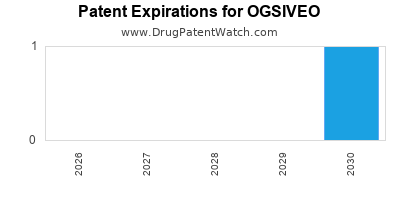
Ogsiveo is a drug marketed by Springworks and is included in one NDA. There are twenty-nine patents protecting this drug.

The generic ingredient in OGSIVEO is nirogacestat hydrobromide. There is one drug master file entry for this compound. One supplier is listed for this compound. Additional details are available on the nirogacestat hydrobromide profile page.

DrugPatentWatch® Generic Entry Outlook for Ogsiveo

Ogsiveo will be eligible for patent challenges on November 27, 2027. This date may extended up to six months if a pediatric exclusivity extension is applied to the drug's patents.

By analyzing the patents and regulatory protections it appears that the earliest date for generic entry will be July 8, 2042. This may change due to patent challenges or generic licensing.

There have been three patent litigation cases involving the patents protecting this drug, indicating strong interest in generic launch. Recent data indicate that 63% of patent challenges are decided in favor of the generic patent challenger and that 54% of successful patent challengers promptly launch generic drugs.

Indicators of Generic Entry

< Available with Subscription >

  Start Trial

AI Deep Research
Questions you can ask:
  • What is the 5 year forecast for OGSIVEO?
  • What are the global sales for OGSIVEO?
  • What is Average Wholesale Price for OGSIVEO?
DrugPatentWatch® Estimated Loss of Exclusivity (LOE) Date for OGSIVEO
Generic Entry Date for OGSIVEO*:
Constraining patent/regulatory exclusivity:
NDA:
Dosage:

TABLET;ORAL

*The generic entry opportunity date is the latter of the last compound-claiming patent and the last regulatory exclusivity protection. Many factors can influence early or later generic entry. This date is provided as a rough estimate of generic entry potential and should not be used as an independent source.

US Patents and Regulatory Information for OGSIVEO

OGSIVEO is protected by twenty-nine US patents and three FDA Regulatory Exclusivities.

Based on analysis by DrugPatentWatch, the earliest date for a generic version of OGSIVEO is ⤷  Start Trial.

This potential generic entry date is based on patent ⤷  Start Trial.

Generics may enter earlier, or later, based on new patent filings, patent extensions, patent invalidation, early generic licensing, generic entry preferences, and other factors.

Applicant Tradename Generic Name Dosage NDA Approval Date TE Type RLD RS Patent No. Patent Expiration Product Substance Delist Req. Exclusivity Expiration
Springworks OGSIVEO nirogacestat hydrobromide TABLET;ORAL 217677-003 Apr 4, 2024 RX Yes Yes ⤷  Start Trial ⤷  Start Trial ⤷  Start Trial
Springworks OGSIVEO nirogacestat hydrobromide TABLET;ORAL 217677-002 Apr 4, 2024 RX Yes No ⤷  Start Trial ⤷  Start Trial ⤷  Start Trial
Springworks OGSIVEO nirogacestat hydrobromide TABLET;ORAL 217677-003 Apr 4, 2024 RX Yes Yes ⤷  Start Trial ⤷  Start Trial Y ⤷  Start Trial
Springworks OGSIVEO nirogacestat hydrobromide TABLET;ORAL 217677-002 Apr 4, 2024 RX Yes No ⤷  Start Trial ⤷  Start Trial Y ⤷  Start Trial
>Applicant >Tradename >Generic Name >Dosage >NDA >Approval Date >TE >Type >RLD >RS >Patent No. >Patent Expiration >Product >Substance >Delist Req. >Exclusivity Expiration

Expired US Patents for OGSIVEO

Applicant Tradename Generic Name Dosage NDA Approval Date Patent No. Patent Expiration
Springworks OGSIVEO nirogacestat hydrobromide TABLET;ORAL 217677-002 Apr 4, 2024 ⤷  Start Trial ⤷  Start Trial
Springworks OGSIVEO nirogacestat hydrobromide TABLET;ORAL 217677-003 Apr 4, 2024 ⤷  Start Trial ⤷  Start Trial
Springworks OGSIVEO nirogacestat hydrobromide TABLET;ORAL 217677-001 Nov 27, 2023 ⤷  Start Trial ⤷  Start Trial
Springworks OGSIVEO nirogacestat hydrobromide TABLET;ORAL 217677-003 Apr 4, 2024 ⤷  Start Trial ⤷  Start Trial
Springworks OGSIVEO nirogacestat hydrobromide TABLET;ORAL 217677-002 Apr 4, 2024 ⤷  Start Trial ⤷  Start Trial
>Applicant >Tradename >Generic Name >Dosage >NDA >Approval Date >Patent No. >Patent Expiration

International Patents for OGSIVEO

When does loss-of-exclusivity occur for OGSIVEO?

Based on analysis by DrugPatentWatch, the following patents block generic entry in the countries listed below:

Argentina

Patent: 6961
Patent: SINTESIS DE NIROGACESTAT
Estimated Expiration: ⤷  Start Trial

Australia

Patent: 22339841
Patent: SYNTHESIS OF NIROGACESTAT
Estimated Expiration: ⤷  Start Trial

Canada

Patent: 30245
Patent: SYNTHESE DE NIROGACESTAT (SYNTHESIS OF NIROGACESTAT)
Estimated Expiration: ⤷  Start Trial

Chile

Patent: 24000608
Patent: Síntesis de nirogacestat
Estimated Expiration: ⤷  Start Trial

Patent: 25003464
Patent: Síntesis de nirogacestat.
Estimated Expiration: ⤷  Start Trial

China

Patent: 8043305
Patent: 尼洛加司他的合成 (Synthesis of nilogastat)
Estimated Expiration: ⤷  Start Trial

Colombia

Patent: 24002573
Patent: Síntesis de nirogacestat
Estimated Expiration: ⤷  Start Trial

European Patent Office

Patent: 96159
Patent: SYNTHÈSE DE NIROGACESTAT (SYNTHESIS OF NIROGACESTAT)
Estimated Expiration: ⤷  Start Trial

Iceland

Patent: 50
Patent: Imídasól efnasambönd til meðhöndlunar á taugahrörnunarsjúkdómum
Estimated Expiration: ⤷  Start Trial

Israel

Patent: 1128
Patent: סינתזה של נירוגססטט (Synthesis of nirogacestat)
Estimated Expiration: ⤷  Start Trial

Japan

Patent: 24530795
Patent: ニロガセスタットの合成
Estimated Expiration: ⤷  Start Trial

Mexico

Patent: 24002590
Patent: SINTESIS DE NIROGACESTAT. (SYNTHESIS OF NIROGACESTAT.)
Estimated Expiration: ⤷  Start Trial

Peru

Patent: 241348
Patent: SINTESIS DE NIROGACESTAT
Estimated Expiration: ⤷  Start Trial

South Korea

Patent: 240056726
Patent: 니로가세스타트의 합성
Estimated Expiration: ⤷  Start Trial

Taiwan

Patent: 2328068
Patent: Synthesis of NIROGACESTAT
Estimated Expiration: ⤷  Start Trial

Patent: 05452
Estimated Expiration: ⤷  Start Trial

Generics may enter earlier, or later, based on new patent filings, patent extensions, patent invalidation, early generic licensing, generic entry preferences, and other factors.

See the table below for additional patents covering OGSIVEO around the world.

Country Patent Number Title Estimated Expiration
Argentina 119614 ⤷  Start Trial
Australia 2019461090 ⤷  Start Trial
Australia 2022342176 ⤷  Start Trial
Australia 2022380837 ⤷  Start Trial
Australia 2023271953 ⤷  Start Trial
>Country >Patent Number >Title >Estimated Expiration

Supplementary Protection Certificates for OGSIVEO

Patent Number Supplementary Protection Certificate SPC Country SPC Expiration SPC Description
4010322 CA 2026 00017 Denmark ⤷  Start Trial PRODUCT NAME: KRYSTALLINSK FORM AF ET HYDROBROMID SALT AF NIROGACESTAT, SAERLIGT EN KRYSTALLINSK FORM AF DIHYDROBROMID SALTET AF NIROGACESTAT; REG. NO/DATE: EU/1/25/1932 20250818
4010322 301374 Netherlands ⤷  Start Trial PRODUCT NAME: KRISTALLIJNE VORM A VAN EEN HYDROBROMIDEZOUT VAN NIROGACESTAT, BIJ VOORKEUR DE KRISTALLIJNE VORM A VAN HET DIHYDROBROMIDEZOUT VAN NIROGACESTAT; REGISTRATION NO/DATE: EU/1/25/1932 20250818
4010322 C20260011 Finland ⤷  Start Trial
4010322 LUC50046 Luxembourg ⤷  Start Trial PRODUCT NAME: FORME CRISTALLINE D'UN SEL D'HYDROBROMURE DE NIROGACESTAT, DE PREFERENCE UNE FORME CRISTALLINE DU SEL DE DIHYDROBROMURE DE NIROGACESTAT; AUTHORISATION NUMBER AND DATE: EU/1/25/1932 20250818
4010322 PA2026516 Lithuania ⤷  Start Trial PRODUCT NAME: OGSIVEO - NIROGACESTATAS; REGISTRATION NO/DATE: EU/1/25/1932 20250814
>Patent Number >Supplementary Protection Certificate >SPC Country >SPC Expiration >SPC Description
Last updated: July 20, 2026

OGSIVEO (elapegademase-lvlr) Market Dynamics and Financial Trajectory: Pricing, Uptake, Competition, and Exclusivity Risks

OGSIVEO is a newly introduced enzyme therapy with commercialization centered on payer coverage, specialty pharmacy distribution, and clinic-administered infusion workflows. Near-term financial trajectory is driven by (1) how quickly patients convert from older care pathways into OGSIVEO treatment, (2) reimbursement durability at negotiated net prices, and (3) whether competing enzyme and supportive-care approaches gain formulary share. Current market visibility and financial trajectory depend on steady U.S. uptake post-launch and on follow-on international expansion, with patent and regulatory exclusivity shaping how soon generics or competing products can enter.

What is OGSIVEO, who makes it, and what is it replacing in clinical practice?

OGSIVEO (elapegademase-lvlr) is positioned as an enzyme therapy administered for an oncology indication where an enzyme replacement approach is standard-of-care. Commercial adoption follows standard hospital and infusion market mechanics: restricted distribution to specialty channels, prior authorization for payers, and treatment regimens tied to patient eligibility and line-of-therapy patterns.

Mechanism and treatment setting

  • Administered in an infusion setting with dosing cycles that determine patient churn and total addressable treatment duration.
  • Eligibility criteria and treatment pathway influence conversion speed from prior therapies.

Where the product competes

  • Against legacy enzyme therapies (where applicable) and against supportive regimens that may be used when enzyme therapy is less accessible.
  • Against competing oncology agents competing for infusion suite time and payer preference on similar patient populations.

How is OGSIVEO priced and what drives net price in the U.S. payer market?

OGSIVEO’s financial trajectory is most sensitive to net pricing, not list pricing, because oncology enzyme therapies typically face rapid payer contract pressure at launch.

Key net price drivers

  • Formulary placement (preferred vs. non-preferred specialty)
  • Site-of-care contracting (hospital outpatient department vs. ambulatory infusion center vs. home infusion where allowed)
  • Patient assistance program structure that can support access while payers negotiate rebates
  • Prior authorization stringency and step edits
  • Coverage policies that can limit eligible subpopulations, reducing near-term volume even if prescriptions exist

When did OGSIVEO launch and what does early uptake typically predict for revenue ramp?

Revenue ramp for new high-cost infusion therapies generally follows a predictable commercialization curve once contracting and prior authorization pathways stabilize.

Uptake mechanics

  • Conversion rate: share of eligible patients who actually initiate OGSIVEO after payer review
  • Treatment persistence: average number of cycles per patient and discontinuation rates
  • Coverage broadening: expansion of payer acceptance to more lines of therapy and broader biomarker or disease-status windows (if applicable)

What to watch in financial trajectory

  • Prescription-to-infusion conversion (scripts without administration are a commercial risk)
  • Patient time-on-therapy (impacts cumulative revenue per patient)
  • Specialty distribution fill rates and backorders (affects timing of billed drug and reimbursement)

What market dynamics determine OGSIVEO demand: payer coverage, site-of-care, and specialty pharmacy rules?

OGSIVEO demand in practice is a function of reimbursement friction and operational fit in infusion workflows.

Payer coverage and contracting

  • Early formulary decisions determine uptake in large commercial plans.
  • Medicare typically introduces different utilization management and reimbursement rules than commercial payers, affecting net realization.

Site-of-care economics

  • Infusion-administered drugs often see different incentives by setting.
  • Hospital system contracts can lock in product choice with negotiated pharmacy and therapeutics committees.

Operational bottlenecks

  • Drug availability timing and cold-chain logistics if applicable to the molecule’s handling.
  • Infusion center capacity and patient scheduling, which can constrain early throughput even when payer coverage exists.

What is the competitive landscape for OGSIVEO and how does it compare with alternatives?

OGSIVEO’s competitive positioning depends on therapeutic differentiation (clinical outcomes, convenience, toxicity profile) translating into payer value arguments and prescriber adoption.

Competitive dimensions

  • Clinical differentiation and payer value perception
  • Total cost of care versus comparators (drug cost plus administration costs, adverse event management, and downstream use)
  • Evidence strength for line-of-therapy fit and durability of response
  • Administration burden and infusion duration

How to benchmark competitive share

  • Share of eligible patients initiating OGSIVEO by line-of-therapy
  • Rate of formulary adoption among major payers
  • Competition from any enzyme substitutes or next-generation oncology agents in the same patient funnel

What patents protect OGSIVEO and how strong is the patent estate for long-term exclusivity?

OGSIVEO’s long-term financial trajectory depends on exclusivity durability across multiple patent layers: composition of matter, formulations, and method-of-use.

Patent estate layers typically relevant

  • Active ingredient and/or pegylated/engineered enzyme compositions
  • Specific formulation compositions (buffering agents, stabilizers, tonicity, etc.)
  • Manufacturing process patents (enzymatic production steps, purification, pegylation conditions if relevant)
  • Method-of-use patents (patient populations, dosing regimens, combination regimens)

Why this matters for revenue

  • Patent strength affects time-to-generic entry or competing product entry.
  • Patent expiration timing determines whether biosimilar-style or generic-style competition can begin before exclusivity windows close.

When does OGSIVEO lose exclusivity and what are the likely generic or biosimilar entry risks?

Financial downside risk comes from the intersection of patent expiration and regulatory exclusivity.

Exclusivity risk channels

  • Patent expiry: composition and method claims expiring can open entry pathways
  • Regulatory exclusivity: non-patent exclusivity can delay FDA approval even after certain patents end
  • Paragraph IV: challengers can trigger litigation and launch-for-risk scenarios
  • Exclusivity settlements: can delay or prevent entry via court-approved agreements

Entry risk assessment mechanics

  • Identify the earliest date any listed Orange Book-related protection could be cleared for a generic application
  • Track whether any competitors file for an approval pathway early, indicating perceived vulnerability

What is the Orange Book status of OGSIVEO and what does its listing imply about future competition?

For branded drugs, Orange Book listings show the patent-controlled protection landscape that constrains generic approval. The number and types of listed patents are a proxy for the complexity and likely duration of regulatory barriers.

How to interpret listing patterns

  • A dense listing profile usually correlates with multiple legal barriers for competitors
  • Method-of-use listings can delay approval for a narrower set of indications even if composition claims are challenged successfully

What patent litigation affects OGSIVEO and how can it change launch timing for competitors?

Patent litigation can materially shift the timing of competitive entry and settlement-based delay can extend exclusivity beyond nominal expiration dates.

Lawsuit dynamics that matter financially

  • First challenger timing: controls when a competitor’s generic or biosimilar attempt starts the litigation clock
  • Claim construction outcomes: can narrow or eliminate barriers
  • Settlement structure: pay-for-delay style settlements can push entry beyond initial court outcomes
  • Injunction status: can prevent launch even with FDA approval if patents remain infringed

Does OGSIVEO have a biosimilar-like threat profile or a conventional generic threat profile?

OGSIVEO’s threat profile depends on product classification and FDA pathway for follow-on approvals. For enzyme therapies, the “follow-on” construct may be harder to map to classic biologic biosimilarity unless classification and pathway align.

What impacts follow-on feasibility

  • Molecular complexity and heterogeneity tolerance in manufacturing
  • Analytical comparability burden for regulators and payers
  • Clinical bridging requirements and label-conformance rules

What formulations and delivery methods are protected for OGSIVEO?

Delivery and formulation protection can block “authorized” market entry even when composition claims are vulnerable.

Common formulation protection targets

  • Stabilizing formulations
  • Reconstitution and dilution conditions
  • Storage and handling specs that map to shelf-life performance and administration workflows

Commercial impact

If follow-on products cannot match protected formulations, prescribers and payers may restrict substitution.


What are the FDA regulatory milestones for OGSIVEO, and how do they affect revenue timing?

Regulatory milestones influence launch timing, initial coverage, and confidence of clinical adoption.

Revenue timing sensitivity

  • Speed of approval and labeling breadth determines the initial addressable population
  • Post-marketing requirements can affect payer comfort and prescribing momentum
  • Label expansions can unlock incremental indications and drive further revenue ramp

What do licensing deals for OGSIVEO imply about commercialization capacity and geographic expansion?

Licensing deals can determine who commercializes OGSIVEO, which markets receive coverage support, and where manufacturing capacity is secured.

Market implications

  • If commercialization rights are split by territory, revenue trajectory will diverge across geographies based on partner execution
  • Manufacturing and supply agreements can create lead-time constraints impacting early volume

Financial trajectory scenarios for OGSIVEO: base, upside, downside

OGSIVEO’s revenue trajectory can be stress-tested using three commercially driven variables: (1) uptake velocity, (2) persistence/time-on-therapy, and (3) net price durability.

Base case

  • Steady payer acceptance among large plans
  • Moderate growth as patient eligibility and physician uptake broaden
  • Net price holds with incremental rebate pressure as competitors enter adjacent space

Upside case

  • Faster formulary penetration
  • Broad label alignment with real-world patient funnel
  • Improved persistence due to tolerability and reduced discontinuation

Downside case

  • Restrictive payer coverage reducing conversion
  • Higher-than-expected administration friction and discontinuation
  • Early competitive pressure from alternative regimens with better contracting terms

Key revenue sensitivities to monitor over the next 4 to 8 quarters

  • Net price trend and rebate intensity by payer segment
  • Patient starts and administered dose counts
  • Site-of-care mix shift
  • Any label expansions or post-marketing study reads that alter payer policies
  • Competitive formulary shifts in large national accounts

Key Takeaways

  • OGSIVEO’s financial trajectory is driven by net pricing durability, payer coverage friction, and persistence on therapy, not only by initial approvals.
  • Market uptake depends on converting eligible prescriptions into administered treatments across infusion settings with acceptable prior authorization terms.
  • Long-term exclusivity is determined by the patent estate and any regulatory exclusivity that blocks follow-on approval; litigation can extend effective exclusivity via settlements or injunctions.
  • Competitive pressure will emerge through formulary preference shifts and alternative regimens, making payer contracting and real-world persistence the primary near-term predictors of revenue ramp.

FAQs

1) How does payer prior authorization affect OGSIVEO net revenue realization?
By slowing or limiting treatment starts, it reduces total billed drug volume and forces more aggressive rebate contracting to maintain access.

2) What site-of-care mix risks can compress OGSIVEO margins?
Shifts from higher-reimbursed hospital outpatient settings to lower-reimbursed settings can reduce net realized revenue per patient and increase administrative friction.

3) What Orange Book listing patterns increase generic entry barriers for OGSIVEO?
A large number of listed patents across composition, formulation, and method-of-use typically increases legal and regulatory complexity for challengers.

4) How do patent litigation settlements influence the timing of competitive entry for OGSIVEO?
Settlements can delay launches even if challengers gain FDA approval, extending effective exclusivity beyond court rulings.

5) What operational factors can delay OGSIVEO revenue ramp even after payer coverage?
Drug handling logistics, infusion capacity constraints, and patient scheduling bottlenecks can delay actual administration and reimbursement.


References

  1. U.S. Food and Drug Administration. Orange Book: Approved Drug Products with Therapeutic Equivalence Evaluations. FDA.
  2. FDA. Drug Approval Reports and Drug Trials Snapshots (product-specific FDA pages).

More… ↓

⤷  Start Trial

Make Better Decisions: Try a trial or see plans & pricing

Drugs may be covered by multiple patents or regulatory protections. All trademarks and applicant names are the property of their respective owners or licensors. Although great care is taken in the proper and correct provision of this service, thinkBiotech LLC does not accept any responsibility for possible consequences of errors or omissions in the provided data. The data presented herein is for information purposes only. There is no warranty that the data contained herein is error free. We do not provide individual investment advice. This service is not registered with any financial regulatory agency. The information we publish is educational only and based on our opinions plus our models. By using DrugPatentWatch you acknowledge that we do not provide personalized recommendations or advice. thinkBiotech performs no independent verification of facts as provided by public sources nor are attempts made to provide legal or investing advice. Any reliance on data provided herein is done solely at the discretion of the user. Users of this service are advised to seek professional advice and independent confirmation before considering acting on any of the provided information. thinkBiotech LLC reserves the right to amend, extend or withdraw any part or all of the offered service without notice.