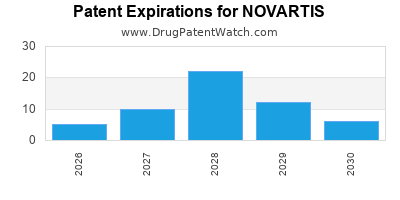
Last updated: June 26, 2026
Novartis is a diversified global biopharma with a large late-stage pipeline and a patent estate anchored by oncology and immunology franchises. Its medium-term commercial profile is shaped by (1) ongoing loss-of-exclusivity for portions of its marketed portfolio in the 2026 to 2031 window, (2) biosimilar and generic erosion risk in crowded therapeutic classes, and (3) strategy shifts toward high-probability late-stage assets in immunology and oncology while sustaining deal activity to backfill pipeline gaps.
Key investor and R&D implications: Novartis’ competitive position is strongest where it pairs clinical differentiation with durable IP coverage (compound, method-of-use, and formulation or manufacturing process claims), and it is most vulnerable where competitors can enter through multiple regulatory pathways (ANDA or biosimilar) tied to established comparability frameworks and Orange Book maturity.
How strong is Novartis’ patent estate versus major competitors by therapeutic area?
Short answer: Novartis’ patent strength is typically highest in oncology and immunology where it builds layered protection around active ingredients, dosing regimens, and specific patient populations, but it faces rising competitive pressure in maturing areas where regulators and payers support faster switching and biosimilar uptake.
Oncology: layered IP but higher biosimilar/generic adjacency
- Novartis’ oncology portfolio includes antibodies and small molecules where generic substitution is generally limited for biologics but small molecules can face earlier ANDA entry for specific strengths, formulations, or indications.
- Competitive pressure usually comes in two phases:
- branded-to-biosimilar or branded-to-generic substitution at the active ingredient level
- indication-specific challenges that can unlock additional market segments even if some labels remain protected.
Strategic insight: Novartis’ competitive strategy in oncology relies on label breadth and post-approval differentiation, which requires sustained patent coverage across multiple indications and dosing regimens.
Immunology: biosimilar risk is lower than ANDA risk but increases with class maturity
- For biologics, exclusivity is driven by:
- composition of matter and method claims
- pediatric exclusivity and patent term adjustments (where applicable)
- biosimilar interchangeability and payer-driven switching.
Strategic insight: Novartis tends to defend share through lifecycle management, including manufacturing/process improvements and label expansion that maintains differentiation even when active ingredient level protection erodes.
Cardiology, respiratory, and other specialty areas: patent cliff management
- Specialty small molecules in cardiovascular and respiratory classes can face earlier ANDA or “authorized generic” pressure compared with biologics.
- Novartis’ defense usually depends on:
- formulation patent coverage (extended-release, dosage form changes)
- combination product strategies
- method-of-use patents where the clinical value proposition supports narrow but defensible indications.
What patents protect Novartis’ blockbuster drugs and how long does exclusivity last?
Short answer: Novartis exclusivity duration is a function of (1) granted patents around chemical entities and combinations, (2) indication-specific method-of-use protection, and (3) regulatory exclusivity and biologics pathways. The practical effect is that exclusivity often expires unevenly by strength, formulation, and label.
Typical Novartis IP layering pattern
- Composition of matter: earliest filing typically creates the longest baseline term.
- Formulation and dosage: later filings can extend effective exclusivity by defending specific presentations.
- Method-of-use: claims can preserve market share when competitors can reference the same MoA but seek label expansion via narrower carve-outs.
Exclusivity timeline frameworks used in market planning
- Regulatory exclusivity: drives the earliest possible generic or biosimilar submission and approval.
- Patent term: controls actual launch timing and settlement scenarios for paragraph IV cases.
- Orange Book status: indicates the patent listings tied to each NDA/BLA and drives litigation leverage.
Strategic insight: Competitive advantage is highest when patents cluster across both the regulatory listing and clinically relevant label segments, reducing carve-out opportunities for challengers.
When does Novartis lose exclusivity and how does that affect revenue exposure?
Short answer: Novartis faces revenue exposure in windows when marketed products transition from patent-protected branded sales to generic/biosimilar competition. The impact is usually largest when:
- the product is high-revenue and label breadth is broad
- competitors can launch multiple SKUs/strengths
- payer formularies shift quickly following launch.
Loss-of-exclusivity risk drivers
- Product concentration: a small number of large assets can dominate exposure.
- Competitive class maturity: oncology and immunology show slower “class-level” erosion than small-molecule markets, but individual molecules can erode quickly if challengers secure label alignment.
- Settlement dynamics: some paragraph IV cases settle early, enabling “at-risk” launches with carve-outs.
Revenue exposure mechanics used by commercial planning
- Price erosion: typically steep in first 6 to 18 months after generic entry.
- Volume shift: uptake depends on switching rules, contracting, and physician familiarity.
- Mix changes: extended-release, combination, and new indications can partially offset erosion.
What generic entry risks exist for Novartis products in paragraph IV ANDA litigation?
Short answer: The highest generic entry risk is for Novartis’ small-molecule oral and injectable drugs where Orange Book listings include multiple standard patents and where generic applicants can target expiration through paragraph IV certifications.
How paragraph IV challengers typically structure risk
- Carve-out by indication or strength: challengers seek FDA approval for narrower segments not covered by active Orange Book patents.
- Settlement and “launch at risk”: challengers may accept early entry dates if litigation outcomes look unfavorable to originator arguments.
- Authorized generics: settlements can include licensed production or “AG” arrangements that reduce originator revenue.
Competitive insight
Novartis’ risk profile depends on the robustness of its Orange Book listings and the breadth of its method-of-use and formulation protection. Weakness usually appears when:
- key listed patents expire earlier than the company’s lifecycle messaging suggests
- patents are limited to a narrow regimen that challengers can avoid.
What is the Orange Book status of Novartis products and how does it influence litigation leverage?
Short answer: Orange Book patent listings define what can be certified in paragraph IV litigation and shape the settlement negotiating space. Strong leverage exists when patents are:
- listed for the same NDA/BLA and relevant dosage forms
- supported by clear clinical relevance.
Orange Book and strategic consequences
- If the active ingredient is protected but only for certain strengths, challengers can launch the non-protected strengths.
- If method-of-use patents are listed, challengers can litigate around label scope rather than the entire product.
Strategic insight: Novartis’ litigation leverage is strongest when it has multiple, independently enforceable patents listed across overlapping product definitions and indications.
What biosimilar risk does Novartis face and how does it compare with originator defense?
Short answer: Biosimilar competition risk for Novartis is concentrated in biologics with mature market adoption and fewer absolute barriers to biosimilar approval. Defense depends on immunogenicity, interchangeability considerations, and patent-layer coverage.
Biosimilar threat assessment factors
- Reference product market size and switching environment.
- Payer incentives tied to biosimilar price.
- Patent estate durability across formulation, method, and manufacturing process.
Competitive comparison vs peer originators
- Competitors with larger biosimilar-in-house or partnered manufacturing footprints can accelerate supply.
- Originators with dense patent thickets and strong enforcement records slow entry or increase settlement payments, but this often shifts the cost-benefit balance over time.
Strategic insight: Novartis’ defensive posture is strongest where clinical differentiation is maintained by robust label protections and where switching is harder due to physician and payer policy inertia.
Which companies are challenging Novartis’ position and what are their likely entry vectors?
Short answer: Novartis’ recurring challengers are major generic makers targeting paragraph IV launches and global biosimilar developers. Their entry vectors align with how regulators interpret bioequivalence or biosimilarity and how originators’ Orange Book listings are structured.
Typical challenger playbooks
- ANDA: target expirations, litigate around patent scope, and win at the earliest permissible launch date.
- Biosimilars: leverage manufacturing comparability and regulatory frameworks, then compete on price after approval.
Strategic comparison
- Large diversified pharma competitors tend to compete on head-to-head clinical differentiation and pipeline succession.
- Generic/biosimilar competitors compete on time-to-launch and margin efficiency.
How does Novartis’ pipeline strategy affect competitive positioning over 3 to 7 years?
Short answer: Novartis’ pipeline strategy improves competitive resilience when late-stage assets map onto the same payers’ needs as its mature franchises and when it can secure durable patent coverage. Where the pipeline depends on crowded MoAs, competitive advantage becomes more fragile.
Pipeline positioning principles seen in Novartis planning
- Focus on:
- immunology and oncology mechanisms with high unmet need
- combinations and dosing regimens that can support patent layering
- Geographic execution: prioritization of markets with higher time-to-reimbursement predictability.
Strategic insight: Competitive advantage is highest when Novartis’ late-stage programs can claim differentiated biology and when the resulting label and IP coverage create barriers to biosimilar/generic substitution in practical reimbursement settings.
What formulation and manufacturing patents protect Novartis products and why do they matter to competitors?
Short answer: Formulation and manufacturing-process patents matter because they can block “non-infringing” substitutes even after core composition protection weakens. Competitors often need to prove either freedom-to-operate or that a different process does not infringe.
Manufacturing process risk
- Competitors may still be blocked by:
- process claim coverage
- impurity profile and control strategies
- specific manufacturing steps.
Formulation risk
- Extended-release, combination, and delivery-system patents are frequent points of leverage.
- Competitors can sometimes avoid these by switching to alternative dosage forms, but payers and patients may require equivalence in performance and switching feasibility.
What patent litigation affects Novartis and how does it typically resolve?
Short answer: Litigation typically resolves through a mix of trial outcomes, consent judgments, or settlement agreements with delayed launch dates and carve-outs. The practical result for market access is a negotiated entry schedule aligned to patent expiry and regulatory readiness.
Common settlement mechanics
- Payment and delayed entry: challengers agree to launch after a defined date.
- Carve-out: challengers launch only for strengths/indications not covered by litigated patents.
- At-risk launch: challengers proceed despite ongoing appeals, creating volatility in launch timing.
Strategic insight: Novartis’ market protection tends to improve where it can maintain multiple overlapping patents through settlement windows and where it can enforce label scope.
How do licensing deals and collaborations factor into Novartis’ competitive defense?
Short answer: Novartis uses licensing to add late-stage assets, fill pipeline gaps, and diversify mechanism risk. Licensing also affects competitive positioning by accelerating timeline and expanding IP access beyond internal discovery.
Commercial implications
- If licensed assets include robust IP families, Novartis can defend market access more effectively than a pipeline built on late-stage acquisition without clear exclusivity.
- If deals depend on third-party manufacturing or shared economics, competitive execution may be constrained during demand peaks.
How does Novartis compare with Pfizer, Roche, Merck, and AbbVie on competitive durability?
Short answer: Broadly, the major peers compete with different strengths:
- Roche and AbbVie often emphasize deep biologics portfolios with biologic defensibility and strong immunology/onco positioning.
- Merck and Pfizer often emphasize oncology franchises and immunology expansion plus new MoA success.
- Novartis’ differentiator is its ability to combine large global specialty reach with portfolio rebalancing and lifecycle management.
Strategic comparison lens
- Patent density: Novartis is strong where it maintains overlapping claims across compound, use, and presentation.
- Pipeline continuity: peers with longer internal late-stage track records can reduce dependence on replenishment deals.
- Competitive timing: Novartis needs pipeline assets to land before major exclusivity drawdowns.
Key Takeaways
- Novartis’ competitive strength is highest where it pairs clinical differentiation with dense IP coverage across compound, method-of-use, and formulation or manufacturing.
- The primary threat vectors are (1) ANDA paragraph IV challenges targeting Orange Book-listed patents for small molecules and (2) biosimilar entrants where payer switching and biologic maturity reduce barriers to adoption.
- Revenue exposure is concentrated in product-specific exclusivity windows; the magnitude depends on label breadth, strength/formulation coverage, and settlement outcomes.
- Litigation and Orange Book structure largely determine launch timing for challengers and therefore shape Novartis’ near-to-mid-term market durability.
- Strategic execution for the next 3 to 7 years hinges on pipeline timing, label differentiation, and obtaining patent-layer continuity for late-stage assets.
FAQs
-
Which Novartis products have the highest generic substitution risk from ANDAs?
Highest risk typically comes from mature oral small molecules with multiple Orange Book-listed patents that expire earlier than expected, especially where method-of-use coverage is narrow.
-
Do Novartis biosimilars face higher payer switching pressure than originator competitors?
Switching pressure depends more on payer contracts and formulary policies than on originator brand; biologics with strong cost-effectiveness rationales see faster biosimilar adoption.
-
What matters more for generic launch timing: Orange Book expirations or regulatory exclusivity?
Launch timing is jointly constrained by regulatory exclusivity (submission/approval timing) and patent term listed in the Orange Book (litigation leverage and permitted entry dates).
-
How do settlement agreements in Novartis patent cases usually influence competition?
They typically define specific launch dates and carve-outs by strength or indication, delaying entry or limiting approved scope.
-
What is the most common non-infringing workaround for competitors against formulation patents?
Competitors often switch dosage form, alter release profile, or use alternative manufacturing steps that target design-around of specific formulation or process claims.
References
- U.S. Food and Drug Administration. Orange Book: Approved Drug Products with Therapeutic Equivalence Evaluations. FDA.
- U.S. Food and Drug Administration. Approved Biosimilar Products. FDA.
- U.S. Food and Drug Administration. Purple Book: Lists of Licensed Biological Products with Reference Product Exclusivity and Biosimilarity or Interchangeability Evaluations. FDA.
- FDA. Paragraph IV Certifications: Overview and statutory framework. FDA.